
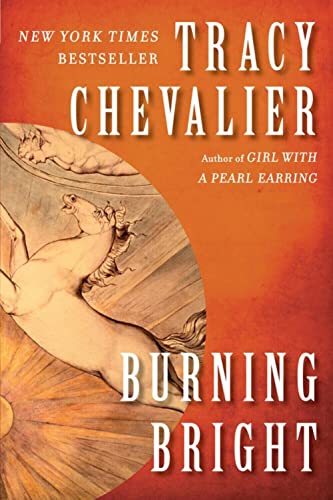
Synopsis
From the bestselling author of Girl With a Pearl Earring comes a stirring eighteenth-century coming-of- age tale
Tracy Chevalier, author of the international bestseller Girl With a Pearl Earring, returns with another brilliantly rendered historical tale set in the waning days of eighteenth-century London. Poet, artist, and printer William Blake works in obscurity as England is rocked by the shock waves of the French Revolution. Next door, the Kellaway family has just moved in, and country boy Jem Kellaway strikes up a tentative friendship with street?savvy Maggie Butterfield. As their stories intertwine with Blake?s, the two children navigate the confusing and exhilarating path to adolescence, and inspire the poet to create the work that enshrined his genius.
"synopsis" may belong to another edition of this title.
About the Author
"I was born and grew up in Washington, DC. After getting a BA in English from Oberlin College (Ohio), I moved to London, England in 1984. I intended to stay 6 months; I’m still here.
"As a kid I’d often said I wanted to be a writer because I loved books and wanted to be associated with them. I wrote the odd story in high school, but it was only in my twenties that I started writing ‘real’ stories, at night and on weekends. Sometimes I wrote a story in a couple evenings; other times it took me a whole year to complete one.
"Once I took a night class in creative writing, and a story I’d written for it was published in a London-based magazine called Fiction. I was thrilled, even though the magazine folded 4 months later.
"I worked as a reference book editor for several years until 1993 when I left my job and did a year-long MA in creative writing at the University of East Anglia in Norwich (England). My tutors were the English novelists Malcolm Bradbury and Rose Tremain. For the first time in my life I was expected to write every day, and I found I liked it. I also finally had an idea I considered ‘big’ enough to fill a novel. I began The Virgin Blue during that year, and continued it once the course was over, juggling writing with freelance editing.
"An agent is essential to getting published. I found my agent Jonny Geller through dumb luck and good timing. A friend from the MA course had just signed on with him and I sent my manuscript of The Virgin Blue mentioning my friend’s name. Jonny was just starting as an agent and needed me as much as I needed him. Since then he’s become a highly respected agent in the UK and I’ve gone along for the ride."
Tracy Chevalier is the New York Times bestselling author of six previous novels, including Girl with a Pearl Earring, which has been translated into thirty-nine languages and made into an Oscar-nominated film. Her latest novel is The Last Runaway. Born and raised in Washington, D.C., she lives in London with her husband and son.
Reviews
Reviewed by Nicholas Delbanco
Burning Bright derives its title from the opening phrase of William Blake's great poem: "Tyger, tyger, burning bright/ In the forests of the night. . . . " When one learns that this novel's author is Tracy Chevalier, it follows as the night the day that we will enter the world of Blake's London and find "fearful symmetry" there. If not precisely formulaic, Chevalier has by now established a formula for her process and success: Take a historical period with a recognized figure or work of art, add some invented families and an engaging young person or two, do the research with specificity, and invite the reader in. Chevalier made her reputation with Girl With a Pearl Earring, the bestselling evocation of an artist's model, Griet, a 16-year-old servant in the house of Johannes Vermeer.
Chevalier, herself an American expatriate, now lives in London and takes full advantage of her knowledge of topography -- evoking the Lambeth of King George III's reign with gusto and, it would seem, precision. There are the teeming streets and bawdy chat and excursions to Soho and Westminster Abbey, the publicans and whores and pinch-faced landladies. We read of hardworking craftsmen and those who cut corners for profit; we meet the blooming country maiden whose maidenhead will not survive the rapacious courtship of a dandy. There's "Cutthroat Lane" and a city grown jittery with rumors, in 1792 and 1793, that revolutionary fervor will be imported cross-channel from France; there's the actual figure of Philip Astley, an "oversized colorful character" who created the modern circus. He swaggers persuasively through the neighborhood -- as does the corrupt Lothario on horseback, his son John. In Chevalier's list of dramatis personae, the principal players include young Jem Kellaway (fresh from Piddletrenthide and come to the big city with his parents and guileless sister) and streetwise Maggie Butterfield (who takes them under her wing but soon needs shelter herself).
Stock figures all, cut from the cloth of Daniel Defoe and Charles Dickens, and stitched together with platitudes for attitude and a scrap of song. But one of the yields of this sort of read is the vein of data mined: We learn how to make Dorsetshire buttons and Windsor chairs, and it doesn't matter all that much if the artisans who fashion them are less than three-dimensional. The language is alternately casual ("Anne Kellaway snorted, trying to mask the laugh that had begun to bubble up") and forced ("He turned his intense gaze on Jem, who looked back at him, though it hurt, the way staring at the sun does, for the man's glittering eyes cut through whatever mask Jem had donned to go this deep into London").
At the novel's center stands the poet and painter of the "intense gaze," William Blake. His is a difficult presence to parse, though we do learn of his habit of lying naked in the garden with his wife, of his pleasure in reciting Milton and his skill with printing press and etcher's plate. We hear him talk to his dead brother and watch him while he draws. A recent biographer, Peter Ackroyd, reports on Blake's argument with Philip Astley (who had attached a log to a boy's leg and made him drag it on parade), and Chevalier brings that scene to fictive life. But she is somewhat less clear as to why Blake would engage the children in long colloquies on the nature of perception and existence, then press upon them his own copies of Songs of Innocence and Songs of Experience. Implausibly, predictably, young Jem and Maggie agree at tale's end that London and Piddletrenthide belong together:
" 'So if I'm on this side o' the fence, and you're on t'other, what's in the middle?'
"Jem put his hand on the stile. 'We are.' "
If you believe in urchins happily united in the country dusk and reciting Blake to each other, then this book will persuade. Chevalier's villains are deep-dyed villains, her good people blindingly good; they go from innocence to experience with scarcely a hitch in their stride.
Copyright 2007, The Washington Post. All Rights Reserved.
Tracy Chevalier's latest novel paints a colorful, compelling portrait of 18th-century London: the teeming streets, bawdy pubs, filthy factories, working-class homes, and the political unease generated by the French Revolution. Yet setting alone doesn't create a novel, and critics agree that Burning Bright lacks a compelling set of characters and, for the most part, devolves into a formulaic plot. The biggest problem is Blake himself: Chevalier never manages to successfully connect him to the young protagonists' adventures; nor does she capture Blake's psychological contradictions and depth. Entertainment and history lite, this novel "isn't exactly burning bright," concludes the Philadelphia Inquirer.
Copyright © 2004 Phillips & Nelson Media, Inc.
Author of Girl with a Pearl Earring, set in the home/studio of Vermeer, and other novels, Chevalier turns in an oblique look at poet and painter William Blake (1757–1827). Following the accidental death of their middle son, the Kellaways, a Dorsetshire chair maker and family, arrive in London's Lambeth district during the anti-Jacobin scare of 1792. Thomas Kellaway talks his way into set design work for the amiable circus impresario Philip Astley, whose fireworks displays provide the same rallying point that the guillotine is providing in Paris. Astley's libertine horseman son, John, sets his sights on Kellaway's daughter, Maisie (an attention she rather demurely returns). Meanwhile, youngest surviving Kellaway boy Jem falls for poor, sexy firebrand Maggie Butterfield. Blake, who imagined heaven and hell as equally incandescent and earth as the point where the two worlds converge, is portrayed as a murky Friar Laurence figure whose task is to bind and loosen the skeins of young love going on around him—that is, until a Royalist mob intrudes into his garden to sound out his rather advanced views on liberty, equality and fraternity. While the setting is dramatically fertile, there's no spark to the dialogue or plot, and allusions to Blake's work and themes are overbaked. (Mar.)
Copyright © Reed Business Information, a division of Reed Elsevier Inc. All rights reserved.
Chevalier made a considerable popular and critical splash with her 2000 novel Girl with a Pearl Earring, based on seventeenth-century Dutch painter Vermeer's model for his painting of that name. It was a precise, elegant evocation of Renaissance Delft, and readers who expect the same kind of atmospheric reconstruction of place in her new novel will not be disappointed; eighteenth-century London, from its shadier neighborhoods to its more elegant areas, arises from these pages in all its cacophony. But where the previous novel moved speedily, this one bogs down in plot inertia. The premise: a family of very modest means moves to the British capital from the countryside; the father of the family, a chair maker, has impressed circus impresario Philip Astley, during his tour of the counties, with his abilities and consequently received an invitation to come to London to join the circus as builder of all sorts of things. This family tale settles for the most part on the shoulders of the two youngest children, a boy and a girl, and a girl they befriend, who introduces them to the byways of the great metropolis. A neighbor of the new-to-the-city family is the famous real-life poet William Blake, but his role in the story never seems to gel. Regardless of its drawbacks, expect considerable demand. Brad Hooper
Copyright © American Library Association. All rights reserved
"About this title" may belong to another edition of this title.
Other Popular Editions of the Same Title

Search results for Burning Bright

Stock Image
Burning Bright
Seller: World of Books (was SecondSale), Montgomery, IL, U.S.A.
Seller rating 5 out of 5 stars

Condition: Acceptable. Item in acceptable condition! Textbooks may not include supplemental items i.e. CDs, access codes etc. Seller Inventory # 00103098197
Stock Image
Burning Bright
Seller: World of Books (was SecondSale), Montgomery, IL, U.S.A.
Seller rating 5 out of 5 stars
Condition: Good. Item in good condition. Textbooks may not include supplemental items i.e. CDs, access codes etc. Seller Inventory # 00055913668
Stock Image
Burning Bright
Seller: World of Books (was SecondSale), Montgomery, IL, U.S.A.
Seller rating 5 out of 5 stars
Condition: Very Good. Item in very good condition! Textbooks may not include supplemental items i.e. CDs, access codes etc. Seller Inventory # 00103118379
Seller Image
Burning Bright
Seller: Reliant Bookstore, El Dorado, KS, U.S.A.
Seller rating 5 out of 5 stars
Condition: very_good. This book is in excellent condition. There may be minimal writing on the inside cover or cover page. Cover image on the book may vary from photo. Ships out quickly in a secure plastic mailer. Seller Inventory # RDV.052594978X.VG
Seller Image
Burning Bright
Seller: Greenworld Books, Arlington, TX, U.S.A.
Seller rating 5 out of 5 stars
Condition: good. Fast Free Shipping â" Good condition. It may show normal signs of use, such as light writing, highlighting, or library markings, but all pages are intact and the book is fully readable. A solid, complete copy that's ready to enjoy. Seller Inventory # GWV.052594978X.G
Stock Image
Burning Bright
Seller: More Than Words, Waltham, MA, U.S.A.
Seller rating 5 out of 5 stars
Condition: Very Good. A bright, square, and overall a nice copy. Seller Inventory # BOS-E-09a-01437
Stock Image
Burning Bright
Seller: More Than Words, Waltham, MA, U.S.A.
Seller rating 5 out of 5 stars
Condition: Good. A sound copy with only light wear. Overall a solid copy at a great price! Seller Inventory # BOS-A-03i-01624
Stock Image
Burning Bright
Published by
Dutton (edition First Edition), 2007
ISBN 10: 052594978X
ISBN 13: 9780525949787
Used
Hardcover
First Edition
Seller: BooksRun, Philadelphia, PA, U.S.A.
Seller rating 5 out of 5 stars
Hardcover. Condition: Very Good. First Edition. With dust jacket. It's a well-cared-for item that has seen limited use. The item may show minor signs of wear. All the text is legible, with all pages included. It may have slight markings and/or highlighting. Seller Inventory # 052594978X-11-6-29
Stock Image
Burning Bright
Seller: ThriftBooks-Phoenix, Phoenix, AZ, U.S.A.
Seller rating 5 out of 5 stars
Hardcover. Condition: As New. No Jacket. Pages are clean and are not marred by notes or folds of any kind. ~ ThriftBooks: Read More, Spend Less. Seller Inventory # G052594978XI2N00
Stock Image
Burning Bright
Published by
Dutton (edition First Edition), 2007
ISBN 10: 052594978X
ISBN 13: 9780525949787
Used
Hardcover
First Edition
Seller: BooksRun, Philadelphia, PA, U.S.A.
Seller rating 5 out of 5 stars
Hardcover. Condition: Fair. First Edition. The item might be beaten up but readable. May contain markings or highlighting, as well as stains, bent corners, or any other major defect, but the text is not obscured in any way. Seller Inventory # 052594978X-7-18