
Items related to The Blue Flower: A Novel
Synopsis
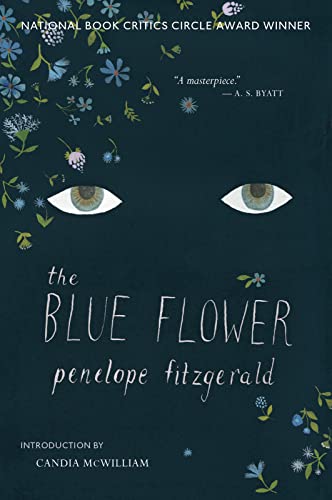
A NATIONAL BOOK CRITICS CIRCLE AWARD WINNER in Fiction. Booker Prize–winning novelist Fitzgerald's crowning literary work centers on the 18th-century German poet and philosopher Novalis and his love for the simple Sophie.
The Blue Flower is set in the age of Goethe among the small towns and great universities of 18th-century Germany. It tells the true story of Friedrich von Hardenberg, a passionate, impetuous student of philosophy who will later gain fame as the romantic poet Novalis. Fritz seeks his father's permission to wed his "heart's heart," his "spirit's guide"—a plain, simple child named Sophievon Kühn. It is an attachment that shocks his family and friends. Their brilliant young Fritz, betrothed to a twelve-year-old dullard? How can this be?
Their rationality of love, the transfiguration of the commonplace, the clarity of purpose that comes with knowing one's own fate— these are the themes of this beguiling novel, themes treated with a mix of wit, grace, and mischievous humor.
“An extraordinary imagining . . . an original masterpiece.”—Financial Times
"An astonishing book...Fitzgerald's greatest triumph."—New York Times Book Review
"synopsis" may belong to another edition of this title.
About the Author
PENELOPE FITZGERALD wrote many books small in size but enormous in popular and critical acclaim over the past two decades. Over 300,000 copies of her novels are in print, and profiles of her life appeared in both The New Yorker and The New York Times Magazine. In 1979, her novel Offshore won Britain's Booker Prize, and in 1998 she won the National Book Critics Circle Prize for The Blue Flower. Though Fitzgerald embarked on her literary career when she was in her 60's, her career was praised as "the best argument ... for a publishing debut made late in life" (New York Times Book Review). She told the New York Times Magazine, "In all that time, I could have written books and I didn’t. I think you can write at any time of your life." Dinitia Smith, in her New York Times Obituary of May 3, 2000, quoted Penelope Fitzgerald from 1998 as saying, "I have remained true to my deepest convictions, I mean to the courage of those who are born to be defeated, the weaknesses of the strong, and the tragedy of misunderstandings and missed opportunities, which I have done my best to treat as comedy, for otherwise how can we manage to bear it?"
From the Back Cover
“An astonishing book . . . Fitzgerald’s greatest triumph.” —New York Times Book Review
The Blue Flower is set in the age of Goethe, in the small towns and great universities of late eighteenth-century Germany. It tells the true story of Friedrich von Hardenberg, a passionate, impetuous student of philosophy who will later gain fame as the Romantic poet Novalis. Fritz seeks his father’s permission to wed his “heart's heart,” his “spirit's guide”—a plain, simple child named Sophie von Kühn. It is an attachment that shocks his family and friends. Their brilliant young Fritz, betrothed to a twelve-year-old dullard? How can this be?
The irrationality of love, the transfiguration of the commonplace, the clarity of purpose that comes with knowing one’s own fate—these are the themes of this beguiling novel, themes treated with a mix of wit, grace, and mischievous humor unique to the art of Penelope Fitzgerald.
“An extraordinary imagining . . . an original masterpiece.” —Hermione Lee, Financial Times
PENELOPE FITZGERALD (1916–2000) was one of the most elegant and distinctive voices in British fiction. She won the National Book Critics Circle Award in fiction for The Blue Flower, the Booker Prize for Offshore, and three of her novels—The Bookshop, The Gate of Angels, and The Beginning of Spring—were short-listed for the Booker Prize.
The Blue Flower is set in the age of Goethe, in the small towns and great universities of late eighteenth-century Germany. It tells the true story of Friedrich von Hardenberg, a passionate, impetuous student of philosophy who will later gain fame as the Romantic poet Novalis. Fritz seeks his father’s permission to wed his “heart's heart,” his “spirit's guide”—a plain, simple child named Sophie von Kühn. It is an attachment that shocks his family and friends. Their brilliant young Fritz, betrothed to a twelve-year-old dullard? How can this be?
The irrationality of love, the transfiguration of the commonplace, the clarity of purpose that comes with knowing one’s own fate—these are the themes of this beguiling novel, themes treated with a mix of wit, grace, and mischievous humor unique to the art of Penelope Fitzgerald.
“An extraordinary imagining . . . an original masterpiece.” —Hermione Lee, Financial Times
PENELOPE FITZGERALD (1916–2000) was one of the most elegant and distinctive voices in British fiction. She won the National Book Critics Circle Award in fiction for The Blue Flower, the Booker Prize for Offshore, and three of her novels—The Bookshop, The Gate of Angels, and The Beginning of Spring—were short-listed for the Booker Prize.
"About this title" may belong to another edition of this title.
Other Popular Editions of the Same Title

Search results for The Blue Flower: A Novel

Stock Image
The Blue Flower
Seller: World of Books (was SecondSale), Montgomery, IL, U.S.A.
Seller rating 5 out of 5 stars

Condition: Good. Good condition ex-library book with usual library markings and stickers. Seller Inventory # 00107035961
Stock Image
The Blue Flower
Seller: World of Books (was SecondSale), Montgomery, IL, U.S.A.
Seller rating 5 out of 5 stars
Condition: Good. Item in good condition. Textbooks may not include supplemental items i.e. CDs, access codes etc. Seller Inventory # 00105324890
Stock Image
The Blue Flower
Seller: World of Books (was SecondSale), Montgomery, IL, U.S.A.
Seller rating 5 out of 5 stars
Condition: Very Good. Item in very good condition! Textbooks may not include supplemental items i.e. CDs, access codes etc. Seller Inventory # 00106702799
Stock Image
The Blue Flower: A Novel
Seller: Wonder Book, Frederick, MD, U.S.A.
Seller rating 5 out of 5 stars
Condition: Good. Good condition. A copy that has been read but remains intact. May contain markings such as bookplates, stamps, limited notes and highlighting, or a few light stains. Seller Inventory # T06D-01031
Stock Image
The Blue Flower: A Novel
Seller: Half Price Books Inc., Dallas, TX, U.S.A.
Seller rating 5 out of 5 stars
Paperback. Condition: Very Good. Connecting readers with great books since 1972! Used books may not include companion materials, and may have some shelf wear or limited writing. We ship orders daily and Customer Service is our top priority! Seller Inventory # S_467441919
Seller Image
The Blue Flower: A Novel
Seller: Greenworld Books, Arlington, TX, U.S.A.
Seller rating 5 out of 5 stars
Condition: good. Fast Free Shipping â" Good condition. It may show normal signs of use, such as light writing, highlighting, or library markings, but all pages are intact and the book is fully readable. A solid, complete copy that's ready to enjoy. Seller Inventory # GWV.0544359453.G
Seller Image
The Blue Flower: A Novel
Seller: ZBK Books, Carlstadt, NJ, U.S.A.
Seller rating 5 out of 5 stars
Condition: very_good. Fast & Free Shipping â" Very Good condition book with a firm cover and clean pages. Shows normal use and some light wear or limited notes markings. A solid, nice copy to enjoy. Seller Inventory # ZWV.0544359453.VG
Stock Image
The Blue Flower: A Novel
Seller: HPB Inc., Dallas, TX, U.S.A.
Seller rating 5 out of 5 stars
Paperback. Condition: Very Good. Connecting readers with great books since 1972! Used books may not include companion materials, and may have some shelf wear or limited writing. We ship orders daily and Customer Service is our top priority! Seller Inventory # S_469718937
Stock Image
The Blue Flower
Seller: ThriftBooks-Phoenix, Phoenix, AZ, U.S.A.
Seller rating 5 out of 5 stars
Paperback. Condition: Good. No Jacket. Pages can have notes/highlighting. Spine may show signs of wear. ~ ThriftBooks: Read More, Spend Less. Seller Inventory # G0544359453I3N00
Stock Image
The Blue Flower
Seller: ThriftBooks-Reno, Reno, NV, U.S.A.
Seller rating 5 out of 5 stars
Paperback. Condition: Good. No Jacket. Pages can have notes/highlighting. Spine may show signs of wear. ~ ThriftBooks: Read More, Spend Less. Seller Inventory # G0544359453I3N00