
Jane and the Stillroom Maid: Being the Fifth Jane Austen Mystery - Hardcover
Book 5 of 14: Being a Jane Austen Mystery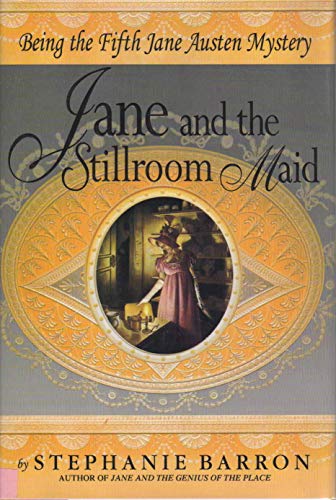
Synopsis
Jane Austen as sleuth continues to delight in her latest adventure (after Jane and the Genius of the Place), which sheds new light on the author's travels in 1806. While enjoying a ramble in the Derbyshire hills near Bakewell (a town Eliza Bennett visits in Pride and Prejudice), Jane discovers the mutilated body of a young man. Jane's suspicions are roused when her escort, Mr. George Hemming, prefers to remove the unidentified corpse to Buxton, rather than Bakewell, and they increase when the body proves to be that of a woman dressed in men's clothing. Moreover, the corpse is identified as Tess Arnold, a servant at one of the area's great houses, whom Mr. Hemming should have recognized. As the compounder of stillroom remedies, Tess had a reputation as a healer, until accused of witchcraft. Rumors of ritual murder by Freemasons-who include most of the neighboring gentry-excite the local populace and jeopardize the investigation of the justice of the peace, himself a Mason. When Mr. Hemming disappears before the inquest, Jane and the justice turn for help to Lord Harold Trowbridge, a guest at the nearby ducal house of Chatsworth. Barron catches Austen's tone amazingly well. Details of early 19th-century country life of all classes ring true, while the story line is clear, yet full of surprises. The "editor's notes" that punctuate the text and old cures for various ills that open each chapter add to the charm. (Aug.)
"synopsis" may belong to another edition of this title.
About the Author
Stephanie Barron is the author of eight previous Jane Austen mysteries. She lives in Colorado, where she is at work on the next Jane Austen mystery.
From the Paperback edition.
From the Inside Flap
as sleuth continues to delight in her latest adventure (after Jane and the Genius of the Place), which sheds new light on the author's travels in 1806. While enjoying a ramble in the Derbyshire hills near Bakewell (a town Eliza Bennett visits in Pride and Prejudice), Jane discovers the mutilated body of a young man. Jane's suspicions are roused when her escort, Mr. George Hemming, prefers to remove the unidentified corpse to Buxton, rather than Bakewell, and they increase when the body proves to be that of a woman dressed in men's clothing. Moreover, the corpse is identified as Tess Arnold, a servant at one of the area's great houses, whom Mr. Hemming should have recognized. As the compounder of stillroom remedies, Tess had a reputation as a healer, until accused of witchcraft. Rumors of ritual murder by Freemasons-who include most of the neighboring gentry-excite the local populace and jeopardize the investigation of the justice of the peace, himself a Mason. When Mr. Hemmin
Reviews
Nominally under the protection of her hymn-singing, trout-fishing, sycophantic cousin Edward Cooper, Jane Austen visits the Derbyshire Peak District in her fifth outing (Jane and the Genius of the Place, 1999, etc.) In this social comedy gone terribly wrong, Jane can't take a lone ramble in the hills without stumbling across a disemboweled young man--who turns out to be Tess Arnold, stillroom maid at a nearby estate. Has the victim been accidentally mistaken for the country apothecary, sometimes thought a witch? Or was she blackmailing aristocrats with unseemly secrets? Why is she in those male clothes? And why does her carved-up body seem to illustrate the Masonic ritual for executing traitors? Jane's aristocratic connection, gentleman rogue Lord Harold Trowbridge, turns up at the estate next door, mourning its recently deceased hostess, the colorful Georgiana, Duchess of Devonshire. His presence keeps Jane alert to possible connections between the late maid and Georgiana's politically powerful Whig Cavendish family--and a good thing, since he's too besotted with Georgiana's daughter, Lady Harriot, to see much else. Only Jane can work through the web of domestic intrigue woven around Tess Arnold. Cryptic though it is, Tess's stillroom journal supplies all the clues Jane needs to unravel the multiply intermeshed mysteries. Now that she's rebutted years of condescending descriptions of Austen's life as placid and uneventful, Barron writes with greater assurance than ever, and her heroine's sleuthing is more confident and accomplished--even if she's still unwisely pining for the unworthy Trowbridge. -- Copyright © 2000 Kirkus Associates, LP. All rights reserved.
Adult/High School-In this fifth Jane Austen mystery, Jane's cousin, Mr. Edward Cooper, rector of Hamstall Ridware, Staffordshire, takes her, her mother, and sister to the town of Bakewell in Derbyshire. He is an avid fisher-man and Jane is an avid walker. The bucolic English countryside and bubbling streams seem to be a perfect fit for them-until Jane finds a body in the hills. The victim has been shot in the head and mutilated and, although dressed as a man, is actually a beautiful still-room maid, Tess Arnold. The story is com-plex and another death follows. Lord Harold Trowbridge is staying in the area and per-suades Jane to accompany him to various so-cial functions and use her investigative skills and interest in the case. The protagonist is at her analytical best, and her fans will love this story. Twists and turns abound and the killer is so evil that readers will never suspect who and why it is until the very end. Austen makes a fine sleuth even if she is quite smitten with the debonair Lord Trowbridge.-Linda A. Vretos, Thomas Jefferson High School for Science and Technology, Alexandria, VA
Copyright 2001 Cahners Business Information, Inc.
Jane Austen as sleuth continues to delight in her latest adventure (after Jane and the Genius of the Place), which sheds new light on the author's travels in 1806. While enjoying a ramble in the Derbyshire hills near Bakewell (a town Eliza Bennett visits in Pride and Prejudice), Jane discovers the mutilated body of a young man. Jane's suspicions are roused when her escort, Mr. George Hemming, prefers to remove the unidentified corpse to Buxton, rather than Bakewell, and they increase when the body proves to be that of a woman dressed in men's clothing. Moreover, the corpse is identified as Tess Arnold, a servant at one of the area's great houses, whom Mr. Hemming should have recognized. As the compounder of stillroom remedies, Tess had a reputation as a healer, until accused of witchcraft. Rumors of ritual murder by FreemasonsAwho include most of the neighboring gentryAexcite the local populace and jeopardize the investigation of the justice of the peace, himself a Mason. When Mr. Hemming disappears before the inquest, Jane and the justice turn for help to Lord Harold Trowbridge, a guest at the nearby ducal house of Chatsworth. Barron catches Austen's tone amazingly well. Details of early 19th-century country life of all classes ring true, while the story line is clear, yet full of surprises. The "editor's notes" that punctuate the text and old cures for various ills that open each chapter add to the charm. (Aug.)
Copyright 2000 Reed Business Information, Inc.
Fifth in Barron's Jane Austen mystery series, this work bears all the wonderful trademarks of the earlier titles, including period detail, measured but often sardonic wit, and authenticity. More blatantly here than in the previous novels, readers can see Jane's mother as the source of oh-so-silly Mrs. Bennett in Pride and Prejudice; and Pemberley, Darcy's home, emerges from Chatsworth, seat of the Dukes of Devonshire. Once again, Jane's friend (would that he were more) Lord Harold is on the scene as suspicion is cast on old friends when a stillroom maid (a young woman who concocted and sold remedies) is murdered. There are numerous red herrings and cliffhangers, though the denouement is unsurprising, but the pacing and tenor make this enjoyable. For fans of Austen and carefully paced historical mysteries.
Copyright 2000 Reed Business Information, Inc.
Jane Austen's fifth venture into sleuthing finds her visiting relatives in Derbyshire. While walking in the hills, she discovers the body of Tess Arnold, a servant at a local estate who is known for her skill as an herbalist. As in Austen's novels, the relationships are complex and full of suppressed passion. Why was Tess suspected of witchcraft? What was her relationship to the duke's family? What do the Freemasons have to do with the case? Jane's keen perception and her curiosity may turn her into the killer's next victim. Readers who enjoy a trip through the late-eighteenth-century English countryside will find Jane's new adventure very appealing. Barbara Bibel
Copyright © American Library Association. All rights reserved
Excerpt. © Reprinted by permission. All rights reserved.
Tuesday
26 August 1806
The Rutland Arms, Bakewell, Derbyshire
~
Mr. Edward Cooper--Rector of Hamstall Ridware, Staffordshire, Fellow of All Souls, devoted supplicant before his noble patron, Sir George Mumps, and my first cousin--is possessed of a taste for hymns. He sings without the slightest encouragement or provocation, in a key entirely of his own choosing. Were he content to sing alone, in a subdued undertone befitting one of his dignity and station, all might be well. But Mr. Cooper has achieved a modest sort of fame as the composer of sacred music; and like the ardent shepherd of many a flock, must needs have company in his rejoicing. There are those who profess to admire my cousin's wistful baritone and remarkable lyrics--Sir George Mumps himself is said to have presented the Staffordshire living on the strength of his esteem--but Jane Austen is not among them. Were Mr. Cooper to sing airs in the Italian, before an audience of five hundred, I should still blush for his execution and taste. My cousin is a very good sort of man, his compassion and understanding quite equal to the duties of his parish; but his strains are not for the enduring, of an early hour of the morning.
I was blushing now, as I rolled towards Miller's Dale in the heart of Derbyshire behind the horse of Mr. Cooper's excellent friend, Mr. George Hemming; and I foresaw a morning's-worth of mortification in store, did my cousin continue to sing as he had begun. I had borne with Mr. Cooper's hymns through his dawn ablutions; I had borne with a determined humming over our morning coffee. And as the pony trap rolled west through a remarkable spread of country, I now reflected that I had borne with a stream of liturgical ditty for nearly a fortnight. To say that I possessed an entire hymnal of Mr. Cooper's work writ large upon my brain was the merest understatement. I heard his powerful strains in my sleep.
"Is it not a beautiful morning, Jane? Does not the heart leap in the human breast for the greater glorification of God?" Mr. Cooper cried. "Pray sing with me, Cousin, that the Lord might hear us and be glad!"
Poor Mr. Hemming cast a troubled glance my way. He was but an instant from a similar application, and I read his distress in his looks. My cousin's talent, we may suspect, had progressed unnoticed by his friend during the long years that interceded between their first acquaintance, and this latest renewal; had Mr. Hemming known of the recital we were to receive during our journey to Miller's Dale, he might well have retracted his invitation. I had long ago learned the surest remedy for Mr. Cooper, however, and I now hastened to employ it. Even the least worldly of men may be prey to vanity.
"Do not destroy all my pleasure in hearing you, Cousin, by requiring me to sing myself!" I cried. "My voice should never be joined with yours; it is not equal to the demands of the performance. Nor, I am certain, is Mr. Hemming's. Pray let us rest a little in your art, and be satisfied."
Mr. Cooper beamed, and commenced a tedious five verses of "The Breath That Breathed O'er Eden."
I endured it in silence; for I owed Mr. Cooper every measure of gratitude and respect. But for my cousin, I should never have set foot in Derbyshire at all. And Derbyshire--with all its wild beauty and untamed peaks--had long been the dearest object of my travels.
What was a little singing, however off-key, to the grandeur of lakes and mountains? Mr. Cooper had long despaired of my mother's ever paying a visit to Staffordshire and her dearest nephew's rectory. It was many years, now, since he had first urged the scheme; his family had annually in-creased, his honours as a vicar and homilist multiplied; Mr. Cooper himself was approaching a complaisant middle-age--and still the Austen ladies remained insensibly at home.
But so lately as June my mother determined to quit the environs of Bath--the town in which we have lived more than three years--it being entirely unsuitable now that my beloved father is laid to rest. Being three women of modest means, and having endeavoured to live respectably on a pittance in the midst of a most expensive town, we at last declared defeat and determined to exchange Bath for anywhere else in England. An interval of rest and refreshment, in the form of an extended tour among our relations, was deemed suitable for the summer months; October should find us in Southampton, where we were to set up housekeeping with my dearest brother, Captain Francis Austen. We should serve as company for his new bride, Mary, when duty called Frank to sea.
And so it was decided--we shook off the dust of Bath on the second of July, with what happy feelings of Escape!--and bent all our energies to a summer of idleness.
We travelled first to Clifton, and from thence to Adlestrop and my mother's cousin, the clergyman Mr. Thomas Leigh. We had not been settled in that gentleman's home five days, when the sudden death of a distant relation sent Mr. Leigh flying to Stoneleigh Abbey in Warwickshire, with the intent of laying claim to a disputed inheritance. After a highly diverting week in the company of Mr. Leigh's solicitor, Mr. Hill, and the absurd Lady Saye and Sele, we parted from the intimates of Stoneleigh and turned our carriage north, towards Staffordshire.
Hamstall Ridware is a prosperous little village lost in a depth of hedgerows, with a very fine Rectory and a finer church spire. Our cousin Mr. Cooper and his dutiful wife, Caroline, possess no less thaneight children, the eldest of whom is but twelve and the youngest barely a year. Some little difficulty in the matter of bedchambers was apparent from the moment of our arrival. Cassandra and I were forced to shift together; my mother claimed a bed in the next room. The little boys were grouped in pallets on the nursery floor, and it was likewise with the little girls, while the baby was taken up in its parents' chamber. And so we contrived to be comfortable; and so we should have been, despite the heat of August and the closeness of such a populous house, had not the whooping cough presently put in an appearance. After three days of Christian endurance, of instruction from the apothecary and draughts that did little good, Mr. Cooper proposed a journey into Derbyshire, with the intent of touring Chatsworth and the principal beauties of the region.
My mother acceded thankfully to the scheme. The harassed Caroline Cooper, beset with ailing children on every side, was relieved of the burden of guests, and the Austens of the fear of contagion. Having set out from the Rectory steps on the Saturday previous, we achieved Bakewell yesterday in the forenoon, very well satisfied with our progress north. But for one aspect of the journey--my cousin's unsuspected ardour for the sport of angling, which has entirely determined our course through Derbyshire--we should have found nothing in our prospects but delight.
"About this title" may belong to another edition of this title.
Other Popular Editions of the Same Title

Search results for Jane and the Stillroom Maid: Being the Fifth Jane Austen...

Stock Image
Jane and the Stillroom Maid: Being the Fifth Jane Austen Mystery
Seller: Orion Tech, Kingwood, TX, U.S.A.
Seller rating 5 out of 5 stars

hardcover. Condition: Fair. Seller Inventory # 0553107348-4-35729656
Stock Image
Jane and the Stillroom Maid: Being the Fifth Jane Austen Mystery
Published by
Bantam (edition First Edition), 2000
ISBN 10: 0553107348
ISBN 13: 9780553107340
Used
Hardcover
First Edition
Seller: BooksRun, Philadelphia, PA, U.S.A.
Seller rating 5 out of 5 stars
Hardcover. Condition: Very Good. First Edition. With dust jacket. It's a well-cared-for item that has seen limited use. The item may show minor signs of wear. All the text is legible, with all pages included. It may have slight markings and/or highlighting. Seller Inventory # 0553107348-11-1-29
Seller Image
Jane and the Stillroom Maid: Being the Fifth Jane Austen Mystery
Seller: Bay State Book Company, North Smithfield, RI, U.S.A.
Seller rating 5 out of 5 stars
Condition: good. The book is in good condition with all pages and cover intact, including the dust jacket if originally issued. The spine may show light wear. Pages may contain some notes or highlighting, and there might be a "From the library of" label. Boxed set packaging, shrink wrap, or included media like CDs may be missing. Seller Inventory # BSM.12ZHZ
Stock Image
Jane and the Stillroom Maid: Being the Fifth Jane Austen Mystery
Seller: World of Books (was SecondSale), Montgomery, IL, U.S.A.
Seller rating 5 out of 5 stars
Condition: Good. Item in good condition. Textbooks may not include supplemental items i.e. CDs, access codes etc. Seller Inventory # 00103177140
Stock Image
Jane and the Stillroom Maid
Published by
Random House Publishing Group, 2000
ISBN 10: 0553107348
ISBN 13: 9780553107340
Used
Hardcover
First Edition
Seller: Better World Books, Mishawaka, IN, U.S.A.
Seller rating 5 out of 5 stars
Condition: Very Good. First Edition. Pages intact with possible writing/highlighting. Binding strong with minor wear. Dust jackets/supplements may not be included. Stock photo provided. Product includes identifying sticker. Better World Books: Buy Books. Do Good. Seller Inventory # 6108112-6
Stock Image
Jane and the Stillroom Maid
Published by
Random House Publishing Group, 2000
ISBN 10: 0553107348
ISBN 13: 9780553107340
Used
Hardcover
First Edition
Seller: Better World Books, Mishawaka, IN, U.S.A.
Seller rating 5 out of 5 stars
Condition: Good. First Edition. Former library copy. Pages intact with minimal writing/highlighting. The binding may be loose and creased. Dust jackets/supplements are not included. Includes library markings. Stock photo provided. Product includes identifying sticker. Better World Books: Buy Books. Do Good. Seller Inventory # 2379400-75
Stock Image
Jane and the Stillroom Maid
Published by
Random House Publishing Group, 2000
ISBN 10: 0553107348
ISBN 13: 9780553107340
Used
Hardcover
First Edition
Seller: Better World Books, Mishawaka, IN, U.S.A.
Seller rating 5 out of 5 stars
Condition: Very Good. First Edition. Former library copy. Pages intact with possible writing/highlighting. Binding strong with minor wear. Dust jackets/supplements may not be included. Includes library markings. Stock photo provided. Product includes identifying sticker. Better World Books: Buy Books. Do Good. Seller Inventory # 4287849-6
Stock Image
Jane and the Stillroom Maid: Being the Fifth Jane Austen Mystery
Seller: ThriftBooks-Reno, Reno, NV, U.S.A.
Seller rating 5 out of 5 stars
Hardcover. Condition: Fair. No Jacket. Former library book; Readable copy. Pages may have considerable notes/highlighting. ~ ThriftBooks: Read More, Spend Less. Seller Inventory # G0553107348I5N10
Stock Image
Jane and the Stillroom Maid: Being the Fifth Jane Austen Mystery
Seller: ThriftBooks-Reno, Reno, NV, U.S.A.
Seller rating 5 out of 5 stars
Hardcover. Condition: Good. No Jacket. Missing dust jacket; Pages can have notes/highlighting. Spine may show signs of wear. ~ ThriftBooks: Read More, Spend Less. Seller Inventory # G0553107348I3N01
Stock Image
Jane and the Stillroom Maid: Being the Fifth Jane Austen Mystery
Seller: ThriftBooks-Phoenix, Phoenix, AZ, U.S.A.
Seller rating 5 out of 5 stars
Hardcover. Condition: Good. No Jacket. Former library book; Pages can have notes/highlighting. Spine may show signs of wear. ~ ThriftBooks: Read More, Spend Less. Seller Inventory # G0553107348I3N10