
Synopsis
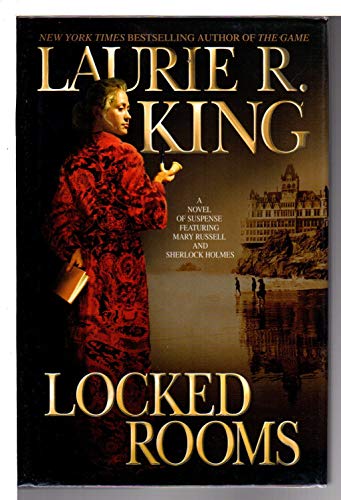
Mary Russell and her husband Sherlock Holmes are back in Laurie R. King’s highly acclaimed New York Times bestselling mystery series. And this time the first couple of detection pair up to unlock the buried memory of a shocking crime with the power to kill again–lost somewhere in Russell’s own past.
After departing Bombay by ship, Mary Russell and her husband Sherlock Holmes are en route to the bustling modern city of San Francisco. There, Mary will settle some legal affairs surrounding the inheritance of her family’s old estate. But the closer they get to port, the more Mary finds herself prey to troubling dreams and irrational behavior–a point not lost on Holmes, much to Russell’s annoyance.
In 1906, when Mary was six, San Francisco was devastated by an earthquake and a raging fire that reduced the city to rubble. For years, Mary has denied any memory of the catastrophe that for days turned the fabled streets into hell on earth. But Holmes suspects that some hidden trauma connected with the “unforgettable” catastrophe may be the real culprit responsible for Mary’s memory lapse. And no sooner do they begin to familiarize themselves with the particulars of the Russell estate than it becomes apparent that whatever unpleasantness Mary has forgotten, it hasn’t forgotten her. Why does her father’s will forbid access to the house except in the presence of immediate family? Why did someone break in, then take nothing of any value? And why is Russell herself targeted for assassination?
The more questions they ask of Mary’s past, the more people from that past turn out to have died violent, unexplained deaths. Now, with the aid of a hard-boiled young detective and crime writer named Hammett, Russell and Holmes find themselves embroiled in a mystery that leads them through the winding streets of Chinatown to the unspoken secrets of a parent’s marriage and the tragic car “accident” that a fourteen-year-old Mary alone survived–an accident that may not have been an accident at all. What Russell is about to discover is that even a forgotten past never dies…and it can kill again.
"synopsis" may belong to another edition of this title.
About the Author
LAURIE R. KING became the first novelist since Patricia Cornwell to win prizes for Best First Crime Novel on both sides of the Atlantic with the publication of her debut thriller, A Grave Talent. She is the bestselling author of four contemporary novels featuring Kate Martinelli, eight Mary Russell mysteries, and the bestselling novels A Darker Place, Folly, and Keeping Watch. She lives in northern California.
Reviews
Adult/High School–Sherlock Holmes and Mary Russell are at it again. Having just traveled to India in The Game (Bantam, 2004), they are stopping in San Francisco, Mary's hometown, before returning to England. It is 1930, 24 years after the great earthquake and 10 years since the death of Mary's brother and parents, and her removal to Anglia. Ostensibly, she is going to wrap up some business interests and sell her parents' house, but she soon becomes aware of strange goings-on there and what seem to be attempts on her life. This is a more character-driven title than many of the previous Russell/Holmes outings, and Mary's emotions and fears are in the forefront. The story is told in alternating sections, by Mary in the first person and from Holmes's point of view in the third. This tale is self-contained, but does explain Mary's origins and probes many secrets she has kept hidden, even from herself. Along with a fascinating story, teens will be introduced on a very personal level not only to the San Francisco of that frightening earthquake, but also to the various social and racial striations so important even into the 1930s. Fans of this series will not be disappointed and newcomers may be intrigued enough to start from the beginning.–Susan H. Woodcock, Fairfax County Public Library, VA
Copyright © Reed Business Information, a division of Reed Elsevier Inc. All rights reserved.
Starred Review. In her last outing, The Game (2004), Mary Russell and her husband, Sherlock Holmes, traveled to India on a case of geopolitical significance, but in the richly imagined eighth novel in this acclaimed series, set in San Francisco in 1924, Russell undertakes a far more personal investigation. Since she began her journey back to her hometown—ostensibly to deal with her father's estate—Russell has been tormented by strange dreams, one of which involves the "locked rooms" of the title, and the sight of her San Francisco childhood home opens a flood of memories and emotions, most of which she's loathe to allow into her über-rational mind. When someone takes a shot at her, Holmes enlists the help of Pinkerton agent Dashiell Hammett and Russell tries to unlock her past, in particular the "accident" that killed her family and left her an orphan in 1914. King's re-creation of San Francisco, especially the backstory during the devastating 1906 earthquake, is superb, and it's a pleasure to see the unusually competent Russell struggling with her own psyche. The plot may be a bit thin, but the narrative has real momentum, the characters are engaging and the prose, as always, is intelligent, evocative and graceful. Agent, Linda Allen. (June 21)
Copyright © Reed Business Information, a division of Reed Elsevier Inc. All rights reserved.
*Starred Review* King makes full use of her considerable skills at probing the dark of the human psyche in this utterly mesmerizing tale of Mary Russell's trip back to the San Francisco of her parents with her husband, Sherlock Holmes. On board ship from India and Japan, where the duo's last adventure took place, Mary begins to have three disturbing and evocative dreams: objects flying, a man without a face, and locked rooms. She remembers almost nothing of her childhood except the car crash that killed her parents and her little brother. But in San Francisco, she remembers that she was there, with her family, during the 1906 earthquake. In alternating sections, told in first person for Mary and third for Holmes, the unraveling of long-buried and terrifying memories also unwinds a skein of wonderful historical texture: the place of Chinese immigrants and the use of feng shui; the nightlife of a city during the age of jazz, Prohibition, and flappers; and the presence of Dash Hammett, who plays a fascinating role as a very different sort of Irregular. A highlight in an altogether outstanding series. GraceAnne DeCandido
Copyright © American Library Association. All rights reserved
Excerpt. © Reprinted by permission. All rights reserved.
Chapter One
Japan had been freezing, the wind that sliced through its famous cherry trees scattering flakes of ice in place of spring blossoms. We had set down there for nearly three weeks, after a peremptory telegram from its emperor had reached us in Hong Kong; people kept insisting that the countryside would be lovely in May.
The greatest benefit of those three weeks had been the cessation of the dreams that had plagued me on the voyage from Bombay. I slept well--warily at first, then with the slow relaxation of defences. Whatever their cause, the dreams had gone.
But twelve hours after raising anchor in Tokyo, I was jerked from a deep sleep by flying objects in my mind.
Three days out from the island nation, the rain stopped and a weak sun broke intermittently through the grey. The cold meant that most of the passengers, after venturing out for a brief turn on the decks, settled in along the windows on the ship's exposed side like so many somnolent cats. I, however, begged a travelling-rug from the purser and found a deck-chair out of the wind. There, wrapped to my chin with a hat tugged down over my close-cropped hair, I dozed.
Halfway through the afternoon, Holmes appeared with a cup of hot coffee. Actually, it was little more than tepid and half the liquid resided in the saucer; nonetheless, I sat up and disentangled one arm to receive it, then freed the other arm so that I could pour the saucer's contents back into the cup. Holmes perched on a nearby chair, taking out his pipe and tobacco pouch.
"The Captain tells me that we are making good time," he commented.
"I'm glad the storm blew itself out," I replied. "I might actually be able to face the dinner table tonight." Something about the angle of the wind the past days had made the perpetual pitch and toss of the boat even more quease-inducing than usual.
"You haven't eaten anything in three days." Holmes disapproved of my weak stomach.
"Rice," I objected. "And tea."
"Or slept," he added, snapping his wind-proof lighter into life and holding it over the bowl of his pipe.
That accusation I did not answer. After a moment, as if to acknowledge that his comment had not required a response, he went on.
"Had you thought any more about pausing in Hawaii?"
I stifled a yawn and put my empty cup onto the chair's wide arm, nestling back into the warmth of the rug. "It's up to you, Holmes. I'm happy to stop there if you like. How many days would it be before the next ship?"
"Normally three, but it seems that the following ship has turned back to Tokyo for repairs, which means we could be marooned there for a week."
I opened one eye, unable to tell from his voice, still less his smoke-girt expression, which way his desires leant. "A week is quite a long diversion," I ventured.
"Particularly if Hawaii has embraced the austerities of Prohibition."
"A half-day would mean a long walk and sit at a table where I don't have to aim a moving soup spoon at my mouth. Both would be quite nice."
"Then another four days to San Francisco." The pointless, unnecessary observation was unlike Holmes. Indeed, this entire conversation was unlike him, I reflected, squinting at him against the glare. He had his pipe between his teeth, and was concentrating on rolling up the pouch, so I shut my eyes again.
"Terra firma," I said. "A week in California, tying up business, and then we can turn for home. By train." I don't get seasick on trains.
"A week will be sufficient, you believe?"
"To draw up the papers for selling the house and business? More than enough."
"And that is what you have decided to do."
This noncommittal, pseudo-Socratic dialogue was beginning to annoy. "What are you getting at, Holmes?"
"Your dreams."
"What about them?" I snapped. I should never have told him about them, although it would have been difficult not to, considering the closeness of the quarters.
"I should say they indicate a certain degree of anxiety."
"Oh for heaven's sake, Holmes, you sound like Freud. The man had sex on the brain. 'Rooms in dreams are generally women,' he declares. 'A dream of going through a series of rooms indicates a brothel, or a marriage'--I can't imagine what his own marriage could have been like to equate the two so readily. And the key--God, you can imagine the fraught symbolism of playing with a key that lies warm in my pocket! 'Innocent dreams can embody crudely erotic desires.' The faceless man he'd no doubt equate with the male organ, and as for the objects that spurt wildly into the air--well, I'm clearly a sick woman. What does it say about my 'erotic desires' that reading the man's book made me need a hot bath? Or perhaps a cold shower-bath."
"You sound as if you've researched this rather thoroughly."
"Yes, well, I found a copy of his Interpretation of Dreams in the ship's library," I admitted, then realised that I was also admitting to a greater degree of preoccupation than I thought sensible. To lead him away from the admission, I said, "I wouldn't have thought that you of all people would fall for the Freud craze, Holmes."
His face darkened as he came close to responding to my diversion, then he caught himself, and counterattacked with a deceptively mild, "A knowledge of psycho-logical jargon is hardly necessary when confronted with such an unambiguous statement such as that contained in those dreams of yours."
"What do you mean, unambiguous?" I protested furiously, and too late realised that I had stepped into his own diversion with both feet.
"San Francisco's earthquake, which sent things flying about, is clearly the paradigm for the first dream. And the locked rooms may represent your family's house, which has stood empty for ten years while you pretended it wasn't there."
"A house is more often symbolic of the self," I told him, although I did not know why I wanted to argue.
"True, although a house may also be simply a house."
I threw off the rug so as to face him unencumbered. "Holmes, you're mad. I've only owned the place for three years, since I turned twenty-one, and I've been rather too busy to travel halfway across the world to take care of things. As for your earthquake fantasy, I wasn't even here in 1906. And what about the faceless man dream, anyway?"
"There is as yet insufficient data to identify him," he said, not in the least troubled by my words.
I drew breath to argue with him, but in the event, I couldn't be bothered. I rose with dignity, and said merely, "If you imagine we shall have time to uncover the relevant data in San Francisco, you are mistaken. We will be there only long enough for me to sign papers, then catch the train for New York."
Tucking the rug under my arm, I left him to his pipe.
Earthquakes. Ridiculous.
He did not bring it up again, and neither did I, although over the following days I often felt his eyes upon me, and knew that at night he too lay awake, waiting for me to speak. But I did not, and he did not, and thus we traversed the Pacific. Between the dreams themselves and lying awake in dread, I scarcely slept, and began to feel as if I was walking in a wrap of cotton gauze.
Hawaii was a pleasant interlude, although the wind blew and the wide beaches were nearly deserted. We walked for hours, and I even managed to eat something, but that night I slept no better.
The following evening I wandered about the ship, up and down the various decks (trying to ignore the Freudian overtones of entering enclosed stairways) until I found myself at the furthest point of the ship, after which there was only water. The wind had stopped that morning, leaving the smoke from the stacks to trail straight back along the various layers of deck, which created a series of solitary if insalubrious places for meditation. I was on the last of those decks, with only a railing between me and the Pacific.
And there I meditated, about the dreams and what Holmes had said.
Clearly, I thought, the damage we had seen in Japan, with Tokyo still recovering from the previous year's devastating earthquake, had set the literalist idea of shaken objects into his mind. I was not worried about the possibility he had suggested; no, despite my words, it was the niggling fear that Freud might be right.
Since leaving England in January, we had marked the ten-year anniversary of our meeting and the third year of marriage. I was content in ways I had not thought possible, well matched mentally and--despite the difference in our ages, despite the regular clash of our personalities, and despite the leering innuendo of Sigmund Freud--well suited physically, to a man who interested my intellect, challenged my spirit, and roused my passions.
So, no: Psychology be damned--the dreams weren't about my marriage.
Yet there they were, keeping me exhausted and irritable and searching out a piece of quiet if smoke-covered deck where I could stand by myself and stare down at the endless sea.
The water stretched out as far as the eye could see in an expanse of gentle grey-blue swells broken only by the occasional white-capped wavelet and the line of the ship's passage, unrolling die-straight behind us until it faded into the glare of sun on the western horizon. Directly below where I stood, dominating my vision if I leant my upper body over the rail, the churn of the great screws dug an indentation in the surface, followed by a rise just behind. Like the earth from a farmer's plough, I thought dreamily, cutting a straight furrow across three thousand miles of sea. And when the ship reached the end of its watery field, it would turn and beg...
"About this title" may belong to another edition of this title.
Other Popular Editions of the Same Title

Search results for Locked Rooms

Stock Image
Locked Rooms (Mary Russell Novels)
Seller: Gulf Coast Books, Cypress, TX, U.S.A.
Seller rating 5 out of 5 stars

hardcover. Condition: Fair. Seller Inventory # 055380197X-4-32404362
Stock Image
Locked Rooms (Mary Russell Mys
Seller: World of Books (was SecondSale), Montgomery, IL, U.S.A.
Seller rating 5 out of 5 stars
Condition: Good. Item in good condition. Textbooks may not include supplemental items i.e. CDs, access codes etc. Seller Inventory # 00102229452
Stock Image
Locked Rooms (Mary Russell Novels)
Seller: More Than Words, Waltham, MA, U.S.A.
Seller rating 5 out of 5 stars
Condition: Good. A sound copy with only light wear. Overall a solid copy at a great price! Seller Inventory # BOS-S-13c-01482
Stock Image
Locked Rooms (Mary Russell Novels)
Seller: BooksRun, Philadelphia, PA, U.S.A.
Seller rating 5 out of 5 stars
Hardcover. Condition: Very Good. With dust jacket. It's a well-cared-for item that has seen limited use. The item may show minor signs of wear. All the text is legible, with all pages included. It may have slight markings and/or highlighting. Seller Inventory # 055380197X-8-1-29
Stock Image
Locked Rooms
Seller: ThriftBooks-Atlanta, AUSTELL, GA, U.S.A.
Seller rating 5 out of 5 stars
Hardcover. Condition: Good. No Jacket. Pages can have notes/highlighting. Spine may show signs of wear. ~ ThriftBooks: Read More, Spend Less. Seller Inventory # G055380197XI3N00
Stock Image
Locked Rooms
Seller: ThriftBooks-Dallas, Dallas, TX, U.S.A.
Seller rating 5 out of 5 stars
Hardcover. Condition: Good. No Jacket. Missing dust jacket; Pages can have notes/highlighting. Spine may show signs of wear. ~ ThriftBooks: Read More, Spend Less. Seller Inventory # G055380197XI3N01
Stock Image
Locked Rooms
Seller: ThriftBooks-Atlanta, AUSTELL, GA, U.S.A.
Seller rating 5 out of 5 stars
Hardcover. Condition: Good. No Jacket. Missing dust jacket; Pages can have notes/highlighting. Spine may show signs of wear. ~ ThriftBooks: Read More, Spend Less. Seller Inventory # G055380197XI3N01
Stock Image
Locked Rooms
Seller: ThriftBooks-Phoenix, Phoenix, AZ, U.S.A.
Seller rating 5 out of 5 stars
Hardcover. Condition: Good. No Jacket. Pages can have notes/highlighting. Spine may show signs of wear. ~ ThriftBooks: Read More, Spend Less. Seller Inventory # G055380197XI3N00
Stock Image
Locked Rooms
Seller: ThriftBooks-Dallas, Dallas, TX, U.S.A.
Seller rating 5 out of 5 stars
Hardcover. Condition: Good. No Jacket. Pages can have notes/highlighting. Spine may show signs of wear. ~ ThriftBooks: Read More, Spend Less. Seller Inventory # G055380197XI3N00
Stock Image
Locked Rooms
Seller: ThriftBooks-Reno, Reno, NV, U.S.A.
Seller rating 5 out of 5 stars
Hardcover. Condition: Good. No Jacket. Missing dust jacket; Pages can have notes/highlighting. Spine may show signs of wear. ~ ThriftBooks: Read More, Spend Less. Seller Inventory # G055380197XI3N01