
Synopsis
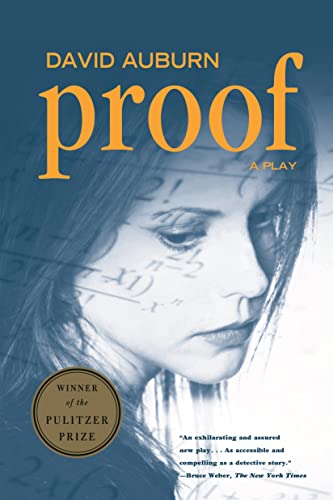
David Auburn's Proof won the Pulitzer Prize for Drama and was adapted to film by director John Madden, starring Gwyneth Paltrow, Anthony Hopkins, and Jake Gyllenhaal.
One of the most acclaimed plays of its time, Proof is a work that explores the unknowability of love as much as it does the mysteries of science.
It focuses on Catherine, a young woman who has spent years caring for her father, Robert, a brilliant mathematician in his youth who was later unable to function without her help. His death has brought into her midst both her sister, Claire, who wants to take Catherine back to New York with her, and Hal, a former student of Catherine's father who hopes to find some hint of Robert's genius among his incoherent scribblings. The passion that Hal feels for math both moves and angers Catherine, who, in her exhaustion, is torn between missing her father and resenting the great sacrifices she made for him. For Catherine has inherited at least a part of her father's brilliance―and perhaps some of his instability as well. As she and Hal become attracted to each other, they push at the edges of each other's knowledge, considering not only the unpredictability of genius but also the human instinct toward love and trust.
"synopsis" may belong to another edition of this title.
About the Author
David Auburn is an American playwright whose 2000 play Proof won the Tony Award for Best Play and the Pulitzer Prize for Drama, and was also adapted into a film. He has received the Helen Merrill Playwriting Award and a Guggenheim Fellowship. He lives in Manhattan.
Reviews
Adult/High School-Twenty-five-year-old Catherine, who sacrificed college to care for her mentally ill father (once a brilliant, much-admired mathematician), is left in a kind of limbo after his death. Socially awkward and a bit of a shut-in, she is gruff with Hal, a former student who shows up even before the funeral wanting to root through the countless notebooks her father kept in the years of his decline, hoping to find mathematical gold. On the heels of his arrival comes Claire, Catherine's cosmopolitan, blandly successful, and pushy sister, with plans to sell their father's house and take Catherine (whom she's convinced has inherited a touch of their father's illness) with her back to New York. Catherine does not want to leave, and things become more complicated as she and Hal tentatively begin to develop a relationship. She gives him the key to a drawer in her father's desk, where the "gold" waits-in the form of a notebook filled with the most original and astonishing mathematical proof Hal has seen in years. Thrilled, he wants to take immediate steps to have the proof published in her father's name, until Catherine shocks both him and Claire by declaring that she is its author. Hal's harsh incredulity pushes Catherine into an indifferent funk, sorely disappointed by the insult of having to prove her honesty to a friend she had trusted. There is much to appeal to YAs in this Pulitzer Prize- and Tony Award-winning play, which crackles with subtle wit while tackling large questions.
Emily Lloyd, Fairfax County Public Library, VA
Copyright 2001 Cahners Business Information, Inc.
At the beginning of this affecting play, Robert, a mathematician, startles his mathematician daughter, Catherine, but apologizes with a bottle of champagne for her birthday. As they celebrate, he berates her recent laziness and urges her to resume work, for she isn't, as she has feared, too old at 25 to produce a great proof. When his former student Hal appears, Robert vanishes. In fact, this is the night of the day of Robert's funeral, and Hal has come to pore over Robert's papers for anything of value amid the reams of nonsense scrawled during 20 years of mental breakdown. Eventually, something valuable is found. But is it Robert's work, or, as she insists, Catherine's? With Catherine's sister, Claire, ready to put her into treatment for having collapsed just as Robert did, and with Hal torn between being smitten with Catherine and distrusting her claim of authorship, the proof becomes the point around which intellectual fascination and emotional needs accrete and compound. A moving complement to Tina Howe's father-daughter play, Painting Churches. Ray Olson
Copyright © American Library Association. All rights reserved
After the death of her mathematical genius father, Catherine, who gave up her own study of mathematics to tend to him, claims that she is the author of a mathematical proof found in the attic among his unpublished, mostly incoherent notebooks by Hal, one of his former students. But what "proof" does Catherine have that she, and not her father, is the author? Her older sister, home to attend the funeral, doubts her claim and, in fact, doubts Catherine's own sanity. Hal, who has professional ambitions of his own, isn't exactly disinterested and may not be trustworthy; his sleeping with Catherine has also complicated the issue. The elusiveness of genius in general and the difficulty of a mathematical proof in particular here become metaphors for the uncertainties of love, trust, and personal integrity. This wonderful play has already won the Kesselring Prize for Auburn, also a recipient of a Guggenheim Fellowship. Proof's deft dialog, its careful structure, and the humanity of the central characters are themselves proof of a major new talent in the American theater. Strongly recommended for all drama collections. Robert W. Melton, Univ. of Kansas Libs., Lawrence
Copyright 2001 Reed Business Information, Inc.
"About this title" may belong to another edition of this title.
Other Popular Editions of the Same Title

Search results for Proof: A Play

Stock Image
Proof A Play
Published by
Farrar, Straus and Giroux, 2001
ISBN 10: 0571199976
ISBN 13: 9780571199976
Used
Softcover
Seller: World of Books (was SecondSale), Montgomery, IL, U.S.A.
Seller rating 5 out of 5 stars

Condition: Acceptable. Item in acceptable condition! Textbooks may not include supplemental items i.e. CDs, access codes etc. Seller Inventory # 00100040919
Stock Image
Proof A Play
Published by
Farrar, Straus and Giroux, 2001
ISBN 10: 0571199976
ISBN 13: 9780571199976
Used
Softcover
Seller: World of Books (was SecondSale), Montgomery, IL, U.S.A.
Seller rating 5 out of 5 stars
Condition: Very Good. Item in very good condition! Textbooks may not include supplemental items i.e. CDs, access codes etc. Seller Inventory # 00105960677
Stock Image
Proof A Play
Published by
Farrar, Straus and Giroux, 2001
ISBN 10: 0571199976
ISBN 13: 9780571199976
Used
Softcover
Seller: World of Books (was SecondSale), Montgomery, IL, U.S.A.
Seller rating 5 out of 5 stars
Condition: Good. Item in good condition. Textbooks may not include supplemental items i.e. CDs, access codes etc. Seller Inventory # 00102675523
Seller Image
Proof: A Play
Published by
Farrar, Straus and Giroux, 2001
ISBN 10: 0571199976
ISBN 13: 9780571199976
Used
Softcover
Seller: 3Brothers Bookstore, Egg harbor township, NJ, U.S.A.
Seller rating 5 out of 5 stars
Condition: good. Books may contain some notes and highlighting. Supplements such as Access Codes, Cd's Dust Jackets, etc. are not guaranteed with used book purchases. Seller Inventory # EVV.0571199976.G
Seller Image
Proof: A Play
Published by
Farrar, Straus and Giroux, 2001
ISBN 10: 0571199976
ISBN 13: 9780571199976
Used
Softcover
Seller: Dream Books Co., Denver, CO, U.S.A.
Seller rating 5 out of 5 stars
Condition: acceptable. This copy has clearly been enjoyedâ"expect noticeable shelf wear and some minor creases to the cover. Binding is strong, and all pages are legible. May contain previous library markings or stamps. Seller Inventory # DBV.0571199976.A
Seller Image
Proof: A Play
Published by
Farrar, Straus and Giroux, 2001
ISBN 10: 0571199976
ISBN 13: 9780571199976
Used
Softcover
Seller: Aspen Book Co., Denver, CO, U.S.A.
Seller rating 5 out of 5 stars
Condition: good. A well-loved companion. Corners and cover might show a little wear, and you could find some notes or highlights. The dust jacket might be MIA, it might have been a library book and extras aren't guaranteedâ"but the story's all there! Seller Inventory # PKV.0571199976.G
Seller Image
Proof: A Play
Published by
Farrar, Straus and Giroux, 2001
ISBN 10: 0571199976
ISBN 13: 9780571199976
Used
Softcover
Seller: ZBK Books, Carlstadt, NJ, U.S.A.
Seller rating 5 out of 5 stars
Condition: good. Fast & Free Shipping â" Good condition. It may show normal signs of use, such as light writing, highlighting, or library markings, but all pages are intact and the book is fully readable. A solid, complete copy that's ready to enjoy. Seller Inventory # ZWV.0571199976.G
Seller Image
Proof: A Play
Published by
Farrar, Straus and Giroux, 2001
ISBN 10: 0571199976
ISBN 13: 9780571199976
Used
Softcover
Seller: Greenworld Books, Arlington, TX, U.S.A.
Seller rating 5 out of 5 stars
Condition: very_good. Fast Free Shipping â" Very Good condition book with a firm cover and clean pages. Shows normal use and some light wear or limited notes markings. A solid, nice copy to enjoy. Seller Inventory # GWV.0571199976.VG
Stock Image
Proof: A Play
Published by
Farrar, Straus and Giroux, 2001
ISBN 10: 0571199976
ISBN 13: 9780571199976
Used
Softcover
Seller: More Than Words, Waltham, MA, U.S.A.
Seller rating 5 out of 5 stars
Condition: Good. . . All orders guaranteed and ship within 24 hours. Before placing your order for please contact us for confirmation on the book's binding. Check out our other listings to add to your order for discounted shipping. Seller Inventory # WAL-E-3f-002592
Stock Image
Proof: A Play
Published by
Farrar, Straus and Giroux, 2001
ISBN 10: 0571199976
ISBN 13: 9780571199976
Used
Paperback
Seller: ThriftBooks-Atlanta, AUSTELL, GA, U.S.A.
Seller rating 5 out of 5 stars
Paperback. Condition: Fair. No Jacket. Readable copy. Pages may have considerable notes/highlighting. ~ ThriftBooks: Read More, Spend Less. Seller Inventory # G0571199976I5N00