
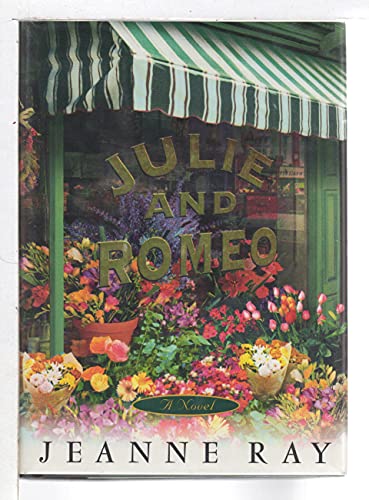
Synopsis
A deliciously funny and wickedly sexy novel of love found (finally!) and love threatened (inevitably) by the families who claim to love us best. Romeo Cacciamani and Julie Roseman are rival florists in Boston, whose families have hated each other for as long as anyone can remember (what they can't remember is why). When these two vital, lonely people see each other across a crowded lobby at a small business owners' seminar, an intense attraction blooms that neither tries to squelch. They're not sure what fate has in store for them, but they're not about to let something as silly as a generations-long feud stand in the way of finding out. That is, not until Romeo's octogenarian mother, Julie's meddling ex-husband, and a cast of grown Cacciamani and Roseman children begin to intervene with a passionate hatred that matches their newly found love, stroke for stroke. Think Montagues and Capulets, think wise and witty and thoroughly modern. Julie and Romeo is a love story for the ages. All ages.
"synopsis" may belong to another edition of this title.
About the Author
JEANNE RAY is a nurse living in Nashville. She is the mother of the novelist Ann Patchett. This is her first novel.
From the Back Cover
"At last, someone has written a love story for and about grown-ups! And that someone is a marvelous new writer named Jeanne Ray, whose contemporary take on old rivalries, star-crossed passions, and clandestine intrigues charts a fresh, funny, exquisitely plotted tale of, well, Shakespearean proportions. Julie and Romeo is absolutely delicious. A smart, sexy celebration of the timeless nature of romance."
--A. Manette Ansay, author of Vinegar Hill and Midnight Champagne
"Love and desire will not be denied in this lighthearted inversion of a classic story. Filled with the delicate sweetness of fresh flowers and new love, Julie and Romeo is a smart, funny, touching book. Where has Jeanne Ray been hiding all these years?"
--Alison McGhee, author of Shadow Baby
From the Inside Flap
A deliciously funny and wickedly sexy novel of love found (finally!) and love threatened (inevitably) by the families who claim to love us best. Romeo Cacciamani and Julie Roseman are rival florists in Boston, whose families have hated each other for as long as anyone can remember (what they can't remember is why). When these two vital, lonely people see each other across a crowded lobby at a small business owners' seminar, an intense attraction blooms that neither tries to squelch. They're not sure what fate has in store for them, but they're not about to let something as silly as a generations-long feud stand in the way of finding out. That is, not until Romeo's octogenarian mother, Julie's meddling ex-husband, and a cast of grown Cacciamani and Roseman children begin to intervene with a passionate hatred that matches their newly found love, stroke for stroke. Think Montagues and Capulets, think wise and witty and thoroughly modern. Julie and Romeo is a love story for the ages. All ages.
Reviews
Shakespeare it isn't, but Ray's beguiling first novel succeeds on the level of romantic entertainment. Narrator Julie Roseman is 60, divorced, loving her job running her family's florist business in Somerville, Mass., but uncomfortably aware that it's failing to turn a profit. All her life she's been aware of her father's violent hatred of the Cacciamani family, the town's only other florist; the Cacciamanis have expressed equal rancor. Julie has always wondered about the source of the enmity, which was never explained. The virulence has seeped down to the third generation, especially after Julie's daughter, Sandy, was caught planning to elope with young Tony Cacciamani when the two were in high school. When Julie bumps into widower Romeo Cacciamani at a seminar, however, love immediately blossoms between them. Their offspring react with horror, forbidding their respective parents to see each other again, and, when Julie and Romeo refuse to comply, the children retaliate with serious spite and fury. Despite a reliance on coincidences, Ray handles her material with vitality and humor, and demonstrates a talent for witty dialogue. She's particularly smart and funny in the realm of mother/daughter relationships, as Julie tries to deal with both Sandy, who's divorced and has moved back home with her two children, and her other daughter, Nora, a real estate whiz with a drive for perfection and a dictatorial personality. It's Nora who alerts her father, Mort, to her mother's foolish liaison, bringing Mort and his young new wife back from Seattle to complicate matters. Since it was Mort who walked out in the first place, Julie is justifiably furious. Meanwhile, Romeo enlists his parish priest as go-between and tries to placate his 89-year-old mother, whose malicious antipathy may hold the key to the family vendetta. Ray's charming little bouquet should blossom into an appealing summer read. 75,000 first printing; film rights to Barwood Films; audio rights to Brilliance Audio; rights sold in Germany, Greece, Italy and the U. K. (June) FYI: Ray is the mother of author Ann Padgett.
Copyright 2000 Reed Business Information, Inc.
This is a short, sweet love story for the 60-plus set by a talented first novelist who is, according to the publicist's blurb, a nurse living in Nashville. Romeo Cacciamani and Julie Roseman are rival florists in Somerville, MA, whose families have feuded for three generations. Romeo's son Tony and Julie's daughter Sandy attempted an elopement in high school but were thwarted. Now it's the turn of widowed Romeo and divorced Julie, who meet at a small-business seminar and fall into a passionate love affair that their families are determined to thwart as well. This is a funny book, and Julie and Romeo are lovable protagonists, but the underlying premise is serious: can deeply held antagonisms be overcome, or are some relationships simply impossible? Ray comes up with some unforgettable characters, including Julie's aggressive real-estate agent daughter, Nora, and Romeo's equally aggressive 90-year-old mother, the witchlike matriarch whose "poke" has unmanned many a Cacciamani and whose rosebush-killing method harks back to Rome's destruction of Carthage. The abrupt ending (and revelation of the basis for the family animosity) may disappoint slightly, but this would still make a terrific movie. Recommended for all collections.
-Jo Manning, Barry Univ., Miami Shores, FL
Copyright 2000 Reed Business Information, Inc.
Excerpt. © Reprinted by permission. All rights reserved.
The first time I heard the name Cacciamani I was five years old. My father said it, and then he spit. The spitting I had seen before. I watched my father spit out his toothpaste into the sink. I had seen him spit once while mowing the lawn when he claimed to have taken in a mouthful of gnats. But this particular spitting, the spitting done in association with the word Cacciamani, was done directly onto the cement floor of the back room of Roseman's, our family's florist shop. That floor, like everything else in my father's world, was kept meticulously clean, nary a leaf hit that floor, and so even as a child I recognized the utter seriousness of his gesture.
"Pigs," my father said, referring not to himself for what he had done to his floor but to the name that had led him to do it.
I wish I could remember the rest of this story, how the Cacciamanis had come up in the first place, but I was five. Fifty-five years later, only the highlights of such childhood memories remain.
Commentators, the people reading their opinions on the news, the people on the op-ed page of the Globe, love to say that hate is a learned thing. Children mimic the appalling racial slurs of their appalling parents, every bitter, contemptible piece of narrow-mindedness is handed down from generation to generation like so much fine family silver. I doubt it is as easy as this, as I know my own two daughters have picked up a few things in this world I will not take responsibility for, but then I think of my father and the small, shimmery pool of his spit on the floor. I hated Cacciamani with all the passionate single-mindedness of a child without even knowing what or who it was. I decided it was a fish. My father, who loved just about everything, was not a fan of fish, and so I assumed the conversation must have gone something like this:
My mother: Howard, I got some nice fresh Cacciamani for dinner tonight.
My Father: Cacciamani! [Spit] Pigs!
For the next several years I imagined pale-fleshed, rubbery bottom feeders, the dreaded Cacciamani, snuffling around blindly at the bottom of Boston Harbor. No doubt my mother intended to fry them and serve them up in a buttery lemon sauce.
When exactly I made the transition from fish to family, from family to rival florists, I don't know (again, remember, this was the distant past). It hardly ruled my life. My path did not cross with the Cacciamanis', and when it did, they had to be pointed out to me like a patch of poison ivy I could have walked right into. We did not go to the same school. Their son went to the idol-worshiping, uniform-wearing Catholic school, while my brother and I attended perfectly normal public school. Their name was rarely spoken and when it was there was a great fanfare of unexplained wrath that I gladly participated in. We were a liberal family, aware of the recent persecution of our people and therefore unlikely to persecute others. As far as I knew, the only prejudice we had was against the Cacciamanis. It didn't extend to other Catholics or all Italians, just those people, those wretched, worthless fish. A prejudice can be a lovely thing to have, which is exactly why so many people have them in the first place. A prejudice is a simplification: Every member of this group is exactly the same and therefore I never have to think about any of them. What a time-saver! Of course, it didn't save me much time because back then there were only three Cacciamanis for me to hate, a father, a mother, and the son. I remember seeing the mother at Haymarket several times on Saturdays. She was beautiful, tall and thin, with black hair and red lips. Still, I thought it was an evil sort of beauty. Then their son grew up, married, and had six children, many of whom married and had children of their own. The Cacciamani clan grew by leaps and bounds and as far as I was concerned the whole lot of them were worthless, a fact that was reinforced when Tony Cacciamani tried to marry my daughter Sandy when they were in high school.
So that was how I came to hate Cacciamanis. Now let me tell you how I stopped. It was five years ago when I came to hate my husband, Mort. Mort ran off with Lila, the thirty-eight-year-old bouquet-grasping bridesmaid he met at a wedding while delivering flowers. Apparently he met her at several weddings. She was practically a professional bridesmaid, many friends, few dates. There went Mort and Lila. After that I knew what it was to really hate someone on your own terms, for your own reasons, which is much more poignant than hating on someone else's behalf. I didn't know I had ceased to carry an axe for the Cacciamanis. There was no conscious moment: I hate Mort and so expunge the record of the Cacciamanis. I simply hadn't thought of them for years. And then one day, while attending a seminar at the downtown Boston Sheraton called "Making Your Small Business Thrive," I practically walked into a man with the name tag romeo cacciamani. I probably would have recognized his face, but I saw the name first. I steeled myself for the great wave of fury that was surely coming. I planted my feet and took a breath, but nothing, not even a twinge. What came instead was this thought: Poor Romeo Cacciamani; his shop must be going bust, too, if he's at this thing.
He tilted his head a little and squinted at me. I think Romeo Cacciamani needed glasses. "Julie Roseman," he said, reading my tag.
And there he was, a nice-looking Italian guy sitting right at sixty. He was wearing pressed khaki pants and a white polo shirt with a sprig of chest hair flourishing at the throat. No gold chains. I was so surprised by my utter lack of hostility that I wanted to laugh. I wanted to shake his hand, and I would have except I had a Styrofoam cup of hot coffee in one hand and several folders of tax spreadsheets and workmen's comp advice in the other. "Romeo Cacciamani," I said with wonder.
"About this title" may belong to another edition of this title.
Other Popular Editions of the Same Title

Search results for Julie and Romeo: A Novel

Stock Image
Julie and Romeo: A Novel
Seller: World of Books (was SecondSale), Montgomery, IL, U.S.A.
Seller rating 5 out of 5 stars

Condition: Acceptable. Item in good condition. Textbooks may not include supplemental items i.e. CDs, access codes etc. Seller Inventory # 00068223364
Stock Image
Julie and Romeo: A Novel
Seller: Your Online Bookstore, Houston, TX, U.S.A.
Seller rating 5 out of 5 stars
Hardcover. Condition: Good. Seller Inventory # 0609606727-3-25276997
Stock Image
Julie and Romeo: A Novel
Seller: World of Books (was SecondSale), Montgomery, IL, U.S.A.
Seller rating 5 out of 5 stars
Condition: Good. Item in good condition. Textbooks may not include supplemental items i.e. CDs, access codes etc. Seller Inventory # 00098497062
Stock Image
Julie and Romeo: A Novel
Seller: World of Books (was SecondSale), Montgomery, IL, U.S.A.
Seller rating 5 out of 5 stars
Condition: Very Good. Item in very good condition! Textbooks may not include supplemental items i.e. CDs, access codes etc. Seller Inventory # 00098184094
Stock Image
Julie and Romeo: A Novel
Published by
Harmony (edition First Edition), 2000
ISBN 10: 0609606727
ISBN 13: 9780609606728
Used
Hardcover
First Edition
Seller: BooksRun, Philadelphia, PA, U.S.A.
Seller rating 5 out of 5 stars
Hardcover. Condition: Fair. First Edition. With dust jacket. The item might be beaten up but readable. May contain markings or highlighting, as well as stains, bent corners, or any other major defect, but the text is not obscured in any way. Seller Inventory # 0609606727-7-1-29
Stock Image
Julie and Romeo: A Novel
Seller: HPB-Ruby, Dallas, TX, U.S.A.
Seller rating 5 out of 5 stars
hardcover. Condition: Very Good. Connecting readers with great books since 1972! Used books may not include companion materials, and may have some shelf wear or limited writing. We ship orders daily and Customer Service is our top priority! Seller Inventory # S_461804056
Stock Image
Julie and Romeo
Published by
Crown Publishing Group, The, 2000
ISBN 10: 0609606727
ISBN 13: 9780609606728
Used
Hardcover
Seller: Better World Books, Mishawaka, IN, U.S.A.
Seller rating 5 out of 5 stars
Condition: Good. Former library copy. Pages intact with minimal writing/highlighting. The binding may be loose and creased. Dust jackets/supplements are not included. Includes library markings. Stock photo provided. Product includes identifying sticker. Better World Books: Buy Books. Do Good. Seller Inventory # GRP83170024
Stock Image
Julie and Romeo
Published by
Crown Publishing Group, The, 2000
ISBN 10: 0609606727
ISBN 13: 9780609606728
Used
Hardcover
Seller: Better World Books: West, Reno, NV, U.S.A.
Seller rating 5 out of 5 stars
Condition: Good. Former library copy. Pages intact with minimal writing/highlighting. The binding may be loose and creased. Dust jackets/supplements are not included. Includes library markings. Stock photo provided. Product includes identifying sticker. Better World Books: Buy Books. Do Good. Seller Inventory # GRP83170024
Stock Image
Julie and Romeo
Published by
Crown Publishing Group, The, 2000
ISBN 10: 0609606727
ISBN 13: 9780609606728
Used
Hardcover
Seller: Better World Books, Mishawaka, IN, U.S.A.
Seller rating 5 out of 5 stars
Condition: Very Good. Former library copy. Pages intact with possible writing/highlighting. Binding strong with minor wear. Dust jackets/supplements may not be included. Includes library markings. Stock photo provided. Product includes identifying sticker. Better World Books: Buy Books. Do Good. Seller Inventory # 38409532-6
Seller Image
Julie and Romeo: A Novel
Seller: Blue Vase Books, Interlochen, MI, U.S.A.
Seller rating 5 out of 5 stars
Condition: good. Missing dust cover, otherwise book is in good condition with some wear from normal use. Seller Inventory # 31UI5600DC5M_ns