
Items related to When the Astors Owned New York: Blue Bloods and Grand...
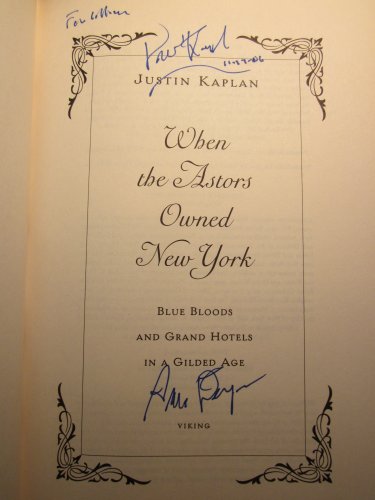
Synopsis
Traces the public and private lives of cousins William Waldorf Astor and John Jacob Astor IV, nineteenth-century heirs and rivals who pursued separate ambitions, built the original Waldorf-Astoria hotel, and influenced social behavior before John Jacob perished aboard the Titanic. 30,000 first printing.
"synopsis" may belong to another edition of this title.
About the Author
Justin Kaplan is an editor, biographer, and author of Mr. Clemens and Mark Twain and Walt Whitman: A Life, among other books. He is a member of the American Academy of Arts and Letters.
From the Back Cover
Advance praise for WHEN THE ASTORS OWNED NEW YORK, by Justin Kaplan
"The Astors may have owned New York, but Justin Kaplan owns the Astors. This is a grand book on a grand subject-the era of the great hotels and the family that created that 'vision of extravagance, grandeur, amplitude, order, and efficiency.' Kaplan is a superb
writer; his prose shines with clarity and crackles with wicked wit. An immensely satisfying read-impossible to put down. Justin Kaplan has done it again."
-Robert R Richardson, author of Henry Thoreau: A life of the Mind and Emerson: The Mind on Fire
"When the Astors Owned New York is a gem of a book by one of our foremost biographers. Justin Kaplan gives us a slice of Manhattan's history that reaches across three centuries, and offers fascinating glimpses of what Henry James has called the 'perfect human felicity' of 'hotel-civilization.' Indeed, no one since James has written with such ease and grace about the era of excess as Kaplan. He recounts the Astor family's 'ventures in the ideal,' as well as their bitter feuds and brushes with scandal, with the economical style and wry wit that marked his Pulitzer-winning biographies of Mark Twain and Walt Whitman. Kaplan's latest achievement is a tour-de-force, brimming with the vitality of its subject."
-Megan Marshall, author of The Peabody Sisters: Three Women Who Ignited American Romanticism
"In velvet prose, Justin Kaplan offers up a family drama that played itself out in the national headlines and the New York skyline. There could be no better guide to that new-fangled l9th century invention: American ostentation. This one is sheer delight.
-Stacy Schiff, author of A Great Improvisation: Franklin, France, and the Birth of America and Vera (Mrs. Vladimir Nabokov), winner of the Pulitzer Prize
"If you've ever wondered about the real life models for Henry James' American novels or Merchant-Ivory's films, this is the book for you. An irresistible panorama of New York City when "the 400" reigned supreme."
-Howard Gardner, author of Multiple Intelligences and Changing Minds
"Justin Kaplan's reconstruction of the Astors and kindred hoteliers is a very entertaining commentary on the Idle Rich and the lavish caravansaries they constructed in the Gilded Age to service their clientele. His book is at once social history and cultural anthropology. The principal actors-the Astors and their ilk-frequent an Aladdinish world of conspicuous consumers. When the Astors Owned New York is a distillation of a place and of a time by a smiling and sardonic observer."
-David Aaron, Harvard University
'I thought I knew everything worth knowing about the Astors. Then I read Justin Kaplan's new book. Wow. Was I ever wrong..."
-Stephen Birmingham, author of Our Crowd, Life at the Dakota, and The Rest of Us
"Though the story of the Astor family and the excesses of the Gilded Age is familiar, it has never been told better than by Justin Kaplan, whose sharply focused, nuanced, and unsentimental snapshot of American ambition and accomplishment is carefully researched and gracefully written. I could not put it down."
-Rober A. M. Stern, architect
"The remarkable talents of this prize-winning biographer have been happily focused uon the hotel and real-estate dynasty of John Jacob Asto, especially his descendents whose blood was never quite blue enough to satisfy their inherited fantasies. The result is New York cultural history at its finest-a fascinating narrative that sparkles with wit and charm from start to finish."
-Jerome Loving, author of The Last Titan: A life of Theodore Dreiser and Walt Whitman: The Song of Himself
Reviews
This frothy look at several generations of Astors by the Pulitzer Prize–winning author of Mr. Clemens and Mark Twain is custom-made for the Waldorf gift shop. The tightwad founder of the Astor dynasty was a butcher's son from the German backwater of Waldorf. By the time John Jacob Astor died in 1848 at the age of 84, the richest man in America had turned a fur trade monopoly into a Manhattan real estate empire. Astor House, his "astonishing" luxury hotel adjacent to City Hall, cosseted the likes of Abraham Lincoln and Britain's future King Edward VII in its 80-year history. John Jacob's "phlegmatic and cautious" son, William, increased the family fortune, married a blueblood and sired sons who couldn't abide one another. "Imperious and somber" John Jacob III and playboy William, who was married to society queen Caroline Schermerhorn, passed on the family feud to their sons who managed to combine forces in 1897 to build the Waldorf-Astoria. Prickly and snobbish William Waldorf Astor failed in New York State politics, became a novelist and an art collector, and died a British viscount. John Jacob IV's military service and his death on the Titanic helped temper his reputation as a spoiled fool. B&w photos. (June 5)
Copyright © Reed Business Information, a division of Reed Elsevier Inc. All rights reserved.
When it opened on Broadway in 1836, John Jacob Astor's hotel Astor House was called a "marvel of the age." However, it was nothing compared to the hotel built some 60 years later by Astor's great-grandsons, William Waldorf and John Jacob IV. Since the cousins could never agree on anything, the Waldorf-Astoria was actually two hotels, connected by corridors that could be sealed off. Henry James, back in the U.S. after an absence of 20 years, stayed there and described it as "one of my few glimpses of perfect human felicity." Kaplan is well known as a biographer, but he presents an unconventional biography here, crafting a fascinating work of social history by focusing on the cousins' hotel-building mania. The Waldorf-Astoria and other Astor hotels served as the stage for the family drama, as well as for people anxious to show off their wealth, and also helped define a new standard of luxury for the aspiring middle class. Mary Ellen Quinn
Copyright © American Library Association. All rights reserved
"About this title" may belong to another edition of this title.
Search results for When the Astors Owned New York: Blue Bloods and Grand...

Stock Image
When the Astors Owned New York: Blue Bloods and Grand Hotels in a Gilded Age
Seller: World of Books (was SecondSale), Montgomery, IL, U.S.A.
Seller rating 5 out of 5 stars

Condition: Good. Item in good condition. Textbooks may not include supplemental items i.e. CDs, access codes etc. Seller Inventory # 00100441098
Stock Image
When the Astors Owned New York: Blue Bloods and Grand Hotels in a Gilded Age
Seller: World of Books (was SecondSale), Montgomery, IL, U.S.A.
Seller rating 5 out of 5 stars
Condition: Acceptable. Item in acceptable condition! Textbooks may not include supplemental items i.e. CDs, access codes etc. Seller Inventory # 00108673725
Stock Image
When the Astors Owned New York: Blue Bloods and Grand Hotels in a Gilded Age
Published by
The Viking Press (edition First Edition), 2006
ISBN 10: 0670037699
ISBN 13: 9780670037698
Used
Hardcover
First Edition
Seller: BooksRun, Philadelphia, PA, U.S.A.
Seller rating 5 out of 5 stars
Hardcover. Condition: Very Good. First Edition. With dust jacket. It's a well-cared-for item that has seen limited use. The item may show minor signs of wear. All the text is legible, with all pages included. It may have slight markings and/or highlighting. Seller Inventory # 0670037699-11-1-29
Stock Image
When the Astors Owned New York: Blue Bloods and Grand Hotels in a Gilded Age
Published by
The Viking Press (edition First Edition), 2006
ISBN 10: 0670037699
ISBN 13: 9780670037698
Used
Hardcover
First Edition
Seller: BooksRun, Philadelphia, PA, U.S.A.
Seller rating 5 out of 5 stars
Hardcover. Condition: Fair. First Edition. With dust jacket. The item might be beaten up but readable. May contain markings or highlighting, as well as stains, bent corners, or any other major defect, but the text is not obscured in any way. Seller Inventory # 0670037699-7-18-29
Stock Image
When the Astors Owned New York: Blue Bloods and Grand Hotels in a Gilded Age
Seller: Duru Media, Tallahassee, FL, U.S.A.
Seller rating 5 out of 5 stars
hardcover. Condition: Good. Seller Inventory # 01KRDV9BS5E6JH2
Stock Image
When the Astors Owned New York: Blue Bloods and Grand Hotels in a Gilded Age
Seller: Book Gurus, Tallahassee, FL, U.S.A.
Seller rating 5 out of 5 stars
hardcover. Condition: Fair. Seller Inventory # 01KX3SNSACW6SF2
Stock Image
When the Astors Owned New York : Blue Bloods and Grand Hotels in a Gilded Age
Published by
Penguin Publishing Group, 2006
ISBN 10: 0670037699
ISBN 13: 9780670037698
Used
Hardcover
Seller: Better World Books, Mishawaka, IN, U.S.A.
Seller rating 5 out of 5 stars
Condition: Very Good. First. Pages intact with possible writing/highlighting. Binding strong with minor wear. Dust jackets/supplements may not be included. Stock photo provided. Product includes identifying sticker. Better World Books: Buy Books. Do Good. Seller Inventory # 3976866-6
Stock Image
When the Astors Owned New York : Blue Bloods and Grand Hotels in a Gilded Age
Published by
Penguin Publishing Group, 2006
ISBN 10: 0670037699
ISBN 13: 9780670037698
Used
Hardcover
Seller: Better World Books, Mishawaka, IN, U.S.A.
Seller rating 5 out of 5 stars
Condition: Good. First. Pages intact with minimal writing/highlighting. The binding may be loose and creased. Dust jackets/supplements are not included. Stock photo provided. Product includes identifying sticker. Better World Books: Buy Books. Do Good. Seller Inventory # 4031971-6
Stock Image
When the Astors Owned New York : Blue Bloods and Grand Hotels in a Gilded Age
Published by
Penguin Publishing Group, 2006
ISBN 10: 0670037699
ISBN 13: 9780670037698
Used
Hardcover
Seller: Better World Books, Mishawaka, IN, U.S.A.
Seller rating 5 out of 5 stars
Condition: Good. First. Former library copy. Pages intact with minimal writing/highlighting. The binding may be loose and creased. Dust jackets/supplements are not included. Includes library markings. Stock photo provided. Product includes identifying sticker. Better World Books: Buy Books. Do Good. Seller Inventory # GRP62116529
Stock Image
When the Astors Owned New York : Blue Bloods and Grand Hotels in a Gilded Age
Published by
Penguin Publishing Group, 2006
ISBN 10: 0670037699
ISBN 13: 9780670037698
Used
Hardcover
Seller: Better World Books: West, Reno, NV, U.S.A.
Seller rating 5 out of 5 stars
Condition: Good. First. Pages intact with minimal writing/highlighting. The binding may be loose and creased. Dust jackets/supplements are not included. Stock photo provided. Product includes identifying sticker. Better World Books: Buy Books. Do Good. Seller Inventory # 4031971-6