
Items related to Invention by Design: How Engineers Get from Thought...
Synopsis
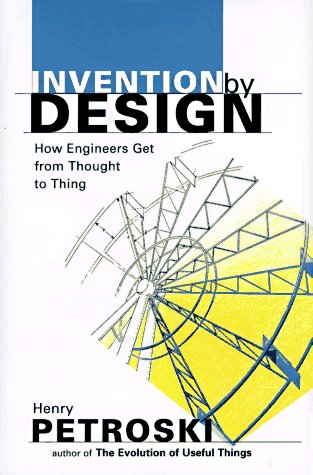
Henry Petroski’s previous bestsellers have delighted readers with intriguing stories about the engineering marvels around us, from the lowly pencil to the soaring suspension bridge. In this book, Petroski delves deeper into the mystery of invention, to explore what everyday artifacts and sophisticated networks can reveal about the way engineers solve problems.
Engineering entails more than knowing the way things work. What do economics and ecology, aesthetics and ethics, have to do with the shape of a paper clip, the tab of a beverage can, the cabin design of a turbojet, or the course of a river? How do the idiosyncrasies of individual engineers, companies, and communities leave their mark on projects from Velcro® to fax machines to waterworks? Invention by Design offers an insider’s look at these political and cultural dimensions of design and development, production and construction.
Readers unfamiliar with engineering will find Petroski’s enthusiasm contagious, whether the topic is the genesis of the Ziploc® baggie or the averted collapse of Manhattan’s sleekest skyscraper. And those who inhabit the world of engineering will discover insights to challenge their customary perspective, whether their work involves failure analysis, systems design, or public relations. Written with the flair that readers have come to expect from his books, Invention by Design reaffirms Petroski as the master explicator of the principles and processes that turn thoughts into the many things that define our made world.
"synopsis" may belong to another edition of this title.
About the Author
Henry Petroski was the Aleksandar S. Vesic Distinguished Professor Emeritus of Civil and Environmental Engineering at Duke University.
Reviews
Invention, Petroski has steadfastly maintained, comes from a failure of design. The paperclip that can only be used in one direction, that becomes easily tangled in a box, or that tears the paper has led inventors to a cycle of improvements and patents. That's the story of the case studies here, many of which Petroski has used in other books?the paperclip, zipper and aluminum can appeared in The Evolution of Useful Things, the pencil in The Pencil; and the San Francisco-Oakland Bay Bridge in Engineers of Dreams. But Petroski still manages to add something new. When talking about the Bay Bridge, for example, he goes into great depth here about the impact of factors far removed from statics, dynamics and hydraulics. He looks at the importance of John Roebling's personal charisma and the impact of the 1879 failure of the Firth of Tay bridge on the subsequent construction of bridges. In the same way, his sections on "Facsimile and Networks" and "Airplanes and Computers" offer very interesting insights into the economics of implementing large-scale projects (fax machines became popular in part because of Federal Express's promotion of its new ZapMail, which turned into a $300 million bath for the company). Those who don't know Petroski's work will find this an enjoyable introduction. Those who do, will appreciate the additional gloss.
Copyright 1996 Reed Business Information, Inc.
A look at the engineering principles behind ordinary objects and processes by the author of the bestsellers The Evolution of Useful Things (1992) and The Pencil (1989). Petroski is, essentially, a cheerleader for civil engineers, who are at their most successful when their designs blend so completely into our environment that we forget about the magnificent achievements they represent. Here Petroski takes a look at the development of such things as pencils, zippers, paper clips, the fax machine, turbojet aircraft, suspension bridges, aluminum beverage cans, and the systems that heat and cool modern buildings. Since he has written before about the history of lead pencils, zippers, and paper clips, he tries this time to turn his emphasis more toward the engineering process involved in developing the object, but many readers will feel that he's merely recapitulating earlier work. (On the other hand, his chapter on the pencil nicely summarizes an entire book, saving new readers some time.) Petroski writes interestingly on the aluminum beverage can, but a widely circulated Scientific American article, which he draws from, covered this ground more succinctly and with more authority in 1994 and is still widely available on the Internet. On the grand if exotic subject of sewers and water management, civil engineering's greatest triumph and, arguably, the greatest achievement of the Roman and later the British empires, Petroski, oddly, loses his popularizer's touch, taking a historical perspective that never escapes the tone of a summary. Perhaps this subject deserves a book all its own. On the fax machine, however, and particularly on the development of the Boeing 777, Petroski flies to his customary heights. Petroski once again goes where many have gone before, this time with mixed results. Not his best effort, but pleasant, readable, and persuasive, nonetheless. -- Copyright ©1996, Kirkus Associates, LP. All rights reserved.
Petroski (The Pencil, LJ 3/1/90) has done much to make the nerdy world of engineering interesting and accessible to the reader. Here, he's after a different audience, one interested in the philosophy and cultural study of the process of invention. By examining the relationship between the invention of devices and their refinement over time by others, Petroski identifies design principles that engineers use to make things work. Written as a series of case studies ranging from the paper clip to the zipper to the FAX machine to the Boeing 777, this book is engaging but tends to instruct rather than entertain. Little exercises that ask the reader to, say, imagine refinements to the basic plastic sandwich bag hint at this book's history as an engineering course curriculum, but it's still good reading for those interested in the gestalt of engineering design. Quotations and illustrations from patent applications are particularly fascinating and are used well. For popular science collections.?Mark L. Shelton, Univ. of Massachusetts Medical Ctr., Worcester
Copyright 1996 Reed Business Information, Inc.
Want to invent a new paper clip? A new mode of electronic communication? You'll succeed only if you can meet the types of challenges Petroski identifies in this lucid and lively book. Readers with no ambitions of becoming inventors will still take a keen interest in these case studies of engineers who, by dint of ingenuity and persistence, have created important new structures or devices. Whether designing something as small as a pencil or as large as the World Trade Center, successful engineers must not only devise new technology but also find a way to situate that technology within the existing economic, social, and ecological order. Every case study includes well-chosen pictures and schematic drawings to clarify how inventors resolve technical difficulties, and the carefully researched text explains how they make their new creations economically feasible and socially acceptable. Students of technology will delight in one part of the book, cultural historians in another, but both groups will praise the author. Bryce Christensen
"About this title" may belong to another edition of this title.
Search results for Invention by Design: How Engineers Get from Thought...

Seller Image
Invention by Design: How Engineers Get from Thought to Thing
Published by
Harvard University Press, 1996
ISBN 10: 0674463676
ISBN 13: 9780674463677
Used
Hardcover
Seller: Greenworld Books, Arlington, TX, U.S.A.
Seller rating 5 out of 5 stars

Condition: good. Fast Free Shipping â" Good condition. It may show normal signs of use, such as light writing, highlighting, or library markings, but all pages are intact and the book is fully readable. A solid, complete copy that's ready to enjoy. Seller Inventory # GWV.0674463676.G
Seller Image
Invention by Design: How Engineers Get from Thought to Thing
Published by
Harvard University Press, 1996
ISBN 10: 0674463676
ISBN 13: 9780674463677
Used
Hardcover
Seller: Greenworld Books, Arlington, TX, U.S.A.
Seller rating 5 out of 5 stars
Condition: very_good. Fast Free Shipping â" Very Good condition book with a firm cover and clean pages. Shows normal use and some light wear or limited notes markings. A solid, nice copy to enjoy. Seller Inventory # GWV.0674463676.VG
Stock Image
Invention by Design: How Engineers Get from Thought to Thing
Published by
Harvard University Press, 1996
ISBN 10: 0674463676
ISBN 13: 9780674463677
Used
Hardcover
Seller: World of Books (was SecondSale), Montgomery, IL, U.S.A.
Seller rating 5 out of 5 stars
Hardback. Condition: Very Good. What do economics and ecology, aesthetics and ethics, have to do with the shape of the paper clip or the tab of a beverage can? This work explores what everyday artifacts and sophisticated networks can reveal about the way engineers solve problems. Seller Inventory # 00109970223
Stock Image
Invention by Design: How Engineers Get from Thought to Thing
Published by
Harvard University Press, 1996
ISBN 10: 0674463676
ISBN 13: 9780674463677
Used
Hardcover
Seller: World of Books (was SecondSale), Montgomery, IL, U.S.A.
Seller rating 5 out of 5 stars
Hardback. Condition: Fair. What do economics and ecology, aesthetics and ethics, have to do with the shape of the paper clip or the tab of a beverage can? This work explores what everyday artifacts and sophisticated networks can reveal about the way engineers solve problems. Seller Inventory # 00107424300
Stock Image
Invention by Design: How Engineers Get from Thought to Thing
Published by
Harvard University Press, 1996
ISBN 10: 0674463676
ISBN 13: 9780674463677
Used
Hardcover
Seller: World of Books (was SecondSale), Montgomery, IL, U.S.A.
Seller rating 5 out of 5 stars
Hardback. Condition: Good. What do economics and ecology, aesthetics and ethics, have to do with the shape of the paper clip or the tab of a beverage can? This work explores what everyday artifacts and sophisticated networks can reveal about the way engineers solve problems. Seller Inventory # 00108409503
Stock Image
Invention by Design: How Engineers Get from Thought to Thing
Published by
Harvard University Press (edition First Edition), 1996
ISBN 10: 0674463676
ISBN 13: 9780674463677
Used
Hardcover
First Edition
Seller: BooksRun, Philadelphia, PA, U.S.A.
Seller rating 5 out of 5 stars
Hardcover. Condition: Very Good. First Edition. With dust jacket. It's a well-cared-for item that has seen limited use. The item may show minor signs of wear. All the text is legible, with all pages included. It may have slight markings and/or highlighting. Seller Inventory # 0674463676-11-6-29
Stock Image
Invention by Design: How Engineers Get from Thought to Thing
Published by
Harvard University Press, 1996
ISBN 10: 0674463676
ISBN 13: 9780674463677
Used
Hardcover
Seller: ThriftBooks-Phoenix, Phoenix, AZ, U.S.A.
Seller rating 5 out of 5 stars
Hardcover. Condition: Very Good. No Jacket. May have limited writing in cover pages. Pages are unmarked. ~ ThriftBooks: Read More, Spend Less. Seller Inventory # G0674463676I4N00
Stock Image
Invention by Design: How Engineers Get from Thought to Thing
Published by
Harvard University Press, 1996
ISBN 10: 0674463676
ISBN 13: 9780674463677
Used
Hardcover
Seller: ThriftBooks-Atlanta, AUSTELL, GA, U.S.A.
Seller rating 5 out of 5 stars
Hardcover. Condition: Very Good. No Jacket. May have limited writing in cover pages. Pages are unmarked. ~ ThriftBooks: Read More, Spend Less. Seller Inventory # G0674463676I4N00
Stock Image
Invention by Design: How Engineers Get from Thought to Thing
Published by
Harvard University Press, 1996
ISBN 10: 0674463676
ISBN 13: 9780674463677
Used
Hardcover
Seller: ThriftBooks-Dallas, Dallas, TX, U.S.A.
Seller rating 5 out of 5 stars
Hardcover. Condition: Very Good. No Jacket. May have limited writing in cover pages. Pages are unmarked. ~ ThriftBooks: Read More, Spend Less. Seller Inventory # G0674463676I4N00
Stock Image
Invention by Design: How Engineers Get from Thought to Thing
Published by
Harvard University Press, 1996
ISBN 10: 0674463676
ISBN 13: 9780674463677
Used
Hardcover
Seller: ThriftBooks-Atlanta, AUSTELL, GA, U.S.A.
Seller rating 5 out of 5 stars
Hardcover. Condition: As New. No Jacket. Pages are clean and are not marred by notes or folds of any kind. ~ ThriftBooks: Read More, Spend Less. Seller Inventory # G0674463676I2N00