
Synopsis
Donald Barthelme's premature death at the age of fifty-eight brought to an end one of the most provocative careers in the history of American literature. Groundbreaking works such as Come Back, Dr. Caligari; The Dead Father; Snow White; Great Days; Overnight to Many Distant Cities; Guilty Pleasures; and his two short-fiction collections, Forty Stories and Sixty Stories, have earned him a place among the most influential and imitated authors of the last half-century. With his marvelously strange and darkly ironic vision of the world, his wizard satire and deadpan humor, Barthelme spoke of and for our time like no one else. He spoke of our national obsessions and weirdnesses, our unspeakable practices and unnatural acts, in what is for many the distinctive voice of postmodern America.
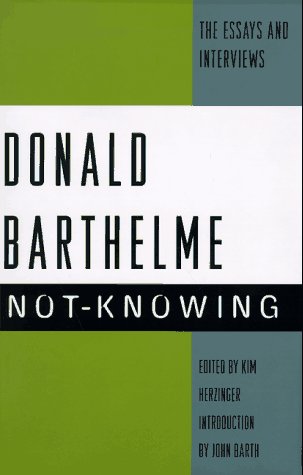
Not-Knowing is the second posthumous collection of Donald Barthelme's work. Like The Teachings of Don B. (1992), it brings together shorter works now almost impossible to come by. While the first volume featured the author's tantalizing experiments in satire, parable, fable, and playwriting, this new volume focuses on his diverse nonfiction pieces, collectively referred to here as essays, although, as always with Barthelme's work, they are feistily resistant to any label. Categorizable or not, Not-Knowing contains Barthelme's pungent comments on writing, art, literature, film, and city life, which are, as John Barth says in his Introduction, among the permanent literary treasures of American postmodernist writing. Also here are several interviews with the author--invaluable for understanding this very private man--including two never before available. The interviews range over the last eighteen years of Barthelme's life, and they give readers the opportunity to watch his ideas as they expand, change, and settle.
Kim Herzinger has gathered here an eclectic selection of pieces for Barthelme's many admirers, creating a work that will confirm his rightful standing as, in the words of Robert Coover, "one of the great citizens of contemporary world letters."
"synopsis" may belong to another edition of this title.
About the Author
The late Donald Barthelme was a longtime contributor to The New Yorker, winner of a National Book Award, a director of PEN and the Authors Guild, and a member of the American Academy and Institute of Arts and Letters. His sixteen books--including Snow White, The Dead Father, and City Life--substantially redefined American short fiction for our time.
About the Editor:
Kim Herzinger teaches at the University of Southern Mississippi. He is the author of books and articles on D.H. Lawrence, modern and contemporary literature, Sherlock Holmes, and baseball, and is now at work on a cultural biography of Donald Barthelme.
From the Inside Flap
elme's premature death at the age of fifty-eight brought to an end one of the most provocative careers in the history of American literature. Groundbreaking works such as Come Back, Dr. Caligari; The Dead Father; Snow White; Great Days; Overnight to Many Distant Cities; Guilty Pleasures; and his two short-fiction collections, Forty Stories and Sixty Stories, have earned him a place among the most influential and imitated authors of the last half-century. With his marvelously strange and darkly ironic vision of the world, his wizard satire and deadpan humor, Barthelme spoke of and for our time like no one else. He spoke of our national obsessions and weirdnesses, our unspeakable practices and unnatural acts, in what is for many the distinctive voice of postmodern America.
Not-Knowing is the second posthumous collection of Donald Barthelme's work. Like The Teachings of Don B. (1992), it brings together shorter works now almost impossible to come by. While the first volume feature
Reviews
What Thomas Pynchon called ``Barthelmismo'' is somewhat lacking in the second posthumous collection edited by Herzinger of Barthelme's miscellaneous writings, which here includes film and book reviews, art catalog essays, and New Yorker pieces. ``Barthelme Takes On Task of Almost Deciphering His Fiction'' ran the New York Times headline when Barthelme delivered a lecture for New York University's Writer at Work series. That headline could equally well describe many of these abbreviated critical pieces and not wholly forthcoming interviews. The often-reprinted ``Not-Knowing'' (1982) is a spirited, idiosyncratic analysis of creativity--the search for an adequate rendering of the world's ``messiness''--as well as a playful, sometimes self-parodying literary performance piece. The essay contains a short ``letter to a literary critic'' expressing condolences on the demise of Postmodernism, which Barthelme recycled into an unsigned piece for his favorite publication, the New Yorker. Barthelme's many other pieces for the magazine waver lamely between its characteristic wryness and his own fabulist flair, though there is one happy, humorous piece that purports to answer a Writer's Digest questionnaire about his drinking habits. Barthelme also tried his hand at film criticism for the New Yorker in 1979, but his reviews of Truffaut, Herzog, and Bertolucci are surprisingly heavy going, as are his writings on abstract expressionists and contemporary architecture. Editor Herzinger (English/Univ. of Southern Mississippi) has also included a number of interviews with Barthelme, of widely varying quality. The longest interview, a radio serial chat from 197576, seems dated and pretentious (e.g.: ``I would not say that Snow White predicts the Manson case''); the most stimulating is actually the transcript of a 1975 symposium with his peers William Gass, Grace Paley, and Walker Percy. Though John Barth calls this a ``booksworth of encores'' in his introduction, many of the pieces seem to be merely magazine outtakes and literary b-sides. -- Copyright ©1997, Kirkus Associates, LP. All rights reserved.
"Art is not difficult because it wishes to be difficult, but because it wishes to be art," wrote Barthelme in the title essay of this collection. That essay, a meditation on art as a necessary process of "not knowing," could be called a full-fledged aesthetic, a major statement, or perhaps even a synopsis of Barthelme's writing process and hopes for his art. But one could just as easily say that it is simply Barthelme playfully pondering and calling into question how we see the world. By exploring and incorporating the details of daily life and news, Barthelme produced innovative essays, hilarious commentaries on society, and astute reviews of art, literature, and film. Not-Knowing is a posthumous gift, and Kim Herzinger, who studied and carefully flushed out these writings from many sources, has given the reader a chance to "hear" Barthelme through interview and discussion-panel form. While this collection provides an opportunity to read Barthelme's previously unpublished work, it also encourages new generations of writers and readers to encounter Barthelme's wit, originality, sensitivity, and skill for the first time. His diversity of subject matter and oddities of expression and the marvelous spin he put on ordinary life all add to the overall impression that Barthelme's death left a wide gap in our contemporary writing, one that is not likely to be filled anytime soon. Janet St. John
In his early essay "After Joyce" (1964), the first title in this nonfiction omnibus, Barthelme, America's preeminent postmodern practitioner, made a strong argument for the literary work "as an object in the world rather than a commentary upon the world." The writer, "betrayed by outmoded forms," may find in play "one of the great possibilities of art." A whole generation of writers obliged, among them Gass, Elkin, Hawkes, Coover, Gaddis, and Pynchon. In one of his last essays, "Not-Knowing" (published not long before his death in 1989, at age 58), Barthelme, having shaken off that "rhetoric of the time," admits that much of contemporary criticism robs the work of its mystery, which indeed "exists." These two essays, offered back to back, buoy this collection, which includes later interviews that demonstrate for writing students his methods, influences, etc. Much of Barthelme's New Yorker commentary (on art, politics, living in Greenwich Village) seems dated now. Important for literature collections and writing programs.?Amy Boaz, "Library Journal"
Copyright 1997 Reed Business Information, Inc.
"About this title" may belong to another edition of this title.
Other Popular Editions of the Same Title

Search results for Not-Knowing: The Essays and Interviews

Seller Image
Not-Knowing: The Essays and Interviews
Seller: Zoom Books Company, Lynden, WA, U.S.A.
Seller rating 5 out of 5 stars

Condition: very_good. Book is in very good condition and may include minimal underlining highlighting. The book can also include "From the library of" labels. May not contain miscellaneous items toys, dvds, etc. . We offer 100% money back guarantee and 24 7 customer service. Seller Inventory # ZBV.0679409831.VG
Stock Image
Not-Knowing: The Essays and Interviews
Seller: ThriftBooks-Phoenix, Phoenix, AZ, U.S.A.
Seller rating 5 out of 5 stars
Hardcover. Condition: Very Good. No Jacket. May have limited writing in cover pages. Pages are unmarked. ~ ThriftBooks: Read More, Spend Less. Seller Inventory # G0679409831I4N00
Stock Image
Not-Knowing: The Essays and Interviews
Seller: ThriftBooks-Dallas, Dallas, TX, U.S.A.
Seller rating 5 out of 5 stars
Hardcover. Condition: Very Good. No Jacket. May have limited writing in cover pages. Pages are unmarked. ~ ThriftBooks: Read More, Spend Less. Seller Inventory # G0679409831I4N00
Stock Image
Not-Knowing: The Essays and Interviews
Seller: ThriftBooks-Dallas, Dallas, TX, U.S.A.
Seller rating 5 out of 5 stars
Hardcover. Condition: Good. No Jacket. Former library book; Pages can have notes/highlighting. Spine may show signs of wear. ~ ThriftBooks: Read More, Spend Less. Seller Inventory # G0679409831I3N10
Stock Image
Not-Knowing: The Essays and Interviews
Seller: ThriftBooks-Atlanta, AUSTELL, GA, U.S.A.
Seller rating 5 out of 5 stars
Hardcover. Condition: Fair. No Jacket. Missing dust jacket; Readable copy. Pages may have considerable notes/highlighting. ~ ThriftBooks: Read More, Spend Less. Seller Inventory # G0679409831I5N01
Stock Image
Not-Knowing: The Essays and Interviews
Seller: ThriftBooks-Atlanta, AUSTELL, GA, U.S.A.
Seller rating 5 out of 5 stars
Hardcover. Condition: Fair. No Jacket. Readable copy. Pages may have considerable notes/highlighting. ~ ThriftBooks: Read More, Spend Less. Seller Inventory # G0679409831I5N00
Stock Image
Not-Knowing: The Essays and Interviews
Seller: ThriftBooks-Atlanta, AUSTELL, GA, U.S.A.
Seller rating 5 out of 5 stars
Hardcover. Condition: Very Good. No Jacket. Former library book; Missing dust jacket; May have limited writing in cover pages. Pages are unmarked. ~ ThriftBooks: Read More, Spend Less. Seller Inventory # G0679409831I4N11
Seller Image
Not-Knowing: The Essays and Interviews
Seller: Goodwill of Greater Milwaukee and Chicago, Racine, WI, U.S.A.
Seller rating 5 out of 5 stars
Condition: good. Book is considered to be in good or better condition. The actual cover image may not match the stock photo. Hard cover books may show signs of wear on the spine, cover or dust jacket. Paperback book may show signs of wear on spine or cover as well as having a slight bend, curve or creasing to it. Book should have minimal to no writing inside and no highlighting. Pages should be free of tears or creasing. Stickers should not be present on cover or elsewhere, and any CD or DVD expected with the book is included. Book is not a former library copy. Seller Inventory # SEWV.0679409831.G
Stock Image
Not-Knowing: The Essays and Interviews
Published by
Random House, 1997
ISBN 10: 0679409831
ISBN 13: 9780679409830
Used
Hardcover
First Edition
Seller: Miranda Books & Ephemera, Easthampton, MA, U.S.A.
Seller rating 5 out of 5 stars
hardcover. Condition: As New. Dust Jacket Condition: Like New. First Edition. FIRST edition, first printing. LIKE NEW in like new dust jacket. Unmarked. Seller Inventory # 2411220033
Seller Image
Not-Knowing: The Essays and Interviews
Published by
Random House, 1997
ISBN 10: 0679409831
ISBN 13: 9780679409830
Used
Hardcover
First Edition
Seller: Southampton Books, Sag Harbor, NY, U.S.A.
Seller rating 5 out of 5 stars
Hardcover. Condition: Very Good. First Edition. First Edition, Second Printing. Not price-clipped. Published by Random House, 1997. Octavo. Hardcover. Book is very good with remainder mark to top page ends. Dust jacket is very good.100% positive feedback. 30 day money back guarantee. NEXT DAY SHIPPING! Excellent customer service. Please email with any questions. All books packed carefully and ship with free delivery confirmation/tracking. All books come with free bookmarks. Ships from Sag Harbor, New York. Seller Inventory # 391766