
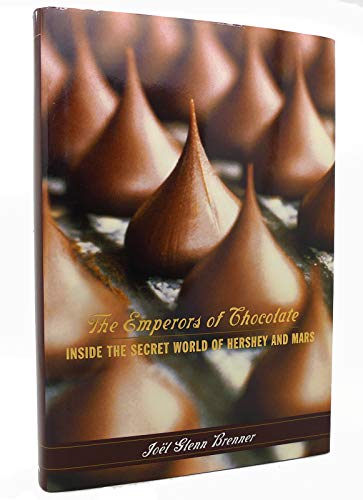
Synopsis
Forrest Mars and Milton Hershey built business empires out of chocolate. In this long-awaited history of the candy business, over eight years in the making, former Washington Post reporter Joël Glenn Brenner tells a unique story that is like chocolate itself, a rich blend of many compelling ingredients--in this case, biography and cultural history, investigative reporting and literary journalism. Along the way, Brenner takes us inside a world as mysterious as Willy Wonka's Chocolate Factory, where industrial spies jockey for inside information as paranoid executives fight an all-out war for America's sweet tooth.
Forrest Mars, often called "the Howard Hughes of candy," was one of the most successful (and private) entrepreneurs in America, a brilliant autocrat who built a unique $20-billion-a-year empire. Milton Hershey was a dreamer who wanted to create not just a company but an industrial paradise, and after making an immense fortune, he promptly gave it all away. To this day, the Hershey company is controlled by a charitable trust and its profits fund the wealthiest orphanage in the world.
What began as a fraternity of small family-owned businesses has grown into a cutthroat industry increasingly dominated by corporate leviathans fighting for shelf space and swallowing their smaller competitors. Joël Glenn Brenner's investigation of this cloistered world is authoritative, eye-opening, and written with deep understanding of and feeling for her subject.
"synopsis" may belong to another edition of this title.
About the Author
Joël Glenn Brenner began reporting on the candy business in 1989. She is the first and only journalist ever to gain access to the Mars company, and her Washington Post Magazine cover story on Mars won numerous prizes. She was recognized five times by the Financial News Journalism Reporter as one of the best financial journalists in the nation under the age of thirty. She is a 1989 graduate of the University of Missouri at Columbia and now lives in New York. She can be reached at www.JoelGlennBrenner.com.
From the Back Cover
Who won't appreciate Joël Glenn Brenner's impressive behind-the-scenes look at the two giants of the American candy business, Hershey and Mars? Fast-moving, fascinating accounts of business are rare, and rarer still are those filled with sweet secrets, compelling characters, and corporate intrigue. The Emperors of Chocolate has it all."
--G. Wayne Miller, author of Toy Wars
From the Inside Flap
and Milton Hershey built business empires out of chocolate. In this long-awaited history of the candy business, over eight years in the making, former Washington Post reporter Joël Glenn Brenner tells a unique story that is like chocolate itself, a rich blend of many compelling ingredients--in this case, biography and cultural history, investigative reporting and literary journalism. Along the way, Brenner takes us inside a world as mysterious as Willy Wonka's Chocolate Factory, where industrial spies jockey for inside information as paranoid executives fight an all-out war for America's sweet tooth.<br> <br>Forrest Mars, often called "the Howard Hughes of candy," was one of the most successful (and private) entrepreneurs in America, a brilliant autocrat who built a unique $20-billion-a-year empire. Milton Hershey was a dreamer who wanted to create not just a company but an industrial paradise, and after making an immense fortune, he
Reviews
YA-As the first and only journalist ever to gain access to the Mars company, Brenner probes its secretive practices and explores its bitter rivalry with the Hershey company, one of the most notorious in American business. She tells the stories of how Forrest Mars, Sr. and Milton S. Hershey both turned their small mom-and-pop enterprises into multibillion-dollar international operations. Similar to J. C. Louis's Cola Wars (Everest House, 1980; o.p.), the book explores the hostile legal and marketing fights between the two chocolate industry giants, including how Reese's Pieces became E.T.'s favorite candy instead of M&M's. Along with business and financial theory, this book has everything from espionage and personality clashes to dreams and failures. Reading about the paranoid Mars company and the fact that Hershey had to stop conducting factory tours in order to protect manufacturing techniques is sure to remind YAs of the candy man of their childhood, Willy Wonka.
Ginger J. Schwartz, Potomac Community Library, Woodbridge, VA
Copyright 1999 Reed Business Information, Inc.
Forrest Mars and Milton Hershey effortlessly hold center stage in this superb study of their competing candy companies. Although both men got rich on chocolate, Mars and Hershey are such markedly different characters that Brenner's book is a riot of dramatic contrasts. Mars is irascible, empire obsessed and insanely tightfisted (his three children never tasted a single M&M during their childhoods because he told them he couldn't spare any). Hershey was generous to a fault, a utopian dreamer who planned and built Hershey, Pa., as a home for his company and its workers. He founded an orphanage for disadvantaged children and, in 1918, almost 30 years before his death, donated his entire estate to the Hershey Trust for the benefit of the orphanage. To her credit, former Washington Post hand Brenner goes beyond these two titans and portrays the entire candy industry. Her prodigious research reveals how the personal style of each candy patriarch continues to influence the current structure and strategy of the company he led. By fully exploiting the many differences between the two companies (Mars is privately held and family-run; Hershey is a publicly held company administered by a management team responsible to the Hershey Trust), Brenner has produced a stellar work of corporate history. Photos. Agent, Flip Wrophy at Sterling Lord; author tour.
Copyright 1998 Reed Business Information, Inc.
Former Washington Post reporter Brenner expands a simple assignment into an inviting visit to candy land, a place dominated by the legacies of two very different corporate dictators. The late Milton Hershey was, reportedly, benevolent and sweet as a Hersheys Kiss; Forrest Mars Sr., obsessed with control and perfection, was not so sugary. Says Brenner: ``where Milton Hershey saw utopia, Forrest Mars saw conquest.'' Now their firms are locked in fierce competition for confectionery hegemony. It's not for peanuts. The retail sales value of candy hit $28 billion last year, and Mars and Hershey together control three quarters of the candy rack. M&Ms by Mars produces more dollars than Camel cigarettes, and Hershey's Reese's Peanut Butter Cups outsell Ivory Soap. It's a global industry, secretive and underreported (especially in the case of privately held Mars). Mars, where they taste dog food to ensure quality, is paranoid, and Hershey, to protect manufacturing techniques, no longer conducts factory tours. Well, how would you get an almond inside a Kiss? Brenner tells how. She tells how Reese's Pieces became ``E.T.'s favorite candy.'' She tells how cocoa is transformed from pods in the tropics to Milky Ways in the supermarket and why chocolate tastes so good. And she describes the people whose life's calling was and is to create cravings for candy. The 25 pounds of sweets Americans ingest each year provide wholesome energy, they say, never acne or tooth decay. The big rock candy mountains have grown and diversified. They sell pasta and dog food. Mars may earn as much from commodity futures trading as from candy sales. With this text, the industry will be a bit better understood by those who don't read Confectioner magazine. Stock up on Godiva and Goo-Goo Bars and be entertained by this substantial report, without sugar coating, on a surefire topic. (photos, not seen) -- Copyright ©1998, Kirkus Associates, LP. All rights reserved.
In 1997, the per capita consumption of chocolate in America was approximately 12 pounds. Here Brenner expands her prize-winning 1992 Washington Post Magazine story on Mars, Inc., with an impressive behind-the-scenes analysis of the two giants of the American candy business, Mars and Hershey. As mysterious as Willy Wonka's chocolate factory, the rival Mars and Hershey ways of making chocolate are thoroughly detailed in this marvelous delight, sure to whet readers' appetites for chocolate. Brenner reveals the Hershey dream of industrial paradise, the Howard Hughes-like reclusiveness of the Mars family, candy spying as serious as Cold War espionage, and other insights into the multibillion-dollar business. With unprecedented access to members of both families and many former and current executives forming an extensive background, Brenner provides an eye-opening look at this fascinating industry. Highly recommended.?Dale Farris, Groves, TX
Copyright 1998 Reed Business Information, Inc.
Excerpt. © Reprinted by permission. All rights reserved.
Bar Wars
Hershey and Mars both supplied U.S. troops with candy during World War II, trumpeting their efforts in promotions on the home front.
Mars, Inc., factory outside Amsterdam,
July 31, 1990,just before midnight
Theo Leenders hadn't moved from his desk all day. He just sat there, stiff and silent, his eyes riveted to the sleek black telephone in front of him as if his gaze could convince it to ring. He thought the phone call would have surely come through by now. After all, three days had passed since he left his first message for Omar Sharir,1 the twenty-seven-year-old manager of Mars's Middle East operations. Sharir, a marketing man and fresh recruit Leenders had sent to the region only six weeks earlier, was supposed to be living at the SAS Hotel in Kuwait City while looking for permanent housing and becoming familiar with the sales territory. But no one at the SAS had seen him for days.
Leenders had left a half-dozen messages with the hotel operator and had even sent the SAS manager to check Sharir's room, but nothing seemed out of place. Nevertheless, Leenders was worried. Sharir was green and arrogant. Born in Egypt, he spoke fluent Arabic though he had lived most of his life in London. Leenders knew Sharir was a savvy salesman, but he wasn't sure the freshman was ready for a big assignment like Kuwait, where he was to oversee and expand the company's Persian Gulf business. Forrest Mars, Sr., the now-retired patriarch of the Mars empire, seeded this territory in the late 1960s, hiring locals to distribute M&M's, Snickers bars and Uncle Ben's rice to Arab shopkeepers. Now, some twenty years after the Old Man sold his first chocolate bar in the desert, the gulf region accounted for more than $40 million in sales annually,2 with Kuwait and Saudi Arabia the leading markets.
Sharir's job was to keep it that way.
His first priority: to convince Kuwaiti merchants to devote precious store space to a new candy bar display, specially designed by Mars engineers. The new display case looked like any ordinary shelf unit, but it was refrigerated, allowing merchants to prominently display Mars chocolates in the heat of the day while the competition's candy stayed buried in the freezer in the back of the store-a distinct advantage for Mars. Sharir was supposed to persuade shopkeepers to make room for the new units by proving that sales of Mars products would be more profitable than sales of chips or sundries, which already crowded the shelves. Sharir was expected to report on his progress daily, but he hadn't called Leenders in Amsterdam since the previous week.
Now, at 2 a.m. local time, Leenders was giving up hope. If Sharir didn't reach him by late morning, he would have to call Mars headquarters in McLean, Virginia, and report the young man's disappearance. The thought made him cringe, like he'd eaten a piece of sour candy.
Next day, McLean headquarters,
just outside Washington, D.C.
Edward J. Stegemann was worried and everybody knew it. The finesse and poise that were typical of the well-dressed corporate attorney had vanished in a frenzy of scowling and pacing and barking.
"Damn it," he yelled across the open office, his remark aimed at no one in particular and, at the same time, at everyone in the room. "Shit."
For three weeks now, Stegemann had closely monitored the growing political crisis in the Persian Gulf. On July 17, when Iraqi president Saddam Hussein gave his "Revolution Day" speech, a rousing oratory peppered with attacks on neighboring Kuwait, Stegemann received a personal translation of Hussein's fiery prose from the intelligence unit at Mars Electronics, a division of the company that, among other things, gathers information on political activities around the world that might affect Mars operations. While Hussein's verbal assault piqued Stegemann's interest, he wasn't deeply disturbed by it; Hussein was known to be a hotheaded fanatic, and Stegemann, like most of the world, had regarded the speech as bluster.
It wasn't until July 24-when two Iraqi armored divisions massed on the Kuwait border-that Stegemann became concerned enough to telephone friends at the State Department to get the inside track on the Iraqi dictator's intentions. Stegemann reminded his contacts-men he knew from his previous career as a U.S. intelligence agent3-that Mars had a rapidly expanding business in the Persian Gulf. The company, he said, would do whatever was necessary to protect its investment in the region, which included two full-time Mars executives, a state-of-the-art distribution warehouse in the free port of Jebel Dhanna in the United Arab Emirates and an extensive network of local candy brokers who distributed Mars products in six gulf states.
If trouble was brewing, he told his State Department sources, he needed to know. But Stegemann's contacts had informed him, just as the government had informed the media, that there was no cause for concern. The Iraqi president promised he would never attack Kuwait, and on July 25, Hussein had personally told the U.S. ambassador to Iraq that the border tanks were meant only to intimidate.
Based on these assurances, Stegemann had advised the owners and CEOs of Mars, Inc.-John Mars and his older brother, Forrest Mars, Jr.-to proceed with business as usual. The brothers did not order Mars personnel to leave the gulf region; just the opposite, additional Mars managers were flying to Saudi Arabia from London right now for a regularly scheduled meeting on marketing strategy for the coming fall season. The team would arrive in Riyadh, the capital of Saudi Arabia, in a matter of hours, just after Stegemann received word from Leenders that Sharir was missing.
"Christ," Stegemann moaned into the telephone as he listened to Leenders's report. "This is just great."
"I'll keep trying to reach him," Leenders assured the corporate counsel in McLean. "I'll send a distributor to look for him."
"You do that," Stegemann barked. "Now!"
But less than twenty-four hours after Stegemann ordered the search for Sharir, Saddam Hussein did the unthinkable, sending his troops to invade Kuwait. Without hesitation, the United Nations Security Council and President George Bush denounced the invasion and demanded the immediate, unconditional withdrawal of Iraqi forces. The United States froze Iraqi and Kuwaiti assets and banned all trade and financial relations with Hussein. On August 3, Iraq said it would withdraw troops from Kuwait within two days, but when the deadline came, hundreds of Westerners were detained in Kuwait City or taken to Baghdad instead. No one knew if Sharir was among them.
"We phoned and phoned, and he never returned our calls," Leenders said. "Finally, SAS International told us he was gone. He had left the hotel. We said, 'Bloody hell, where is he?' That was the hotel where all the internationals were staying . . . but he wasn't there."
Leenders called the Egyptian secret police, hoping they might help in the search as Sharir was an Egyptian citizen. He also sent telegrams directly to Baghdad demanding Iraq release all international citizens from Kuwait, which on August 8 was "annexed" by its Iraqi invaders. Leenders pleaded with the British Embassy, the American Embassy and the Egyptian Embassy for news of his missing colleague. But for four weeks, there was no word. Not a message or a rumor. Nothing.
Mike Davies couldn't imagine what had happened to Sharir, but he didn't have much time to think about it. What began for him as a regularly scheduled marketing meeting in Riyadh had turned into a nightmarish effort to save Mars's Middle East operations from collapse. All channels leading into the gulf had been blocked by the U.S. Navy; communication with anyone in Kuwait was impossible for those not in the military; journalists from around the world were swarming around the King James Hotel, where Davies and the other Mars managers were staying, making it impossible for the Mars executives to send even a simple fax to McLean because the machines were so jammed. It was a circus that threatened the entire business.
If Mars couldn't get its products into the region and distribute them as usual, the record-breaking sales year that Davies had envisioned would be lost. What's more, the company's relationships with local shopkeepers and candy brokers, carefully cultivated over decades, could be severely damaged. That would make it impossible for Davies to expand Mars sales in the future. And that could ultimately cost Davies his job.
"Saudi was fifty percent of the business; Kuwait was twenty-five percent," Davies recalled. "We had to turn the whole thing into an opportunity or else." As Iraqi troops prepared for a showdown, marching closer and closer to the Saudi border, Davies and the rest of the London team hurriedly set up a crisis management center in a conference room of the King James. The posh, European-style hotel was quickly becoming a headquarters for every major media outlet in the world, including CNN, which was mesmerizing America with its frontline, twenty-four-hour coverage of the events unfolding in the gulf.
But the men from Mars were oblivious to all of this; their mission, as spelled out by headquarters, was to protect the Mars franchise-to sell Mars bars, Milky Ways, Starburst Fruit Chews and Uncle Ben's rice to anyone who could possibly use the products during the standoff.
In just a few days, Davies and his team plotted a new marketing campaign aimed at increasing Mars sales throughout the region. They code-named the operation "SuperSavers," and Davies personally traveled to Bahrain, Qatar and the UAE to launch the program.
"We told the trade [distributors and shopkeepers], 'We know times are tough, the future is uncertain, but our products are the market leaders in their category. "'You know that if you buy our produ...
"About this title" may belong to another edition of this title.
Other Popular Editions of the Same Title

Search results for The Emperors of Chocolate: Inside the Secret World...

Stock Image
The Emperors of Chocolate: Inside the Secret World of Hershey and Mars
Seller: The Maryland Book Bank, Baltimore, MD, U.S.A.
Seller rating 5 out of 5 stars

hardcover. Condition: Very Good. Used - Very Good. Seller Inventory # 7-O-4-0212
Seller Image
The Emperors of Chocolate: Inside the Secret World of Hershey and Mars
Seller: Goodwill of Greater Milwaukee and Chicago, Racine, WI, U.S.A.
Seller rating 5 out of 5 stars
Condition: acceptable. Book is considered to be in acceptable condition. The actual cover image may not match the stock photo. Book may have one or more of the following defects: noticeable wear on the cover dust jacket or spine; curved, dog eared or creased page s ; writing or highlighting inside or on the edges; sticker s or other adhesive on cover; CD DVD may not be included; and book may be a former library copy. Seller Inventory # SEWV.0679421904.A
Seller Image
The Emperors of Chocolate: Inside the Secret World of Hershey and Mars
Seller: Goodwill of Greater Milwaukee and Chicago, Racine, WI, U.S.A.
Seller rating 5 out of 5 stars
Condition: good. Book is considered to be in good or better condition. The actual cover image may not match the stock photo. Hard cover books may show signs of wear on the spine, cover or dust jacket. Paperback book may show signs of wear on spine or cover as well as having a slight bend, curve or creasing to it. Book should have minimal to no writing inside and no highlighting. Pages should be free of tears or creasing. Stickers should not be present on cover or elsewhere, and any CD or DVD expected with the book is included. Book is not a former library copy. Seller Inventory # SEWV.0679421904.G
Seller Image
The Emperors of Chocolate: Inside the Secret World of Hershey and Mars
Seller: ebooks Keystone, Reading, PA, U.S.A.
Seller rating 5 out of 5 stars
Condition: good. This book is in good condition, with minimal signs of wear and tear. Seller Inventory # GWKV.0679421904.G
Seller Image
The Emperors of Chocolate: Inside the Secret World of Hershey and Mars
Seller: -OnTimeBooks-, Phoenix, AZ, U.S.A.
Seller rating 5 out of 5 stars
Condition: very_good. Gently read. May have name of previous ownership, or ex-library edition. Binding tight; spine straight and smooth, with no creasing; covers clean and crisp. Minimal signs of handling or shelving. 100% GUARANTEE! Shipped with delivery confirmation, if you're not satisfied with purchase please return item! Ships USPS Media Mail. Seller Inventory # OTV.0679421904.VG
Seller Image
The Emperors of Chocolate: Inside the Secret World of Hershey and Mars
Seller: Lake Country Books and More, Excelsior, MN, U.S.A.
Seller rating 5 out of 5 stars
hardcover. Condition: Good +. Dust Jacket Condition: Very Good -. Clean, solid copy with unmarked text. Binding is solid. Cover corners and spine ends have light bumps; a small stronger bump is on bottom front edge next to spine. Jacket is glossy with mild surface and edge wear, no tears. We are unable to ship oversize books and multi-volume sets internationally. Seller Inventory # CA22605250011
Stock Image
The Emperors of Chocolate: Inside the Secret World of Hershey and Mars
Seller: medimops, Berlin, Germany
Seller rating 5 out of 5 stars
Condition: very good. Gut/Very good: Buch bzw. Schutzumschlag mit wenigen Gebrauchsspuren an Einband, Schutzumschlag oder Seiten. / Describes a book or dust jacket that does show some signs of wear on either the binding, dust jacket or pages. Seller Inventory # M00679421904-V
Buy Used
US$ 25.46
US$ 11.66 shipping
Ships from Germany to U.S.A.
Ships from Germany to U.S.A.
Quantity: 1 available
Stock Image
The Emperors of Chocolate: Inside the Secret World of Hershey and Mars
Seller: GoldBooks, Denver, CO, U.S.A.
Seller rating 5 out of 5 stars
Hardcover. Condition: new. New Copy. Customer Service Guaranteed. Seller Inventory # 51R86_80_0679421904
Stock Image
The Emperors of Chocolate: Inside the Secret World of Hershey and Mars
Published by
Random House, 1998
ISBN 10: 0679421904
ISBN 13: 9780679421900
Used
Hardcover
First Edition
Seller: The Book Corner, Sunrise, FL, U.S.A.
Seller rating 5 out of 5 stars
Hardcover. Condition: As New. Dust Jacket Condition: As New. 1st Edition. 40,015-BA, FIRST EDITION, text like new, VERY GOOD READING COPY, tight spine, clean pages, NO highlighting/markings, very fine dust jacket. Seller Inventory # 40,015-BA
Seller Image
Emperors of Chocolate: Inside the Secret World of Hershey and Mars
Seller: Les Livres des Limbes, Chisseaux, France
Seller rating 5 out of 5 stars
Hardcover. Condition: Very Good. Dust Jacket Condition: Very Good. Minor scuffing to dust jacket in overall excellent condition. Book. Seller Inventory # 16966
Buy Used
US$ 60.05
US$ 64.13 shipping
Ships from France to U.S.A.
Ships from France to U.S.A.
Quantity: 1 available