
Items related to The All-American Skin Game, or, The Decoy of Race:...
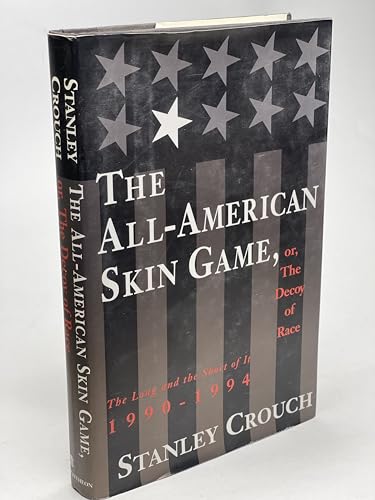
The All-American Skin Game, or, The Decoy of Race: The Long and the Short of It, 1990-1994 - Hardcover
Synopsis
In this collection of essays long and short, the hugely controversial critic and author of Notes of a Hanging Judge gives us a refreshingly iconoclastic view of race in American culture and society. Whether Crouch is writing about the U.S. Constitution as blues, or jazz (Dizzy Gillespie, Miles Davis, Wynton Marsalis), he is always incisive and provocative.
"synopsis" may belong to another edition of this title.
From the Inside Flap
ection of essays long and short, the hugely controversial critic and author of Notes of a Hanging Judge gives us a refreshingly iconoclastic view of race in American culture and society. Whether Crouch is writing about the U.S. Constitution as blues, or jazz (Dizzy Gillespie, Miles Davis, Wynton Marsalis), he is always incisive and provocative.
Reviews
In speeches, essays and reviews from publications like the New Republic, Crouch (Notes of a Hanging Judge) offers eloquent, pungent takes on racial politics, literature, film and music. The author made his name as a jazz critic, and he invokes jazz to proclaim that our society's "multiple miscegenations" are proof and source of enduring vitality and renewal. Thus, he has no truck with racial balkanizers or those who claim rapsters as the soul of black authenticity. A disciple of Ralph Ellison, he hails the recently departed writer as "a citizen of this nation" and argues that black filmmakers must develop a more nuanced American vision. Crouch's deconstruction of Miles Davis, his sympathy for Quentin Tarantino, his celebration of novelist Leon Forrest?all make good reading. So what's missing? Crouch's view of a practical politics to engage and enhance his oft-invoked democratic vistas.
Copyright 1995 Reed Business Information, Inc.
Crouch, contributing editor to the New Republic, once a jazz critic for Village Voice, artistic consultant to Jazz at Lincoln Center, and author of Notes of a Hanging Judge (1990), is not an easy person to relate to because he is one of those "in-your-face" thinkers whose very smugness seems meant to alienate and provoke. He refers to himself and other blacks as "Negroes" and Amiri Baraka as LeRoi Jones; surprisingly, Malcolm X is not recognized as Malcolm Little (mustn't give him ideas). One gets the feeling from his numerous television appearances that the conservative Right consult only with Crouch on questions about black Americans, for no black critic attacks liberals, feminists, and black power leaders with the flair of Mr. Crouch. This self-conscious flair extends to his writing in spades, as in the opening essay on the role of the outlaw in American democracy, where at one point he writes of a "set of appetites focused on the exotic, bedeviled by a nostalgia for the mud, given to a love of sensationalism that completely hollows out a pretentious vulgarity." So, imagine my frustration as I continued reading to discover a creative, at times, eloquent thinker who will lead readers through many subtle discoveries if given the chance. The book is a collection of pieces Crouch prepared for diverse purposes: essays printed elsewhere, converted talks, and reflections on cultural happenings. His interests are wide ranging--film, literature, politics--all informed by a keen analytical mind that, at times, transcends the liberal or conservative labels. His analysis of films vis-a-vis his concerns for the challenges black filmmakers "need to meet" yields startling results when applied to the work of Quentin Tarantino, Albert and Allen Hughes' Menace to Society, and Leon Ichaso's Sugar Hill. This in-your-face Negro, this provocateur, talks a lot of interesting stuff. Bonnie Smothers
"About this title" may belong to another edition of this title.
Search results for The All-American Skin Game, or, The Decoy of Race:...

Stock Image
The All-American Skin Game, or, The Decoy of Race: The Long and the Short of It, 1990-1994
Seller: BooksRun, Philadelphia, PA, U.S.A.
Seller rating 5 out of 5 stars

Hardcover. Condition: Fair. 1. With dust jacket. The item might be beaten up but readable. May contain markings or highlighting, as well as stains, bent corners, or any other major defect, but the text is not obscured in any way. Seller Inventory # 0679442022-7-1-29
Seller Image
The All-American Skin Game, or, The Decoy of Race: The Long and the Short of It, 1990-1994
Seller: Greenworld Books, Arlington, TX, U.S.A.
Seller rating 5 out of 5 stars
Condition: very_good. Fast Free Shipping â" Very Good condition book with a firm cover and clean pages. Shows normal use and some light wear or limited notes markings. A solid, nice copy to enjoy. Seller Inventory # GWV.0679442022.VG
Stock Image
The All-American Skin Game, or, The Decoy of Race: The Long and the Short of It, 1990-1994
Seller: World of Books (was SecondSale), Montgomery, IL, U.S.A.
Seller rating 5 out of 5 stars
Condition: Good. Item in good condition. Textbooks may not include supplemental items i.e. CDs, access codes etc. Seller Inventory # 00107955249
Stock Image
The All-American Skin Game, or, The Decoy of Race: The Long and the Short of It, 1990-1994
Seller: ThriftBooks-Dallas, Dallas, TX, U.S.A.
Seller rating 5 out of 5 stars
Hardcover. Condition: Good. No Jacket. Pages can have notes/highlighting. Spine may show signs of wear. ~ ThriftBooks: Read More, Spend Less. Seller Inventory # G0679442022I3N00
Stock Image
The All-American Skin Game, or, The Decoy of Race: The Long and the Short of It, 1990-1994
Seller: ThriftBooks-Atlanta, AUSTELL, GA, U.S.A.
Seller rating 5 out of 5 stars
Hardcover. Condition: Good. No Jacket. Missing dust jacket; Pages can have notes/highlighting. Spine may show signs of wear. ~ ThriftBooks: Read More, Spend Less. Seller Inventory # G0679442022I3N01
Stock Image
The All-American Skin Game, or Decoy of Race : The Long and the Short of It, 1990-1994
Published by
Knopf Doubleday Publishing Group, 1995
ISBN 10: 0679442022
ISBN 13: 9780679442028
Used
Hardcover
Seller: Better World Books, Mishawaka, IN, U.S.A.
Seller rating 5 out of 5 stars
Condition: Good. Former library copy. Pages intact with minimal writing/highlighting. The binding may be loose and creased. Dust jackets/supplements are not included. Includes library markings. Stock photo provided. Product includes identifying sticker. Better World Books: Buy Books. Do Good. Seller Inventory # 4385817-6
Stock Image
The All-American Skin Game, or Decoy of Race : The Long and the Short of It, 1990-1994
Published by
Knopf Doubleday Publishing Group, 1995
ISBN 10: 0679442022
ISBN 13: 9780679442028
Used
Hardcover
Seller: Better World Books, Mishawaka, IN, U.S.A.
Seller rating 5 out of 5 stars
Condition: Very Good. Former library copy. Pages intact with possible writing/highlighting. Binding strong with minor wear. Dust jackets/supplements may not be included. Includes library markings. Stock photo provided. Product includes identifying sticker. Better World Books: Buy Books. Do Good. Seller Inventory # 4297531-6
Stock Image
The All-American Skin Game, or, The Decoy of Race: The Long and the Short of It, 1990-1994
Seller: Wonder Book, Frederick, MD, U.S.A.
Seller rating 5 out of 5 stars
Condition: Very Good. Very Good condition. Good dust jacket. From the collection of Tom Verlaine. Verlaine was a guitarist, singer, and songwriter who was a founding member of the seminal punk rock band Television. He was known for his innovative guitar playing and songwriting, and he is considered to be one of the most important and influential musicians of the past 50 years. Seller Inventory # F01A-03275
Stock Image
The All-American Skin Game, or, The Decoy of Race: The Long and the Short of It, 1990-1994
Seller: Wonder Book, Frederick, MD, U.S.A.
Seller rating 5 out of 5 stars
Condition: Very Good. Very Good condition. Very Good dust jacket. A copy that may have a few cosmetic defects. May also contain light spine creasing or a few markings such as an owner's name, short gifter's inscription or light stamp. Seller Inventory # E06M-1159
Stock Image
All-American Skin Game, or Decoy of Race: The Long and the Short of It, 1990-1994
Published by
Pantheon Books October 1995, 1995
ISBN 10: 0679442022
ISBN 13: 9780679442028
Used
Hardcover
Seller: A Cappella Books, Inc., Atlanta, GA, U.S.A.
Seller rating 5 out of 5 stars
Hardcover. Condition: Very Good. Dust Jacket Condition: Very Good. Seller Inventory # 350902