
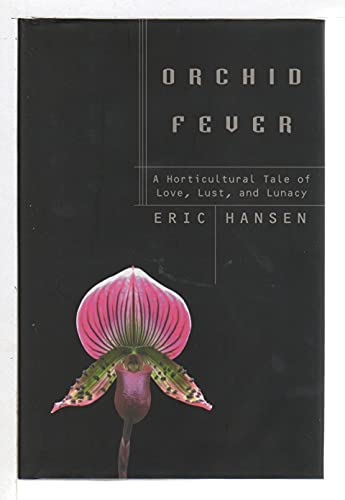
Synopsis
A seductive journey into the obsessive, outrageous, and mesmerizing world of orchids.
From the steaming jungles of Borneo to the hallowed hallways of Kew Gardens, from the clandestine orchid nurseries of Europe to the peat bogs of northern Minnesota, here are luscious, sexy flowers, orchid smugglers, fist-fighting botanists, moths with twelve-inch-long tongues, and government officials who raid orchid nurseries with attack dogs and automatic weapons. Strange tales of insect pollinator fidelity, the orchid ice cream makers of eastern Turkey, and man-crushing killer orchids weighing half a ton are blended with stories about a wide range of gentle people whose passion in life is the creation of scented, fragile flowers.
Eric Hansen spent seven years exploring the far corners of the earth -- marveling at flowers of uncommon beauty, studying the history of the orchid trade, and grappling with the vicious, bizarre, and petty world of plant politics that sometimes makes it impossible to protect endangered species. Hansen brings to life the colorful flowers and the even more colorful people who are attracted to them, as he illuminates a funny, weird, and poignant world of horticultural passion and pathos.
"synopsis" may belong to another edition of this title.
About the Author
Eric Hansen now lives in San Francisco, but over the last twenty-five years he has traveled throughout Europe, the Middle East, Australia, Nepal, and Southeast Asia. His articles and reviews have appeared in The New York Times, Travel and Leisure, Conde Nast Traveler, Outside Magazine, Men's Journal, Natural History Magazine, GEO, and Amica. He is also the author of two highly acclaimed books: Stranger in the Forest and Motoring with Mohammed (available in paperback from Vintage Books). He can be reached at ekhansen@ix.netcom.com.
From the Back Cover
"A wonderful book. I've been up all night reading it, laughing and crying out in horror and clucking at the vivid images of bureaucracy with the bit in its teeth....Orchid Fever is a bitterly funny, lubricious, lunatic journey in the unsettling company of the orchid world's most outrageous screwballs, some so bizarre and irrational they seem to have fallen among us from a flying saucer."
-- Annie Proulx, author of The Shipping News
"Orchid Fever is a tale that cross-pollinates Darwin and Conrad. A vivid and compelling investigation of how simple flowers can lure strong minds to madness."
-- Joe Kane, author of Running the Amazon
"Told with great style and sardonic wit, this is a story about greed, tragicomic bureacracy, and a most peculiar obsession that I still find hard to believe."
-- Marc Reisner, author of Cadillac Desert
From the Inside Flap
journey into the obsessive, outrageous, and mesmerizing world of orchids.
From the steaming jungles of Borneo to the hallowed hallways of Kew Gardens, from the clandestine orchid nurseries of Europe to the peat bogs of northern Minnesota, here are luscious, sexy flowers, orchid smugglers, fist-fighting botanists, moths with twelve-inch-long tongues, and government officials who raid orchid nurseries with attack dogs and automatic weapons. Strange tales of insect pollinator fidelity, the orchid ice cream makers of eastern Turkey, and man-crushing killer orchids weighing half a ton are blended with stories about a wide range of gentle people whose passion in life is the creation of scented, fragile flowers.
Eric Hansen spent seven years exploring the far corners of the earth -- marveling at flowers of uncommon beauty, studying the history of the orchid trade, and grappling with the vicious, bizarre, and petty world of plant politics that sometimes makes it impossible to protect
Reviews
In the same vein as Susan Orlean's Orchid Thief, this captivating tale is not so much about flowers as it is about obsession. In various chapters (some of which have appeared in Natural History magazine), Hansen (Stranger in the Forest; Motoring with Mohammed) examines different facets of the mysterious world of orchids, a universe of incredible subterfuge, erotic plant names and some very eccentric characters. He visits Borneo with two orchid growers and two Penan guides who are extremely puzzled about such enthusiasm over a flower that serves no medicinal or nutritive purpose. Hansen also interviews 84-year-old Eleanor Kerrigan, who in her Seattle basement greenhouse cultivates an illicit orchid collection worth $70,000. The Convention on International Trade in Endangered Species of Wild Fauna and Flora has a strict policy about certain types of orchids, and many orchid growers and collectors, it turns out, operate on the wrong side of that policy, resulting in an underworld that, as the author notes, resembles the illegal drug trade. Hansen manages to talk to the secretive Henry Azadehdel (a cause c?l?bre in the orchid world since he was arrested for orchid smuggling in 1987) and travels to Turkey to taste orchid ice cream, which is rumored to be an aphrodisiac. Eventually, he comes to the conclusion that after five years of research he has become as obsessed with his subjects as they are with their flowers ("Orchids were doing strange things to me"). The results are fully enjoyable. (Mar.)
Copyright 2000 Reed Business Information, Inc.
Travel writer Hansen profiles botanists, plant smugglers, hobbyists, nurserymen, and others whose lives are devoted to orchids. His title is somewhat misleading: although the subjects depicted are all keenly passionate about orchids, only a few are feverishly consumed by their interest. Readers expecting a true tale of orchid mania should turn instead to Susan Orlean's The Orchid Thief (LJ 1/99). Most of Hansen's sketches are fundamentally vehicles for illustrating his serious and provocative argument against CITES (the Convention on International Trade in Endangered Species of Wild Fauna and Flora). According to the author, CITES thwarts orchid conservation and perversely legitimizes plant smuggling by botanical institutions. This controversial perspective alone makes this title an essential purchase for botanical and horticultural libraries, but it is an optional acquisition for other collections.
-Brian Lym, City Coll. Lib. of San Francisco
Copyright 2000 Reed Business Information, Inc.
Excerpt. © Reprinted by permission. All rights reserved.
Chapter One: Journey to Fire Mountain
There is something distinctive about the sight and sound of a human body falling from the rain forest canopy. The breathless scream, the wildly gyrating arms and legs pumping thin air, the rush of leaves, snapping branches, and the sickening thud, followed by uneasy silence. Listening to that silence, I reflected on how plant collecting can be an unpleasant sort of activity.
Bits of debris continued to fall from the trees and I could make out a faint plume of dust, caught in a shaft of sunlight, that indicated where the body had landed. A nearby sapling swayed back and forth a few times, then stood still. In the distance, obscured by the steaming labyrinth of trees and climbing woody vines, a cicada began its shrieking high-pitched call. The rain forest suddenly felt much closer and far less friendly than it had just a few moments earlier. Sweat dripped from my chin, and I held my breath to halt my growing sense of panic. Then I heard the first moan of pain, and all sense of time and fear was swept away.
Earlier that day, I had entered the Borneo rain forest in search of wild orchids. The morning mist was still rising and the dawn bird chorus had just faded as Tiong, a government plant collector, and two of his helpers paused at the base of a limestone cliff to burn joss sticks and stacks of Chinese devotional money. These offerings were intended to appease the spirit world before we started our climb. Everything began well enough, but by midday the mountain spirits responded to our presence. Tiong was near the top of a tree when he reached up and gripped a Wragler's pit viper sleeping on a branch. Within moments, my guide and protector was hurtling through space with two fang marks in the back of his hand. We didn't find the orchids we were looking for, and we spent the rest of the afternoon trying to get Tiong off the mountain. Tiong lived, but after that experience, I felt confident that I wouldn't be participating in any more orchid-hunting trips.
My journey with Tiong was part of a plan that I had come up with to build an upriver plant nursery for a group of indigenous people known as the Penan. Members of this tribe had helped me to walk across the island of Borneo in 1982 during a six-month-long, 1,500-mile cross-country journey. At the time, many of the Penan were still nomadic hunters and gatherers and I traveled with them in order to experience a vanishing way of life. The journey nearly cost me my life, but in the end I returned home and wrote my first book, Stranger in the Forest. During that harrowing journey, the Penan taught me how to survive, but more important, they showed me a different way of being, and my life has never been quite the same since then. For years I have felt a profound debt of gratitude to these people. Today, most Penan lead settled lives in remote villages. They are not farmers, and without language or business skills they have no steady source of income apart from working as migrant laborers for logging or mining companies. They are highly skilled at collecting jungle products from the primary rain forest, and this got me to thinking. Years went by, but I eventually came up with the idea that a small commercial nursery filled with exotic jungle plants salvaged from the nearby logging concessions might be the perfect financial solution for them.
The only problem was that I knew absolutely nothing about how to start or maintain a nursery, and I didn't know which plants might be of horticultural interest, or which species were valuable. I also had no idea that international regulations prohibited such a venture. I continued to think about the village nursery idea, and this is why I eventually ended up on top of the mountain with Tiong. I wanted him to educate me in the fine art of collecting wild orchids and other desirable plants. As it turned out, Tiong went to the hospital, where he was put on a respirator, and I returned home to rethink my village nursery scheme.
Six months later I received a letter from Richard Baskin, an orchid grower in Minneapolis. I had no idea who the man was, but a friend had told him I knew all about upriver travel in Borneo. Richard wanted to know if I would take him and a friend, Donald Levitt, an orchid grower from North Dakota, to the Borneo rain forest to look for an orchid known as Paphiopedilum (pronounced "paf-ee-oh-pedilum") sanderianum. It seemed a long way to go for the sake of looking at a plant that might not be in flower, but I phoned him a few days later to discuss the idea. In the back of my mind, I thought these two men might teach me something about orchids and help me with the village nursery idea.
"It's the holy grail of orchids," Richard explained. "Maybe only a dozen botanists on earth have seen it bloom in the wild. It has the whole orchid world in turmoil. Conservationists, scientists, and commercial growers are at each other's throats over the plant."
Orchid world in turmoil? I had no idea what the orchid world was, let alone how such a thing could be in turmoil or why I should get involved with another orchid hunt. At the time, I couldn't distinguish a Phalaenopsis from an Odontoglossum, but from dozens of visits to Borneo over the previous eighteen years I knew the isolated mountain area that Richard and Donald wanted to visit. I had the time, they had the money, and three months later we stood ankle-deep in mud at the edge of a jungle river in Sarawak, the East Malaysian state on the island of Borneo. We were one hundred miles upriver, one hundred years back in time, and judging from the childlike looks of wonderment on my companions' faces, we had arrived in orchid heaven. Then the little men with the spears arrived.
I introduced the two orchidophiles to my diminutive Penan friends -- Bati and Katong. Like all Penan they are masters of the deep forest, and I had traveled hundreds of miles through the jungle with Bati and Katong over the previous ten years. I had sent word of our plans to them by way of an upriver trading post. The message was for them to meet us at the junction of the Limbang and Medalam rivers on the full moon of the fourth month of 1993.
Bati and Katong have never seen a compass or a map, but what they don't know about hunting dogs, the use of a spear, or long-distance jungle travel isn't worth knowing. They can build a waterproof shelter from leaves in twenty minutes, catch fish with their feet, and light a fire without matches in a tropical downpour. The forest is their home. It is the setting for their creation myths, the resting place of their ancestors, and, until recently, an unlimited storehouse of food, medicine, and building material. To the average Western visitor, the Borneo rain forest is a chaotic, steaming green hell of leeches, biting insects, giant cockroaches, bad smells, and certain death. Bati and Katong speak no English, so it was my job to translate and to try to explain the purpose of our trip to these two jungle men.
"They have come twelve thousand miles to look at a flower?" Bati asked me in Malay.
"It is true," I replied.
"Can you eat this flower?" Katong asked.
"No."
"Is it used for medicine?"
"No."
"What do they want to do with this flower?"
"Take photographs and measure the leaves."
"And how much have these men paid to come look at the flower?"
"About $3,500 each," I said.
Having established these basic facts, Bati and Katong retreated into a special Penan silence that suggests indifference or nonchalance, but in fact is an expression of profound disbelief.
Once we had the dugout canoe loaded, a quick look at the orchid hunters' baggage pretty well said all there was to say about our respective cultures. Donald had brought a sling psychrometer for measuring relative humidity, an altimeter, litmus paper, a handheld Satellite Global Positioning System for establishing the precise latitude and longitude of any orchid on earth -- within ten feet. Or was it ten inches? I can't remember. Then there were the video camera and still cameras and all their accessories, a compass, tape recorders, batteries and battery rechargers, binoculars, electrolyte balancers, Powerbars, sunblock, water purification tablets, a hand pump for filtering water, dental floss, hair shampoo and conditioners, deodorants, breath fresheners, hiking boots, recently purchased adventure-travel clothing, and insect repellent. They had freeze-dried food, inflatable sleeping mattresses and pillows, mosquito nets, rolls of toilet paper, rip-stop nylon tents, Cordura cloth cot stretchers, a stove-top espresso maker, canteens, tripods, notebooks, umbrellas, plastic tea cups, and digital wristwatches. Donald put on a pair of wraparound sunglasses with mirrored lenses and then won the prize for weirdness with a shrink-wrapped collapsible toilet made from die-cut sections of camouflaged cardboard.
The Penan had brought a cooking pot, two spear-tipped blowguns, a quiver of poisoned darts, and jungle knives. They also carried two empty backpacks, which was just as well, because they would need all the space they could find in those backpacks to haul the orchid hunters' equipment through the jungle.
We shoved off from shore and continued our journey into the remote interior of the island. The Medalam River was in flood. We slowly motored against the brown current, which was littered with tangles of uprooted vegetation and floating logs. Scattered along this winding green corridor of giant trees, the branches were laden with pitcher plants and flowering orchids.
"Dimorphorchis lowii," Donald called out, as he slapped at a mosquito on his forehead.
Then Richard spotted Dayakia hendersoniana, and Grammatophyllum speciosum, the largest orchid on earth. They continued their roll call of Borneo orchids and eventually fell into a heated discuss...
"About this title" may belong to another edition of this title.
Other Popular Editions of the Same Title

Search results for Orchid Fever: A Horticultural Tale of Love, Lust, and...

Seller Image
Orchid Fever: A Horticultural Tale of Love, Lust, and Lunacy
Seller: 3Brothers Bookstore, Egg harbor township, NJ, U.S.A.
Seller rating 5 out of 5 stars

Condition: very_good. Cover may have light wear, pages in very good condition and binding is sturdy; may have other light shelf wear or creases. May have notes or highlighting. Seller Inventory # EVV.0679451412.VG
Stock Image
Orchid Fever: A Horticultural Tale of Love, Lust, and Lunacy
Seller: World of Books (was SecondSale), Montgomery, IL, U.S.A.
Seller rating 5 out of 5 stars
Condition: Good. Item in good condition. Textbooks may not include supplemental items i.e. CDs, access codes etc. Seller Inventory # 00082635574
Seller Image
Orchid Fever: A Horticultural Tale of Love, Lust, and Lunacy
Seller: Zoom Books East, Glendale Heights, IL, U.S.A.
Seller rating 5 out of 5 stars
Condition: very_good. Book is in very good condition and may include minimal underlining highlighting. The book can also include "From the library of" labels. May not contain miscellaneous items toys, dvds, etc. . We offer 100% money back guarantee and 24 7 customer service. Seller Inventory # ZEV.0679451412.VG
Stock Image
Orchid Fever: A Horticultural Tale of Love, Lust, and Lunacy
Published by
Pantheon (edition First Edition), 2000
ISBN 10: 0679451412
ISBN 13: 9780679451419
Used
Hardcover
First Edition
Seller: BooksRun, Philadelphia, PA, U.S.A.
Seller rating 5 out of 5 stars
Hardcover. Condition: Fair. First Edition. With dust jacket. The item might be beaten up but readable. May contain markings or highlighting, as well as stains, bent corners, or any other major defect, but the text is not obscured in any way. Seller Inventory # 0679451412-7-1-29
Stock Image
Orchid Fever: A Horticultural Tale of Love, Lust, and Lunacy
Seller: ThriftBooks-Reno, Reno, NV, U.S.A.
Seller rating 5 out of 5 stars
Hardcover. Condition: Very Good. No Jacket. May have limited writing in cover pages. Pages are unmarked. ~ ThriftBooks: Read More, Spend Less. Seller Inventory # G0679451412I4N00
Stock Image
Orchid Fever: A Horticultural Tale of Love, Lust, and Lunacy
Seller: ThriftBooks-Reno, Reno, NV, U.S.A.
Seller rating 5 out of 5 stars
Hardcover. Condition: Fair. No Jacket. Readable copy. Pages may have considerable notes/highlighting. ~ ThriftBooks: Read More, Spend Less. Seller Inventory # G0679451412I5N00
Stock Image
Orchid Fever: A Horticultural Tale of Love, Lust, and Lunacy
Seller: ThriftBooks-Phoenix, Phoenix, AZ, U.S.A.
Seller rating 5 out of 5 stars
Hardcover. Condition: Good. No Jacket. Former library book; Pages can have notes/highlighting. Spine may show signs of wear. ~ ThriftBooks: Read More, Spend Less. Seller Inventory # G0679451412I3N10
Stock Image
Orchid Fever: A Horticultural Tale of Love, Lust, and Lunacy
Seller: ThriftBooks-Phoenix, Phoenix, AZ, U.S.A.
Seller rating 5 out of 5 stars
Hardcover. Condition: Good. No Jacket. Missing dust jacket; Pages can have notes/highlighting. Spine may show signs of wear. ~ ThriftBooks: Read More, Spend Less. Seller Inventory # G0679451412I3N01
Stock Image
Orchid Fever: A Horticultural Tale of Love, Lust, and Lunacy
Seller: ThriftBooks-Phoenix, Phoenix, AZ, U.S.A.
Seller rating 5 out of 5 stars
Hardcover. Condition: Good. No Jacket. Pages can have notes/highlighting. Spine may show signs of wear. ~ ThriftBooks: Read More, Spend Less. Seller Inventory # G0679451412I3N00
Stock Image
Orchid Fever: A Horticultural Tale of Love, Lust, and Lunacy
Seller: ThriftBooks-Dallas, Dallas, TX, U.S.A.
Seller rating 5 out of 5 stars
Hardcover. Condition: Good. No Jacket. Pages can have notes/highlighting. Spine may show signs of wear. ~ ThriftBooks: Read More, Spend Less. Seller Inventory # G0679451412I3N00