
Items related to Fugitive Pieces
Synopsis
This first novel from an award-winning poet -- a #1 best-seller in Canada -- is certain to propel her into the front ranks of our very best practitioners of contemporary fiction.
It is a story of World War II as remembered and imagined by one of its survivors: a poet named Jakob Beer, traumatically orphaned as a young child and smuggled out of Poland, first to a Greek island (where he will return as an adult), and later to Toronto. It is the story of how, over his lifetime, Jakob learns the power of language -- to destroy, to omit, to obliterate, but also to restore and to conjure, witness and tell -- as he comes to understand and experience what was lost to him and of what is possible for him to regain.
Profoundly moving, brilliantly written -- as sensual and lyric as it is emotionally resonant -- Fugitive Pieces delves into the most difficult workings of the human heart and mind: the grief and healing of remembrance. It is a first novel of astonishing achievement.
"synopsis" may belong to another edition of this title.
About the Author
Anne Michaels teaches creative writing in Toronto. Her two collections of poetry are The Weight of Oranges (1986), which won the Commonwealth Prize for the Americas, and Miner's Pond (1991), which received the Canadian Authors Award and was shortlisted for the Governor General's Award and the Trillium Award. Fugitive Pieces is her first novel.
From the Back Cover
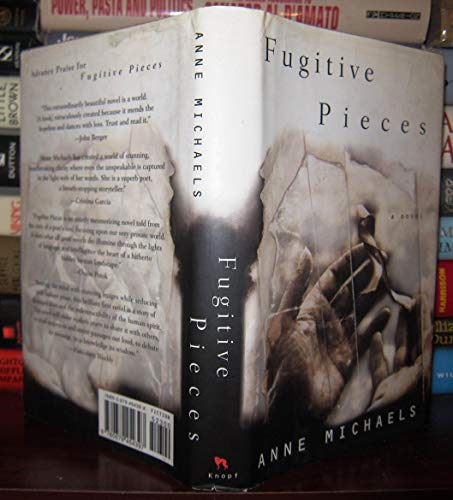
Advance Praise for Fugitive Pieces
"This extraordinarily beautiful novel is a world.
[A book] miraculously created because it mends the
hopeless and dances with loss. Trust and read it."
--John Berger
"Anne Michaels has created a world of stunning,
heartbreaking clarity where even the unspeakable is captured in the light-web of her words. She is a superb poet,
a breath-stopping storyteller."
--Cristina García
"Fugitive Pieces is an utterly mesmerizing novel told from
the core of a poet's soul focusing upon our very prosaic world. It does what all great novels do: illumine through the lights
of language and intelligence the heart of a hitherto
hidden human landscape."
--Chaim Potok
"Searing the mind with stunning images while seducing
with radiant prose, this brilliant first novel is a story of
damaged lives and the indestructibility of the human spirit. The novel will make readers yearn to share it with others,
to read sentences and entire passages out loud, to debate
its message, to acknowledge its wisdom."
--Publishers Weekly
From the Inside Flap
ovel from an award-winning poet -- a #1 best-seller in Canada -- is certain to propel her into the front ranks of our very best practitioners of contemporary fiction.<br><br>It is a story of World War II as remembered and imagined by one of its survivors: a poet named Jakob Beer, traumatically orphaned as a young child and smuggled out of Poland, first to a Greek island (where he will return as an adult), and later to Toronto. It is the story of how, over his lifetime, Jakob learns the power of language -- to destroy, to omit, to obliterate, but also to restore and to conjure, witness and tell -- as he comes to understand and experience what was lost to him and of what is possible for him to regain.<br><br>Profoundly moving, brilliantly written -- as sensual and lyric as it is emotionally resonant -- <b>Fugitive Pieces</b> delves into the most difficult workings of the human heart and mind: the grief and healing of remembrance. It is a first novel of astonishing
Reviews
A moving tale of survival becomes a grave and stately hymn to the revivifying qualities of language and learning in this impressive debut by a Canadian poet. The main narrator, Jakob Beer, who tells his story at age 60 in 1992, was a Polish survivor of the Holocaust who, after losing his entire family in 1939, was rescued by Antanasios Roussos, a middle-aged scholar and polymath, who took Jakob to safety and raised him on the Greek island of Zakynthos. Jakob's narrative is a rich chronicle of intellectual hungers generously satisfied, as ``Athos's tales of geologists and explorers, cartographers and navigators'' stimulate his young disciple's active imagination--an imagination also possessed by vivid memories of Jakob's dead parents and sister Bella, who appear to him as both vocal and visible presences. The pair travel to Athens, where Jakob's own insistent memories jostle against stories of that city's wartime sufferings, and thence to Toronto, where ``Athos'' has been invited to teach, and where he dies--leaving Jakob to complete his mentor's masterwork, a study of how the Nazis distorted archaeology to alter the past and ``prove'' Aryan supremacy. Jakob's life thereafter is devoted to his own writing (he is a gifted poet), to a search for love he never seems quite able to fulfill, and, centrally, to his progression from experiencing ``the power of language to destroy to omit to obliterate'' to discovering in ``poetry, the power of language to restore.'' Then, in an only partially successful shift, the novel's last third observes Jakob's later life and his legacy from the viewpoint of a younger friend and admirer, who is himself the child of Holocaust survivors and whose sensitivity to what Jakob's life signifies is aided by his own realization that ``Every moment is two moments'' (that is, the past is always present in the present). A stunning work, quite beautifully written, and a lovely homage to the imperiled yet indomitable culture and individuals it celebrates. (First printing of 35,000) -- Copyright ©1997, Kirkus Associates, LP. All rights reserved.
YA. A survivor of his family's annihilation by the Nazis, young Jakob Beer hides in a Polish forest alone and traumatized, longing for his parents and sister Bella. He stumbles upon a Greek scientist, Athos Roussos, and is smuggled to the Greek island of Zakynthos. The novel, written like a memoir, weaves together Jakob's memories of his family and his life with Athos into a tapestry of pain and eventual healing. Reminiscent of Elie Wiesel's Night (Bantam, 1982), Michaels's language creates haunting images of sorrow, pain, loss, and self-discovery. Jakob becomes a poet and survives both Athos's death and an ill-conceived marriage before he finds love and peace. Ben, a professor who is the child of deeply wounded Holocaust survivors, meets Beer before his death and, through the man's poetry and notes, confronts his own family horrors and finds reconciliation. The memoirs flow back and forth freely and may be difficult for some YAs to follow. However, this is a stunning first novel that attests to the strength of the human spirit.?Carol DeAngelo, formerly at Fairfax County Public Library, VA
Copyright 1997 Reed Business Information, Inc.
Searing the mind with stunning images while seducing with radiant prose, this brilliant first novel is a story of damaged lives and the indestructibility of the human spirit. It speaks about loss, about the urgency, pain and ultimate healing power of memory, and about the redemptive power of love. Its characters come to understand the implacability of the natural world, the impartial perfection of science, the heartbreak of history. The narrative is permeated with insights about language itself, its power to distort and destroy meaning, and to restore it again to those with stalwart hearts. During WWII, when Jakob Beer is seven, his parents are murdered by Nazi soldiers who invade their Polish village, and his beloved, musically talented 15-year-old sister, Bella, is abducted. Fleeing from the blood-drenched scene, he is magically saved by Greek geologist Athos Roussos, who secretly transports the traumatized boy to his home on the island of Zakynthos, where they live through the Nazi occupation, suffering privations but escaping the atrocities that decimate Greece's Jewish community. Jakob is haunted by the moment of his parents' death?the burst door, buttons spilling out of a saucer onto the floor, darkness?and his spirit remains sorrowfully linked with that of his lost sister, whose fate anguishes him. But he travels in his imagination to the places that Athos describes and the books that this kindly scholar provides. At war's end, Athos accepts a university post in Toronto, and Jakob begins a new life. Yet he remains disoriented and unmoored, trapped by memory and grief, "a damaged chromosome"?the more so after Athos' premature death. By then, however, Jakob has discovered his metier as poet and essayist and strives to find in language the meaning of his life. The miraculous gift of a soul mate in his second wife, "voluptuous scholar" Michaela, comes late for Jakob. Their marriage is brief, and ends in stunning irony. The second part of the novel concerns a younger man, Ben, who is profoundly influenced by Jakob's poetry and goes to the Greek island of Idhra in an attempt to find the writer's notebooks after his death. Ben is another damaged soul. The son of Holocaust survivors, he carries their sorrow like a heavy stone. Emotionally maimed and fearful, Ben feels that he was "born into absence... a hiding place, rotted out by grief." Yet when it seems that the past will go on wreaking destruction, Jakob's writings, and the example of his life, show Ben the way to acknowledge love and to accept a future. These intertwined stories are related by Canadian poet Michaels in incandescent prose, dark and tender and poetically lyrical. A bestseller in Canada, the novel will make readers yearn to share it with others, to read sentences and entire passages aloud, to debate its message, to acknowledge its wisdom. 35,000 first printing.
Copyright 1996 Reed Business Information, Inc.
Two stories form the basis of this novel from award-winning Canadian poet Michaels. In the first, poet and Holocaust survivor Jakob Beer details his flight from occupied Poland and his life and travels with the man who aids his escape. Finally, he settles in Toronto, where he finds a woman who helps free him from the horrific war memories that paralyze his soul. Beer plays an important role in the life of Ben, who narrates the second story. Ben's appreciation of Beer's work leads to his eventual immersion in the author's life, examining himself through the poet's experiences and providing a different outlook on his own problematic relationships with his parents (also war survivors) and his wife. Michael's first novel demonstrates well how one person's life can touch and instruct another's through the power of words. Recommended for general collections.?Marc A. Kloszewski, Indiana Free Lib., Pa.
Copyright 1997 Reed Business Information, Inc.
Stories of the Holocaust keep surfacing in the minds of writers like bone fragments working their way through skin. Award-winning poet Michaels revisits that monstrous time in her beautiful first novel, a work every bit as haunting as her fellow Canadian Michael Ondaatje's celebrated The English Patient. Michaels' lyrical tale revolves around the life of a young Polish Jew, Jakob Beer, who, after witnessing the murder of his parents, is miraculously rescued by Athos, a Greek geologist. A man of heroic intellect and spirituality, Athos risks his life to bring Jakob to Greece only to find that the tide of evil has even reached those hallowed shores. They immigrate to Canada, and their mentor-disciple relationship deepens as each studious year passes. The earth is sacred to Athos; he finds wisdom in the stony pages of mountain and ravine. Language is holy for Jakob; he becomes a poet whose work, in turn, comforts others. As Michaels, an exquisitely sensual writer, reveals the souls of her extraordinary characters and, like Athos, "applies the geologic to the human," she defines love in its most lasting, resonant, and meaningful manifestations. Donna Seaman
Excerpt. © Reprinted by permission. All rights reserved.
My sister had long outgrown the hiding place. Bella was fifteen and even I admitted she was beautiful, with heavy brows and magnificent hair like black syrup, thick and luxurious, a muscle down her back. "A work of art," our mother said, brushing it for her while Bella sat in a chair. I was still small enough to vanish behind the wallpaper in the cupboard, cramming my head sideways between choking plaster and beams, eyelashes scraping.
Since those minutes inside the wall, I've imagined the dean lose every sense except hearing. The burst door. Wood ripped from hinges, cracking like ice under the shouts. Noises never heard before, torn from my father's mouth. Then silence. My mother had been sewing a button on my shirt. She kept her buttons in a chipped saucer. I heard the rim of the saucer in circles on the floor. I heard the spray of buttons, little white teeth.
Blackness filled me, spread from the back of my head into my eyes as if my brain has been punctured. Spread from stomach to legs. I gulped and gulped, swallowing it whole. The wall filled with smoke. I struggled out and stared while the air caught fire.
I wanted to go to my parents, to touch them. But I couldn't, unless I stepped on their blood.
The soul leaves the body instantly, as if it can hardly wait to be free: my mother's face was not her own. My father was twisted with falling. Two shapes in the flesh-heap, his hands.
I ran and fell, ran and fell. Then the river: so cold it felt sharp.
The river was the same blackness that was inside me; only the thin membrane of my skin kept me floating.
From the other bank, I watched darkness turn to purple-orange light above the town; the color of flesh transforming to spirit. They flew up. The dead passed above me, weird haloes and arcs smothering the stars. The trees bent under their weight. I'd never been alone in the night forest, the wild bare branches were frozen snakes. The ground tilted and I didn't hold on. I strained to join them, to rise with them, to peel from the ground like paper ungluing at its edges. I know why we bury our dead and mark the place with stone, with the heaviest, most permanent thing we can think of: because the dead are everywhere but the ground. I stayed where I was. Clammy with cold, stuck to the ground. I begged: If I can't rise, then let me sink, sink into the forest floor like a seal into wax.
Then -- as if she'd pushed the hair from my forehead, as if I'd heard her voice--I knew suddenly my mother was inside me. Moving along sinews, under my skin the way she used to move through the house at night, putting things away, putting things in order. She was stopping to say goodbye and was caught, in such pain, wanting to rise, wanting to stay. It was my responsibility to release her, a sin to keep her from ascending. I tore at my clothes, my hair. She was gone. My own fast breath around my head.
I ran from the sound of the river into the woods, dark as the inside of a box. I ran until the first light wrung the last grayness out of the stars, dripping dirty light between the trees. I knew what to do. I took a stick and dug. I planted myself like a turnip and hid my face with leaves.
My head between the branches, bristling points like my father's beard. I was safely buried, my wet clothes cold as armor. Panting like a dog. My arms tight up against my chest, my neck stretched back, tears crawling like insects into my ears. I had no choice but to look straight up. The dawn sky was milky with new spirits. Soon I couldn't avoid the absurdity of daylight even by closing my eyes. It poked down, pinned me like the broken branches, like my father's beard.
Then I felt the worst shame of my life: I was pierced with hunger. And suddenly I realized, my throat aching without sounds -- Bella.
"About this title" may belong to another edition of this title.
Search results for Fugitive Pieces

Stock Image
Fugitive Pieces
Seller: World of Books (was SecondSale), Montgomery, IL, U.S.A.
Seller rating 5 out of 5 stars

Condition: Acceptable. Item in acceptable condition! Textbooks may not include supplemental items i.e. CDs, access codes etc. Seller Inventory # 00081829994
Stock Image
Fugitive Pieces
Seller: World of Books (was SecondSale), Montgomery, IL, U.S.A.
Seller rating 5 out of 5 stars
Condition: Good. Item in good condition. Textbooks may not include supplemental items i.e. CDs, access codes etc. Seller Inventory # 00100993483
Stock Image
Fugitive Pieces
Seller: Your Online Bookstore, Houston, TX, U.S.A.
Seller rating 5 out of 5 stars
Hardcover. Condition: Good. Seller Inventory # 067945439X-3-24140417
Stock Image
Fugitive Pieces
Seller: Orion Tech, Kingwood, TX, U.S.A.
Seller rating 5 out of 5 stars
Hardcover. Condition: Fair. Seller Inventory # 067945439X-4-25181330
Stock Image
Fugitive Pieces
Seller: Gulf Coast Books, Cypress, TX, U.S.A.
Seller rating 5 out of 5 stars
Hardcover. Condition: Fair. Seller Inventory # 067945439X-4-22900630
Seller Image
Fugitive Pieces
Seller: Greenworld Books, Arlington, TX, U.S.A.
Seller rating 5 out of 5 stars
Condition: good. Fast Free Shipping â" Good condition. It may show normal signs of use, such as light writing, highlighting, or library markings, but all pages are intact and the book is fully readable. A solid, complete copy that's ready to enjoy. Seller Inventory # GWV.067945439X.G
Stock Image
Fugitive Pieces
Seller: More Than Words, Waltham, MA, U.S.A.
Seller rating 5 out of 5 stars
Condition: Good. A sound copy with only light wear. Overall a solid copy at a great price! Seller Inventory # WAL-U-2d-02113
Stock Image
Fugitive Pieces
Published by
Alfred A. Knopf (edition First Edition), 1997
ISBN 10: 067945439X
ISBN 13: 9780679454397
Used
Hardcover
First Edition
Seller: BooksRun, Philadelphia, PA, U.S.A.
Seller rating 5 out of 5 stars
Hardcover. Condition: Fair. First Edition. The item might be beaten up but readable. May contain markings or highlighting, as well as stains, bent corners, or any other major defect, but the text is not obscured in any way. Seller Inventory # 067945439X-7-1-13
Stock Image
Fugitive Pieces
Seller: HPB-Diamond, Dallas, TX, U.S.A.
Seller rating 5 out of 5 stars
hardcover. Condition: Very Good. Connecting readers with great books since 1972! Used books may not include companion materials, and may have some shelf wear or limited writing. We ship orders daily and Customer Service is our top priority! Seller Inventory # S_467207596
Stock Image
Fugitive Pieces
Seller: HPB-Movies, Dallas, TX, U.S.A.
Seller rating 5 out of 5 stars
hardcover. Condition: Very Good. Connecting readers with great books since 1972! Used books may not include companion materials, and may have some shelf wear or limited writing. We ship orders daily and Customer Service is our top priority! Seller Inventory # S_462581470