
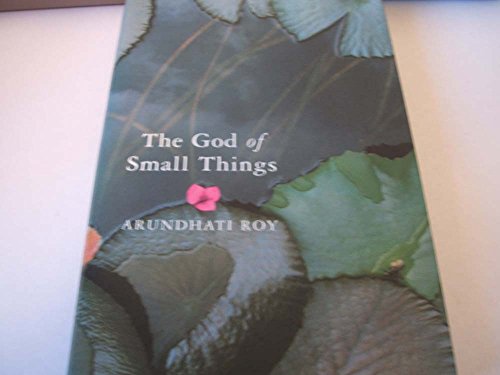
Synopsis
"They all crossed into forbidden territory. They all tampered with the laws that lay down who should be loved and how. And how much. "
The year is 1969. In the state of Kerala, on the southernmost tip of India, a skyblue Plymouth with chrome tailfins is stranded on the highway amid a Marxist workers' demonstration. Inside the car sit two-egg twins Rahel and Esthappen, and so begins their tale. . . .
Armed only with the invincible innocence of children, they fashion a childhood for themselves in the shade of the wreck that is their family--their lonely, lovely mother, Ammu (who loves by night the man her children love by day), their blind grandmother, Mammachi (who plays Handel on her violin), their beloved uncle Chacko (Rhodes scholar, pickle baron, radical Marxist, bottom-pincher), their enemy, Baby Kochamma (ex-nun and incumbent grandaunt), and the ghost of an imperial entomologist's moth (with unusually dense dorsal tufts).
When their English cousin, Sophie Mol, and her mother, Margaret Kochamma, arrive on a Christmas visit, Esthappen and Rahel learn that Things Can Change in a Day. That lives can twist into new, ugly shapes, even cease forever, beside their river "graygreen." With fish in it. With the sky and trees in it. And at night, the broken yellow moon in it.
The brilliantly plotted story uncoils with an agonizing sense of foreboding and inevitability. Yet nothing prepares you for what lies at the heart of it.
The God of Small Things takes on the Big Themes--Love. Madness. Hope. Infinite Joy. Here is a writer who dares to break the rules. To dislocate received rhythms and create the language she requires, a language that is at once classical and unprecedented. Arundhati Roy has given us a book that is anchored to anguish, but fueled by wit and magic.
"synopsis" may belong to another edition of this title.
About the Author
Arundhati Roy was trained as an architect. She has worked as a production designer and written the screenplays for two films. She lives in New Delhi. This is her first book.
From the Inside Flap
"They all crossed into forbidden territory. They all tampered with the laws that lay down who should be loved and how. And how much. "
The year is 1969. In the state of Kerala, on the southernmost tip of India, a skyblue Plymouth with chrome tailfins is stranded on the highway amid a Marxist workers' demonstration. Inside the car sit two-egg twins Rahel and Esthappen, and so begins their tale. . . .
Armed only with the invincible innocence of children, they fashion a childhood for themselves in the shade of the wreck that is their family--their lonely, lovely mother, Ammu (who loves by night the man her children love by day), their blind grandmother, Mammachi (who plays Handel on her violin), their beloved uncle Chacko (Rhodes scholar, pickle baron, radical Marxist, bottom-pincher), their enemy, Baby Kochamma (ex-nun and incumbent grandaunt), and the ghost of an imperial entomologist's moth (with unusually dense dorsal tufts).
When their English cousin, Sophie Mol, and her mother, Margaret Kochamma, arrive on a Christmas visit, Esthappen and Rahel learn that Things Can Change in a Day. That lives can twist into new, ugly shapes, even cease forever, beside their river "graygreen." With fish in it. With the sky and trees in it. And at night, the broken yellow moon in it.
The brilliantly plotted story uncoils with an agonizing sense of foreboding and inevitability. Yet nothing prepares you for what lies at the heart of it.
The God of Small Things takes on the Big Themes--Love. Madness. Hope. Infinite Joy. Here is a writer who dares to break the rules. To dislocate received rhythms and create the language she requires, a language that is at once classical and unprecedented. Arundhati Roy has given us a book that is anchored to anguish, but fueled by wit and magic.
Reviews
With sensuous prose, a dreamlike style infused with breathtakingly beautiful images and keen insight into human nature, Roy's debut novel charts fresh territory in the genre of magical, prismatic literature. Set in Kerala, India, during the late 1960s when Communism rattled the age-old caste system, the story begins with the funeral of young Sophie Mol, the cousin of the novel's protagonists, Rahel and her fraternal twin brother, Estha. In a circuitous and suspenseful narrative, Roy reveals the family tensions that led to the twins' behavior on the fateful night that Sophie drowned. Beneath the drama of a family tragedy lies a background of local politics, social taboos and the tide of history?all of which come together in a slip of fate, after which a family is irreparably shattered. Roy captures the children's candid observations but clouded understanding of adults' complex emotional lives. Rahel notices that "at times like these, only the Small Things are ever said. The Big Things lurk unsaid inside." Plangent with a sad wisdom, the children's view is never oversimplified, and the adult characters reveal their frailties?and in one case, a repulsively evil power?in subtle and complex ways. While Roy's powers of description are formidable, she sometimes succumbs to overwriting, forcing every minute detail to symbolize something bigger, and the pace of the story slows. But these lapses are few, and her powers coalesce magnificently in the book's second half. Roy's clarity of vision is remarkable, her voice original, her story beautifully constructed and masterfully told. First serial to Granta; foreign rights sold in France, Spain, Portugal, Germany, Italy, Finland, Norway, Sweden, Denmark, Estonia, Holland, India, Greece, Canada and the U.K.
Copyright 1998 Reed Business Information, Inc.
A brilliantly constructed first novel that untangles an intricate web of sexual and caste conflict in a vivid style reminiscent of Salman Rushdie's early work. The major characters are Estha and Rahel, the fraternal twin son and daughter of a wealthy family living in the province of Kerala. The family's prosperity is derived from a pickle factory and rubber estate, and their prideful Anglophilia essentially estranges them from their country's drift toward Communism and their ``inferiors' '' hunger for independence and equality. The events of a crucial December day in 1969--including an accidental death that may have been no accident and the violent consequences that afflict an illicit couple who have broken ``the Love Law''-- are the moral and narrative center around which the episodes of the novel repeatedly circle. Shifting backward and forward in time with effortless grace, Roy fashions a compelling nexus of personalities that influence the twins' ``eerie stealth'' and furtive interdependence. These include their beautiful and mysteriously remote mother Ammu; her battling ``Mammachi'' (who runs the pickle factory) and ``Pappachi'' (an insufficiently renowned entomologist); their Oxford-educated Marxist Uncle Chacko and their wily ``grandaunt'' Baby Kochamma; and the volatile laborite ``Untouchable'' Velutha, whose relationship with the twins' family will prove his undoing. Roy conveys their explosive commingling in a vigorous prose dominated by odd syntactical and verbal combinations and coinages (a bad dream experience during midday nap-time is an ``aftermare'') reminiscent of Gerard Manly Hopkins's ``sprung rhythm,'' incantatory repetitions, striking metaphors (Velutha is seen ``standing in the shade of the rubber trees with coins of sunshine dancing on his body'') and sensuous descriptive passages (``The sky was orange, and the coconut trees were sea anemones waving their tentacles, hoping to trap and eat an unsuspecting cloud''). In part a perfectly paced mystery story, in part an Indian Wuthering Heights: a gorgeous and seductive fever dream of a novel, and a truly spectacular debut. (First serial to Granta) -- Copyright ©1997, Kirkus Associates, LP. All rights reserved.
This "piercing study of childhood innocence lost" mirrors the growing pains of modern India. Twin sister and brother Rahel and Estha are at the center of a family in crisis and at the heart of this "moving and compactly written book."
Copyright 1997 Reed Business Information, Inc.
It's easier to talk about small things because the big things in life are far too complex and painful. But even small things can loom large, and everything can change, radically, in a day, a moment. These are the sort of big things first-time novelist Roy ponders in this highly original and exquisitely crafted tale set in the tiny river town of Ayemenem in Kerala, India. The story revolves around a pair of twins, brother and sister, whose mother has left her violent husband to live with her blind mother and kind, if ineffectual, brother, Chacko. Chacko's ex-wife, an Englishwoman, has returned to Ayemenem after a long absence, bringing along her and Chacko's lovely young daughter. Their arrival not only unsettles the already tenuous balance of the divisive household, it also coincides with political unrest. The twins and their cousin--each brimming with vernal intelligence, innocent love and longing, curiosity and fear--barely have time to get acquainted before tragedy strikes, first in the form of an accident (caused by carelessness in love), then murder (the result of ancient prejudice). Roy's intricate, enchanting, and often wry tale is positively mythical in its cosmic inevitability, evocative circularity, and paradoxical wisdom. Donna Seaman
"About this title" may belong to another edition of this title.
Search results for The God of Small Things

Seller Image
The God of Small Things
Seller: Zoom Books East, Glendale Heights, IL, U.S.A.
Seller rating 5 out of 5 stars

Condition: good. Book is in good condition and may include underlining highlighting and minimal wear. The book can also include "From the library of" labels. May not contain miscellaneous items toys, dvds, etc. . We offer 100% money back guarantee and 24 7 customer service. Seller Inventory # ZEV.0679457313.G
Seller Image
The God of Small Things
Seller: ZBK Books, Carlstadt, NJ, U.S.A.
Seller rating 5 out of 5 stars
Condition: very_good. Fast & Free Shipping â" Very Good condition book with a firm cover and clean pages. Shows normal use and some light wear or limited notes markings. A solid, nice copy to enjoy. Seller Inventory # ZWV.0679457313.VG
Seller Image
The God of Small Things
Seller: Zoom Books East, Glendale Heights, IL, U.S.A.
Seller rating 5 out of 5 stars
Condition: very_good. Book is in very good condition and may include minimal underlining highlighting. The book can also include "From the library of" labels. May not contain miscellaneous items toys, dvds, etc. . We offer 100% money back guarantee and 24 7 customer service. Seller Inventory # ZEV.0679457313.VG
Seller Image
The God of Small Things
Seller: Greenworld Books, Arlington, TX, U.S.A.
Seller rating 5 out of 5 stars
Condition: good. Fast Free Shipping â" Good condition. It may show normal signs of use, such as light writing, highlighting, or library markings, but all pages are intact and the book is fully readable. A solid, complete copy that's ready to enjoy. Seller Inventory # GWV.0679457313.G
Seller Image
The God of Small Things
Seller: Zoom Books Company, Lynden, WA, U.S.A.
Seller rating 5 out of 5 stars
Condition: very_good. Book is in very good condition and may include minimal underlining highlighting. The book can also include "From the library of" labels. May not contain miscellaneous items toys, dvds, etc. . We offer 100% money back guarantee and 24 7 customer service. Seller Inventory # ZBV.0679457313.VG
Seller Image
The God of Small Things
Seller: Greenworld Books, Arlington, TX, U.S.A.
Seller rating 5 out of 5 stars
Condition: very_good. Fast Free Shipping â" Very Good condition book with a firm cover and clean pages. Shows normal use and some light wear or limited notes markings. A solid, nice copy to enjoy. Seller Inventory # GWV.0679457313.VG
Stock Image
The God of Small Things
Seller: World of Books (was SecondSale), Montgomery, IL, U.S.A.
Seller rating 5 out of 5 stars
Condition: Acceptable. Item in acceptable condition! Textbooks may not include supplemental items i.e. CDs, access codes etc. Seller Inventory # 00099147800
Stock Image
The God of Small Things
Seller: World of Books (was SecondSale), Montgomery, IL, U.S.A.
Seller rating 5 out of 5 stars
Condition: Good. Item in good condition. Textbooks may not include supplemental items i.e. CDs, access codes etc. Seller Inventory # 00104270606
Stock Image
The God of Small Things
Seller: ThriftBooks-Dallas, Dallas, TX, U.S.A.
Seller rating 5 out of 5 stars
Paperback. Condition: Good. No Jacket. Missing dust jacket; Pages can have notes/highlighting. Spine may show signs of wear. ~ ThriftBooks: Read More, Spend Less. Seller Inventory # G0679457313I3N01
Stock Image
The God of Small Things
Seller: ThriftBooks-Dallas, Dallas, TX, U.S.A.
Seller rating 5 out of 5 stars
Paperback. Condition: Fair. No Jacket. Readable copy. Pages may have considerable notes/highlighting. ~ ThriftBooks: Read More, Spend Less. Seller Inventory # G0679457313I5N00