
Synopsis
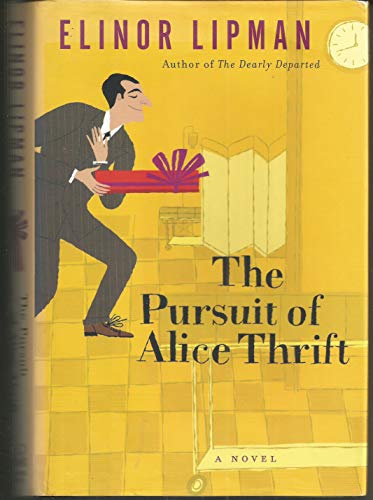
Meet poor Alice Thrift, surgical intern in a Boston hospital, high of I.Q. but low in social graces. She doesn’t mean to be acerbic, clinical, or painfully precise, but where was she the day they taught Bedside Manner 101? Into Alice’s workaholic and romantically challenged life comes Ray Russo, a purveyor of fairground fudge, in need of rhinoplasty and well-heeled companionship, not necessarily in that order. Is he a con man or a sincere suitor? Good guy or bad? His well-engineered cruise into carnal waters introduces Alice to a new and baffling concept, chemistry—and not of the organic kind. Is it possible for a woman of science to cure her own loneliness in the unsuitable arms of a parental nightmare? Luckily, Leo Frawley, R.N., who has a high threshold for Alice’s left-footed people skills, and Sylvie Schwartz, M.D., fellow resident and woman of the world, take on the task of guiding Alice through the narrow straits of her own no-rapport zone.
“Almost nobody writes serious entertainment with more panache,” said the Chicago Tribune of Elinor Lipman. Now comes the novel Publishers Weekly is calling “surely her best to date...a triumph...a book you can’t put down.”
The Pursuit of Alice Thrift showcases a rare and generous talent at the top of her witty, irresistible form.
"synopsis" may belong to another edition of this title.
About the Author
Elinor Lipman is the author of seven books: the novels The Pursuit of Alice Thrift, The Dearly Departed, The Ladies' Man, The Inn at Lake Devine, Isabel's Bed, The Way Men Act, Then She Found Me, and a collection of stories, Into Love and Out Again. She has been called "the diva of dialogue" (People) and "the last urbane romantic" (Chicago Tribune). Book Magazine said of The Pursuit of Alice Thrift, "Like Jane Austen, the past master of the genre, Lipman isn't only out for laughs. She serves up social satire, too, that's all the more trenchant for being deftly drawn."
Her essays have appeared in the Boston Globe Magazine, Gourmet, Chicago Tribune, and The New York Times’ Writers on Writing series. She received the New England Booksellers' 2001 fiction award for a body of work.
From the Back Cover
Meet poor Alice Thrift, surgical intern in a Boston hospital, high of I.Q. but low in social graces. She doesn’t mean to be acerbic, clinical, or painfully precise, but where was she the day they taught Bedside Manner 101? Into Alice’s workaholic and romantically challenged life comes Ray Russo, a purveyor of fairground fudge, in need of rhinoplasty and well-heeled companionship, not necessarily in that order. Is he a con man or a sincere suitor? Good guy or bad? His well-engineered cruise into carnal waters introduces Alice to a new and baffling concept, chemistry—and not of the organic kind. Is it possible for a woman of science to cure her own loneliness in the unsuitable arms of a parental nightmare? Luckily, Leo Frawley, R.N., who has a high threshold for Alice’s left-footed people skills, and Sylvie Schwartz, M.D., fellow resident and woman of the world, take on the task of guiding Alice through the narrow straits of her own no-rapport zone.
“Almost nobody writes serious entertainment with more panache,” said the Chicago Tribune of Elinor Lipman. Now comes the novel Publishers Weekly is calling “surely her best to date...a triumph...a book you can’t put down.”
The Pursuit of Alice Thrift showcases a rare and generous talent at the top of her witty, irresistible form.
From the Inside Flap
Meet poor Alice Thrift, surgical intern in a Boston hospital, high of I.Q. but low in social graces. She doesn t mean to be acerbic, clinical, or painfully precise, but where was she the day they taught Bedside Manner 101? Into Alice s workaholic and romantically challenged life comes Ray Russo, a purveyor of fairground fudge, in need of rhinoplasty and well-heeled companionship, not necessarily in that order. Is he a con man or a sincere suitor? Good guy or bad? His well-engineered cruise into carnal waters introduces Alice to a new and baffling concept, chemistry and not of the organic kind. Is it possible for a woman of science to cure her own loneliness in the unsuitable arms of a parental nightmare? Luckily, Leo Frawley, R.N., who has a high threshold for Alice s left-footed people skills, and Sylvie Schwartz, M.D., fellow resident and woman of the world, take on the task of guiding Alice through the narrow straits of her own no-rapport zone.
Almost nobody writes serious entertainment with more panache, said the Chicago Tribune of Elinor Lipman. Now comes the novel Publishers Weekly is calling surely her best to date...a triumph...a book you can t put down.
The Pursuit of Alice Thrift showcases a rare and generous talent at the top of her witty, irresistible form.
Reviews
Snappy wit, a clever plot and the sheer fun of a book you can't put down await readers of Lipman's (The Inn at Lake Divine) eighth novel, surely her best to date. The eponymous Alice is a sleep-deprived surgical intern at a Boston hospital. A graduate of MIT and Harvard and a congenital workaholic, she's also devoid of social skills, a sense of humor or elementary tact. Though miserably unequipped with self-esteem, Alice is an intelligent, well-brought-up offspring of upper-middle-class parents. Why, then, does she fall prey to the romantic blandishments of Ray Russo, a vulgar loudmouth and con artist who-it turns out-lies every time he opens his mouth? That Lipman can make this story plausible, and tell it with humor, psychological insight and rising suspense, is a triumph. Despite her roommate Leo's description of Ray as " a slimeball who won't take no for an answer," Alice fails to see through her conniving beau because she's achingly lonely and because he remains devoted when she's put on probation for falling asleep while assisting in the OR. It's easy for her to dismiss the concern of family and friends as simple snobbery-which, in some cases, it is. Lipman's knowledge of hospital routine, especially the bone-weary lives of interns and residents, is a major reason that the plot moves along as smoothly as if on ball bearings. The dozen or so supporting characters, from Alice's horrified parents to her good friends and fellow residents, are vividly three-dimensional. Lipman's eye for social pretense has never been so keen-or so cruel. There's a dark moral here-that class differences cannot be breached-but readers will appreciate the candor.
Copyright 2003 Reed Business Information, Inc.
Fans of Lipman's seven previous novels, including The Dearly Departed (2001), will be delighted with her latest. Whimsical, heartwarming, and engaging, Lipman tells the tale of the maladroit, socially inept, and very appealing Alice Thrift. Alice, an intern in a Boston hospital, hopes to one day perform plastic surgery on the poor and disenfranchised. Her roommate is the hunky and charming Leo Frawley, a nurse in neonatal intensive care. Leo does his best to help Alice adapt to the politics and strife of the hospital and to become less of a social basket case. His quest is interrupted by his own love life and the entrance of Ray Russo, a man who decides Alice is for him. To call Ray awful and icky, and to shudder while saying so, is to compliment him. A traveling fudge salesman, he shows up all the time and somehow gets Alice to do what he wants. Toss in a very mean doctor and a very cool fellow intern, allow Lipman to do her magic, and the results are as expected--funny, pitch perfect, and utterly charming. Neal Wyatt
Copyright © American Library Association. All rights reserved
Excerpt. © Reprinted by permission. All rights reserved.
1
Tell the Truth
You may have seen us in “Vows” in The New York Times: me, alone, smoking a cigarette and contemplating my crossed ankles, and a larger blurry shot of us, postceremony, ducking and squinting through a hail of birdseed. We didn’t have pretty faces or interesting demographics, but we had met and married in a manner that was right for SundayStyles: Ray Russo came to my department for a consultation. I said what I always said to a man seeking rhinoplasty: Your nose is noble, even majestic. It has character. It gives you character. Have you thought this through?
The Times had its facts right: We met as doctor and patient. I digitally enhanced him, capped his rugged, haunted face with a perfect nose and symmetrical, movie-star nostrils—and he didn’t like what he saw on the screen. “Why did I come?” he wondered aloud, in a manner that suggested depth. “Did I expect this would make me handsome?”
“It’s the way we’ve been socialized,” I said.
“It’s not like I have a deviated septum or anything. It’s not like my insurance is going to pick up the tab.”
Vanitas vanitatum: elective surgery, in other words.
He asked for my professional opinion. I said, “There’s no turning back once we do this, so take some time and think it over. There’s no rush. I don’t like to play God. I’m only an intern doing a rotation here.”
“But you must see a lot of noses in life, on the street, and you must have an artistic opinion,” said Ray.
“If it were I, I wouldn’t,” I said for reasons that had nothing to do with aesthetics and everything to do with the nauseating sound of bones cracking under mallets in the OR.
“Really? You think the one I have is okay?”
“May I ask why you want to do this now, Mr. Russo?” I asked, glancing at the chart that told me he’d turn forty in a month.
“Let’s be honest: Women like handsome men,” he said, voice wistful, eyes downcast.
What could I say except a polite “And you don’t think you’re handsome enough? Do you think women judge you by the dimensions of your nose?”
Next to me he smiled. The camera mounted above the monitor played it back. He had good teeth.
“I haven’t been very lucky in love,” he added. “I’m forty-five and I don’t have a girlfriend.”
“Is your date of birth wrong?” I asked, pointing to the clipboard.
“Oh, that,” he said. “I knock five years off when I’m filling out a job application because of age discrimination, even at forty-five. Bad habit. I forgot you should always tell the truth on medical forms.”
“And what is your field?”
“I’m in business, self-employed.”
I asked what field.
“Concessions. Which puts me before the public. Wouldn’t you think that if everything was okay in the looks department, I’d have met someone by now?”
I hated this part—the psychiatry, the talking. So instead of asserting what is hard to practice and even harder to preach in my chosen field—that beauty’s only skin deep and vastly overrated—I pecked at some keys and moved the mouse. We were back to Ray’s original face, bones jutting, cartilage flaring, nose upstaging, a face that my less scrupulous attending physicians would have loved to pin to their drawing boards. If it sounds as if I saw something there, some goodness, some quality of mercy or masculinity that overrode the physical, I didn’t. I was flattering him to serve my own principles, my own anti–plastic surgery animus. Ray Russo thought my silence meant I wouldn’t change a hair.
“Vows” would reconstruct our consultation, with Ray remembering, “I heard something in her voice. Not that there was a single unprofessional moment between us, but I had an inkling she may have been saying ‘No, don’t fix it’ in order to terminate our doctor-patient relationship and embark on a personal one.”
Reading between the lines, and knowing the outcome, you’d think something was ignited in that consultation, a spark between us, but I wasn’t one of those attractive doctors with a stethoscope draped around her shoulders and a red silk blouse under her lab coat. I was an unhappy intern, plain and no-nonsense at best, and hoping to perform only noble procedures once I’d finished my residency, my fellowship, my board certification—to reconstruct the soft tissue of poor people, to correct their birth defects, their cleft lips and palates, their cranial deformities, their burns, their mastectomies, to stitch up their torn flesh in emergency rooms so that no scar would force them to relive their horrible accidents. I’d hand off to my less idealistic and more affluent associates the nose jobs, the liposuctions, the face-lifts, the eye and tummy tucks, the breast augmentations, and all cosmetic procedures that make the marginally attractive beautiful.
Ray Russo should have consulted someone who would graduate from the program and set up a suite of sleek offices in a big city. I wished him well and sent him home with the four-color brochure that covers the gruesome steps of rhinoplasty.
Why did I take his phone call six months later? Because I didn’t remember him. He dropped the name of my chairman, which made me think he was a friend of that august family—as if he’d sensed I was worried about my standing in the department and my ambivalence toward my then chosen field. Of course, I am summarizing for narrative convenience. Why go into detail about our history, our motivation, our sweet moments, if I’m going to break your heart soon enough? I could add that I have a mother who worries about me, a mother whose motto is “Go for a cup of coffee. It doesn’t mean you have to marry him,” but I’m not blaming her. This is about the weak link in my own character—wishful thinking—and a husband of short duration with a history of bad deeds.
If I sound bitter, I apologize. “Vows” should revisit their brides and grooms a year later, or five or ten. I’d enjoy that on a Sunday morning—scanning the wedding announcements stenciled with updates: not speaking. divorced. separated. annulled. cheating on him with the pool-maintenance guy. gave birth 5 months later. in counseling. came out of the closet—any number of interesting developments that reveal the truth about brides and grooms. Ray’s and mine could have multiple stamps, like an expired passport. It could say didn’t last the honeymoon or should have known better. Or, across his conniving forehead, above that hideous nose, succinctly and aptly, liar.
2
Later Classified as Our First Date
Raymond Russo’s self-improvement campaign began with a stroke of Las Vegas luck: He won a free teeth-bleaching, upper and lower arches, in a dentist’s lottery. It explained his too-easy grin and his drinking coffee through a straw during what would later be classified as our first date. We were side by side, on stools at the Friendly’s in the lobby of my hospital. Conversation was stalled on my medical degree, which evoked something close to reverence, expressed in boyish, gee-whiz fashion, as if he’d never encountered such a miraculous career trajectory. Was it not flattering? Was I not psychologically pummeled every day? Insulted by evaluations that described my performance as workmanlike and my people skills as hypothermic? Was I not ready for someone, anyone, to utter words of admiration?
“I can’t be the only woman doctor you’ve ever met,” I said. “You must have gone to college with women who went on to medical school.”
“Believe it or not, I didn’t.”
“There are thousands of us,” I said. “Maybe millions. A third of my medical school class were women.”
“Well, keep it coming,” he said. “I know I was happy when you walked into the examining room. It helped me more than some guy saying, ‘Your nose is fine the way it is.’ I might have thought he wanted to keep me homely—you know—to reduce the competition.”
I hoped he was joking, but humor comprehension was never my strong suit. I asked, “Did I take measurements that day, or a history?”
Still smiling, he said, “You don’t remember me at all, do you?”
I said, “It’s coming back to me. Definitely.” Studying his nose in profile, I added, “I’m not a plastic surgeon. I just happened to be in the wrong place at the wrong time.”
“Just the opposite! Thanks to you, I’m going to live with this nose of mine and see how it goes. I know a couple of guys who had nose jobs—I’m not saying they were done upstairs—but I think they look pretty fake.”
I stated for the record—should anyone more senior be listening—“We have some true artists in the department. You could come up and look at the before-and-after photos. They’re quite reassuring.”
He waved away the whole notion. “I could die on the table, and then what? My obituary would say ‘Died suddenly after no illness whatsoever’? ‘In pursuit of a more handsome face’? How would my old man feel? It’s his nose I inherited.”
“General anesthesia always carries a risk,” I said, “and of course there’s always swelling and ecchymoses, but I doubt whether the hospital has ever lost a rhinoplasty patient.”
He smiled again. He tapped the back of my hand and said, “You’re a seriou...
"About this title" may belong to another edition of this title.
Other Popular Editions of the Same Title

Search results for The Pursuit of Alice Thrift

Stock Image
The Pursuit of Alice Thrift
Seller: World of Books (was SecondSale), Montgomery, IL, U.S.A.
Seller rating 5 out of 5 stars

Condition: Acceptable. Item in acceptable condition! Textbooks may not include supplemental items i.e. CDs, access codes etc. Seller Inventory # 00104712283
Stock Image
The Pursuit of Alice Thrift
Seller: World of Books (was SecondSale), Montgomery, IL, U.S.A.
Seller rating 5 out of 5 stars
Condition: Good. Item in good condition. Textbooks may not include supplemental items i.e. CDs, access codes etc. Seller Inventory # 00094153916
Stock Image
The Pursuit of Alice Thrift
Seller: World of Books (was SecondSale), Montgomery, IL, U.S.A.
Seller rating 5 out of 5 stars
Condition: Very Good. Item in very good condition! Textbooks may not include supplemental items i.e. CDs, access codes etc. Seller Inventory # 00104175897
Stock Image
The Pursuit of Alice Thrift
Seller: More Than Words, Waltham, MA, U.S.A.
Seller rating 5 out of 5 stars
Condition: Good. . good. All orders guaranteed and ship within 24 hours. Before placing your order for please contact us for confirmation on the book's binding. Check out our other listings to add to your order for discounted shipping. Seller Inventory # WAL-P-3e-02202
Stock Image
The Pursuit of Alice Thrift
Published by
Random House (edition First Edition), 2003
ISBN 10: 0679463135
ISBN 13: 9780679463139
Used
Hardcover
First Edition
Seller: BooksRun, Philadelphia, PA, U.S.A.
Seller rating 5 out of 5 stars
Hardcover. Condition: Very Good. First Edition. With dust jacket. It's a well-cared-for item that has seen limited use. The item may show minor signs of wear. All the text is legible, with all pages included. It may have slight markings and/or highlighting. Seller Inventory # 0679463135-8-1-29
Stock Image
The Pursuit of Alice Thrift
Published by
Random House Publishing Group, 2003
ISBN 10: 0679463135
ISBN 13: 9780679463139
Used
Hardcover
First Edition
Seller: Better World Books, Mishawaka, IN, U.S.A.
Seller rating 5 out of 5 stars
Condition: Very Good. 1st. Former library copy. Pages intact with possible writing/highlighting. Binding strong with minor wear. Dust jackets/supplements may not be included. Includes library markings. Stock photo provided. Product includes identifying sticker. Better World Books: Buy Books. Do Good. Seller Inventory # 17137451-6
Stock Image
The Pursuit of Alice Thrift
Published by
Random House Publishing Group, 2003
ISBN 10: 0679463135
ISBN 13: 9780679463139
Used
Hardcover
First Edition
Seller: Better World Books, Mishawaka, IN, U.S.A.
Seller rating 5 out of 5 stars
Condition: Very Good. 1st. Pages intact with possible writing/highlighting. Binding strong with minor wear. Dust jackets/supplements may not be included. Stock photo provided. Product includes identifying sticker. Better World Books: Buy Books. Do Good. Seller Inventory # 17236406-75
Stock Image
The Pursuit of Alice Thrift
Published by
Random House Publishing Group, 2003
ISBN 10: 0679463135
ISBN 13: 9780679463139
Used
Hardcover
First Edition
Seller: Better World Books, Mishawaka, IN, U.S.A.
Seller rating 5 out of 5 stars
Condition: Good. 1st. Former library copy. Pages intact with minimal writing/highlighting. The binding may be loose and creased. Dust jackets/supplements are not included. Includes library markings. Stock photo provided. Product includes identifying sticker. Better World Books: Buy Books. Do Good. Seller Inventory # GRP64706330
Stock Image
The Pursuit of Alice Thrift
Seller: HPB-Emerald, Dallas, TX, U.S.A.
Seller rating 5 out of 5 stars
hardcover. Condition: Very Good. Connecting readers with great books since 1972! Used books may not include companion materials, and may have some shelf wear or limited writing. We ship orders daily and Customer Service is our top priority! Seller Inventory # S_453598080
Stock Image
The Pursuit of Alice Thrift
Seller: ThriftBooks-Dallas, Dallas, TX, U.S.A.
Seller rating 5 out of 5 stars
Hardcover. Condition: Very Good. No Jacket. Former library book; May have limited writing in cover pages. Pages are unmarked. ~ ThriftBooks: Read More, Spend Less. Seller Inventory # G0679463135I4N10