
Synopsis
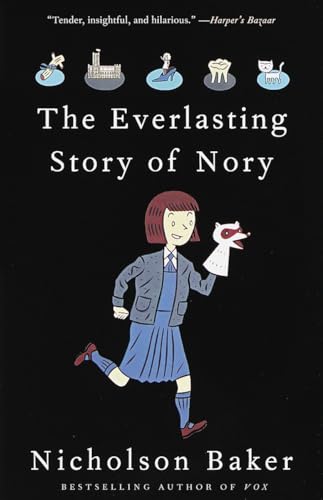
Our supreme fabulist of the ordinary now turns his attention on a 9-year-old American girl and produces a novel as enchantingly idiosyncratic as any he has written. Nory Winslow wants to be a dentist or a designer of pop-up books. She likes telling stories and inventing dolls. She has nightmares about teeth, which may explain her career choice. She is going to school in England, where she is mocked for her accent and her friendship with an unpopular girl, and she has made it through the year without crying.
Nicholson Baker follows Nory as she interacts with her parents and peers, thinks about God and death-watch beetles, and dreams of cows with pointed teeth. In this precocious child he gives us a heroine as canny and as whimsical as Lewis Carroll's Alice and evokes childhood in all its luminous weirdness.
"synopsis" may belong to another edition of this title.
About the Author
Nicholson Baker has published five novels–The Mezzanine, Room Temperature, Vox, The Fermata, and The Everlasting Story of Nory–and two works of nonfiction, U and I and The Size of Thoughts. He lives with his wife and two children in Maine.
From the Back Cover
Our supreme fabulist of the ordinary now turns his attention on a 9-year-old American girl and produces a novel as enchantingly idiosyncratic as any he has written. Nory Winslow wants to be a dentist or a designer of pop-up books. She likes telling stories and inventing dolls. She has nightmares about teeth, which may explain her career choice. She is going to school in England, where she is mocked for her accent and her friendship with an unpopular girl, and she has made it through the year without crying.
Nicholson Baker follows Nory as she interacts with her parents and peers, thinks about God and death-watch beetles, and dreams of cows with pointed teeth. In this precocious child he gives us a heroine as canny and as whimsical as Lewis Carroll's Alice and evokes childhood in all its luminous weirdness.
From the Inside Flap
fabulist of the ordinary now turns his attention on a 9-year-old American girl and produces a novel as enchantingly idiosyncratic as any he has written. Nory Winslow wants to be a dentist or a designer of pop-up books. She likes telling stories and inventing dolls. She has nightmares about teeth, which may explain her career choice. She is going to school in England, where she is mocked for her accent and her friendship with an unpopular girl, and she has made it through the year without crying.
Nicholson Baker follows Nory as she interacts with her parents and peers, thinks about God and death-watch beetles, and dreams of cows with pointed teeth. In this precocious child he gives us a heroine as canny and as whimsical as Lewis Carroll's Alice and evokes childhood in all its luminous weirdness.
Excerpt. © Reprinted by permission. All rights reserved.
The Everlasting Story of Nory
By Nicholson BakerVintage Books USA
Copyright ©1999 Nicholson BakerAll right reserved.
ISBN: 9780679763758
Chapter One
1. What She Liked to Do
Eleanor Winslow was a nine-year-old girl from America withstraight brown bangs and brown eyes. She was interested indentistry or being a paper engineer when she grew up. A paperengineer is an artist who designs pop-up books and pop-upgreeting cards, which are extremely important to have easilyavailable in stores because they make people happier in theirlives. Lately Nory was in a stage of liking to draw pictures ofChinese girls wearing patchwork Chinese robes with their hairup in a little hat, or held on the side with a pin. She told aconstant number of stories to herself in the car while they droveto Stately Homes. She also told them to herself in the bathtub orin the mirror. Sometimes she and her friends made up storiestogether, but that of course depended heavily on the friend.Another thing Nory liked doing was making up new designs ofdolls that she wished you could have the opportunity to buy butyou can't and probably never will.
For example, she drew a doll named `Riena.' Riena hadstraight hair parted on the side and puffy sleeves. She was notstretched out with a teenagery figure or short with a massiverounded head. Her hands and wrists could bend so she couldhold a miniature carton of eggs, and every egg would have arealistic crack in the middle. You would help Riena put the eggdown on the saucing pan, and shuffle it around, and after a whilethe egg would break by itself,because it would be filled with a special substance that expandedwhen you jostled it. A little folded-up rubbery thing that was anegg would goosh out, probably sunny side up, in the pan. Or youcould have the second option of scrambled style, or an omelette.Riena had an apron with a pattern of spoons and forks. Sadlyshe didn't exist except as a drawing.
Nory was tall for her age, especially in the city of Threll, inEngland, where she and her mother, her father, and her brother,who was two, were living for a certain amount of time, Therewere quite a number of girls at her school, the Threll JuniorSchool. She was hoping she would meet a good friend.
2. An Important Building
Threll Cathedral was the biggest thing in the city, by anymeans. It was an old cathedral that had a tower on it that hadthe unique ability to look close to you, and yet be very far away.Airplanes can do that, too. They seem close but aren't, unless itisn't your lucky day. Inside the cathedral was almost as beautifulas outside except that there were modern things like wires andplugs that looked as if' somebody had made a careless mistake,and modern-day loudspeakers up on the columns looking prettyindistinct. There were also some big tombs carved out of acertain kind of black and red stone that was not preciselyfrightening but was certainly alarming, because it was so vividlyblack, and of course there were corpses buried here and there inthe walls or in the floor, some of which might be quitemummified. Saint Rufina, a famous woman whohad been a very lovely young princess with long black hair whodecided to give up her jewelry and become a nun and wear onlythe roughest clothes, and who died in a terrible way, by beingeaten to death by wild dogs that ran through the church in thedead of wintertime, was in a special chapel all to herself, whereone arm of her was set aside, that someone had scooped up andsaved from the dogs, because everyone had loved her for herkindness and her healing ability. Nearby her chapel was a verytall thin window with pictures of tanks and warships andbombers on it. War pictures didn't seem like a perfect idea for asubject in stained glass in a famously holy cathedral, but on theother hand if you're going to have a stained-glass tank orbattleship, this was probably the most beautiful tank you wouldever find. The caterpillar treads were made of tiny scribs andscrabs of green and blue glass. The window was in honor ofsome of the people from the city of Threll who had died at war.
Way, way up in a tower above the stone floor of theCathedral was the Jasperium. It was a kind of a stained-glasswindow in the form of a dome, right over where the two piecesof the cross met. A cathedral is usually arranged in the shape ofa crucifiction, because Jesus died up on the cross. `But why,'Nory wondered sometimes, `do they have to concentrate on theawful way he died? Why not have a cathedral in the shape of aG, for God, a squared-off G with an inner courtyard with awishing well and herbs growing to make tea for the sick, forinstance?' A thousand upon a thousand pieces of green glasswere up there in the Jasperium in a little circle--a pretty bigcircle, actually, but it was little from the distance away you werestanding when you looked up at it, When the sun was brightoutside, it sent the green light down in a soft green stalk onto thefloor of the Cathedral. They had a group of black chairsspecially positioned so you could sit in a chair and wait for thegreen light to come over you like a spotlight on a slug, andsupposedly at that moment you could almost think God'sthoughts. You were not really thinking God's thoughts, of course,but the thoughts God wanted you to think. If you didn't believe inGod, you were thinking what others thought of God, or whatthey thought God wanted them to think, At least you werethinking the Cathedral's thoughts in some fashion, which was apretty worthwhile thing to be able to do on its own.
3. A Story About Beetles
The owners of the Threll Cathedral, who were the AnglicanBishops and Deans, had just spent millions of dollars, or pounds,to clean all the glass in the Jasperium and make sure it wasn'tgoing to fall down. But while they were doing that, they haddiscovered that Death Watch Beetles had chewed through thelead that covered the ends of the beams of wood that attachedthe Jasperium to the tops of the stone columns. So they had toreplace some of the wood, but not all. Death Watch Beetleswere called that because in former times, when a person wasvery sick, if his family heard any of these beetles banging theirsmall heads against the wood of a house--chk, chk, chk--it meantthe sick person would die soon. Nory, because she wanted to bea dentist, had a specific thought about this, which was: `Theirteeth must be extraordinarily strong to have chewed throughlead, They must be hidden away normally and then fold out whenthey open their mouths.' Crocodiles grow twenty-four sets of teeth intheir lives and they can perform for two years without food. But Noryseverely doubted that the Death Watch Beetle had more than one set ofteeth. `it must be a difficult way of life up there,' Nory thought,`generation after generation of Beetle, trying to find enough toeat in the old, horrible, chewed-over wood. They must be downto the bare gristle.' Near the Cathedral was a very good tea shopthat had an extremely good chocolate fudge cake. The cake wasserved with a little cup of whipped cream, by the way.
Nory didn't like a certain picture in one of the brochures thather parents bought about Threll Cathedral that showed a manwearing a mask putting a metal tube into one of the old pieces ofwood under the Jasperium in order to squirt powerful bug-killingfoam inside, She had to make up a story about a family of DeathWatch Beetles who learned of the approach of a squirt of thepoison and packed up their household and made little parachutesout of some candy wrappers one of the bug-killing men had leftin the scaffolding and parachuted down, down, down, smugglingthrough the cool empty air of the inside of the cathedral,swaying, their feelers curled up tight in fear, until they landed in ahuge stone land of green light on the cold floor near a little girlwith bright eyes and black hair named Mariana.
Mariana was sitting with her eyes closed, waiting to see if shecould think the thoughts God wanted her to think. She openedher eyes to see how close the light was to her feet, because shethought that as soon as the light touched her feet she would startto feel the sacred holiness, and she was just creeping her feet alittle closer to the light, so that the holiness would get there morequickly, when she thought she noticed something. Yes, she didnotice something: four tiny creatures, carefully folding up achewing-gum wrapper. `Oh, who are you?' she said, bending toward themand letting them hop onto her palm.
`We're Death Watch Beetles,' said one of them. `A bad manis squirting our country full of terrible poison,'
`Oh,' said Mariana, `he isn't a bad man, I'm sure, he just wantsto be sure that the Jasperium doesn't fall down. You see, whenyou eat the wood, the wood becomes weaker and weaker, andfinally the whole thing would turn to crumbs and fall. Youwouldn't want that to happen to the Cathedral, would you?'
`Well,' grudged the Death Watch Beetle, `if they'd justexplained what the problem was, and given us another piece ofwood to live in, we would have left on our own. As it is, look atlittle Gary, he has gotten sick from chewing on the lead.' Andindeed Mariana saw that little Gary was lying on his back and hedid not look at all well. He looked as pale as a bug can look, andnear death. Mariana gently put all four beetles in her pencil caseand walked out to the forest. She knew where a special fallentree lay. There was a pool of rainwater in a groove of this tree,and she picked a certain kind of flower as she went, singing amild song, and crushed the petals in the water. It was a specialkind of flower that could cure any kind of lead poisoning, and itwas called the Montezuma flower, because it could grow inreally hot or very cold places, so that it was a great survivor.Then she opened the pencil case. The three healthy DeathWatch Beetles carried Gary, the sick one, out, `Wash him in thewater,' said Mariana gently. She was a tall girl with dark brownhair. `The potion will help him.'
At first the beetles weren't sure, and they sniffed the waterand tested it with their feelers and that sort of usual behavior.Then gradually they lost their fears and dippedGary freely in, not head-first but gently, tail-first, and they allwent in, one by one, and splashed in the water contentedly.They had spent so many centuries cooped up inside the oldNorman beams of the Jasperium that they had forgotten thatrainwater could be so clean and pure, and they wereoverjoyed. Gary sat up in the water and said he felt muchbetter. Then all four of them found a place in a spot of sun todry their bodies and when they were toasty and warm again,they waved goodbye, and began chewing their mazes in thehuge tree trunk. `Lovely layers of wood!' they said. `Rings andrings and rings! It'll be a long time before we chew up thisenormous country! Don't tell anyone you brought us here.'
`I won't,' laughed Mariana. `Good luck!'
`Thank you, Mariana,' they called, giving a last happy wave.`Bye! Bye! Bye!'
That was a story she had made about them. In real life Noryhad never even seen a Death Watch Beetle. But there weredefinitely some unusual creatures in Threll. The worst one wasa huge spider that her mother spotted in the shower curtainwhile Nory and Littleguy were in the bathtub setting up a storeto sell pretend cappuccinos, with bubble foam. Her mothersuddenly jumped up with her magazine and hurried them outand called Nory's father.
`What is it?' said Nory, who hadn't gotten a took becauseshe was shoveled out of the bathroom so quick.
`Don't look,' said Nory's father. `It's a loathsome Anglo-Saxonbug. It's huge.'
`I won't be disgusted,' said Nory. `I promise, I won't be.'She peered in, then instantly wailed out in a misery of disgustand hugged her mother. `Oh, awful!' It was an enormous thing,like a black crab, with the dastardliest hairy legs Nory had everseen on a spider, and not like adaddy longlegs's legs, which are quite graceful, but hairy in anugly thick fearful way. Normally Nory liked all insects, evenearwigs, and especially ladybugs, and she did not appreciate anykilling, because of the important rule of Do Unto Others, andhow would you like it if a huge scrumple of toilet paper camedown on you and stole your life away? But this spider inparticular was just too hideously hairy-legged to get any empathyfrom her.
Nory's father came out.
`Is it dead?' they all asked.
Nory's father said that yes, it was dead.
`Good,' said Nory, although immediately she felt a little sad,not to mention embarrassed about shrieking to pieces when shesaw it. `What did you do with it?'
`Flushed it into the depths,' Nory's father said. `The worst partis I always feel I have to open up the toilet paper to look.'
`Not to dwell,' her mother said.
That was their first adventure in Threll. Nory had sometrouble sleeping for two nights, but then she got quickly over it.The only problem was that now she didn't like going to thebathroom in the middle of the night because she sometimesworried that a second-cousin-once-removed of that big blackspider was lurching under the seat. But gradually she got overthat worry, too. It was a wooden toilet seat--the landlady said thatshe had bought it for five pounds at an auction from a StatelyHome, and that the Duke of Tunaparts, or someone quiteobscure like that, had sat on it every day of his life, which wasnot really a point to its favor.
4. Littleguy Had a Sensible Fear of Owls
Nory was a day student at Threll Junior School, where sheused a medium-nib fountain pen with a kind of blue ink that youcould make disappear completely from the page with a two-endedinstrument called an ink-eradicator. Even when the inkhad had a chance to dry for three weeks, the ink-eradicator stillhad the power to make it disappear. Threll School was startedby a kind-looking person with a fur collar whose picture hung onthe stairs going up to the dining hall. Pamela Shavers, who was agirl in Nory's class, said he was called Prior Rowland becausehe lived prior to Henry the Eighth. The dining hall used to be thebarn for the monk's cows, another older kid said, but Norycouldn't understand why the monks would have wanted to dragcows up and down stairs twice a day. Then her motherexplained that they had built in a second floor when they shippedout the cows. There was still sometimes a slight barny smellabout the place, though. The wood had twisting beams, likedriftwood, but no Death Watch Beetles that Nory could see; ofcourse she couldn't possibly have heard them banging theirheads since kids at lunch make tons and tons of noise.
Prior Rowland began the school to honor the memory of SaintRufina, something like two thousand years ago, or `early thismorning,' as Nory's brother used to say. Littleguy he was called,although his name was really Frank Wood Winslow. To Littleguy`long ago' and `early this morning' meant pretty much the samething, because his head was still basically a construction site, filled withdiggers and dumpers driving around in mushy dirt, and it was hard for him totell what were the real outlines of his ideas. He knew how to say`construction site,' and `traction engine,' and `coupling,' and `levelcrossing,' and `hundred-ton dump truck,' and `articulated dumptruck' and `auger driller,' because he loved those sorts of things.But he sometimes held up a very simple object, like a fork or acandle, and said, `I forgot the word for this.' And he still called apillow a pibble. But that was a normal thing to expect, Norythought, because you have to spend your whole life learningmore and more about how to draw a difference between oneidea and another idea and how to keep them separated outrather than totally dredged together in a sludgy mass. Forexample, if you say that you're doing something to the honor ofsomeone's memory, say to the honor of Saint Rufina's memory,you don't mean that you're honoring the wonderful memory theymight have, as in they can dash off the names of every kid in theclass by heart, because they don't have any memories at all,since they're dead. And you don't mean that they havewonderful happy memories of picnics and chicken sandwichesand feeding the ducks that you're honoring, because they don'thave those, either. You can't mummify a nice memory insomeone's head--no magic herbs will do it. And you don't meanyou're honoring any particular other person's memories of theperson that is being honored, because the people who arehonoring him may not even have known him or met him, Or her,in the case of Saint Rufina. You're just simply honoring the basicidea that this person once lived her life and you're trying toconvince the world not to forget her. But any person whoremembers her is going to die also, obviously, so you have tokeep convincing people from scratch--`Remember this person,remember this person, remember this person.' It isn't easy, butit may be satisfying work.
Littleguy liked having Nory read books to him. However, shehad to be careful about certain books. He was not frightened ofspiders so much. But owls were a different bowl of fish! To himthe nighttime was full of owls rustling and blinking their hugestaring eyes. In Nory's house, they couldn't even say `owl,' theyhad to spell it out. When Nory read Littleguy a book like TheCountry Noisy Book and they came to the page with an o-w-lsitting in a tree at nighttime, she would bustle to the next page. Ifshe tried to casually cover the owl up with her hand, it neverworked, because he knew it was under there. SometimesLittleguy would try to be brave. `I like owls very much,' hewould say. `But I don't like just that owl.'
Once Nory's mother found Littleguy in the Art Room late atnight trying to color over the yellow eyes of a scary owl with ared market, because he didn't like coming across it in his Winniethe Pooh magazine, which he had been flipping through beforehe fell asleep. Another time he told Nory that two very bad owlswere wanting to look in his window, behind the curtain. WhenNory heard that, with the frightened seriousness on his face, shealso felt a little twizzle of fear down the back of her neck andplaces like that, because she especially did not like the idea ofthings waiting outside for her and staring in through blank, blackwindowpanes at night. The first and one of the few early, earlythings she remembered about her life was of running down along hall and stopping at the edge of a window. Then bang: shethought she saw the ugliness of the Tweety Monster with itsfrown-eyed face, on the other side of the window, and shescreamed `Mommeeeee!' The Tweety Monster was just simplya monster version of Tweety-birdin a Sylvester and Tweety tape--Tweety turned into it when hedrank a special potion. No reason to be scared of a casual littlecartoon. But it was scary, and when Nory screamed and dashedaway from the window Nory's mother said gently, `I know, Iknow, but it's just drawings. There's no Tweety Monster outthere, no bad thing, only the gentle night and the squirrels allfluffed up to keep from getting too cold, and the raccoons havinga pleasant chew of garbage. Everything's all right.' Her mother'seyes were the most soothing, nicest, softest, deepest eyes thatany mother could ever have. They were, to be specific, blue.Sometimes instead of two owls Littleguy had a bad dream abouttwo old, old trucks from the scrapyard with huge tires drivingaround the living room with their bright lights on. And yet in reallife, Littleguy loved trucks more than anything, except trains.One time Littleguy even said he had a nightmare about sitting onthe toilet and not having a book to read.
That was one thing that Nory really thought was not quite fairabout bad dreams, when they went ahead and took somethingyou loved, like trucks, or mirrors, or your mother, or were proudof, like sitting in the bathroom all by yourself, and made themscary. If Nory had a library, she would not allow anyGoosebumps books in the children's department, because just thecovers were frightening, never mind the dreadful insides, andkids weren't even aware how frightened they were sometimesuntil later that evening. There was one book with a picture of anevil doll that she really thought was a bad idea. Why ruin theidea of something nice, like a doll, by making it so horribly scarythat you couldn't think about it and couldn't trust it? Your dollsaren't going to do anything bad to you. Your dolls should betrusted to be in your room with you in the middleof the night. Goosebumps books got kids much more scared thanthey ever wanted to be, or ever expected they would be, andthey didn't need that help anyway, since their own dreams woulddo a superb job of scaring their dits off just on their own. Butstill, Nory's cousin Anthony and her friend Debbie loved readingGoosebumps books and couldn't think of a funner thing to do. Sonot everyone had the same reaction.
Nory especially disliked when she had teeth-dreams. Say, forexample, a beautiful graceful fluffer-necked duck that was justsitting away the time in the reeds by a river, its feathers beingfluttered by the wind, and when you came up to it in the dreamto hold out your hand to it to say hello and give it a piece ofbread it would suddenly curl back its beaks and show huge fangyteeth. Or a horse with pointy teeth and bug-eyes with white rimswould chase her. Or cows with pointed teeth. But those dreamswere mostly ones she'd had long ago and gotten adjusted to.Another fairly old dream Nory had was of being chased throughvarious shades of colors by a queen who was determined to cutoff her arm for a punishment. Nory dashed away from her, butthe Queen came chugging closer, with some of her men, andNory realized she couldn't escape. So she made them acompromise. She said to the Queen, `Okay, okay, don't chop offmy arm, you can chop off my head.' That way, she wouldn'texperience the pain. The Queen said, `All right!' And wham, theax came circling. `Ah, how nice,' Nory felt. She didn't have tobow or anything. She didn't even have to put a paper bag overher head.
The moral of the dream was; Better to be dead than armlessin agony. It wasn't a perfect moral, though, Nory thoughtafterward, even for a dream--which isn't too surprising since it'stoo much to expect of your dreams thatthey would end up giving off good morals--but really, you canlearn to do almost everything you would need to do without arms:play cards with your toes, and that kind of thing. You mighthesitate for a moment if your dentist wanted to work on yourmouth holding the tools in his toes, true. That might not be theworld's most raging success.
Continues...
Excerpted from The Everlasting Story of Noryby Nicholson Baker Copyright ©1999 by Nicholson Baker. Excerpted by permission.
All rights reserved. No part of this excerpt may be reproduced or reprinted without permission in writing from the publisher.
Excerpts are provided by Dial-A-Book Inc. solely for the personal use of visitors to this web site.
"About this title" may belong to another edition of this title.
Other Popular Editions of the Same Title

Search results for The Everlasting Story of Nory

Stock Image
The Everlasting Story of Nory
Seller: World of Books (was SecondSale), Montgomery, IL, U.S.A.
Seller rating 5 out of 5 stars

Condition: Very Good. Item in very good condition! Textbooks may not include supplemental items i.e. CDs, access codes etc. Seller Inventory # 00098806256
Stock Image
The Everlasting Story of Nory
Seller: World of Books (was SecondSale), Montgomery, IL, U.S.A.
Seller rating 5 out of 5 stars
Condition: Good. Item in good condition. Textbooks may not include supplemental items i.e. CDs, access codes etc. Seller Inventory # 00099577292
Stock Image
The Everlasting Story of Nory
Seller: ThriftBooks-Atlanta, AUSTELL, GA, U.S.A.
Seller rating 5 out of 5 stars
Paperback. Condition: Very Good. No Jacket. May have limited writing in cover pages. Pages are unmarked. ~ ThriftBooks: Read More, Spend Less. Seller Inventory # G0679763759I4N00
Stock Image
The Everlasting Story of Nory
Seller: ThriftBooks-Atlanta, AUSTELL, GA, U.S.A.
Seller rating 5 out of 5 stars
Paperback. Condition: Good. No Jacket. Pages can have notes/highlighting. Spine may show signs of wear. ~ ThriftBooks: Read More, Spend Less. Seller Inventory # G0679763759I3N00
Stock Image
The Everlasting Story of Nory
Published by
Knopf Doubleday Publishing Group, 1999
ISBN 10: 0679763759
ISBN 13: 9780679763758
Used
Softcover
Seller: Better World Books, Mishawaka, IN, U.S.A.
Seller rating 5 out of 5 stars
Condition: Good. Former library copy. Pages intact with minimal writing/highlighting. The binding may be loose and creased. Dust jackets/supplements are not included. Includes library markings. Stock photo provided. Product includes identifying sticker. Better World Books: Buy Books. Do Good. Seller Inventory # 45948199-6
Stock Image
The Everlasting Story of Nory
Published by
Knopf Doubleday Publishing Group, 1999
ISBN 10: 0679763759
ISBN 13: 9780679763758
Used
Softcover
Seller: Better World Books: West, Reno, NV, U.S.A.
Seller rating 5 out of 5 stars
Condition: Very Good. Pages intact with possible writing/highlighting. Binding strong with minor wear. Dust jackets/supplements may not be included. Stock photo provided. Product includes identifying sticker. Better World Books: Buy Books. Do Good. Seller Inventory # 734852-75
Stock Image
The Everlasting Story of Nory
Seller: Wonder Book, Frederick, MD, U.S.A.
Seller rating 5 out of 5 stars
Condition: As New. Like New condition. A near perfect copy that may have very minor cosmetic defects. Seller Inventory # Z06G-00358
Stock Image
The Everlasting Story of Nory
Seller: Wonder Book, Frederick, MD, U.S.A.
Seller rating 5 out of 5 stars
Condition: Very Good. Very Good condition. A copy that may have a few cosmetic defects. May also contain light spine creasing or a few markings such as an owner's name, short gifter's inscription or light stamp. Seller Inventory # A07N-01191
Stock Image
The Everlasting Story of Nory
Seller: Roundabout Books, Greenfield, MA, U.S.A.
Seller rating 4 out of 5 stars

paperback. Condition: Very Good. Condition Notes: Clean, unmarked copy with some edge wear. Good binding. Dust jacket included if issued with one. We ship in recyclable American-made mailers. 100% money-back guarantee on all orders. Seller Inventory # 1751471
Stock Image
The Everlasting Story of Nory
Seller: Midtown Scholar Bookstore, Harrisburg, PA, U.S.A.
Seller rating 5 out of 5 stars
Paperback. Condition: Very Good. crisp clean w/light shelfwear/edgewear - may have remainder mark Standard-sized. Seller Inventory # 0679763759-03