
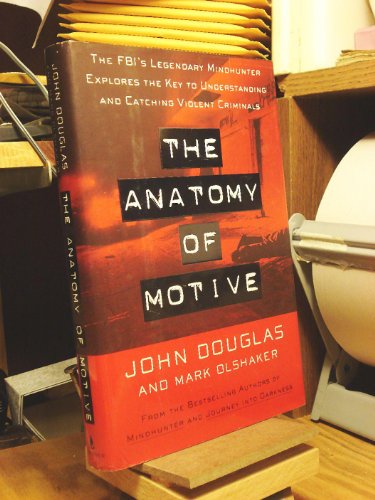
The Anatomy of Motive: The FBI's Legendary Mindhunter Explores the Key to Understanding and Catching Violent Criminals - Hardcover
Synopsis
An FBI criminal profiling expert discusses his theories of motive
"synopsis" may belong to another edition of this title.
About the Author
John Douglas has become the leading expert on criminal-personality profiling and the pioneer of modern criminal investigative analysis during his remarkable twenty-five-year career with the FBI. A veteran of the Air Force, he is the author of numerous articles and presentations on criminology and the coauthor of the landmark books Sexual Homicide: Patterns and Motives and Crime Classification Manual. He has been called upon to analyze violent crimes from those of the Unabomber to the Nicole Brown Simpson-Ron Goldman and JonBenet Ramsey murders. John Douglas and Mark Olshaker coauthored Mindhunter: Inside the FBI's Elite Serial Crime Unit; Unabomber: On the Trail of America's Most-Wanted Serial Killer; Journey into Darkness; and Obsession. Douglas lives in the Washington, D.C., area.
Reviews
A volume of case studies by Douglas, the former chief profiler at the FBI's legendary behavioral sciences unit, and Olshaker has become an annual event, from 1995's Mind Hunter to last year's Obsession. Here, the duo exhume the victims of Andrew Cunanan, Charles Whitman, Theodore Kaczynski and many others for insight into the killers' minds. Douglas's formula is deceptively simple: "WHY? + HOW? = WHO." But since serial killers are rarely caught through profiling, the formula is better expressed as "WHO + HOW = WHY." Douglas is tops in the field. He was among the first to suggest that the Atlanta child murderer was African-American, and he delivered a dead-on profile of Scottish mass-murderer Thomas Watt Hamilton on live TV based on preliminary news accounts. Still, most of what's here will be familiar to readers of other profiling books: the lonely white male with an obsessive sense of his own failure who tortured animals, wet his bed and played with matches as a child. Though Douglas promises to explain the differences among bombers, arsonists, shooters, cutters and stranglers, his profiles too often cleave to predictable, reductive formulations. Both Lee Harvey Oswald and Jack Ruby are characterized as "paranoid losers"; Timothy McVeigh is "a scrawny, pissed-off young hick." As always, Douglas and Olshaker deliver an entertaining read, but fewer case studies presented with more depth would better inform and educate the amateur profiler. (June)
Copyright 1999 Reed Business Information, Inc.
Renowned G-man Douglas, originator of the FBIs Investigative Support Unit, offers his fourth collaboration with co-author Olshaker (Obsession, 1998, etc.), a dense admixture of profiling theory, grim criminal history, and cautionary admonishment that, though at times unwieldy, adds up to an informative, provocative page-turner. As fans of Thomas Harriss novels know, Douglass essential thesis is that even the most violent antisocial deeds contain signature elements (as distinct from modus operandi) that allow investigators to construct the framework of what he calls that key question: Why do criminals commit the crimes they do? This technique creates the profile of an unknown suspect that often aids investigations with startling accuracy. Douglas recaps this theory more than is necessary. Fortunately, he also illustrates it with a plethora of actual cases, assembling quite a rogues gallery: obscure serial arsonists, snipers, and spree killers, along with such media demons as Timothy McVeigh, Andrew Cunanan, and Theodore Kaczynski. Douglas is a good teller of gruesome tales, although he undermines his own insights by referring to his prey as pathetic and with sarcastic asides. The books strength is its arsenal of details and insider knowledge: we learn, for example, the profilers homicidal triad of early indicators for potential offenders; that the most violent crimes stem from a relatively small population of antisocial loners who are almost always straight white males under 50; and that such figures may be set off by a single dislocating event, often a workplace downsizing. Readers in such diverse fields as human resources and journalism may thus find this thriller to be quite useful. Indeed, Douglass advocacy of awareness and observation, combined with his chilling accounts of criminal motivation, offer a valuable lesson to all in staying abreast of the unlikely but most lethal dangers of our society. (8 pages b&w photos, not seen) (Author tour) -- Copyright ©1999, Kirkus Associates, LP. All rights reserved.
The team that brought you Mindhunter and other best sellers on tracking criminals is back with more.
Copyright 1999 Reed Business Information, Inc.
"About this title" may belong to another edition of this title.
Other Popular Editions of the Same Title

Search results for The Anatomy of Motive: The FBI's Legendary Mindhunter...

Seller Image
The Anatomy of Motive: The FBI's Legendary Mindhunter Explores the Key to Understanding and Catching Violent Criminals
Seller: Books for Life, LAUREL, MD, U.S.A.
Seller rating 5 out of 5 stars

Condition: acceptable. Book is in acceptable condition. May have shelf wear, edge wear, and spine wear, but a very readable copy. May not come with supplemental materials if applicable. Does not include original dustcover jacket. Possibly Ex Library Copy. Seller Inventory # LFM.65ZN
Stock Image
The Anatomy of Motive: The FBI
Seller: World of Books (was SecondSale), Montgomery, IL, U.S.A.
Seller rating 5 out of 5 stars
Condition: Good. Item in good condition. Textbooks may not include supplemental items i.e. CDs, access codes etc. Seller Inventory # 00099331088
Stock Image
The Anatomy of Motive: The FBI
Seller: World of Books (was SecondSale), Montgomery, IL, U.S.A.
Seller rating 5 out of 5 stars
Condition: Acceptable. Item in acceptable condition! Textbooks may not include supplemental items i.e. CDs, access codes etc. Seller Inventory # 00101772030
Stock Image
The Anatomy of Motive: The FBI's Legendary Mindhunter Explores the Key to Understanding and Catching Violent Criminals
Seller: Evergreen Goodwill, Seattle, WA, U.S.A.
Seller rating 5 out of 5 stars
hardcover. Condition: Good. Seller Inventory # mon0000144158
Stock Image
The Anatomy of Motive: The FBI's Legendary Mindhunter Explores the Key to Understanding and Catching Violent Criminals
Seller: ThriftBooks-Reno, Reno, NV, U.S.A.
Seller rating 5 out of 5 stars
Hardcover. Condition: Very Good. No Jacket. Missing dust jacket; May have limited writing in cover pages. Pages are unmarked. ~ ThriftBooks: Read More, Spend Less. Seller Inventory # G0684845989I4N01
Stock Image
The Anatomy of Motive: The FBI's Legendary Mindhunter Explores the Key to Understanding and Catching Violent Criminals
Seller: ThriftBooks-Reno, Reno, NV, U.S.A.
Seller rating 5 out of 5 stars
Hardcover. Condition: Fair. No Jacket. Former library book; Readable copy. Pages may have considerable notes/highlighting. ~ ThriftBooks: Read More, Spend Less. Seller Inventory # G0684845989I5N10
Stock Image
The Anatomy of Motive: The FBI's Legendary Mindhunter Explores the Key to Understanding and Catching Violent Criminals
Seller: ThriftBooks-Phoenix, Phoenix, AZ, U.S.A.
Seller rating 5 out of 5 stars
Hardcover. Condition: Very Good. No Jacket. Missing dust jacket; May have limited writing in cover pages. Pages are unmarked. ~ ThriftBooks: Read More, Spend Less. Seller Inventory # G0684845989I4N01
Stock Image
The Anatomy of Motive: The FBI's Legendary Mindhunter Explores the Key to Understanding and Catching Violent Criminals
Seller: ThriftBooks-Phoenix, Phoenix, AZ, U.S.A.
Seller rating 5 out of 5 stars
Hardcover. Condition: Good. No Jacket. Pages can have notes/highlighting. Spine may show signs of wear. ~ ThriftBooks: Read More, Spend Less. Seller Inventory # G0684845989I3N00
Stock Image
The Anatomy of Motive: The FBI's Legendary Mindhunter Explores the Key to Understanding and Catching Violent Criminals
Seller: ThriftBooks-Phoenix, Phoenix, AZ, U.S.A.
Seller rating 5 out of 5 stars
Hardcover. Condition: Good. No Jacket. Missing dust jacket; Pages can have notes/highlighting. Spine may show signs of wear. ~ ThriftBooks: Read More, Spend Less. Seller Inventory # G0684845989I3N01
Stock Image
The Anatomy of Motive: The FBI's Legendary Mindhunter Explores the Key to Understanding and Catching Violent Criminals
Seller: ThriftBooks-Reno, Reno, NV, U.S.A.
Seller rating 5 out of 5 stars
Hardcover. Condition: Good. No Jacket. Missing dust jacket; Pages can have notes/highlighting. Spine may show signs of wear. ~ ThriftBooks: Read More, Spend Less. Seller Inventory # G0684845989I3N01