
Items related to Parrots of the World (Princeton Field Guides)
Synopsis
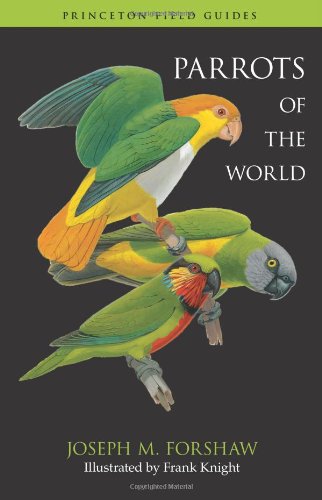
From the macaws of South America to the cockatoos of Australia, parrots are among the most beautiful and exotic birds in the world--and also among the most endangered. This stunningly illustrated, easy-to-use field guide covers all 356 species and well-differentiated subspecies of parrots, and is the only guide organized by geographical distribution--Australasian, Afro-Asian, and neotropical. It features 146 superb color plates depicting every kind of parrot, as well as detailed, facing-page species accounts that describe key identification features, distribution, subspeciation, habitat, and status. Color distribution maps show ranges of all subspecies, and field identification is further aided by relevant upperside and underside flight images. This premier field guide also shows where to observe each species in the wild, helping make this the most comprehensive and user-friendly guide to the parrots of the world.
- The only parrot guide to focus on geographical distribution
- Covers all 356 species
- Features 146 color plates depicting all species and well-differentiated subspecies
- Provides detailed facing-page species accounts that describe key identification features, distribution, subspeciation, habitat, and status
- Includes color distribution maps
- Shows where to observe each species in the wild
"synopsis" may belong to another edition of this title.
About the Author
Joseph M. Forshaw is one of Australia's foremost ornithologists and a world-renowned expert on parrots. His books include Parrots of the World: An Identification Guide (Princeton). Frank Knight has been an illustrator for three decades, producing artwork for scientific papers, books, and lectures. His books include The Field Guide to the Birds of Australia.
Excerpt. © Reprinted by permission. All rights reserved.
PARROTS OF THE WORLD
By JOSEPH M. FORSHAWPrinceton University Press
Copyright © 2010 Joseph M. ForshawAll right reserved.
ISBN: 978-0-691-14285-2
Contents
List of Color Plates........................................................6Preface.....................................................................8Plan of the Book............................................................10Introduction................................................................15Parrots in the Australasian Distribution (Plates 1-62)......................22Parrots in the Afro-Asian Distribution (Plates 63-76).......................146Parrots in the Neotropical Distribution (Plates 77-144).....................174Extinct or Presumed Extinct Parrots (Plates 145-146)........................310Index of English Names......................................................314Index of Scientific Names...................................................320
Chapter One
PLATE 1 BLACK COCKATOOS (in part)Large black cockatoos with or without colored tail-bands; mostly arboreal; forests and woodlands; seeds, fruits, and insect larvae in diet; labored flight with deep wingbeats; harsh screeches and shrill whistles.
PALM COCKATOO Probosciger aterrimus 60cm
Unmistakable; no colored tail-band; prominent crest; enormous bill; red naked face; sexes alike, JUV with yellow barring on underside; loud keer-eeeow whistle, and harsh raark. Rainforest and adjacent woodland; pairs or small groups. DISTRIBUTION New Guinea and adjacent islands, and northernmost Queensland, Australia; up to 1350m; declining, CITES I. SUBSPECIES three poorly differentiated and one distinctive subspecies. 1. P. a. aterrimus smaller size. Range Aru Islands and Misool in western Papuan Islands, Indonesia. 2. P. a. macgillivrayi larger than aterrimus. Range southern New Guinea, between Fly and Balim Rivers, and Cape York Peninsula, northernmost Queensland, Australia. 3. P. a. goliath larger than macgillivrayi. Range western Papuan Islands, except Misool, and southern New Guinea. 4. P. a. stenolophus like goliath, but narrower crest feathers. Range northern New Guinea. SIMILAR SPECIES Pesquet's Parrot Psittrichas fulgidus (plate 45) red underparts, no crest. Red-tailed Black Cockatoo Calyptorhynchus banksii (plate 2) tail-band red ([??]) or barred orange ([??]), different call. LOCALITIES Iron Range National Park, Cape York Peninsula, northernmost Queensland, Australia. Crater Mountain Research Station, Chimbu Province, Papua New Guinea.
YELLOW-TAILED BLACK COCKATOO Calyptorhynchus funereus 67cm
Unmistakable; yellow tail-band and ear-coverts; bill black ([??]) or white ([??]); eye-ring pink ([??]) or gray ([??]), JUV like [??]; loud keee-ow whistle. Pairs or flocks; attracted to Pinus plantations. DISTRIBUTION eastern Australia; up to 2000m; increasing. SUBSPECIES two subspecies differentiated mainly by size. 1. C. f. funereus larger size and longer tail with dark flecking. Range central Queensland south to eastern Victoria. 2. C. f. xanthanotus smaller size; shorter tail with little dark flecking. Range Tasmania and Bass Strait islands, where only black cockatoo, and eastern Victoria to southeastern South Australia. SIMILAR SPECIES Red-tailed C. banksii and Glossy C. lathami Black Cockatoos (plate 2) tail-band red ([??]) or barred orange ([??]); different calls. LOCALITIES Werrikimbe National Park, New South Wales. Cradle Mountain National Park, Tasmania.
CARNABY'S BLACK COCKATOO Calyptorhynchus latirostris 55cm
One of two almost indistinguishable black cockatoos with white tail-band and white ear-coverts; black ([??]) or white ([??]) bill without elongated upper mandible; eye-ring pink ([??]) or gray ([??]), JUV like [??]; loud wy-lah cry. Pairs or small flocks; attracted to Pinus plantations. DISTRIBUTION (see map above) southwestern Australia; endangered. SIMILAR SPECIES Baudin's Black Cockatoo C. baudinii (see below) with elongated upper mandible. Red-tailed Black Cockatoo C. banksii (plate 2) see above. LOCALITIES Yanchep, Moore River, and Lesueur National Parks, Western Australia.
BAUDIN'S BLACK COCKATOO Calyptorhynchus baudinii 56cm
Distinguishable from Carnaby's Black Cockatoo only at close quarters; bill with elongated upper mandible; more prolonged wy-lah call. Not attracted to Pinus plantations. DISTRIBUTION extreme southwestern Australia; near-threatened. SIMILAR SPECIES Carnaby's Black Cockatoo C. latirostris (see above) without elongated upper mandible. Red-tailed Black Cockatoo C. banksii (plate 2) see above. LOCALITIES Leeuwin-Naturaliste and D'Entrecasteaux National Parks, Western Australia.
RED-TAILED BLACK COCKATOO Calyptorhynchus banksii 60cm
Larger of two similar black cockatoos with tail-band red ([??]) or barred orange ([??] & JUV); prominent recumbent crest; far-carrying, screeching kree-ee or krur-rr. Noisy and conspicuous; often in flocks feeding on ground. DISTRIBUTION mainland Australia; common in north, scarce in south. SUBSPECIES five subspecies differ in size and female plumage. 1. C. b. banksii large size; [??] uniformly black; bill dark gray; [??] & JUV head and upper wing-coverts spotted pale yellow, underparts barred yellow, tailband barred orange, and bill white. Range north Queensland to northeastern New South Wales, northeastern Australia. 2. C. b. macrorhynchus large size; [??] like banksii; [??] & JUV like banksii, but pale barred tail-band, head and upper wing-coverts spotted palest yellow, and pale barring on underparts. Range Kimberleys to Gulf of Carpentaria, northern Australia. 3. C. b. samueli smaller than banksii. Range four isolated populations across inland eastern, central, and western Australia. 4. C. b. graptogyne like samueli, but [??] & JUV with head, upper wing-coverts and underparts more heavily marked with darker yellow. Range isolated in southwestern Victoria and southeastern South Australia; endangered. 5. C. b. naso like samueli, but larger bill; [??] & JUV with head, upper wing-coverts, and underparts more heavily marked yellow. Range extreme southwestern Australia; near-threatened. SIMILAR SPECIES Glossy Black Cockatoo C. lathami (see below) smaller with inconspicuous, short crest; bulbous bill; [??] with yellow patches, not spots on head, no yellow barring on underparts; quiet, inconspicuous; different call. Yellow-tailed Black Cockatoo C. funereus (plate 1) yellow tail-band and ear-coverts; different call. Carnaby's C. latirostris and Baudin's C. baudinii Black Cockatoos (plate 1) white tail-band and ear-coverts; different call. LOCALITIES Kakadu National Park, Northern Territory. Lakefield National Park, Queensland.
GLOSSY BLACK COCKATOO Calyptorhynchus lathami 48cm
Smaller black cockatoo with tail-band red ([??]) or barred orange ([??] & JUV); very short, inconspicuous crest; peculiarly bulbous bill; soft, wheezy taar-red. Feeds exclusively on seeds of casuarinas, so always in or near these trees; pairs or family trios; arboreal; quiet and unobtrusive. DISTRIBUTION coastal and subcoastal eastern Australia, including Kangaroo Island. SUBSPECIES three doubtful subspecies differ by bill size. 1. C. l. lathami head and underparts sooty brown; [??] with yellow feathers on head; JUV with yellow spots on upper wing-coverts and sides of head, and lower underparts barred pale yellow. Range southeastern Queensland to eastern Victoria; uncommon. 2. C. l. halmaturinus like lathami, but larger bill. Range Kangaroo Island, South Australia; endangered. 3. C. l. erebus like lathami, but smaller bill. Range Paluma Range to Dawson-Mackenzie-Isaac Rivers basin, northeastern Queensland; scarce. SIMILAR SPECIES Red-tailed Black Cockatoo C. banksii (see above) larger with prominent crest; [??] & JUV yellow spotted; noisy and conspicuous; different call. Yellow-tailed Black Cockatoo C. funereus (plate 1) yellow tail-band and ear-coverts; different call. LOCALITIES Werrikimbe National Park, New South Wales. Western River Conservation Park, Kangaroo Island, South Australia.
GANG GANG COCKATOO Callocephalon fimbriatum 35cm
Unmistakable; midsized pale-barred gray cockatoo with forward-curving filamentary crest; head and crest red ([??]) or gray ([??] & JUV); distinctive rasping call like rusty hinge. Cooler mountain and lowland forests, visiting urban gardens; pairs or small groups; arboreal; confiding and easily approached; "owl-like" flight with deep wingbeats. DISTRIBUTION southeastern mainland Australia from lat. 32S south to southeastern South Australia; up to 2000m; locally common, generally uncommon; introduced to Kangaroo Island, South Australia. LOCALITIES National Botanic Gardens, Canberra. Kosciuszko National Park, New South Wales.
GALAH Eolophus roseicapilla 35cm
Unmistakable; midsized pink and gray cockatoo with short, recumbent crest; carunculated bare eye-ring; iris dark brown ([??]), pink-red ([??]), or pale brown (JUV); distinctive chet and tit-ew. All wooded areas except dense forests; common in urban parklands; ubiquitous family groups to large flocks; feeds mostly on ground; strong flight with full, rhythmic wingbeats. DISTRIBUTION Australia generally, chiefly inland; mostly below 1300m; abundant in expanding range. SUBSPECIES two distinctive and one poorly differentiated subspecies. 1. E. r. roseicapilla crown and crest pale pink; eye-ring gray-white. Range western and central Australia, south of Great Sandy Desert and east to southern Northern Territory. 2. E. r. albiceps crown and crest white; eye-ring dull red. Range eastern Tasmania and eastern mainland Australia, north to about lat. 20S and west to Simpson Desert. 3. E. r. kuhli generally paler than albiceps; shorter crest. Range northern Australia, from Kimberley division of Western Australia east to north Queensland. LOCALITIES easily seen throughout range.
MAJOR MITCHELL'S COCKATOO Lophocroa leadbeateri (formerly Cacatua leadbeateri) 35cm
Unmistakable; midsized pink and white cockatoo with forward-curving multicolored crest; yellow band in crest narrow ([??]) or broad ([??]); iris dark brown ([??]), pink-red ([??]), or pale brown (JUV); quavering creek-ery-cree. Arid and semiarid woodlands; pairs or small flocks; feeds in trees or on ground; wary; flapping wingbeats with brief gliding. DISTRIBUTION inland Australia, except northeast; up to 300m; uncommon. SUBSPECIES two poorly differentiated subspecies. 1. L. l. leadbeateri crest scarlet with prominent yellow band. Range inland southeastern Australia, from southwestern Queensland and western New South Wales to northwestern Victoria and central-eastern South Australia. 2. L. l. mollis crest darker red with little or no yellow band ([??]) or ill-defined yellow band ([??]). Range inland western and central Australia, east to Eyre Peninsula and Lake Eyre basin, South Australia. LOCALITIES Currawinya National Park, Queensland. Hattah-Kulkyne National Park, Victoria. Eyre Bird Observatory, Western Australia.
YELLOW-CRESTED COCKATOO Cacatua sulphurea 33cm
Smaller of two white cockatoos with yellow forward-curving crest and black bill; yellow undersides of wings and tail; bare eye-ring cream-white; sexes alike, and JUV resembles adults; loud, harsh screeches. Forests, woodlands, plantations; pairs or small groups; mostly arboreal; wary; shallow wingbeats with gliding. DISTRIBUTION Sulawesi to Lesser Sunda Islands and islands in Flores and Java Seas, Indonesia; up to 1200m; critically endangered; introduced to Hong Kong and Singapore. SUBSPECIES three poorly differentiated and one distinctive subspecies. 1. C. s. sulphurea yellow ear-coverts and yellow bases to feathers of head and underparts. Range Sulawesi and adjacent islands and islands in Flores Sea; introduced to Hong Kong and Singapore. 2. C. s. parvula paler yellow ear-coverts and less yellow on head and underparts. Range Nusa Penida and Lesser Sunda Islands, except Sumba. 3. C. s. abbotti larger than parvula. Range Masalembu Island in Java Sea; near extinction. 4. C. s. citrinocristata (Citron-crested Cockatoo) crest and ear-coverts orange. Range Sumba, Lesser Sunda Islands. LOCALITIES Komodo National Park, Komodo Island. Langgaliru-Manipeu, Sumba Island.
SULPHUR-CRESTED COCKATOO Cacatua galerita 50cm
Larger than Yellow-crested Cockatoo; little yellow on ear-coverts or bases to feathers of head and underparts; raucous raa-aach. All wooded lands and many urban areas; mostly arboreal in north, ground-feeding in south; common cagebird; large flocks in south, mostly pairs and small groups in north; very noisy and conspicuous; shallow wingbeats with gliding. DISTRIBUTION northern and eastern Australia, New Guinea, and western Papuan and Aru Islands, Indonesia; up to 2000m; abundant in south, less numerous in north; introduced to southwestern Australia, New Zealand, Palau Islands in Micronesia, Kai Islands and some islands of East Moluccas, Indonesia, and Taiwan. SUBSPECIES five poorly differentiated subspecies. 1. C. g. galerita yellow suffusion on ear-coverts; white eye-ring. Range eastern and southeastern Australia, from Tasmania and southeastern South Australia north to north Queensland. 2. C. s. queenslandica smaller size; broader, ridged bill. Range Cape York Peninsula and southern Torres Strait islands, northernmost Queensland. 3. C. g. fitzroyi larger than queenslandica; eye-ring blue. Range northern Australia, from Kimberley division of Western Australia east to Gulf of Carpentaria, north Queensland. 4. C. g. triton like fitzroyi, but broader crest feathers. Range western Papuan Islands, Indonesia, and New Guinea; introduced to Palau Islands, some islands of East Moluccas, Indonesia, and probably the subspecies in Taiwan. 5. C. g. eleonora smaller than triton. Range Aru Islands; introduced to Kai Islands. SIMILAR SPECIES Corellas (plate 6) no yellow crest; white bill; different calls. LOCALITIES easily seen in range in Australia.
BLUE-EYED COCKATOO Cacatua ophthalmica 50cm
Large white cockatoo with backward-curving yellow crest, and only cockatoo in range; eye-ring blue; sexes alike, JUV resembles adults; nasal aa-aah or naa-aa. Forest canopy; arboreal; pairs or small groups; noisy and conspicuous; fluttering wingbeats with gliding. DISTRIBUTION New Britain, eastern Papua New Guinea. LOCALITY Wide Bay, eastern New Britain.
SALMON-CRESTED COCKATOO Cacatua moluccensis 52cm
Unmistakable, and only cockatoo in range; large salmon-pink cockatoo with backward-curving, deeper salmon-pink fan-like crest; black bill; eye-ring cream-white; sexes alike, JUV resembles adults; discordant, harsh screech. Forests and tall secondary growth; pairs and small groups; arboreal, wary; noisy and conspicuous; rapid, shallow wingbeats with short glides. DISTRIBUTION Seram, Haruku, and Saparua, in South Moluccas, Indonesia; also nearby Ambon, where possibly introduced; up to 900m; vulnerable and declining; CITES I. LOCALITIES Manusela National Park, Seram, and Hitu Peninsula, Ambon.
WHITE-CRESTED COCKATOO Cacatua alba 46cm
Unmistakable, and only cockatoo in range; large white cockatoo with backward-curving, all-white fan-like crest; black bill; eye-ring cream-white; sexes alike, JUV resembles adults; very nasal, high-pitched screech. Forests, woodlands, plantations; pairs, small groups or roosting flocks; arboreal; fairly tame, but wary where hunted; noisy and conspicuous; rapid, shallow wingbeats with short glides. DISTRIBUTION Halmahera and adjacent islands, North Moluccas, Indonesia; birds on Obi and Bisa, Central Moluccas, probably escaped pets; up to 900m, mostly below 600m; vulnerable and declining; introduced to Taiwan. SIMILAR SPECIES Sulphur-crested Cockatoo C. galerita (plate 4) sympatric feral population in Taiwan; prominent forward-curving yellow crest. LOCALITY Kali Batu Putih, Halmahera, North Moluccas.
PLATE 6 CORELLAS (in part
Midsized to large white cockatoos with short, recumbent crest and white bill; yellow underwings and undertail; prominent bare eye-ring; sexes alike, JUV resembles adults. Noisy and conspicuous; often in large flocks, especially at roosts near water; fluttering wingbeats with short glides.
SLENDER-BILLED CORELLA Cacatua tenuirostris 37cm
Smaller of two corellas with elongated, sharply-pointed bill; frontal band, lores, band across foreneck, and bases to feathers of head and breast scarlet; blue eye-ring more extensive beneath eye; quavering curr-ur-rup. Woodlands and farmlands; feeds on ground, digging up seeds, roots, and bulbs. DISTRIBUTION southeastern mainland Australia from southeastern South Australia to central Victoria and southwestern New South Wales; up to 400m; feral populations in or near many urban centers outside natural range; very common. SIMILAR SPECIES Little Corella C. sanguinea (see below) no scarlet band on foreneck; short, blunt bill. LOCALITIES Deniliquin, New South Wales. Grampians National Park, Victoria.
WESTERN CORELLA Cacatua pastinator 45cm
Larger than Slender-billed Corella and without scarlet band across foreneck; trisyllabic chuckling. Forests, woodlands and farmlands; feeds on ground. DISTRIBUTION southwestern Australia; up to 400m. SUBSPECIES two subspecies differentiated by size. 1. C. p. pastinator larger size. Range extreme southwest, mostly near Lake Muir; endangered. 2. C. p. derbyi smaller size. Range wheatbelt from Geraldton south to about lat. 32S; common and increasing. SIMILAR SPECIES Little Corella C. sanguinea (see below) distinguishable only at close quarters when short, blunt bill visible. LOCALITIES Lake Muir Reserve and Watheroo National Park, Western Australia.
(Continues...)
Excerpted from PARROTS OF THE WORLDby JOSEPH M. FORSHAW Copyright © 2010 by Joseph M. Forshaw. Excerpted by permission.
All rights reserved. No part of this excerpt may be reproduced or reprinted without permission in writing from the publisher.
Excerpts are provided by Dial-A-Book Inc. solely for the personal use of visitors to this web site.
"About this title" may belong to another edition of this title.
Search results for Parrots of the World (Princeton Field Guides)

Stock Image
Parrots of the World
Published by
Princeton University Press, 2010
ISBN 10: 0691142858
ISBN 13: 9780691142852
Used
Paperback
Seller: World of Books (was SecondSale), Montgomery, IL, U.S.A.
Seller rating 5 out of 5 stars

Paperback. Condition: Good. Frank Knight (illustrator). From the macaws of South America to the cockatoos of Australia, parrots are among the most beautiful and exotic birds in the world - and also among the most endangered. This guide covers 356 species and well-differentiated subspecies of parrots. It is organized by geographical distribution - Australasian, Afro-Asian, and neotropical. Seller Inventory # 00107833050
Stock Image
Parrots of the World
Published by
Princeton University Press, 2010
ISBN 10: 0691142858
ISBN 13: 9780691142852
Used
Paperback
Seller: World of Books Inc, Montgomery, IL, U.S.A.
Seller rating 4 out of 5 stars

Paperback. Condition: Good. Frank Knight (illustrator). From the macaws of South America to the cockatoos of Australia, parrots are among the most beautiful and exotic birds in the world - and also among the most endangered. This guide covers 356 species and well-differentiated subspecies of parrots. It is organized by geographical distribution - Australasian, Afro-Asian, and neotropical. Seller Inventory # CIN0691142858G
Stock Image
Parrots of the World (Princeton Field Guides)
Published by
Princeton University Press, 2010
ISBN 10: 0691142858
ISBN 13: 9780691142852
Used
paperback
Seller: Books-R-Keen, DuBois, PA, U.S.A.
Seller rating 5 out of 5 stars
paperback. Condition: Good. Frank Knight (illustrator). Used items may contain, highlighting, writing, and other previous signs of use. Used items may not contain CD's. access codes and other accompanying items when applicable. Seller Inventory # 57B60705
Stock Image
Parrots of the World (Princeton Field Guides)
Published by
Princeton University Press, 2010
ISBN 10: 0691142858
ISBN 13: 9780691142852
New
Paperback
Seller: GoldBooks, Denver, CO, U.S.A.
Seller rating 5 out of 5 stars
Paperback. Condition: new. Frank Knight (illustrator). New Copy. Customer Service Guaranteed. Seller Inventory # 14N75_35_0691142858
Stock Image
Parrots of the World (Princeton Field Guides (70))
Published by
Princeton University Press, 2010
ISBN 10: 0691142858
ISBN 13: 9780691142852
Used
Softcover
Seller: Labyrinth Books, Princeton, NJ, U.S.A.
Seller rating 5 out of 5 stars
Condition: Good. Frank Knight (illustrator). Seller Inventory # 127041