
Items related to Philosophical Logic (Princeton Foundations of Contemporary...
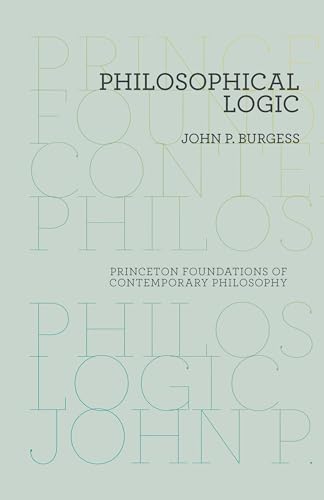
Synopsis
A brief account of philosophical logic from one of the world's leading authorities
Philosophical Logic is a clear and concise critical survey of nonclassical logics of philosophical interest written by one of the world's leading authorities on the subject. After giving an overview of classical logic, John Burgess introduces five central branches of nonclassical logic (temporal, modal, conditional, relevantistic, and intuitionistic), focusing on the sometimes problematic relationship between formal apparatus and intuitive motivation. Requiring minimal background and arranged to make the more technical material optional, the book offers a choice between an overview and in-depth study, and it balances the philosophical and technical aspects of the subject.
The book emphasizes the relationship between models and the traditional goal of logic, the evaluation of arguments, and critically examines apparatus and assumptions that often are taken for granted. Philosophical Logic provides an unusually thorough treatment of conditional logic, unifying probabilistic and model-theoretic approaches. It underscores the variety of approaches that have been taken to relevantistic and related logics, and it stresses the problem of connecting formal systems to the motivating ideas behind intuitionistic mathematics. Each chapter ends with a brief guide to further reading.
Philosophical Logic addresses students new to logic, philosophers working in other areas, and specialists in logic, providing both a sophisticated introduction and a new synthesis.
"synopsis" may belong to another edition of this title.
About the Author
John P. Burgess is professor of philosophy at Princeton University. His books include Fixing Frege and Truth, which was cowritten with his son, Alexis G. Burgess.
From the Back Cover
"Nicely done and very useful for someone who wants a compact and accessible introduction to nonclassical logic."--Kit Fine, New York University
"This book is terrific. It covers the basics of philosophical logic in a lively, interesting, and informative way. Readers do not have to wade through pages and pages of technical material. Instead, they get the basics, and the big picture."--Stewart Shapiro, editor of The Oxford Handbook of Philosophy of Mathematics and Logic
"About this title" may belong to another edition of this title.
Search results for Philosophical Logic (Princeton Foundations of Contemporary...

Stock Image
Philosophical Logic
Published by
Princeton University Press, 2012
ISBN 10: 0691156336
ISBN 13: 9780691156330
Used
Paperback
Seller: World of Books (was SecondSale), Montgomery, IL, U.S.A.
Seller rating 5 out of 5 stars

Paperback. Condition: Good. Philosophical Logic is a clear and concise critical survey of nonclassical logics of philosophical interest written by one of the world's leading authorities on the subject. After giving an overview of classical logic, John Burgess introduces five central branches of nonclassical logic (temporal, modal, conditional, relevantistic, and intuitionisti. Seller Inventory # 00104419376
Stock Image
Philosophical Logic
Published by
Princeton University Press, 2012
ISBN 10: 0691156336
ISBN 13: 9780691156330
Used
Paperback
Seller: World of Books (was SecondSale), Montgomery, IL, U.S.A.
Seller rating 5 out of 5 stars
Paperback. Condition: Fair. Philosophical Logic is a clear and concise critical survey of nonclassical logics of philosophical interest written by one of the world's leading authorities on the subject. After giving an overview of classical logic, John Burgess introduces five central branches of nonclassical logic (temporal, modal, conditional, relevantistic, and intuitionisti. Seller Inventory # CIN0691156336A
Seller Image
Philosophical Logic (Princeton Foundations of Contemporary Philosophy)
Published by
Princeton University Press, 2012
ISBN 10: 0691156336
ISBN 13: 9780691156330
Used
Softcover
Seller: -OnTimeBooks-, Phoenix, AZ, U.S.A.
Seller rating 5 out of 5 stars
Condition: very_good. Gently read. May have name of previous ownership, or ex-library edition. Binding tight; spine straight and smooth, with no creasing; covers clean and crisp. Minimal signs of handling or shelving. 100% GUARANTEE! Shipped with delivery confirmation, if you're not satisfied with purchase please return item! Ships USPS Media Mail. Seller Inventory # OTV.0691156336.VG
Seller Image
Philosophical Logic (Princeton Foundations of Contemporary Philosophy)
Published by
Princeton University Press, 2012
ISBN 10: 0691156336
ISBN 13: 9780691156330
Used
Softcover
Seller: Goodwill of Central and Coastal Virginia, Richmond, VA, U.S.A.
Seller rating 4 out of 5 stars

Condition: acceptable. Seller Inventory # CCVV.0691156336.A
Stock Image
Philosophical Logic
Published by
Princeton University Press, 2012
ISBN 10: 0691156336
ISBN 13: 9780691156330
Used
Paperback
Seller: World of Books Inc, Montgomery, IL, U.S.A.
Seller rating 4 out of 5 stars
Paperback. Condition: Good. Philosophical Logic is a clear and concise critical survey of nonclassical logics of philosophical interest written by one of the world's leading authorities on the subject. After giving an overview of classical logic, John Burgess introduces five central branches of nonclassical logic (temporal, modal, conditional, relevantistic, and intuitionisti. Seller Inventory # CIN0691156336G
Stock Image
Philosophical Logic
Published by
Princeton University Press, 2012
ISBN 10: 0691156336
ISBN 13: 9780691156330
Used
Paperback
Seller: World of Books Inc, Montgomery, IL, U.S.A.
Seller rating 4 out of 5 stars
Paperback. Condition: Fair. Philosophical Logic is a clear and concise critical survey of nonclassical logics of philosophical interest written by one of the world's leading authorities on the subject. After giving an overview of classical logic, John Burgess introduces five central branches of nonclassical logic (temporal, modal, conditional, relevantistic, and intuitionisti. Seller Inventory # CIN0691156336A
Stock Image
Philosophical Logic (Princeton Foundations of Contemporary Philosophy)
Published by
Princeton University Press, 2012
ISBN 10: 0691156336
ISBN 13: 9780691156330
New
Soft cover
Seller: Olimpianbooks, Avon Lake, OH, U.S.A.
Seller rating 5 out of 5 stars
Soft cover. Condition: New. Brand New. MINT. Seller Inventory # k4 horizo abe
Stock Image
Philosophical Logic (Princeton Foundations of Contemporary Philosophy)
Published by
Princeton University Press, 2012
ISBN 10: 0691156336
ISBN 13: 9780691156330
Used
Paperback
Seller: Books From California, Simi Valley, CA, U.S.A.
Seller rating 4 out of 5 stars
Paperback. Condition: Good. Seller Inventory # mon0003913726
Seller Image
Philosophical Logic
Published by
Princeton University Press, 2012
ISBN 10: 0691156336
ISBN 13: 9780691156330
New
Softcover
Seller: GreatBookPrices, Columbia, MD, U.S.A.
Seller rating 5 out of 5 stars
Condition: New. Seller Inventory # 17188464-n
Seller Image
Philosophical Logic
Published by
Princeton University Press, US, 2012
ISBN 10: 0691156336
ISBN 13: 9780691156330
New
Paperback
Seller: Rarewaves USA, HEBRON, KY, U.S.A.
Seller rating 5 out of 5 stars
Paperback. Condition: New. Philosophical Logic is a clear and concise critical survey of nonclassical logics of philosophical interest written by one of the world's leading authorities on the subject. After giving an overview of classical logic, John Burgess introduces five central branches of nonclassical logic (temporal, modal, conditional, relevantistic, and intuitionistic), focusing on the sometimes problematic relationship between formal apparatus and intuitive motivation. Requiring minimal background and arranged to make the more technical material optional, the book offers a choice between an overview and in-depth study, and it balances the philosophical and technical aspects of the subject. The book emphasizes the relationship between models and the traditional goal of logic, the evaluation of arguments, and critically examines apparatus and assumptions that often are taken for granted. Philosophical Logic provides an unusually thorough treatment of conditional logic, unifying probabilistic and model-theoretic approaches.It underscores the variety of approaches that have been taken to relevantistic and related logics, and it stresses the problem of connecting formal systems to the motivating ideas behind intuitionistic mathematics. Each chapter ends with a brief guide to further reading. Philosophical Logic addresses students new to logic, philosophers working in other areas, and specialists in logic, providing both a sophisticated introduction and a new synthesis. Seller Inventory # LU-9780691156330