
Synopsis
The patterns and fabrics of American knitting are an intricate, and intimate, part of the nations history, reflecting the styles and the interests, the concerns and the comforts that touched every homebody, every newborn and newlywed, every homesick patriot in the field.
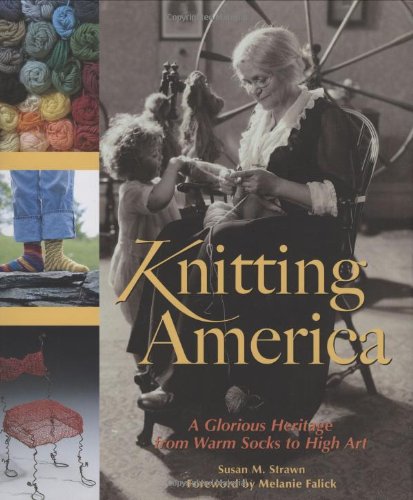
This is the history that Knitting America celebrates. The first fully detailed, full-color, comprehensive history of knitting in America from colonial times to the present, the book conveys the social and historical realities that the craft embodied as well as the emotional narrative that unfolded at the hands of the nations knitters. With vintage patterns and designs typical of each era, Knitting America comprises a knitted history of American society. Here are the trends and the shortages, the historical happenings and the social movements, the advertising and economic developments that affected knitting and style.
Also included are 20 historic knitting patterns for todays knitters. Beautifully illustrated with vintage pattern booklets, posters, postcards, black-and-white historical photographs, and contemporary color photographs of knitted pieces in private collections and in museums, this book is a treasure of history and craft, an exquisite view of America through the handiwork of its knitters.
"synopsis" may belong to another edition of this title.
About the Author
Knitter, writer, and illustrator Susan Strawn has a Ph.D. in Textiles and Clothing from Iowa State University. A regular contributor to Piecework, Interweave Knits, Spin-Off, and other textile magazines and journals, she presented a paper entitled \u201cBack to the Knitting Needle: Manufacturers, retailers, and the image of handknitting in America, 1935-1955\u201d to the Costume Society of America. Strawn teaches textile-related classes at Dominican University in River Forest, Illinois, and researches hand-produced traditional textiles. She lives in Oak Park, IL, a suburb of Chicago.Knitter, writer, and illustrator Susan Strawn has a Ph.D. in Textiles and Clothing from Iowa State University. A regular contributor to Piecework, Interweave Knits, Spin-Off, and other textile magazines and journals, she presented a paper entitled "Back to the Knitting Needle: Manufacturers, retailers, and the image of handknitting in America, 1935-1955" to the Costume Society of America. Strawn teaches textile-related classes at Dominican University in River Forest, Illinois, and researches hand-produced traditional textiles. She lives in Oak Park, IL, a suburb of Chicago.
Excerpt. © Reprinted by permission. All rights reserved.
Introduction Knitting America This is a book that tells many stories about knitting in America. There are stories about ways that knitting was brought to America and helped provide for the early settlers who spread across the land. There is a story about the role knitting played in one of America's first best-selling books, the captivity narrative of Mary Rowlandson. Yarn and knitting needles in portraits of American women tell the story of personal industry and of dedication to home and family. And there are stories too numerous to mention about knitting during America's many wars, all except one war. The story of American knitting also holds many success stories about immigrants who founded yarn companies and about knitting instructors and designers who carved out careers in the knitting industry.
Bishop Rutt, the eminent historian of hand knitting, wrote, "Information about the history of hand knitting in the United States is hard to find." I understand how he felt. The history of knitting can be illusive. In the past, knitters have seldom thought to mention such an ordinary, everyday part of life as knitting. And most things that are knit are practical. They are intended to be used up and worn out, not preserved under glass. Writing this book, I learned that knitting was there in the historical record, but I had to look closely and develop a certain savvy about finding it. Once I did, my dilemma changed from desperate searching to coping with an encroaching avalanche of information about knitting that appeared in the historical record.
Without technological advances in the way our civilization stores and retrieves knowledge, this book would have taken a lifetime to research and write. So many scholarly articles and books have been digitized and can be searched for references to knitting (or "stocking" or "mitten"). In the past, this simple task carried out now in a few keyboard strokes would have required extensive travel, research permission, and weeks of reading. The presidential papers at the Library of Congress, for example, have been transcribed, so online keyword searches uncovered the history of women who sent hand knit stockings to President Abraham Lincoln. And I discovered more stories about knitters who are otherwise lost to history.
Collections of photographs, many digitized and searchable in online databases, often raise more questions than answers about knitters and knitting. Why was a Japanese American woman photographed with her knitting in a World War II internment camp? Similarly, collections of hand knits, seldom digitized or searchable online, hold stories of families who preserved and donated them to museums. If knitting is intended to be used and worn out, why are so many everyday pieces of practical hand knits donated to museums? Without the librarians and collection curators, the fragile stories in the photos and textiles would also be lost to history.
One purpose of this book is to entertain. Another is to consider knitting as a topic worthy of serious research. If you close your eyes and place your finger on any page of this book, you will find a topic for a thesis, dissertation, or biography. More than anything else the stories in this book are intended to honor the craft of knitting and take knitting beyond its often trivialized stereotype.
"About this title" may belong to another edition of this title.
Other Popular Editions of the Same Title

Search results for Knitting America: A Glorious Heritage from Warm Socks...

Seller Image
Knitting America: A Glorious Heritage from Warm Socks to High Art
Seller: -OnTimeBooks-, Phoenix, AZ, U.S.A.
Seller rating 5 out of 5 stars

Condition: very_good. Gently read. May have name of previous ownership, or ex-library edition. Binding tight; spine straight and smooth, with no creasing; covers clean and crisp. Minimal signs of handling or shelving. 100% GUARANTEE! Shipped with delivery confirmation, if you're not satisfied with purchase please return item! Ships USPS Media Mail. Seller Inventory # OTV.0760326215.VG
Stock Image
Knitting America: A Glorious Heritage from Warm Socks to High Art
Seller: Books From California, Simi Valley, CA, U.S.A.
Seller rating 4 out of 5 stars

hardcover. Condition: Very Good. Seller Inventory # mon0004126922
Stock Image
Knitting America: A Glorious Heritage from Warm Socks to High Art
Seller: World of Books (was SecondSale), Montgomery, IL, U.S.A.
Seller rating 5 out of 5 stars
Condition: Good. Item in good condition. Textbooks may not include supplemental items i.e. CDs, access codes etc. Seller Inventory # 00103718423
Stock Image
Knitting America: A Glorious Heritage from Warm Socks to High Art
Seller: HPB Inc., Dallas, TX, U.S.A.
Seller rating 5 out of 5 stars
Hardcover. Condition: Very Good. Connecting readers with great books since 1972! Used books may not include companion materials, and may have some shelf wear or limited writing. We ship orders daily and Customer Service is our top priority! Seller Inventory # S_472678946
Stock Image
Knitting America: A Glorious Heritage from Warm Socks to High Art
Seller: HPB-Diamond, Dallas, TX, U.S.A.
Seller rating 5 out of 5 stars
Hardcover. Condition: Very Good. Connecting readers with great books since 1972! Used books may not include companion materials, and may have some shelf wear or limited writing. We ship orders daily and Customer Service is our top priority! Seller Inventory # S_473094716
Stock Image
Knitting America: A Glorious Heritage from Warm Socks to High Art
Seller: GoldBooks, Denver, CO, U.S.A.
Seller rating 5 out of 5 stars
Hardcover. Condition: new. New Copy. Customer Service Guaranteed. Seller Inventory # 98H95_92_0760326215
Stock Image
Knitting America: A Glorious Heritage from Warm Socks to High Art
Seller: Revaluation Books, Exeter, United Kingdom
Seller rating 5 out of 5 stars
Hardcover. Condition: Brand New. 208 pages. 11.00x9.50x1.00 inches. In Stock. Seller Inventory # 0760326215
Buy New
US$ 122.74
US$ 20.17 shipping
Ships from United Kingdom to U.S.A.
Ships from United Kingdom to U.S.A.
Quantity: 1 available