
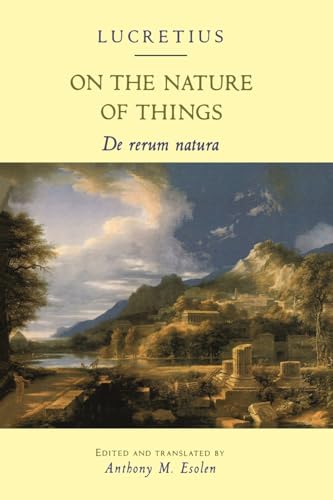
Synopsis
"Anthony Esolen has the rare gift of being both a fine poet and a lover of languages. His diction is poetic and natural; he has a fine ear for sound, and the translation benefits greatly from being read aloud--as Latin poetry was meant to be. Esolen's verse translation is clear and forceful. It can, and will, be read."--Kenneth J. Reckford, University of North Carolina, Chapel Hill
Little is known about Titus Lucretius Carus, except that he lived in the early first century B.C. What does survive is a masterful poetic work that stands as the greatest exposition of Epicurean philosophy. Writing in the waning days of the Roman Republic--as Rome's politics grew individualistic and treacherous, its high-life wanton, its piety introspective and morbid--Lucretius sets forth a rational and materialistic view of the world which offers a retreat into a quiet community of wisdom and friendship.
Until now, there has been no adequate English verse translation of De Rarum Natura. Anthony Esolen fills that gap with a version that reproduces--with remarkable faithfulness--the meaning, pace, and tone and even the poetic meter (accentual pentameter) of the original Latin.
A careful observer of nature, Lucretius writes with an innocent curiosity into how things are put together--from the oceans, lands, and stars to a mound of poppy seeds, from the "applause" of a rooster's wings to the human mind and soul. Yet he is no romantic. Nature is what it is--fascinating,purposeless, beautiful, deadly. Once we understand this, we free ourselves of superstitious fears, becoming as human and as godlike as we can be. The poem, then, is about the universe and how human beings ought to live in it. Epicurean physics and morality converge.
Anthony Esolen's masterful translation will introduce a new generation of readers to a thinker whose powers of observation and depth of insight remain fresh to the present day.
"synopsis" may belong to another edition of this title.
About the Author
Anthony Esolen is the author of over twenty-five books and over 600 articles in both scholarly and general interest journals. A senior editor of Touchstone: A Journal of Mere Christianity, Esolen is known for his elegant essays on the faith and for his clear social commentaries. His articles appear regularly in Touchstone, Crisis, First Things, Public Discourse, The Catholic Thing, Chronicles, and Magnificat. An accomplished poet in his own right, Esolen is known for his widely acclaimed three-volume verse translation of Dante's Divine Comedy (Modern Library) and for his verse translation of Tasso's Jerusalem Delivered (Johns Hopkins). His Ten Ways to Destroy the Imagination of Your Child has been described as "a worthy successor to C.S. Lewis's The Abolition of Man." And its sequel, Life Under Compulsion, has been called "essential reading for parents, educators, and anyone who is concerned to rescue children from the tedious and vacuous thing childhood has become." His recent books include Out of the Ashes: Rebuilding American Culture, Nostalgia: Going Home in a Homeless World, and, No Apologies: How Civilization Depends on the Strength of Men.
The grandson of Italian immigrants to America, Dr. Esolen was born and raised in the coal-mining country of Northeastern Pennsylvania. He received his B.A. from Princeton University, and his Ph. D. from the University of North Carolina, Chapel Hill. He is a professor of humanities and writer-in-residence at Magdalen College of the Liberal Arts in Warner, New Hampshire.
"About this title" may belong to another edition of this title.
Other Popular Editions of the Same Title

Search results for On the Nature of Things: De rerum natura

Stock Image
On the Nature of Things: De rerum natura
Published by
Johns Hopkins University Press, 1995
ISBN 10: 080185055X
ISBN 13: 9780801850554
Used
Softcover
Seller: World of Books (was SecondSale), Montgomery, IL, U.S.A.
Seller rating 5 out of 5 stars

Condition: Good. Item in good condition. Textbooks may not include supplemental items i.e. CDs, access codes etc. Seller Inventory # 00103742428
Stock Image
On the Nature of Things: De rerum natura
Published by
Cengage Learning (edition First Edition), 1995
ISBN 10: 080185055X
ISBN 13: 9780801850554
Used
Paperback
First Edition
Seller: BooksRun, Philadelphia, PA, U.S.A.
Seller rating 5 out of 5 stars
Paperback. Condition: Very Good. First Edition. It's a well-cared-for item that has seen limited use. The item may show minor signs of wear. All the text is legible, with all pages included. It may have slight markings and/or highlighting. Seller Inventory # 080185055X-11-1
Stock Image
On the Nature of Things: De rerum natura
Seller: Open Books, Chicago, IL, U.S.A.
Seller rating 5 out of 5 stars
Paperback. Condition: Good. General wear from age and use. Open Books is a nonprofit social venture that provides literacy experiences for thousands of readers each year through inspiring programs and creative capitalization of books. Seller Inventory # mon0000830255
Stock Image
On the Nature of Things: De rerum natura
Published by
Cengage Learning, 1995
ISBN 10: 080185055X
ISBN 13: 9780801850554
Used
paperback
First Edition
Seller: Textbooks_Source, Columbia, MO, U.S.A.
Seller rating 5 out of 5 stars
paperback. Condition: Good. First Edition. Ships in a BOX from Central Missouri! May not include working access code. Will not include dust jacket. Has used sticker(s) and some writing or highlighting. UPS shipping for most packages, (Priority Mail for AK/HI/APO/PO Boxes). Seller Inventory # 000263106U
Seller Image
On the Nature of Things : De Rerum Natura
Seller: GreatBookPrices, Columbia, MD, U.S.A.
Seller rating 5 out of 5 stars
Condition: good. May show signs of wear, highlighting, writing, and previous use. This item may be a former library book with typical markings. No guarantee on products that contain supplements Your satisfaction is 100% guaranteed. Twenty-five year bookseller with shipments to over fifty million happy customers. Seller Inventory # 262972-5
Stock Image
On the Nature of Things: De rerum natura
Seller: medimops, Berlin, Germany
Seller rating 5 out of 5 stars
Condition: good. Befriedigend/Good: Durchschnittlich erhaltenes Buch bzw. Schutzumschlag mit Gebrauchsspuren, aber vollständigen Seiten. / Describes the average WORN book or dust jacket that has all the pages present. Seller Inventory # M0080185055X-G
Buy Used
US$ 25.80
US$ 11.64 shipping
Ships from Germany to U.S.A.
Ships from Germany to U.S.A.
Quantity: 1 available
Stock Image
On the Nature of Things (Paperback)
Published by
Johns Hopkins University Press, Baltimore, MD, 1995
ISBN 10: 080185055X
ISBN 13: 9780801850554
New
Paperback
Seller: Grand Eagle Retail, Bensenville, IL, U.S.A.
Seller rating 5 out of 5 stars
Paperback. Condition: new. Paperback. Titus Lucretius Carus was probably born in the early first century B.C., and died in the year 55. Little is known of his life, although two tantalizing bits of gossip were passed on by St. Jerome: that he was poisoned by a madness-inducing aphrodisiac given him by his wife, and that his great poem On the Nature of Things was posthumously edited by Cicero. For the latter assertion, writes Anthony Esolen in his introduction to the present volume, there is little evidence, and none whatsoever for the former. What does survive is a masterful poetic work that stands as the greatest exposition of Epicurean philosophy. Writing in the waning days of the Roman Republic-as Rome's politics grew individualistic and treacherous, its high-life wanton, its piety introspective and morbid-Lucretius sets forth a rational and materialistic view of the world which offers a retreat into a quiet community of wisdom and friendship. Even to modern readers, the sweep of Lucretius's observations is remarkable.A careful observer of nature, he writes with an innocent curiosity into how things are put together-from the oceans, lands, and stars to a mound of poppy seeds, from the "applause" of a rooster's wings to the human mind and soul. Yet Lucretius is no romantic. Nature is what it is-fascinating,purposeless, beautiful, deadly. Once we understand this, we free ourselves of superstitious fears, becoming as human and as godlike as we can be. The poem, then, is about the universe and how human beings ought to live in it. Epicurean physics and morality converge. Until now, there has been no adequate English verse translation of Lucretius's work. Anthony Esolen fills that gap with a version that reproduces-with remarkable faithfulness-the meaning, pace, and tone of the original Latin. Here is a book that will introduce a new generation of readers to a thinker whose powers of observation and depth of insight remain fresh to the present day. "Esolen has the rare gift of being both a fine poet and a lover of languages. His diction is poetic and natural; he has a fine ear for sound, and the translation benefits greatly from being read aloud-as Latin poetry was meant to be.This translation is clear and forceful. It can, and will, be read."-Kenneth J. Reckford, University of North Carolina, Chapel Hill "-Kenneth J. Reckford, University of North Carolina, Chapel Hill Shipping may be from multiple locations in the US or from the UK, depending on stock availability. Seller Inventory # 9780801850554
Seller Image
On the Nature of Things : De Rerum Natura
Seller: GreatBookPrices, Columbia, MD, U.S.A.
Seller rating 5 out of 5 stars
Condition: New. Seller Inventory # 262972-n
Stock Image
ON THE NATURE OF THINGS. DE RERUM NATURA
Published by
JOHNS HOPKINS UNIVERSITY PRESS, 1995
ISBN 10: 080185055X
ISBN 13: 9780801850554
New
Rustica (tapa blanda)
Seller: Antártica, Madrid, M, Spain
Seller rating 5 out of 5 stars
Rustica (tapa blanda). Condition: New. Dust Jacket Condition: Nuevo. 1. Little is known about Titus Lucretius Carus, except that he lived in the early first century B.C. What does survive is a masterful poetic work that stands as the greatest exposition of Epicurean philosophy. Writing in the waning days of the Roman Republic--as Romes politics grew individualistic and treacherous, its high-life wanton, its piety introspective and morbid--Lucretius sets forth a rational and materialistic view of the world which offers a retreat into a quiet community of wisdom and friendship. LIBRO. Seller Inventory # 439798
Seller Image
On the Nature of Things: de Rerum Natura (Paperback or Softback)
Published by
Johns Hopkins University Press 6/19/1995, 1995
ISBN 10: 080185055X
ISBN 13: 9780801850554
New
Paperback or Softback
Seller: BargainBookStores, Grand Rapids, MI, U.S.A.
Seller rating 5 out of 5 stars
Paperback or Softback. Condition: New. On the Nature of Things: de Rerum Natura. Book. Seller Inventory # BBS-9780801850554