
Items related to Alan Jay Lerner: A Biography
Synopsis
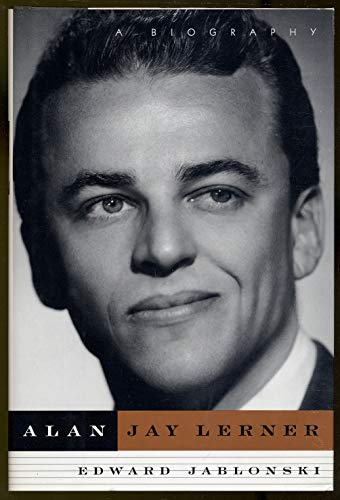
During his lifetime, Alan Jay Lerner received every imaginable award in American musical theater, and rightly so: As the lyricist of such astonishing Broadway successes as Brigadoon, My Fair Lady, Gigi, and Camelot, he was one of its architects. He was also one of its last greats, never quite able to regain his footing once the face of Broadway changed for good in the 1960s. Here, noted scholar of musical theater Edward Jablonski tells the story of Lerner's career and of his personal life, filling in the cracks purposely left open in Lerner's own autobiography.
A well-off child of the Depression, Lerner was born in New York City, the son of the founder and president of Lerner Stores. Following an education in England and at Harvard, he ended up in New York, where he wrote advertising copy, radio scripts, and spring gambols for the Lambs Club. While lunching at the Lambs one day, he was approached by composer Frederick Loewe, who asked Lerner if he would like to work with him - and thus began a celebrated collaboration.
Lerner also worked with a roll call of Broadway's and Hollywood's best, with varying degrees of success: Fred Astaire and Jane Powell (Royal Wedding), Kurt Weill (Love Life), Burton Lane (On a Clear Day You Can See Forever), Leonard Bernstein (1600 Pennsylvania Avenue), and, of course, Rex Harrison and Julie Andrews (My Fair Lady). He experienced the vertiginous highs of being at Broadway's pinnacle: My Fair Lady ran for 2,717 performances in New York, establishing Lerner's reputation as a master of urbane, highly literate songwriting. But when his money ran out - as did the Broadway for which he had been born - his life soured, and, by all accounts, it was something he himself failed to realize. Compelled to keep working by a nervous drive and a stubborn perfectionism, Lerner in later years wrote lyrics for some famously troubled productions. His personal life became just as tangled: All eight of his marriages ended in acrimonious and well-publicized dissolutions, and he was an anxiety-ridden spendthrift to the end.
"synopsis" may belong to another edition of this title.
Reviews
In this bloodless biography, Jablonski chronicles the life and career of the noted lyricist and screenwriter Alan Jay Lerner (1918-1986) from his earliest project, the 1938 Harvard Hasty Pudding Club production of So Proudly We Hail, to his last show, Dance A Little Closer, a dismal failure that closed after opening night in 1983. In between, there were numerous successes, including Brigadoon, Paint Your Wagon, My Fair Lady and the movie Gigi, and many disappointments on Broadway as well as in life. Lerner, the son of the founder of the Lerner stores, was difficult to work with, partly because he was addicted to amphetamines and an incorrigible procrastinator, and also because he was constantly involved in divorce proceedings (he married eight times). Eventually, his most important collaborator, the composer Frederick Loewe, got fed up and retired. Lerner was then allied with a number of other composers, including Burton Lane, Andre Previn and Leonard Bernstein. Jablonski (George Gershwin) dutifully recounts the progress of each of Lerner's theatrical ventures but fails to shed much light on the talent behind some of America's greatest lyrics and screenplays. Photos not seen by PW.
Copyright 1996 Reed Business Information, Inc.
As lyricist and bookwriter, Alan Jay Lerner was responsible for some of the most enduring stage and screen musicals--Brigadoon, An American in Paris, Gigi, Camelot. Moreover, his lyrics are among the most playfully literate and romantic in the genre. Yet, as Jablonski points out in this affectionate yet uneven biography, Lerner's personal life was a shambles. A workaholic and "speed" freak, he married only slightly more frequently than he divorced, and nothing he wrote during his last 29 years equaled the power and beauty of the magnificent My Fair Lady (1956). Once, with his partner Frederick Loewe, the rival of Rodgers and Hammerstein, Lerner died virtually penniless and owing the IRS thousands. Jablonski charts Lerner's slow rise in the theater world, from college shows to early flops to first glimmers of success, with the passion of a true lover of the American musical. Alas, he spends too much time thereafter recounting in tedious detail the plots of Lerner's shows and not enough time unraveling the mystery of Lerner's wonderful songs or the mystery of his melancholy life. Jack Helbig
"About this title" may belong to another edition of this title.
Search results for Alan Jay Lerner: A Biography

Stock Image
Alan Jay Lerner: A Biography
Seller: World of Books (was SecondSale), Montgomery, IL, U.S.A.
Seller rating 5 out of 5 stars

Hardback. Condition: Good. Seller Inventory # 00109972310
Seller Image
Alan Jay Lerner: A Biography
Seller: Greenworld Books, Arlington, TX, U.S.A.
Seller rating 5 out of 5 stars
Condition: very_good. Fast Free Shipping â" Very Good condition book with a firm cover and clean pages. Shows normal use and some light wear or limited notes markings. A solid, nice copy to enjoy. Seller Inventory # GWV.0805040765.VG
Stock Image
Alan Jay Lerner: A Biography
Seller: ThriftBooks-Dallas, Dallas, TX, U.S.A.
Seller rating 5 out of 5 stars
Hardcover. Condition: Very Good. No Jacket. Missing dust jacket; May have limited writing in cover pages. Pages are unmarked. ~ ThriftBooks: Read More, Spend Less. Seller Inventory # G0805040765I4N01
Stock Image
Alan Jay Lerner: A Biography
Seller: ThriftBooks-Dallas, Dallas, TX, U.S.A.
Seller rating 5 out of 5 stars
Hardcover. Condition: Good. No Jacket. Pages can have notes/highlighting. Spine may show signs of wear. ~ ThriftBooks: Read More, Spend Less. Seller Inventory # G0805040765I3N00
Stock Image
Alan Jay Lerner: A Biography
Seller: ThriftBooks-Atlanta, AUSTELL, GA, U.S.A.
Seller rating 5 out of 5 stars
Hardcover. Condition: Good. No Jacket. Missing dust jacket; Pages can have notes/highlighting. Spine may show signs of wear. ~ ThriftBooks: Read More, Spend Less. Seller Inventory # G0805040765I3N01
Stock Image
Alan Jay Lerner: A Biography
Seller: ThriftBooks-Reno, Reno, NV, U.S.A.
Seller rating 5 out of 5 stars
Hardcover. Condition: Good. No Jacket. Pages can have notes/highlighting. Spine may show signs of wear. ~ ThriftBooks: Read More, Spend Less. Seller Inventory # G0805040765I3N00
Stock Image
Alan Jay Lerner: A Biography
Seller: ThriftBooks-Phoenix, Phoenix, AZ, U.S.A.
Seller rating 5 out of 5 stars
Hardcover. Condition: Good. No Jacket. Pages can have notes/highlighting. Spine may show signs of wear. ~ ThriftBooks: Read More, Spend Less. Seller Inventory # G0805040765I3N00
Stock Image
Alan Jay Lerner: A Biography
Seller: ThriftBooks-Atlanta, AUSTELL, GA, U.S.A.
Seller rating 5 out of 5 stars
Hardcover. Condition: Good. No Jacket. Pages can have notes/highlighting. Spine may show signs of wear. ~ ThriftBooks: Read More, Spend Less. Seller Inventory # G0805040765I3N00
Stock Image
Alan Jay Lerner : A Biography
Published by
Holt & Company, Henry, 1996
ISBN 10: 0805040765
ISBN 13: 9780805040760
Used
Hardcover
First Edition
Seller: Better World Books, Mishawaka, IN, U.S.A.
Seller rating 5 out of 5 stars
Condition: Good. 1st. Former library copy. Pages intact with minimal writing/highlighting. The binding may be loose and creased. Dust jackets/supplements are not included. Includes library markings. Stock photo provided. Product includes identifying sticker. Better World Books: Buy Books. Do Good. Seller Inventory # GRP35207784
Seller Image
Alan Jay Lerner: A Biography
Seller: Bay State Book Company, North Smithfield, RI, U.S.A.
Seller rating 5 out of 5 stars
Condition: good. The book is in good condition with all pages and cover intact, including the dust jacket if originally issued. The spine may show light wear. Pages may contain some notes or highlighting, and there might be a "From the library of" label. Boxed set packaging, shrink wrap, or included media like CDs may be missing. Seller Inventory # BSM.1DKR9