
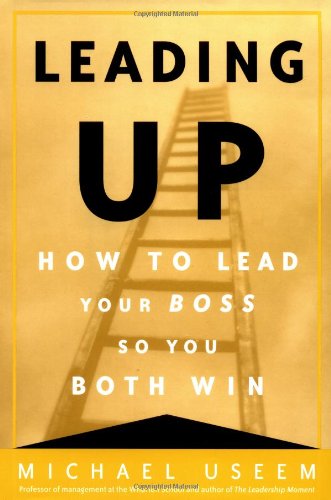
Synopsis
Eight true stories show that Leaders today aren’t just bosses, they’re self-starters who take charge even when they haven’t been given a charge. Upward leaders get results by helping their superiors lead. They make sure that good ideas don’t die on the vine because a boss’s understanding doesn’t reach down deep enough into the organization. Upward leadership assures that advice arrives from all points on the corporate compass, not just from the top down. And it applies at every level: Even CEOs need to learn about leading up because they ultimately answer to their boards.
In Leading Up, Michael Useem offers instructive accounts of this vital and unexplored facet of leadership. Drawing on the extraordinary experiences of real people, Useem shows us what happens when those not in charge rise to the challenge, and also what happens when those who should step forward fail to do so:
* Civil War generals openly disrespected and frequently misinformed their commanders in chief, with tragic consequences for both sides.
* COO David Pottruck learned how to lead with his superiors at Charles Schwab & Co. in order to radically change Schwab’s core business.
* Had he been able to convince his superiors of the dire situation in Rwanda, United Nations commander Roméo Dallaire might have prevented the genocide that claimed 800,000 lives.
* The CEOs of CBS, Compaq, and British Airways concentrated on leading down when they needed to lead up to their boards, too. The result: All three were fired.
* U.S. Marine Corps general Peter Pace reconciled conflicting priorities while reporting to six bosses with varying agendas by keeping all of them informed and challenging them when necessary.
* Mount Everest mountaineers admitted they might have protected themselves and others from harm during a fateful ascent if only they had questioned their guides’ flawed instructions and decisions.
* Even in government, representatives often need to first strike a deal, then lead their bosses to embrace it, as examples from the United States and Argentina illustrate.
* No one ever had a tougher job of leading up than Old Testament prophets Moses, Abraham, and Samuel, who interceded with the ultimate authority.
Leading up is not the same as managing up. Managing up is running the office; leading up is taking the reins and exceeding what’s expected. As hierarchies everywhere shed much of their rigidity, upward leadership at all levels becomes more possible—and more necessary. Leading Up is a call to action. It asks us to build on the best in everybody’s nature, and it offers a pragmatic blueprint for doing so.
"synopsis" may belong to another edition of this title.
About the Author
MICHAEL USEEM is a professor of management and the director of the Center for Leadership and Change Management at the Wharton School of the University of Pennsylvania. His previous book, The Leadership Moment: Nine True Stories of Triumph and Disaster and Their Lessons for Us All, offers compelling accounts of leadership when it really counted.
From the Back Cover
“Often the best coaching a leader can receive is directly from the team he/she leads. Openness to their feedback is critical, and Professor Useem’s new book provides many dramatic examples of successes and failures in this important dimension.”
—Arthur Martinez, former chief executive officer of Sears, Roebuck & Co.
“Teaching your boss is the most important thing that anyone in business, government, or the nonprofit world needs to know. Leading Up is a must-read for everyone.”
—Leonard A. Lauder, chairman, the Estée Lauder Companies, Inc.
“Professor Michael Useem has shown himself a master in the use of vignettes to teach us about leadership. In his latest book, Leading Up, he has again used reality, this time to discuss ‘those who would dare to lead their leaders.’ In today’s fast-moving and often chaotic world, this book is a must-read. It will help you help your boss be the best he can be and in doing so, build a better organization and increase your value to that organization.”
—General Charles C. Krulak, former commandant of the U.S. Marine Corps and senior vice chairman, MBNA Corporation
“Leadership is not just about telling people what to do. It is about building a common purpose—a goal—that everyone on the team works hard to achieve. To do that, leaders must understand that it is not just about them and their goals. It is about creating a group where voices are heard and help offered is help received. Leading Up shows how great leaders create groups that win.”
—Joel Kurtzman, Global Lead Partner, Thought Leadership, PricewaterhouseCoopers
“The message afforded by Leading Up is powerful and germane as we continue to decentralize and empower our organizations. As Mike Useem says, ‘If we expect our subordinates to furnish us with unvarnished, unbiased advice and unswerving support at times when it really counts, we need to have cultivated a culture that encourages and rewards them to do so.’ His diverse selection of historical examples and his storytelling ability bring the concepts alive.”
—Charles O. Holliday, Jr., chairman and chief executive officer, DuPont
From the Inside Flap
tories show that Leaders today aren t just bosses, they re self-starters who take charge even when they haven t been given a charge. Upward leaders get results by helping their superiors lead. They make sure that good ideas don t die on the vine because a boss s understanding doesn t reach down deep enough into the organization. Upward leadership assures that advice arrives from all points on the corporate compass, not just from the top down. And it applies at every level: Even CEOs need to learn about leading up because they ultimately answer to their boards.
In Leading Up, Michael Useem offers instructive accounts of this vital and unexplored facet of leadership. Drawing on the extraordinary experiences of real people, Useem shows us what happens when those not in charge rise to the challenge, and also what happens when those who should step forward fail to do so:
* Civil War generals openly disrespected and frequently misinf
Reviews
In his first book, The Leadership Moment (1998), Useem used stories to provide examples of leadership in extreme situations. He does it again, now using diverse stories from throughout the ages to show both good and bad examples of "leading up." Useem includes leadership lessons to reinforce the value of the stories and highlight particular points. An integral ingredient throughout the leadership lessons is communications. Providing accurate data, not withholding information or being afraid to speak up to a superior, is part of what he perceives as essential. He realizes that there can be risk associated for the person trying to lead up, especially in a business that doesn't foster managers communicating risks, strategies, and values up to CEOs. In the last chapter, he ties all this together in a formula for managers to use to lead up. Useem does provide insightful information for thoughtful consideration by managers and reinforces the importance of feedback and long-range thinking as necessary to keep the organization moving forward. Eileen Hardy
Copyright © American Library Association. All rights reserved
Excerpt. © Reprinted by permission. All rights reserved.
Chapter 1
Informing Your Commander
General Robert E. Lee Informed His Commander in Chief, but Generals Joseph E. Johnston and George B. McClellan Did Not, and Their Causes Paid Dearly
The American Civil War brought to the fore hundreds of military officers whose battlefield decisions have shaped our history. Some proved adept in commanding troops, other proved disastrous. Some worked exceedingly well with their superiors, others just the opposite.
Those dexterous -- or disastrous -- at leading up could be found on both the Union and Confederate sides of the battlefields. In this resource, neither side dominated, and both sides discovered that its supply often spelled the difference between triumph and disaster. Nowhere is this more evident than in the contrasting styles of three of the great generals of the Civil War: George B. McClellan, Joseph E. Johnston, and Robert E. Lee.
By spring of 1862, a year after Confederate rebels fired on Federal troops at Fort Sumter, South Carolina, a Union army under McClellan's command was on the offensive. With more than 120,000 troops and enormous siege guns, McClellan sent his force up a Virginia peninsula toward the Confederate capital of Richmond. His strategy was simple: destroy the defending army, capture the Confederate leadership, end the war.
Though attacking to restore the Union, George McClellan treated its commander in chief with thinly veiled disdain. In the general's view, Abraham Lincoln was uncouth, uncivilized, and untutored in battlefield affairs. McClellan would insulate his strategy against meddling from the president by resisting policy directives, inflating enemy threats, and withholding battlefield reports. For his part, Lincoln was less interested in personalities than results, but without orders honored, numbers trusted, or intelligence delivered, how could he render McClellan the support he requested?
Meanwhile, as McClellan launched his vast and unprecedented military campaign against Richmond, the Confederacy assigned its premier commander, Joseph E. Johnston, the imperative of defending the capital. Like McClellan, Johnston was supremely confident in his own generalship and brooked no advice from political superiors. To ensure that little advice was received, he kept the Confederacy's supreme commander, President Jefferson Davis, in the dark.
But President Davis had been a military commander in his own right. A graduate of West Point and a veteran of the Mexican War, he had served as chairman of the U.S. Senate's military affairs committee and as U.S. secretary of war. He expected his commanders to welcome his advice, but he also appreciated that he could render real counsel only if his commanders informed him of what they were facing in the field and what they were intending to do about it.
When a shell fragment felled Johnston on May 31, 1862, President Davis replaced him with his own aide, Robert E. Lee. General Lee continued his own well-established practice of informing and consulting with the president. The result was Davis's unswerving support for Lee. Lee received the men and materiel he required, and within days he had stopped the Union advance on Richmond that General McClellan had been unable to sustain and General Johnston unable to reverse.
By aggressively keeping his president in the picture, Lee acquired what he needed from his superior for both to win. McClellan and Johnston had not -- and they did not. As we will see in this chapter, the disparity between the upward incapacity of generals McClellan and Johnston (on opposing sides of the war) and the upward facility of General Lee could not have been greater, nor more momentous for the course of the war. Lee's exceptional ability to work with those above gave an enormous advantage to the secessionist cause in the weeks that followed. History offers few starker contrasts of upward leadership performed so differently to such great consequence, nor few clearer examples of the difference that appreciating and informing your superior can make-for you, your superior, and your mutual cause.
Setting the Stage:
Early Battles in the Civil War
Newly elected president Abraham Lincoln had warned in his inaugural address on March 4, 1861, that a "disruption of the Federal Union, heretofore only menaced, is now formidably attempted" but that the rush to "secession is the essence of anarchy." He appealed to the "mystic chords of memory, stretching from every battlefield and patriot grave to every living heart and hearthstone." He asked that we heed the "better angels of our nature."
Lincoln's words fell on deaf ears. South Carolina, Mississippi, and five other states had already declared their exit from the Union. On April 10, 1861, Brigadier General Pierre G. T. Beauregard, commander of provisional Confederate forces, demanded the surrender of the Federal garrison of Fort Sumter in the harbor of Charleston, South Carolina. The demand refused, he opened fire on the fortress and forced its surrender on April 13 without a casualty suffered on either side. Virginia announced its exit from the Union on April 17. The first land battle of the Civil War came six weeks later when a Union brigade surprised and routed a small Confederate force at Philippi, Virginia (now West Virginia). The human toll: 26 Rebel casualties and 4 Federal losses.
The first large-scale engagement of the Civil War erupted on July 21 when Confederate generals Johnston and Beauregard confronted and defeated Union General Irvin McDowell's Army of Northeastern Virginia in a battle along Bull Run near Manassas, Virginia, just twenty-five miles southwest of Washington, D.C. The engagement brutally dispelled any notion on either side that the secession would be quickly secured or crushed. Southern forces suffered 1,750 casualties, Northern forces 2,950.
In the wake of the Federal defeat at Manassas, President Lincoln on July 27 appointed George McClellan commander of the Army of the Potomac, the Union's largest and most potent fighting machine. His immediate job was to protect Washington from further attack by General Johnston, whose Confederate forces had dug in after the battle just twenty miles from the capital. Neither general, though, was yet primed to strike a decisive blow against the other-or even start a fight. As summer turned to fall, the opposing forces recruited, regrouped, and reviewed their options, but neither moved to battle. By the end of 1861, the two sides' combined losses would not total a fraction of those cut down in a single day's fighting at Antietam, Maryland, less than a year later.
In March of 1862, the standoff in northern Virginia came to an end. After rancorous debate in the White House and War Department, the Union settled on an aggressive strategy of grand attack, with George McClellan targeting the biggest prize of all, the Confederate capital. Since little remained secret in a conflict where both sides compiled a steady flow of information from newspaper reporters, amateur observers, and professional spies, the Confederacy withdrew Johnston's forces from its offensive position near Washington to a defensive posture around Richmond.
As the great confrontation took form, the combat fate of each side -- and the eventual fate of the rebellion and the republic -- depended on Johnston's and McClellan's strategic theories with respect to each other's army, on their field equipment and military discipline, on their intelligence networks, and in part on dumb luck. But it also depended in no small part on the two commanders' relations with their superiors.
In both cases, the relations were lethally impaired by the flawed behavior of the two generals themselves. Historians have judged their failings harshly. President Davis "had come to view" Joseph Johnston -- his own general, whom he himself had appointed -- "as the enemy," concluded Craig L. Symonds, a Johnston biographer, and Johnston must bear a "major responsibility for the failure of the Confederate war effort." On the Union side, George McClellan "was inarguably the worst commander" that the Army of the Potomac ever had, offered Stephen W. Sears, a McClellan biographer, and "the record is equally clear that it was his own decisions, rather than those of the government, that doomed his grand campaign to end the war."
Among the most dooming decisions of both McClellan and Johnston were their open displays of contempt for their superiors and their consistent denial of data to them. The fatal consequences of their overt antagonism stood in pointed contrast to what Lee would subsequently achieve with the opposite tack.
Such judgments, of course, are made in hindsight. As the Union march against Richmond neared, all that could be said for certain was that the fortunes of both sides rested on a very thin reed of trust extending between the leadership in the field and the supreme commanders at the top of each army.
Failing to "Lead Up" on the Union Side: General McClellan Scorned His Boss, President Lincoln
In March 1862, as Washington hatched the Peninsula Campaign to end the secession, George McClellan was serving not only as commanding general for the Union Army of the Potomac, but also as general in chief for all Northern armies. With seven months in the first role and four in the latter, the thirty-five-year-old McClellan was both the youngest and most senior general officer in Federal service.
McClellan's riveting attention to engineering efficiency and combatant welfare greatly endeared him to his troops. He made a point of mastering the names of his officers, and he frequently rode and walked among his enlisted men. During one campaign, after he shook the hand of a soldier and commended his brigade for its fight, news of the general's personal compliment spread like wildfire. McClellan believed that personifying the army in the form of the commander would foster the morale and verve needed for succ...
"About this title" may belong to another edition of this title.
Other Popular Editions of the Same Title

Search results for Leading Up: How to Lead Your Boss So You Both Win

Stock Image
Leading Up: How to Lead Your Boss So You Both Win
Seller: More Than Words, Waltham, MA, U.S.A.
Seller rating 5 out of 5 stars

Condition: Good. A sound copy with only light wear. Overall a solid copy at a great price! Seller Inventory # BOS-I-13i-01592
Stock Image
Leading Up: How to Lead Your Boss So You Both Win
Seller: World of Books (was SecondSale), Montgomery, IL, U.S.A.
Seller rating 5 out of 5 stars
Condition: Good. Item in good condition. Textbooks may not include supplemental items i.e. CDs, access codes etc. Seller Inventory # 00104253628
Stock Image
Leading Up: How to Lead Your Boss So You Both Win
Seller: ThriftBooks-Atlanta, AUSTELL, GA, U.S.A.
Seller rating 5 out of 5 stars
Hardcover. Condition: Very Good. No Jacket. May have limited writing in cover pages. Pages are unmarked. ~ ThriftBooks: Read More, Spend Less. Seller Inventory # G0812933109I4N00
Stock Image
Leading Up: How to Lead Your Boss So You Both Win
Seller: ThriftBooks-Dallas, Dallas, TX, U.S.A.
Seller rating 5 out of 5 stars
Hardcover. Condition: Very Good. No Jacket. May have limited writing in cover pages. Pages are unmarked. ~ ThriftBooks: Read More, Spend Less. Seller Inventory # G0812933109I4N00
Stock Image
Leading Up: How to Lead Your Boss So You Both Win
Seller: ThriftBooks-Reno, Reno, NV, U.S.A.
Seller rating 5 out of 5 stars
Hardcover. Condition: Very Good. No Jacket. May have limited writing in cover pages. Pages are unmarked. ~ ThriftBooks: Read More, Spend Less. Seller Inventory # G0812933109I4N00
Stock Image
Leading Up : How to Lead Your Boss So You Both Win
Published by
Penguin Random House South Africa, 2001
ISBN 10: 0812933109
ISBN 13: 9780812933109
Used
Hardcover
First Edition
Seller: Better World Books, Mishawaka, IN, U.S.A.
Seller rating 5 out of 5 stars
Condition: Very Good. 1st. Former library copy. Pages intact with possible writing/highlighting. Binding strong with minor wear. Dust jackets/supplements may not be included. Includes library markings. Stock photo provided. Product includes identifying sticker. Better World Books: Buy Books. Do Good. Seller Inventory # 5446537-6
Stock Image
Leading Up : How to Lead Your Boss So You Both Win
Published by
Penguin Random House South Africa, 2001
ISBN 10: 0812933109
ISBN 13: 9780812933109
Used
Hardcover
First Edition
Seller: Better World Books, Mishawaka, IN, U.S.A.
Seller rating 5 out of 5 stars
Condition: Very Good. 1st. Pages intact with possible writing/highlighting. Binding strong with minor wear. Dust jackets/supplements may not be included. Stock photo provided. Product includes identifying sticker. Better World Books: Buy Books. Do Good. Seller Inventory # 4333639-6
Stock Image
Leading Up: How to Lead Your Boss So You Both Win
Seller: HPB-Diamond, Dallas, TX, U.S.A.
Seller rating 5 out of 5 stars
hardcover. Condition: Very Good. Connecting readers with great books since 1972! Used books may not include companion materials, and may have some shelf wear or limited writing. We ship orders daily and Customer Service is our top priority! Seller Inventory # S_442963566
Stock Image
Leading Up: How to Lead Your Boss So You Both Win
Seller: HPB Inc., Dallas, TX, U.S.A.
Seller rating 5 out of 5 stars
hardcover. Condition: Very Good. Connecting readers with great books since 1972! Used books may not include companion materials, and may have some shelf wear or limited writing. We ship orders daily and Customer Service is our top priority! Seller Inventory # S_460474032
Seller Image
Leading Up: How to Lead Your Boss So You Both Win
Seller: WeBuyBooks, Rossendale, LANCS, United Kingdom
Seller rating 5 out of 5 stars
Condition: Very Good. Most items will be dispatched the same or the next working day. A copy that has been read, but is in excellent condition. Pages are intact and not marred by notes or highlighting. The spine remains undamaged. Seller Inventory # rev8876065473
Buy Used
US$ 4.72
US$ 9.25 shipping
Ships from United Kingdom to U.S.A.
Ships from United Kingdom to U.S.A.
Quantity: 1 available