
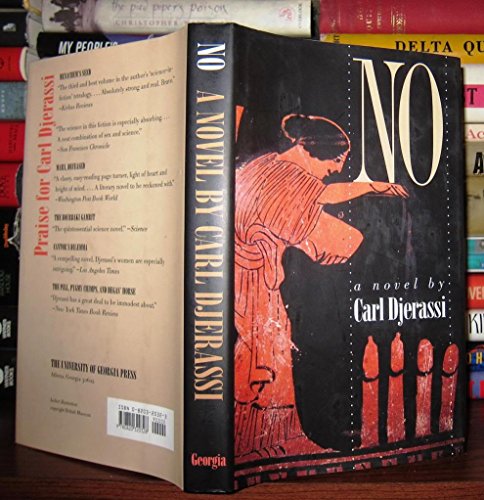
Synopsis
A conclusion to the renowned "science-in-fiction" tetralogy by an award-winning chemist follows two married scientists who develop breakthroughs in human reproduction and find themselves engulfed in a whirlwind of fame, fortune, and celebrity. UP.
"synopsis" may belong to another edition of this title.
About the Author
Carl Djerassi is a professor of chemistry at Stanford University. He is also the founder of the Djerassi Resident Artists Program, an artists' colony near San Francisco that supports working artists in various disciplines.
Reviews
The recent publication of superb fiction by contemporary physicians -- Richard Selzer, Ethan Canin, Susan Mates, and Ferrol Sams, among others -- suggests that physicians are granted, by their medicine, a privileged view of human events, and that doctors graced with literary gifts can, indeed, give the world news that is unavailable to other writers. Two new novels written by physicians support this idea, although in extravagantly different ways.
NO, by Carl Djerassi, is a romp of excess, a set of vaguely related plot lines that converge on insatiability and the drive to control biologic and social events. The margin of uncertainty recedes with every chapter, eventually transforming the world into financial, reproductive, and emotional formulas that erase doubt, replacing mystery with puzzles that can be cracked scientifically. The White Life, by Michael Stein, is a spare, first-person narrative, probing not greed and control but their opposites: gratitude for the unnamed gifts of the universe, humility in the face of the unknown and the unknowable, and a sense of being dazzled and nourished by the mysterious, the unexpected, and the silent revelations of ordinary life.
In NO, young molecular biologist Renu Krishnan has synthesized novel nitric oxide-releasing agents and becomes the pivotal American scientist in a global enterprise. Along the way, Renu falls in love with and marries her Israeli coinvestigator, learns hard lessons about academic politics, disclaims traditional Indian notions of womanhood, takes intellectual and financial risks in bringing her product to market, and becomes a millionaire and potential Nobelist. Along the way, the reader learns an astonishing amount about intracellular messenger molecules, mechanisms of penile tumescence, intracytoplasmic sperm injection, and prefertilization determinants of fetal sex, as well as how to pull off a successful initial public offering, how to navigate a New Drug Application through the Food and Drug Administration, and how to profit from corporate start-ups and stock options.
The intercalation of distinct plot elements is marvelously playful and revealing. As soon as nitric oxide is called "promiscuous," the various governing images of this pop-scientific thriller collapse into identity: science, venture capital, intellectual drive, and sexual drive are equated, while the intracellular becomes a metaphor for the interpersonal. All this breathless business culminates in courtship displays and big-bucks risk taking, and, at the end, everybody is rich and therefore happy.
"Mr. Dittus is bereft of something," broods The White Life's Dr. Cave about his unusual, unfocused, obscure, and willful new patient. When Cave was 13 years old, his father died of a heart attack; he became a doctor to protest his loss. Convinced that he, too, will die while his sons are teenagers, the novel's protagonist lives as if he is a temporary visitor to a strange planet, proud of his ability to exchange pleasantries with the natives, stunned by their ease in moving through a day of this stuff, and awed by the simplest aspects of ordinary life. His provisional perch grants him an astonishingly clear view of medicine, of sickness, and of life.
Cave admits to his hospital ward a man who has just had his second myocardial infarction in two weeks and who reminds him of his father. The man reminds him of himself as well -- both the doctor and the patient are men easily lost and out of place. Although stabilized by the corporeal rituals and language of medicine, Cave lives "on the edge of the uncontrollable," and, like his patient Dittus, finds himself "confused by the signposts." Meeting Dittus propels Cave to confront his own father's physician, whom he accuses of killing his father, seeking answers or justice. He receives only more yearning sadness and more of the unanswerable, but realizes, as a dividend, how like his father he has become.
What general internist Michael Stein does in this novel is to offer, with resonant intelligence and the generous irony of Walker Percy or Milan Kundera, scenes and questions of medicine to the world at large, a world he suspects is bereft of metaphors for its own meaning. This local story about minor medical events in Providence over a four-day period in June enlarges, by virtue of the author's gift, to embrace and illuminate the perils, the abandonments, the dark joys, and the giddy celebrations of being human. Stein's novel about a doctor and his patient splits the "white light" of hospitals so that it penetrates the opaque and suffuses the familiar with translucent meaning. Says Cave, "Thomas Mann was right: `All interest in disease and death is only another expression of interest in life."'
Reviewed by Rita Charon, M.D., Ph.D.
Copyright © 1999 Massachusetts Medical Society. All rights reserved. The New England Journal of Medicine is a registered trademark of the MMS.
Stanford professor Djerassi (Menachems Seed, etc.), eminent chemist and Father of the Pill, here concludes his science-in-fiction tetralogy with another speculation about the frontiers of sexuality, this time concerning the effects of nitric oxide (NO) on male impotence. Carefully distinguishing his work from generic science fiction, Djerassi claims that his science is accurate, while implying that the science of science fiction isnt. He seeks to portray the tribal behavior of scientists, typically displayed as they work out methods to test a new theoryin this case, the effect of NO on penile erection. Then there are also the potential hazards of any new treatment to consider: its carcinogenic potential, for instance, duly tested in experiments with laboratory rats. The sometimes pompous Djerassi well knows this world, and his arch sexual humor is fun. Less persuasive, though, is the scientist-as-storyteller. First, Djerassi scuttles the suspense of whether NO will work at all simply by announcing to the reader that it doesboth in an introduction and in his first chapter. Second, his protagonist and principal NO researcher, 26-year-old Renu Krishnan, is more of an ideal than a character. Back home in India, her brother and widowed mother continually urge Renu to marry and take up a normal Indian womans life, but Renu, insisting that she chart her own course, falls for an Israeli scientist, Jephtah Cohn, who has invented a device for injecting NO (and even tries it himself). The two become lovers but entertain doubts about male and female roles, Judaism vs. Hinduism, etc. As though meant to illustrate a theory of people, yet failing ever really to seem like people, the characters remain constructs who lack humanizing rough edges. Entertaining enough, but all the hoopla over Viagra has somewhat undermined Djerassi's premiseand his moxie. But for insight into the grants apparatus, the bureaucracy of science, and the way scientists think and work, Djerassis your man. -- Copyright ©1998, Kirkus Associates, LP. All rights reserved.
Carl "The Father of the Pill" Djerassi returns with another "science-in-fiction" account (after Menachem's Seed) of discovery in the making, his newest subject being the intersection of capitalism and reproductive technology. Brilliant grad student Renu Krishnan is sent by her professor at Brandeis, Felix Frankenthaler, to research the effect of nitric oxide (the NO of the title) on penile tumescence. In Israel, she falls for her co-worker, Jeptha Cohn; their experiments on his erection invention become downright personal. She also falls, in a different way, for Martin Gestler?a businessman who persuades Renu to give up academic science to produce and market their NO "platform." The dizzying array of acronyms and superwonks (including return players like Menachem Dvir and Melanie Laidlaw) can bore and terrify readers by turns as they throw around words like "polyzeniumpolyolates" in casual conversation, but Djerassi clearly knows his way around labs and the money that makes them go?even if the success of Viagra lends unintentional prescience to the novel's scientific-fiscal intrigues.
Copyright 1998 Reed Business Information, Inc.
This is the concluding work in Carl "the Father of the Pill" Djerassi's science-in-fiction tetralogy on the life and behavior of modern scientists, and it focuses on Renu Krishnan, an Indian chemist, who, along with a group of scientists and investors, works to bring a device that helps with male impotence to market. The chemical component of the device is based on the nitric oxide molecule, whose abbreviation gives the book its title. The story follows Renu's career struggles as she works with teams in both academic and corporate environments trying to refine the pharmaceutical and delivery mechanisms of the new invention. Djerassi shows how the process is influenced by the personal lives of the development team and by the financial desires of the investors. Like the previous works in this series, NO contains all the requisite parts for an informative and compelling novel, but they don't quite jell, and what remains is emotionally detached, more process than plot. Eric Robbins
This fourth novel in Stanford chemistry professor Djerassi's science-in-fiction tetralogy (e.g. Menachem's Seed, LJ 7/97) centers around the timely issue of a new treatment for male impotence utilizing nitric oxide (one possible reading of the "NO" of the title). Readers will appreciate watching the personal and professional growth of Renu Krishnan, an Indian postdoctoral student at Brandeis whose involvement in the development of the NO method allows her to break through many of the gender barriers still facing female scientists. This tale of scientific ethics combined with straightforward descriptions of the behind-the-scenes machinations common in both academia and industry is characteristic Djerassi, and his exploration of topical scientific issues and updates on recurring characters should appeal to fans of his previous work.?Rachel Singer, Franklin Park P.L., IL
Copyright 1998 Reed Business Information, Inc.
"About this title" may belong to another edition of this title.
Other Popular Editions of the Same Title

Search results for No: A Novel

Stock Image
NO
Seller: Wonder Book, Frederick, MD, U.S.A.
Seller rating 5 out of 5 stars

Condition: Very Good. Very Good condition. Very Good dust jacket. A copy that may have a few cosmetic defects. May also contain light spine creasing or a few markings such as an owner's name, short gifter's inscription or light stamp. Seller Inventory # R11C-04265
Stock Image
No : A Novel
Published by
University of Georgia Press, 1998
ISBN 10: 0820320323
ISBN 13: 9780820320328
Used
Hardcover
Seller: Better World Books: West, Reno, NV, U.S.A.
Seller rating 5 out of 5 stars
Condition: Good. Pages intact with minimal writing/highlighting. The binding may be loose and creased. Dust jackets/supplements are not included. Stock photo provided. Product includes identifying sticker. Better World Books: Buy Books. Do Good. Seller Inventory # 1002196-6
Stock Image
No : A Novel
Published by
University of Georgia Press, 1998
ISBN 10: 0820320323
ISBN 13: 9780820320328
Used
Hardcover
Seller: Better World Books, Mishawaka, IN, U.S.A.
Seller rating 5 out of 5 stars
Condition: Good. Pages intact with minimal writing/highlighting. The binding may be loose and creased. Dust jackets/supplements are not included. Stock photo provided. Product includes identifying sticker. Better World Books: Buy Books. Do Good. Seller Inventory # 1002196-6
Stock Image
No: A Novel
Seller: Housing Works Online Bookstore, New York, NY, U.S.A.
Seller rating 5 out of 5 stars
Condition: Very Good. Minimal wear to cover. Pages clean and binding tight. shelf wear. bumped edges. Hardcover. Seller Inventory # HK2-03212
Stock Image
No: A Novel
Seller: HPB-Movies, Dallas, TX, U.S.A.
Seller rating 5 out of 5 stars
hardcover. Condition: Very Good. Connecting readers with great books since 1972! Used books may not include companion materials, and may have some shelf wear or limited writing. We ship orders daily and Customer Service is our top priority! Seller Inventory # S_452016289
Stock Image
No : A Novel
Seller: Dunaway Books, St. Louis, MO, U.S.A.
Seller rating 4 out of 5 stars

Hardcover. Condition: Near Fine. Dust Jacket Condition: Near Fine. Seller Inventory # 47207
Stock Image
No
Published by
University of Georgia Press, 1998
ISBN 10: 0820320323
ISBN 13: 9780820320328
Used
Hardcover
Seller: gigabooks, Spokane, WA, U.S.A.
Seller rating 5 out of 5 stars
Hardcover. Condition: Very Good. Dust Jacket Condition: Very Good. Hard Cover - VG/VG - Book and dust jacket are clean and tight with light wear - 276 pages. Seller Inventory # 257459
Stock Image
No
Published by
University of Georgia Press, Athens, GA, 1998
ISBN 10: 0820320323
ISBN 13: 9780820320328
Used
Hardcover
First Edition
Seller: MARK POST, BOOKSELLER, San Francisco, CA, U.S.A.
Seller rating 5 out of 5 stars
Hard Cover. First Edition, First printing. AS NEW IN DJ. Seller Inventory # 10143
Stock Image
No : A Novel
Published by
University of Georgia Press, Athens, GA, 1998
ISBN 10: 0820320323
ISBN 13: 9780820320328
Used
Hardcover
Seller: Daedalus Books, Portland, OR, U.S.A.
Seller rating 4 out of 5 stars
Hardcover. Condition: Near Fine. Dust Jacket Condition: Near Fine. 8vo. Seller Inventory # 16866hg
Stock Image
No A Novel
Published by
University of Georgia Press, Athens, GA & London, 1998
ISBN 10: 0820320323
ISBN 13: 9780820320328
Used
Hardcover
Seller: Willis Monie-Books, ABAA, Cooperstown, NY, U.S.A.
Seller rating 5 out of 5 stars
Hardcover. Condition: Very Good. Dust Jacket Condition: Very Good. First Printing. Old store label on the back.; Seller Inventory # 63016