
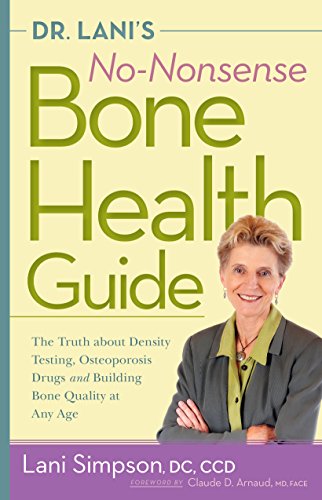
Dr. Lani's No-Nonsense Bone Health Guide: The Truth About Density Testing, Osteoporosis Drugs, and Building Bone Quality at Any Age - Softcover
Synopsis
The Truth About Osteoporosis, Bone Density, and Lasting Wellness
Discover the groundbreaking book that challenges conventional wisdom about bone health. Part whistle-blower exposé and part bone health bible, Dr. Lani’s No-Nonsense Bone Health Guide reveals the hidden pitfalls of bone density testing, the risks of long-term osteoporosis medications, and the essential steps you can take to protect your bones for life. With clarity and expertise, Dr. Lani Simpson offers a whole-body approach that empowers readers to build strength, prevent fractures, and enjoy vibrant health well into their golden years.
Inside this essential guide, you will learn:
- Why accurate bone density readings are harder to get than most people realize
- The hidden dangers of long-term osteoporosis medications
- How digestive health, diet, and lifestyle choices directly impact bone strength
- Which foods and medicines can harm bone health, and which ones support strong, healthy bones
- The truth about calcium supplementation—and how to do it the right way
- Practical strategies for exercise, aging, and daily habits that help preserve bone health
With science-based insights and easy-to-follow advice, Dr. Lani’s No-Nonsense Bone Health Guide is the ultimate resource for anyone who wants to take charge of their health and live a fracture-free life.
"synopsis" may belong to another edition of this title.
About the Author
Dr. Lani Simpson is a chiropractic doctor and a Certified Clinical (bone) Densitometrist (CCD). She has been an expert in women’s health care for 25 years, treating thousands of patients with a multidisciplinary and holistic approach to health. She cofounded the East Bay Menopause and PMS Center and the Osteoporosis Diagnostic Center in Berkeley, CA, where she lives. She is an expert in bone density, osteoporosis, and menopause and aging, and gives continuing education seminars to health professionals about these issues.
Excerpt. © Reprinted by permission. All rights reserved.
Chapter 2: Bone Density Screening — Right Test, Wrong Results?
If your car’s fuel gauge is off, the worst that might happen is you’d run out of gas and need a tow ― or a battery charge, if the car’s electric. But if the tools used to gauge your health malfunction, the consequences are much more serious. Unfortunately, when it comes to evaluating fracture risk, bone density testing procedures can be off the mark. And that can result in your getting the wrong diagnosis, the wrong treatment plan, or unnecessary medications.
Consider what happened to Ellen, a woman in her sixties who’d had several bone density tests over the years because of concerns about osteoporosis.
Positioning Error Leads to Prescription for Fosamax: Ellen’s Story
Ellen called me from her home on the East Coast after a mutual friend recommended she ask me to assess her latest bone density test. Just listening to her story over the phone, I could tell that something was not right regarding the reported findings of her test. The most recent exam showed that Ellen had lost 7 percent of the bone density in her hip since her previous test a year earlier, but her spine remained unchanged. The discrepancy raised a red flag for me. As a densitometrist, I know that it is highly unusual to see such an extreme loss in the hip, especially within one year.
My suspicions were confirmed when I sorted through the stack of paperwork Ellen sent and after I reviewed each of her bone density scans. Comparing the two most recent tests, I could tell that the first technician had failed to position Ellen’s hip properly (using a fifteen- to twenty-degree internal rotation), while in the second test the hip was properly positioned.
Why does hip rotation matter during a bone density test? If the hip is incorrectly positioned, errors in density readings of up to 10 percent can occur. That can make the difference in whether or not a doctor recommends medication, as bone loss is a trigger for prescribing drugs. It could also make the difference in whether or not a person is diagnosed with osteoporosis. In Ellen’s case, the mistake led to an erroneous report of a 7 percent bone loss, which, understandably, made her very upset.
What’s worse, none of it should have happened. In Ellen’s first bone density test, the technologist’s failure to properly rotate her hip should have been caught and corrected before the report was made ― if not by the technologist then by the reporting doctor handling the test. Then, for Ellen’s second test, the technologist did rotate her hip correctly, but failed to note the error from the previous test. This is the mistake that resulted in the report of an apparent 7 percent bone loss in Ellen’s hip. Compounding the problem, the doctor who wrote the report on the second test results did not catch the mistake either. If the test results were truly showing such a significant change in her bone density, Ellen’s own physician should have ordered lab tests to investigate the problem further, but that did not happen; instead, she was prescribed Fosamax, a drug for treating osteoporosis. Believing that the reports were accurate, most medical doctors would likely have done what Ellen’s physician did, which was to recommend medications solely on the basis of apparent bone loss.
Once I was able to guide Ellen in getting an accurate bone density reading, we discovered that her bone was stable ― meaning no active loss of bone. Additional lab tests verified this finding. To date, she has been able to maintain her bone stability by following a bone-healthy nutrition and exercise program that includes appropriate nutritional supplements ― and currently she has no need for osteoporosis medications.
I wish I could tell you that Ellen’s case is unusual. But it’s not. I see similar bone density testing errors over and over when consulting with my patients. These problems are common knowledge among those trained in densitometry. We all know that preventable mistakes are being made. Why does this happen?
"About this title" may belong to another edition of this title.
Other Popular Editions of the Same Title

Search results for Dr. Lani's No-Nonsense Bone Health Guide: The Truth...

Seller Image
Dr. Lani's No-Nonsense Bone Health Guide: The Truth About Density Testing, Osteoporosis Drugs, and Building Bone Quality at Any Age
Seller: Dream Books Co., Denver, CO, U.S.A.
Seller rating 5 out of 5 stars

Condition: good. Gently used with minimal wear on the corners and cover. A few pages may contain light highlighting or writing, but the text remains fully legible. Dust jacket may be missing, and supplemental materials like CDs or codes may not be included. May be ex-library with library markings. Ships promptly! Seller Inventory # DBV.0897936612.G
Seller Image
Dr. Lani's No-Nonsense Bone Health Guide: The Truth About Density Testing, Osteoporosis Drugs, and Building Bone Quality at Any Age
Seller: Greenworld Books, Arlington, TX, U.S.A.
Seller rating 5 out of 5 stars
Condition: very_good. Fast Free Shipping â" Very Good condition book with a firm cover and clean pages. Shows normal use and some light wear or limited notes markings. A solid, nice copy to enjoy. Seller Inventory # GWV.0897936612.VG
Seller Image
Dr. Lani's No-Nonsense Bone Health Guide: The Truth About Density Testing, Osteoporosis Drugs, and Building Bone Quality at Any Age
Seller: Zoom Books Company, Lynden, WA, U.S.A.
Seller rating 5 out of 5 stars
Condition: very_good. Book is in very good condition and may include minimal underlining highlighting. The book can also include "From the library of" labels. May not contain miscellaneous items toys, dvds, etc. . We offer 100% money back guarantee and 24 7 customer service. Seller Inventory # ZBV.0897936612.VG
Stock Image
Dr LaniS NoNonsense Bone Healt
Seller: World of Books (was SecondSale), Montgomery, IL, U.S.A.
Seller rating 5 out of 5 stars
Condition: Good. Item in good condition and has highlighting/writing on text. Used texts may not contain supplemental items such as CDs, info-trac etc. Seller Inventory # 00103564031
Stock Image
Dr LaniS NoNonsense Bone Healt
Seller: World of Books (was SecondSale), Montgomery, IL, U.S.A.
Seller rating 5 out of 5 stars
Condition: Very Good. Item in very good condition! Textbooks may not include supplemental items i.e. CDs, access codes etc. Seller Inventory # 00103614524
Stock Image
Dr LaniS NoNonsense Bone Healt
Seller: World of Books (was SecondSale), Montgomery, IL, U.S.A.
Seller rating 5 out of 5 stars
Condition: Good. Item in good condition. Textbooks may not include supplemental items i.e. CDs, access codes etc. Seller Inventory # 00103269228
Seller Image
Dr. Lani's No-Nonsense Bone Health Guide: The Truth About Density Testing, Osteoporosis Drugs, and Building Bone Quality at Any Age
Seller: Goodwill Industries, Spokane, WA, U.S.A.
Seller rating 5 out of 5 stars
Condition: acceptable. Condition: Acceptable â" Heavily used book with significant signs of wear. May include stickers, a missing or damaged dust jacket, heavy wear to the spine or inside cover, curled or torn corners, staining, writing or highlighting, and noticeable wear to the fore edge. May also show signs of water damage, such as rippling or warping, but does not affect readability. All orders are shipped via UPS Mail Innovations and may take up to 10 business days from the initial scan to be delivered. Seller Inventory # INWV.0897936612.A
Stock Image
Dr. Lani's No-Nonsense Bone Health Guide: The Truth about Density Testing, Osteoporosis Drugs and Building Bone Quality at Any Age
Published by
Hunter House Publishers, 2014
ISBN 10: 0897936612
ISBN 13: 9780897936613
Used
Paperback
Seller: ThriftBooks-Atlanta, AUSTELL, GA, U.S.A.
Seller rating 5 out of 5 stars
Paperback. Condition: Good. No Jacket. Pages can have notes/highlighting. Spine may show signs of wear. ~ ThriftBooks: Read More, Spend Less. Seller Inventory # G0897936612I3N00
Stock Image
Dr. Lani's No-Nonsense Bone Health Guide: The Truth about Density Testing, Osteoporosis Drugs and Building Bone Quality at Any Age
Published by
Hunter House Publishers, 2014
ISBN 10: 0897936612
ISBN 13: 9780897936613
Used
Paperback
Seller: ThriftBooks-Atlanta, AUSTELL, GA, U.S.A.
Seller rating 5 out of 5 stars
Paperback. Condition: Very Good. No Jacket. May have limited writing in cover pages. Pages are unmarked. ~ ThriftBooks: Read More, Spend Less. Seller Inventory # G0897936612I4N00
Stock Image
Dr. Lani's No-Nonsense Bone Health Guide: The Truth about Density Testing, Osteoporosis Drugs and Building Bone Quality at Any Age
Published by
Hunter House Publishers, 2014
ISBN 10: 0897936612
ISBN 13: 9780897936613
Used
Paperback
Seller: ThriftBooks-Phoenix, Phoenix, AZ, U.S.A.
Seller rating 5 out of 5 stars
Paperback. Condition: Good. No Jacket. Pages can have notes/highlighting. Spine may show signs of wear. ~ ThriftBooks: Read More, Spend Less. Seller Inventory # G0897936612I3N00