
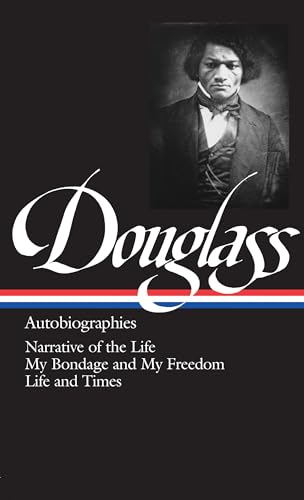
Frederick Douglass : Autobiographies : Narrative of the Life of Frederick Douglass, an American Slave / My Bondage and My Freedom / Life and Times of Frederick Douglass (Library of America) - Hardcover
Synopsis
Henry Louis Gates, Jr. presents the only authoritative edition of all three autobiographies by the escaped slave who became a great American leader.
Here in this Library of America volume are collected Frederick Douglass's three autobiographical narratives, now recognized as classics of both American history and American literature. Writing with the eloquence and fierce intelligence that made him a brilliantly effective spokesman for the abolition of slavery and equal rights, Douglass shapes an inspiring vision of self-realization in the face of monumental odds.
Narrative of the Life of Frederick Douglass, an American Slave (1845), published seven years after his escape, was written in part as a response to skeptics who refused to believe that so articulate an orator could ever have been a slave. A powerfully compressed account of the cruelty and oppression of the Maryland plantation culture into which Douglass was born, it brought him to the forefront of the anti-slavery movement and drew thousands, black and white, to the cause.
In My Bondage and My Freedom (1855), Douglass expands the account of his slave years. With astonishing psychological penetration, he probes the painful ambiguities and subtly corrosive effects of black-white relations under slavery, and recounts his determined resistance to segregation in the North. The book also incorporates extracts from Douglass’s speeches, including the searing “What to the Slave Is the Fourth of July?”
Life and Times, first published in 1881, records Douglass’s efforts to keep alive the struggle for racial equality udirng Reconstruction. John Brown, Abraham Lincoln, William Lloyd Garrison, and Harriet Beecher Stowe all feature prominently in this chronicle of a crucial epoch in American history. The revised edition of 1893, presented here, includes an account of his controversial diplomatic mission to Haiti.
This volume contains a detailed chronology of Douglass’s life, notes providing further background on the events and people mentioned, and an account of the textual history of each of the autobiographies.
LIBRARY OF AMERICA is an independent nonprofit cultural organization founded in 1979 to preserve our nation’s literary heritage by publishing, and keeping permanently in print, America’s best and most significant writing. The Library of America series includes more than 300 volumes to date, authoritative editions that average 1,000 pages in length, feature cloth covers, sewn bindings, and ribbon markers, and are printed on premium acid-free paper that will last for centuries.
"synopsis" may belong to another edition of this title.
About the Author
Born into slavery, Frederick Douglass (c. 1818-1895) educated himself, escaped, and made himself one of the greatest leaders in American history.
Henry Louis Gates, Jr., editor, is the Alphonse Fletcher University Professor and Director of the Hutchins Center for African and African American Research at Harvard University. Emmy Award–winning filmmaker, literary scholar, journalist, cultural critic, and institution builder, Gates has authored or coauthored twenty-one books and created fifteen documentary films.
From the Back Cover
Born a slave, Frederick Douglass educated himself, escaped, and made himself one of the greatest leaders in American history. His three autobiographical narratives, collected here in one volume, are now recognized as classics of both American history and American literature. Writing with the eloquence and fierce intelligence that made him a brilliantly effective spokesman for abolition and equal rights, Douglass shapes an inspiring vision of self-realization in the face of monumental odds. Narrative of the Life of Frederick Douglas, an American Slave (1845), published seven years after his escape, was written in part as a response to skeptics who refused to believe that so articulate an orator could ever have been a slave. A powerfully compressed account of the cruelty and oppression of the Maryland plantation culture into which Douglass was born, it brought him to the forefront of the anti-slavery movement and drew thousands, black and white, to the cause. In My Bondage and My Freedom (1855), written after he had established himself as a newspaper editor, Douglass expands the account of his slavery years. With astonishing psychological penetration, he probes the painful ambiguities and subtly corrosive effects of black-white relations under slavery; and goes on to account his determined resistance to segregation in the North. The book also incorporates extracts from Douglass' renowned speeches, including the searing "What to the Slave Is the Fourth of July?" Life and Times of Frederick Douglass, first published in 1881, records Douglass' efforts to keep alive the struggle for racial equality in the years following the Civil War. Now a socially and politically prominent figure, he looksback, with a mixture of pride and bitterness; on the triumphs and humiliations of a unique public career. John Brown, Abraham Lincoln, William Lloyd Garrison, and Harriet Beecher Stowe are all featured prominently in this chronicle of a crucial epoch in American history. The revised edition of 1893, presented here, includes an account of his controversial diplomatic mission to Haiti. This volume contains a detailed chronology of Douglass' life, notes providing further background on the events and people mentioned, and an account of the textual history of each of the autobiographies.
Reviews
This omnibus volume collects three noted autobiographical works by Douglass (1818-1895), the ex-slave who became one of the nation's most powerful advocates, on the stump and in print, for abolition and racial justice. His first work, Narrative of the Life of Frederick Douglass, An American Slave, Written by Himself , published in 1845, seven years after his escape, set out the cruelties and hypocrisies of slavery, "thus putting it in the power of any who doubted, to ascertain the truth or falsehood of my story of being a fugitive slave." Ten years later, he increased the heat with My Bondage and My Freedom which, though it relies heavily on the earlier edition, also included samples of his speeches. "Not only is slavery on trial, but unfortunately, the enslaved people are also on trial," wrote Douglass regarding this book. After the Civil War, he continued to fight racial injustice through writings about slavery and his struggles during Reconstruction in Life and Times , which, though first published in 1881, is presented here in the updated 1893 edition. The volume includes a detailed and lengthy chronology of Douglass's life and work, as well as notes and an essay on the varieties of past Douglass texts contributed by Gates, who chairs the Afro-American studies department at Harvard. However, the book would have been more valuable with an introductory essay and a more extensive comparison of the three autobiographies.
Copyright 1994 Reed Business Information, Inc.
Douglass (1818-95), a former slave, rose to become an abolitionist, writer, and orator. In this collection of his autobiographical writings, edited by Gates (humanities, Harvard Univ.), he gives an extensive overview of his life. The work includes Narrative of the Life of Frederick Douglass, an American Slave (1845); My Bondage and My Freedom (1855); and Life and Times of Frederick Douglass (1881). In Narrative , Douglass comments on his birth, his parentage, his two masters, and the brutality of slavery he witnessed. In Bondage , he reflects on his childhood, life on the plantation, and his runaway plot. Life and Times concludes the trilogy: it covers his early life as a slave, his escape from bondage, and his connection with the antislavery movement. This one volume containing Douglass's seminal works is highly recommended for black history collections.
- Ann Burns, "Library Journal"
Copyright 1994 Reed Business Information, Inc.
"About this title" may belong to another edition of this title.
Search results for Frederick Douglass : Autobiographies : Narrative of...

Stock Image
Frederick Douglass : Autobiographies : Narrative of the Life of Frederick Douglass, an American Slave / My Bondage and My Freedom / Life and Times of Frederick Douglass (Library of America)
Seller: Textbooks_Source, Columbia, MO, U.S.A.
Seller rating 5 out of 5 stars

hardcover. Condition: Good. Ships in a BOX from Central Missouri! May not include working access code. Will not include dust jacket. Has used sticker(s) and some writing or highlighting. UPS shipping for most packages, (Priority Mail for AK/HI/APO/PO Boxes). Seller Inventory # 000277768U
Stock Image
Douglass: Autobiographies (Narrative of the Life, My Bondage and My Freedom, Life and Times)
Seller: Magers and Quinn Booksellers, Minneapolis, MN, U.S.A.
Seller rating 5 out of 5 stars
hardcover. Condition: Very Good. May have light to moderate shelf wear and/or a remainder mark. Complete. Clean pages. Seller Inventory # 1058922
Stock Image
Frederick Douglass : Autobiographies : Narrative of the Life of Frederick Douglass, an American Slave / My Bondage and My Freedom / Life and Times of Frederick Douglass (Library of America)
Seller: Half Price Books Inc., Dallas, TX, U.S.A.
Seller rating 5 out of 5 stars
Hardcover. Condition: Very Good. Connecting readers with great books since 1972! Used books may not include companion materials, and may have some shelf wear or limited writing. We ship orders daily and Customer Service is our top priority! Seller Inventory # S_468452852
Stock Image
Frederick Douglass : Autobiographies : Narrative of the Life of Frederick Douglass, an American Slave / My Bondage and My Freedom / Life and Times of Frederick Douglass (Library of America)
Seller: HPB-Emerald, Dallas, TX, U.S.A.
Seller rating 5 out of 5 stars
Hardcover. Condition: Very Good. Connecting readers with great books since 1972! Used books may not include companion materials, and may have some shelf wear or limited writing. We ship orders daily and Customer Service is our top priority! Seller Inventory # S_471342815
Stock Image
Frederick Douglass : Autobiographies : Narrative of the Life of Frederick Douglass, an American Slave / My Bondage and My Freedom / Life and Times of Frederick Douglass (Library of America)
Seller: HPB Inc., Dallas, TX, U.S.A.
Seller rating 5 out of 5 stars
Hardcover. Condition: Very Good. Connecting readers with great books since 1972! Used books may not include companion materials, and may have some shelf wear or limited writing. We ship orders daily and Customer Service is our top priority! Seller Inventory # S_470531835
Stock Image
Frederick Douglass : Autobiographies : Narrative of the Life of Frederick Douglass, an American Slave / My Bondage and My Freedom / Life and Times of Frederick Douglass (Library of America)
Seller: HPB-Diamond, Dallas, TX, U.S.A.
Seller rating 5 out of 5 stars
Hardcover. Condition: Very Good. Connecting readers with great books since 1972! Used books may not include companion materials, and may have some shelf wear or limited writing. We ship orders daily and Customer Service is our top priority! Seller Inventory # S_470955169
Stock Image
Frederick Douglass : Autobiographies : Narrative of the Life of Frederick Douglass, an American Slave/My Bondage and My Freedom/Life and Times of Fr
Seller: GreatBookPrices, Columbia, MD, U.S.A.
Seller rating 5 out of 5 stars
Condition: good. May show signs of wear, highlighting, writing, and previous use. This item may be a former library book with typical markings. No guarantee on products that contain supplements Your satisfaction is 100% guaranteed. Twenty-five year bookseller with shipments to over fifty million happy customers. Seller Inventory # 504345-5
Seller Image
Frederick Douglass : Autobiographies : Narrative of the Life of Frederick Douglass, an American Slave / My Bondage and My Freedom / Life and Times of Frederick Douglass (Library of America)
Seller: Nightshade Booksellers, IOBA member, Atlanta, GA, U.S.A.
Seller rating 5 out of 5 stars
Hardcover. Condition: Fine. Special Edition. Library of America edition, first printing stated. A fine copy in subscriber slipcase. See my photos of the book you will receive, not stock photos. More available upon request. This book is in my possession and will be packed in bubble wrap and shipped in a cardboard box. USPS tracking provided. #185. Seller Inventory # 025101
Stock Image
Frederick Douglass : Autobiographies : Narrative of the Life of Frederick Douglass, an American Slave/My Bondage and My Freedom/Life and Times of Fr
Seller: GreatBookPrices, Columbia, MD, U.S.A.
Seller rating 5 out of 5 stars
Condition: New. Seller Inventory # 504345-n
Seller Image
Frederick Douglass : Autobiographies : Narrative of the Life of Frederick Douglass, an American Slave / My Bondage and My Freedom / Life and Times of Frederick Douglass (Library of America)
Seller: Birkitt's Books, SARASOTA, FL, U.S.A.
Seller rating 5 out of 5 stars
hardcover. Condition: Very Good. First THUS. First Library of America, 1st printing in slipcase. Slipcase has light wear, book appears unread, fine condition. Seller Inventory # 250429017