
Synopsis
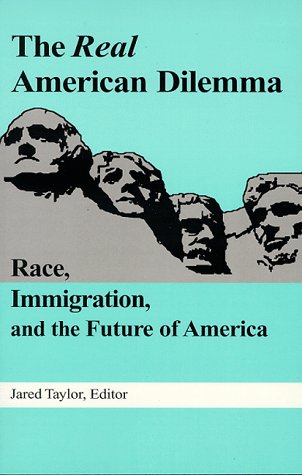
Race is still the American dilemma. This is partly because Americans dare not speak frankly about it. There is no other subject on which private opinion diverges so greatly from public expression.
This book is different. Its contributors--some of the most thoughtful people writing about race today--refuse to be intimidated by accusations of "racism." Here is straight talk on the burning issues that will shape our future:
-Why is integration not working?
-Is Third-World immigration good for America?
-Why is there so much black crime?
-Are there racial differences in IQ?
Are whites destined to become a minority?
This collection of essays on race and immigration is written by eight leading thinkers who are not afraid of being called "racist." It is published by the staff of American Renaissance, a monthly publication that has been called "a literate, undeceived journal of race, immigration, and the decline of civility."
"synopsis" may belong to another edition of this title.
About the Author
Jared Taylor is the editor of this collection. He was born in Japan, where he lived until age sixteen. He received a BA in Philosophy from Yale University in 1973 and an MA in international economics from the Institut d'Etudes Politiques de Paris in 1978. He is the editor of American Renaissance and the author of three books:
Shadows of the Rising Sun: A Critical View of the Japanese Miracle (William Morrow & Co., 1983, 336 pp.)
The Tyranny of the New and Other Essays (Kinseido Publishing, Tokyo, 1992, 89 pp.)
Paved With Good Intentions: The Failure of Race Relations in Contemporary America: (Carroll & Graf, 1992, 416 pp.)
Excerpt. © Reprinted by permission. All rights reserved.
From the Introduction: More and more Americans believe that the liberal approach to race relations has been a catastrophe, but they are loathe to say so openly. This is because the liberal analysis has been an accepted part of the intellectual landscape for so long that it is essentially unassailable. Race is, in fact, the great taboo. There is no other subject on which private opinion diverges so widely from public pronouncement.
Conventional thinking about race has become a little like a religion, complete with dogma and excommunication of free- thinkers. People know that certain views about race will prompt damaging accusations of "racism," so they keep their opinions to themselves.
The tragedy is that if there is any subject about which America needs the greatest possible candor and freedom of expression it is race. Race relations have always been the nation's greatest challenge, and are the backdrop to nearly every worrying front-page story about crime, illegitimacy, illiteracy, school failure, or welfare dependency. If we are not free to question current assumptions about race we will continue to blunder down a path that shows no sign of leading to a better future.
This book is a volume of dissent. Its contributors have thought very carefully about the vital questions of our time and have reached conclusions that violate intellectual orthodoxy. All have, to some degree, paid a price for doing so.
Every chapter of this book except the last is based on a presentation given at a conference on race and immigration held from May 25th through 27th, 1996, in Louisville, Kentucky. When Louisville's guardians of orthodoxy learned that we planned to hold a conference in their town, they immediately set out to sabotage it. Activists first alerted the Louisville Courier-Journal to our plans, and the newspaper obliged with a long article about "white supremacists." The local leftist weekly headlined its story, "Racists Without a Klu."
The Courier-Journal ran several more worried articles about the conference and denounced it in editorials. "Purveyors of racial division are, at heart, scared people," it observed, preferring to speculate about the mental state of dissenters rather than examine their views.
Activists visited the hotel where we planned to hold the conference, and put pressure on the general manager to cancel his contract with us. When he politely declined, demonstrators held daily "prayer vigils" in front of the hotel, asking God to interfere with our plans. They arranged for their vigils to be reported on the nightly television news.
Two local high schools had planned proms at the same hotel on the same weekend. They were caught up in the hysteria about "white supremacy" and joined the chorus demanding that we be ejected. When the hotel once again said it would abide by its contract, the schools broke theirs. The proms had been planned for a completely different part of the hotel, ten floors away from the conference, and the students would not have even known we were there. One prom was scheduled for Friday night whereas the conference did not begin until Saturday night, but some ideas, it seems, are so loathsome they can contaminate an entire building 24 hours before the people who hold those views even arrive. It is hard to imagine a meeting on any other subject causing such a panic.
The conference itself was met with demonstrations, teach- ins, and more worried news coverage, none of which disrupted a marvelous series of lectures and discussions. Two of the speeches, mine and Samuel Francis,' were broadcast repeatedly by C-SPAN.
I am sure that the proceedings would have been a great disappointment to the demonstrators, who no doubt imagined all manner of fantastic goings-on. In fact, this moral ordeal for the city of Louisville amounted to nothing more than a few middle-aged men exchanging ideas-interesting and rarely articulated ideas, to be sure-but just a few men with ideas. We are pleased, in this volume, to offer these ideas to the judgment of the general public.
"About this title" may belong to another edition of this title.
Search results for The Real American Dilemma: Race, Immigration, and the...

Stock Image
The Real American Dilemma: Race, Immigration, and the Future of America Jared Taylor; Philippe Rushton; Samuel Francis; Michael Levin and Glayde Whitney
Seller: Legendary Collectibles LLC, Grants Pass, OR, U.S.A.
Seller rating 1 out of 5 stars

Soft cover. Condition: Very Good. Very Good condition. Clean pages, intact binding. Seller Inventory # 9G-CVKC-4RW8
Stock Image
The Real American Dilemma: Race, Immigration, and the Future of America
Seller: Mispah books, Redhill, SURRE, United Kingdom
Seller rating 4 out of 5 stars

paperback. Condition: Good. Good. Dust Jacket NOT present. CD WILL BE MISSING. . SHIPS FROM MULTIPLE LOCATIONS. book. Seller Inventory # ERICA82909656383084
Buy Used
US$ 167.78
US$ 33.38 shipping
Ships from United Kingdom to U.S.A.
Ships from United Kingdom to U.S.A.
Quantity: 1 available
Stock Image
The Real American Dilemma: Race, Immigration, and the Future of America
Seller: GoldBooks, Denver, CO, U.S.A.
Seller rating 5 out of 5 stars

Paperback. Condition: new. New Copy. Customer Service Guaranteed. Seller Inventory # 22T51_60_0965638308
Stock Image
The Real American Dilemma: Race, Immigration, and the Future of America
Seller: Revaluation Books, Exeter, United Kingdom
Seller rating 5 out of 5 stars
Paperback. Condition: Brand New. 152 pages. 8.00x5.25x0.75 inches. In Stock. Seller Inventory # 0965638308
Buy New
US$ 493.10
US$ 13.35 shipping
Ships from United Kingdom to U.S.A.
Ships from United Kingdom to U.S.A.
Quantity: 1 available