
Synopsis
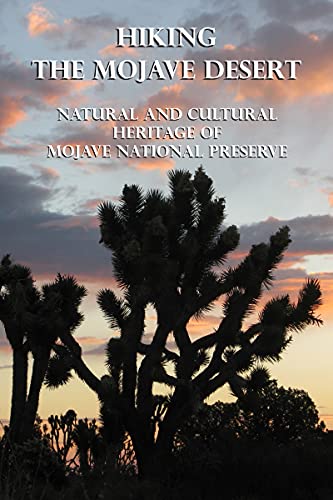
Discover nearly 100 hiking options, and learn about the natural and cultural histories of the Mojave National Preserve in Southern California.
The third largest desert park in the country, Mojave National Preserve protects 1.6 million acres of spectacular arid lands at the heart of the Mojave Desert. Part of the celebrated Great Basin province, it is a spellbinding region of mighty mountain ranges rising thousands of feet above vast inland basins. Famous for the majestic Kelso Dunes, the Devils Playground, and its extensive Joshua tree forests, the preserve also holds considerable natural and cultural wealth, including a wild range of landscapes, striking plant communities, and a rich mining past. Above all, it is a land of contrasts, alternatively forlorn and vibrant with life, stark and colorful, blanketed in snow in the winter, awash with wildflowers in the spring, and scorching hot in the summer. Being high-desert country and generally a little cooler than Death Valley, topographically less rugged, and far less visited, it offers a tremendous potential for comparatively easier hiking in complete solitude.
"synopsis" may belong to another edition of this title.
About the Author
Michel Digonnet is a professor of Applied Physics at Stanford University. Other than his lifelong interest in photonics and fiber sensors, he has been exploring many of the deserts of North America and other continents, and he has written several books on desert national parks of the United States.
Excerpt. © Reprinted by permission. All rights reserved.
The reason Carruthers Canyon is so special is its giant field of Cretaceous quartz monzonite, which erosion has fashioned into countless hoodoos. The start of the rough road passes by fine samples. The most striking one is Easter Island Rock, a slender monolith that towers over the road’s east side. It rests on a contact point so narrow that it seems to violate the laws of gravity. About 150 yards past it, just before the first rough spot in the road, an opening on the west side provides easy foot access down into a particularly scenic wonderland of rocks. You can walk and scramble to your heart’s content among fantastic formations resembling erect beetles and gargantuan molars. In another 100 yards an unusual formation known as Foot Rock stands by the road—it looks remarkably like a bare foot seen from the bottom, toes wiggling in the air.
After 0.4 mile, the road splits. The right branch, easy to miss, climbs into the east fork. The main road continues up the narrower canyon, closely hugging the wash. The stone walls the miners carefully erected over abrupt ledges have kept the road from collapsing, but time is still slowly winning. The road is now an impressive mess of rocks and gouged bedrock. Over time, I have seen a few jeeps grind their way up here, but none made it very far. The hard limit is the 10- ton fallen slab that blocks the road 0.5 mile from the fork. Once again we can be thankful to miners for such a path. On both sides of it, great inclines of reddish monzonite rise hundreds of feet. All of it has been diced into bewildering gardens of jointed fins, bulging boulders, and fat pinnacles. Up on the high rims loom even more formidable monuments. The most distinctive one is the pointed mountain that towers on the east side of the canyon. Crowned with a tilted spire of barren rock and shaped like a Chinese hat, this landmark is visible for miles. The Giant Ledge Mine is on the far side of it, at the end of this bumpy little road.
One of Carruthers Canyon’s other delights is its vegetation diversity, encouraged by its higher moisture. Species that are more at home in the Pacific Coast chaparral live among the boulders—hollyleaf redberry, manzanita, desert mountain lilac, silktassel, and scrub oak. Rock spiraea coats shaded nooks. In late spring, the blooms of mound and grizzly bear cacti, globemallow, penstemon, and many annuals brighten the slopes. Year-round the air is saturated with the smell of sap.
The road ends at the top of the long and slender tailing of the Giant Ledge Mine. This area was exploited via two tunnels, one of which has collapsed. In spite of its unimpressive past, this small mine has a profusion of minerals, from galena to chalcopyrite, scheelite, huebnerite, pyrite, and bornite. Between two shallow shafts, a rock face is coated with a dazzling palette of azurite and malachite. Colorful ore sparkles on the tailing. Blue and green minerals outcrop in small veins along the candelabra-shaped corridors of the tunnel, which is still partly timbered and coursed by a narrow-gauge rail. The wooden dock where the ore was unloaded from the mine car still teeters lopsided on the tailing’s edge.
There is another tunnel about 60 feet up the slope. To get to it, from the azurite wall climb the short loose talus to the flat area where the shaft emerges from the tunnel below (be careful not to fall into it!). To your left, away from the shaft, a narrow trail circles around steeply 100 yards up to the upper tunnel near the top of the hill. This very short tunnel also has a shaft. Its entrance is decorated with smears of sky-blue chrysocolla and a stockpile of greenish ore.
The upper canyon offers an altogether different experience. Whereas most of the Mojave Desert’s canyons are hopelessly barren, Carruthers Canyon abounds in the opposite excess—it is filled with trees. Progress is slow, and slower deeper into the canyon—dodging pines, circling around fallen boulders, and bush whacking when all else fails. It makes us better appreciate the convenience of old mining roads. The highlight is the slickrock wall, a massive nose of polished monzonite that looms over the canyon’s west side shortly past the mine. The wash describes a long arc around its base, for the only purpose, it seems, to give us better views of this work of art. In the summertime, hawks often circle overhead; hummingbirds buzz by, drawn by the Indian paintbrush. In early spring or after a storm, a little water sometimes flows over the wash’s bedrock. For a great view of the upper canyon from above, 0.25 mile past the end of the slickrock wall scramble up the canyon’s steep northern slope to the divide with Keystone Canyon (this is also the route to hike on into this canyon).
This action-packed canyon does not quit... The chiseled sugarloaf that looms above its head is New York Peak, the highest point in this range, and climbing it is this canyon’s crowning glory. From the slickrock wall it is only about half a mile away as the crow flies, but nearly 1,400 feet higher, hard work across the canyon’s thickly forested upper drainage. Follow the wash as far as practicable. When the bushwhacking gets too tedious, climb up the canyon’s north slope a little and continue on a course roughly parallel to the wash. This very steep, lopsided tract ends at North New York Peak (labeled "New York" on the USGS 7.5’ map). The rest of the route is across a gentle saddle to the foot of New York Peak (labeled "New York Two").
For a more aerial route, from the divide with Keystone Canyon continue up the even steeper ridge west-northwest to the main crest, and follow it as it circles around the head of Carruthers Canyon to the two peaks. Both routes have sharp grades and require a lot of zigzagging around obstacles. The canyon route has fewer outcrops but more trees and brush. The high route is about 0.25 mile longer, but it commands awesome views and passes right over the small grove of white fir that graces the New York Mountains’ abrupt north slope.
The summit block is an impressive pointed pyramid of tightly packed fins and spires rising above the heads of pine. Several routes zigzag up to its small summit, all at least a Class-3 scramble, with some exposure; choose carefully. The easiest access is from the west, but the north side is a go too—it is a matter of taste. Even if you don’t make the very top, the panoramas and the arresting sight of the stony peak are fine rewards in themselves.
It is a demanding ascent, but the views from the summit rank among the most breathtaking in the eastern Mojave Desert. The southern slope is a fantastic landscape worthy of a science-fiction master, buckled and distorted, bristling with hundreds of pinnacles. Beyond it, a rolling sea of pine and juniper washes down to the bright edge of Lanfair Valley. On a clear day you will gaze across thousands of square miles of largely empty desert, from the San Bernardino Mountains to western Arizona and Death Valley country.
"About this title" may belong to another edition of this title.
Other Popular Editions of the Same Title

Search results for Hiking the Mojave Desert: Natural and Cultural Heritage...

Seller Image
Hiking the Mojave Desert : Natural and Cultural Heritage of Mojave National Preserve
Seller: GreatBookPrices, Columbia, MD, U.S.A.
Seller rating 5 out of 5 stars

Condition: New. Seller Inventory # 43680892-n
Stock Image
Hiking the Mojave Desert: Natural and Cultural Heritage of Mojave National Preserve
Seller: Lakeside Books, Benton Harbor, MI, U.S.A.
Seller rating 5 out of 5 stars
Condition: New. Brand New! Not Overstocks or Low Quality Book Club Editions! Direct From the Publisher! We're not a giant, faceless warehouse organization! We're a small town bookstore that loves books and loves it's customers! Buy from Lakeside Books! Seller Inventory # OTF-S-9780965917841
Seller Image
Hiking the Mojave Desert : Natural and Cultural Heritage of Mojave National Preserve
Seller: GreatBookPrices, Columbia, MD, U.S.A.
Seller rating 5 out of 5 stars
Condition: As New. Unread book in perfect condition. Seller Inventory # 43680892
Stock Image
HikingtheMojaveDesert Format: Paperback
ISBN 10: 0965917843
ISBN 13: 9780965917841
Used
Seller: INDOO, Avenel, NJ, U.S.A.
Seller rating 5 out of 5 stars
Condition: As New. Unread copy in mint condition. Seller Inventory # PG9780965917841
Stock Image
HikingtheMojaveDesert Format: Paperback
ISBN 10: 0965917843
ISBN 13: 9780965917841
New
Seller: INDOO, Avenel, NJ, U.S.A.
Seller rating 5 out of 5 stars
Condition: New. Brand New. Seller Inventory # 9780965917841
Seller Image
Hiking the Mojave Desert: Natural and Cultural Heritage of Mojave National Preserve (Paperback or Softback)
Published by
Michel Diggonet 11/23/2021, 2021
ISBN 10: 0965917843
ISBN 13: 9780965917841
New
Paperback or Softback
Seller: BargainBookStores, Grand Rapids, MI, U.S.A.
Seller rating 5 out of 5 stars
Paperback or Softback. Condition: New. Hiking the Mojave Desert: Natural and Cultural Heritage of Mojave National Preserve. Book. Seller Inventory # BBS-9780965917841
Stock Image
Hiking the Mojave Desert (Paperback)
Published by
Michel Digonnet, Paolo Alto, 2021
ISBN 10: 0965917843
ISBN 13: 9780965917841
New
Paperback
Seller: Grand Eagle Retail, Bensenville, IL, U.S.A.
Seller rating 5 out of 5 stars
Paperback. Condition: new. Paperback. Discover nearly 100 hiking options, and learn about the natural and cultural histories of the Mojave National Preserve in Southern California.The third largest desert park in the country, Mojave National Preserve protects 1.6 million acres of spectacular arid lands at the heart of the Mojave Desert. Part of the celebrated Great Basin province, it is a spellbinding region of mighty mountain ranges rising thousands of feet above vast inland basins. Famous for the majestic Kelso Dunes, the Devils Playground, and its extensive Joshua tree forests, the preserve also holds considerable natural and cultural wealth, including a wild range of landscapes, striking plant communities, and a rich mining past. Above all, it is a land of contrasts, alternatively forlorn and vibrant with life, stark and colorful, blanketed in snow in the winter, awash with wildflowers in the spring, and scorching hot in the summer. Being high-desert country and generally a little cooler than Death Valley, topographically less rugged, and far less visited, it offers a tremendous potential forcomparatively easier hiking in complete solitude. This guidebook to the Mojave National Preserve presents nearly 100 hiking options, as well information on the area's natural and cultural histories. Shipping may be from multiple locations in the US or from the UK, depending on stock availability. Seller Inventory # 9780965917841
Seller Image
Hiking the Mojave Desert
Seller: Rarewaves USA, OSWEGO, IL, U.S.A.
Seller rating 5 out of 5 stars
Paperback. Condition: New. Seller Inventory # LU-9780965917841
Stock Image
Hiking the Mojave Desert
Seller: PBShop.store US, Wood Dale, IL, U.S.A.
Seller rating 5 out of 5 stars
PAP. Condition: New. New Book. Shipped from UK. Established seller since 2000. Seller Inventory # CW-9780965917841
Seller Image
Hiking the Mojave Desert
Seller: Rarewaves.com USA, London, LONDO, United Kingdom
Seller rating 5 out of 5 stars
Paperback. Condition: New. Seller Inventory # LU-9780965917841
Buy New
US$ 25.73
Free Shipping
Ships from United Kingdom to U.S.A.
Ships from United Kingdom to U.S.A.
Quantity: 7 available