
Synopsis
“Complex and haunting…vivid and unforgettable.” —People
“Ardent, ambitious.” —The New York Times Book Review
“Stunning…elegant…It’s enormously refreshing to read a story that talks about complicated women with so much empathy.” —Missoula Independent
“Reverberates with the tones of a modern western—except that its tough-talking hero is a woman…all surliness and cheek…self-punishing, defiant, vulnerable.” —San Francisco Chronicle
From a quiet family farm in Montana in the 60s to the grit and haze of San Francisco in the 70s to a gypsy-populated, post-war Saigon, The Given World spins around its unconventional and unforgettable heroine, Riley. When her big brother is declared MIA in Vietnam, young Riley packs up her shattered heart and leaves her family, her first love, and “a few small things” behind. By trial and error she builds a new life, working on cars, delivering newspapers, tending bar. She befriends, rescues, and is rescued by a similarly vagabond cast of characters whose “‘unraveled souls’ sting hardest and linger the longest.” (The New York Times Book Review) Foolhardy, funny, and wise, Riley’s challenge as she grows into a woman is simple: survive long enough to go home again, or at least figure out where home is, and who might be among the living there.
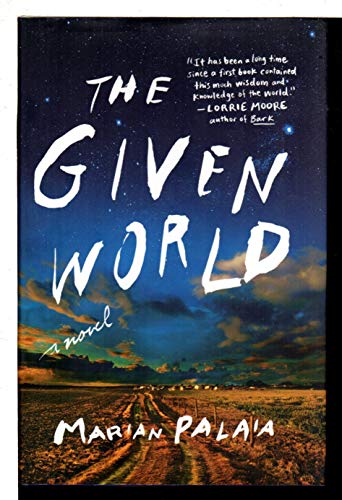
Lorrie Moore said, “It’s been a long time since a first book contained this much wisdom and knowledge of the world.” The Given World is the remarkable debut of “an immense writing talent.” (Booklist)
"synopsis" may belong to another edition of this title.
About the Author
Marian Palaia was born in Riverside, California, and grew up there and in Washington, DC. She lives in San Francisco and has also lived in Montana, Hong Kong, Ho Chi Minh City, and Nepal, where she was a Peace Corps volunteer. Marian has also been a truck driver, a bartender, and a logger. The Given World is her first novel.
Excerpt. © Reprinted by permission. All rights reserved.
Given World
PROLOGUE
Jasper says this is the kind of heat that makes people in Australia shoot each other. Or stab. Strangle. Run over. Whatever. But we are not in Australia. We are in a once-infamous city whose inhabitants still call it Saigon. It has not rained in months, but tonight it will, and the rain will go more or less unmentioned but not unnoticed. It will still be hot, but the relief will be palpable. In Australia, they will stop killing each other, but only if they get some rain there too.
We have been waiting—playing pool and drinking beer and sometimes, when we can’t take it anymore, finding air-conditioned places that will let us in. In those places, you pay the usual dollar for a 333 beer; two more dollars for the air. The Caravelle is one of those places, and the Rex, and now these fancy new restaurants appearing block by block, almost overnight. There is a swimming pool on the roof of the Rex, and it is often full of corpulent Russian tourists, suntanned like scraped cowhide. They are loud, and they never come to the Lotus. This is our bar. No air-con. Rats the size of puppies, but they stay in the dark corners, usually, until closing time.
The government here is renting Jasper from Australia so he can teach young Vietnamese pilots how to fly passenger planes. He is part of a contingent of Qantas boys—another of whom has managed to woo me into bed, which really didn’t require all that much effort. This other one looks vaguely like Jim Morrison and has a room at the Rex, with air-con and a bathtub. We are not in love; not by a long shot. If he were one of the French boys, maybe I would be in love. The Aussie is mainly in love with himself, but the bathtub is nice. It slows down the process of going crazy.
Back in February, during Tet, Jasper drank so much it almost killed him and they had to send him home. The day after the hospital set him loose, I waited on the steps of the Rex with him while they put his gear in a cab. He didn’t want to go. He’d found his place. He was almost in tears; big, broad-shouldered, rowdy Cairns bruiser, barely able to get the words out.
“Nothing for me there,” he said. “I shouldn’t have done it.”
“It was in the air,” I said. “Couldn’t be helped.” He patted my shoulder. The street was still littered with mounds of pink paper from the millions of firecrackers that had gone off nonstop for three days.
They let him come back last week; he promised to behave. If he fucks up this time, he goes home for good. A little while ago he headed across the street to the Apocalypse Now, a serious bar where people go to get seriously drunk. He was shaky, even after three beers. I won’t see him come out. I won’t see him ever again.
• • •
It’s slow tonight, and since she is not needed to flirt and serve drinks, Phu?ng and I are hanging out at the front window. It is octagonal and quite large—maybe six or eight feet across—and contains not a bit of glass. The sill is fairly wide, meaning a person could sit on it if she were so inclined, and often I can be found perched there, gecko-like, trying to blend in. At last call, Tho, the bartender, will close the rusted aluminum accordion shutters and latch them with a heavy round padlock the diameter of a dessert plate. I wonder if the shutters are made, like so much is here, of metal salvaged from crashed American warplanes. I wonder about a lot of things at this window. Last call is still hours away.
It is April. In a few short years, Bill Clinton will mark the middle of his first term by reestablishing diplomatic relations with Vietnam, and Americans will turn up in droves; some for the first time, some not. For now, we are few and far between, and except for one in particular, I have not yet missed us very much.
This American (the one telling this story) is almost, but not quite, old enough to have been here the first time around. I don’t know where the years have gone. If I didn’t have to count the ones I don’t entirely remember, I would actually be a lot younger. This is not all that funny. I know. But it was not deliberate, either. Some things just happen. Shit happens. Everyone says so.
“Gone to C? Chi already?” Phu?ng asks. “Visit brother?” By which she means have I gone by now. She says this without looking directly at me, because she knows. I have not gone. One of these days, though, maybe I will surprise her.
Mick has been away more than half my life, but this is the first time I have set out to look for him, as I have been very busy denying the undeniable. When I was a kid he would take me into the foothills of the Little Rockies on his motorcycle. He knew where to look for fossils; knew what they were when he found them. I can still see, set on the palm of his hand, a chunk of quartz etched with tiny filaments, like hairs. He tells me the etchings are the imprint of dinosaur feathers. We are in a cave, and I am holding the flashlight. I search his face to see if he is making it up, but think maybe this time he is telling the truth.
Remember this, Riley, I tell myself. Hang on to this.
To Phu?ng I say, “Not yet.”
She looks at me and rolls her eyes. Just up, over to one side and back again, not all the way around. Her eyebrows are pencil-line thin and perfectly arched. I would look ridiculous in those eyebrows. I tell her she looks like Madame Nhu.
“Điên cái đ?u,” she says. Crazy in the head. I agree: I have seen photos of the madame soon after her husband and his brother, South Vietnam’s president, were assassinated in 1963. She is holding court in L.A., accusing Kennedy, not a hair out of place. The woman had some nerve; you have to give her that.
It dawns on me that Phu?ng might not be talking about the Dragon Lady. If she isn’t, I can’t argue. Crazy is clearly my comfort zone, my DMZ. And as for visiting ghosts, the Vietnamese are used to that; it is no cause for commotion.
My brother, if I am being honest, is only one of the ghosts I have come here to visit. By which I mean the shadows in my head and not necessarily dead people, because I still don’t know. Show me a body; maybe I’ll believe.
• • •
The dive we are in, this flimsy but cozy excuse for a glitzy rock ’n’ roll nightclub, is fairly quiet at the moment—five or so regulars take turns playing pool, a few strangers and a small flock of taxi girls look on. On a suitcase-size and decoratively beat-up boom box he keeps behind the bar, Tho plays the homemade cassette tapes we give him. Tonight Prince rules the airwaves, along with The Pretenders and a little Culture Club. Some nights Tho’s box delivers the same stuff American soldiers would have listened to here: Country Joe, Sly, The Youngbloods, Three Dog Night, Aretha. Occasionally we get the soundtrack for Good Morning, Vietnam. We especially love the part where Robin Williams says, “It’s hot. It’s damn hot.” Because it is.
When the conversation about my brother hits the wall that is my refusal to acknowledge any reasonable probability, Phu?ng and I talk about something easier: in this case, the rain. “Tr?i mua,” she says, a simple statement even I can understand: it is raining.
I nod. “R?t mua.” A lot of rain. During our nightly conversations we roam haltingly into each other’s languages, my excursions considerably more hesitant than hers, but I am learning, and Phu?ng has had far more practice with English.
“Wet rat,” she says, and giggles at the play on words. “Wet rat bastard.” She is not really giggling anymore, but she doesn’t sound pissed either, which makes it difficult to know for sure if she has really pegged anyone in particular for a rat bastard, or if she has been watching more old American movies on Star TV and this is just another practice persona. Probably a little of each, knowing Phu?ng. She sounds like Humphrey Bogart in Vietnamese drag. I do not ask, and imagine she is just messing around. I am too dreamy with beer and the heat to work it out anyway, watching my own movie, the scenes dim and sputtery as a hand-cranked newsreel.
Outside, cyclo drivers on the watch for passengers pedal their three-wheelers through fitful patches of brightness. They drift strong and stork legged, all sinew and bone skinny. Dangling from their lips or fingers are cigarettes somehow still smoldering in the rain. The way they smoke, so casually oblivious, reminds me of my father—on the porch, maybe, or out in the yard at night, looking up at the sky, for weather, but it’s not as if he could miss the stars. I hear my name in his voice: “Riley . . .” Never loud or angry, just gentle reminders: try to grow up with some degree of intentionality and grace; try to believe the world is more benevolent than not. I wonder if he knows I did hear him. I’m sure I never said. Here I am, though, working on it. Working on something.
Firelight emanates from small blazes kept alive with jet fuel and tended on the fractured sidewalks by itinerant bicycle mechanics; these men once repaired jeeps and tanks for the Americans and now keep their tools in battered, surplus, army-green ammo boxes. They have long ago forgiven us for leaving them behind. Buddhists, they say there is nothing to forgive.
My fake-French bicycle is locked up out front where I can keep an eye on it. It is how I get around in this city of five million, to my various English-teaching jobs, to the street kids’ center where I try to offer something of relative value, and into which we try to coax them from the stoops, the rain, the robbers. But the kids are so wild—wilder than wild red pandas—and they find their protection in each other, mostly coming only to eat and then disappearing again into the night.
I try to formulate in my pidgin Vietnamese an explanation for Phu?ng of how the cyclo guys look like those mythological birds to me, and how some kids in America are told that storks bring babies, tied up in bandanas dangling from their beaks. It sounds even more ridiculous in Vietnamese than it does in English, and it also occurs to me how many birds there are already in this story: Phu?ng, the phoenix, cyclo-storks, the girls at the bar, a scrawny pidgin that is my grasp of the language, a language I am learning to love, for translations like this one, for barbed wire: “steel string with thorns.”
Phu?ng tells me the stork story is so much baloney; she actually says, “Stork babies baloney, Chi.” Chi is what they call me here. It means big sister. Hardly anyone calls me by my actual name, but I’m used to that; I’ll answer to just about anything.
Phu?ng has recently been knocked up by one of our local British boys. She tells me this as we stand at the window. Ian, the father, is an old Saigon hand, having been here for three years already, captaining some kind of bamboo furniture enterprise. He is tall, blond, dubiously handsome, and wears his jaded weariness like a badge. I hear the first few years it was all he could do to stay in the country and out of prison, for uncommitted crimes.
This town is full of romantically hazardous men: Brits, Aussies, Froggies. Especially, maybe, the Froggies, with their Ça vas, their Gitanes, their sleepy eyes and sexy accents that require of a girl perpetual vigilance. Luc could be a poster child for these Froggies. He looks like Jean-Paul Belmondo in Breathless, and rumor has it that he is indeed here to make a movie, though I have never seen him with a camera or a lighting crew, and suspect he is really here (like me) on account of a movie he keeps in his head.
Phu?ng tells me he has his eye on me. “Luc like you style, Chi. Think Chi beaucoup sweetie pie.”
Luc has never said more than two words in a row to me. If he thinks I am beaucoup sweetie pie, he has a funny way of showing it. Phu?ng says this is because he is shy. Shy and adorable. A little young. A hazard, like I said. Besides, there is that Jim Morrison Aussie, the one I became entangled with almost as soon as I arrived, and who will very soon, and surgically, break my heart—able to do that because this is Saigon, not because the reasons I am sleeping with him have anything to do with love. Love would require a part of me that I have not been able to precisely locate or properly identify the remains of for a long time now.
So that is the romantic inventory—the pertinent bits.
At least I am not pregnant. This time. I look over at Phu?ng, who leans her elbows on the windowsill, her chin on her interlocked fingers. I say I am sorry for bringing up the storks.
“No worries,” she says. Then, “Shit.” Softly, infinitely sweetly. She picked that up from me, I think—the word, not the delicate delivery of it. I never heard her say it before we started hanging out together at the window.
“Don’t say ‘shit,’ ” I say. “It’s not ladylike.”
“What is ladylike?”
“Like a lady.”
“Woman?” she asks. She looks puzzled, those fine eyebrows drawn together to meet above the bridge of her delicate nose. Her delicate nose that matches the rest of her delicate self. I feel like an Amazon next to her, all five and a half feet of me.
“Different,” I say. “More feminine. Ladies don’t swear.”
“Merde,” she says. She’s not buying it, in any language.
I swear all the time, though my favorite swearword is not “shit,” it is “fuck.” Mick taught me how to cuss when I was nine or ten, but that is not one of the words he taught me. It is one I picked up out of necessity a few years later. I try not to say it around Phu?ng. I do have some manners.
“What are you going to do, Phu?ng?”
“Don’t know. Maybe will go away,” she says.
“What? Where?” I am alarmed. For me. I don’t want her to go anywhere. She is the only truly sane person I know in this town—besides my students, for whom I must keep up some sense of decorum, meaning I cannot go out drinking with them, and Tho. But I have learned it is not healthy to become too attached to the bartender.
“Not me, silly,” she says. “Nó.” Nó means It. I still don’t know what she’s saying. “Em bé,” she says, and smacks my forehead lightly with her fingertips for emphasis.
“Oh.” The baby. I get it; that part I get. Maybe it’s the beer, but I don’t know what else to say; not sure if she means what I think she means. I realize I don’t have any idea what can happen here, what’s legal or accepted. I don’t know either if Phu?ng is Catholic or Buddhist, animist or Cao Đài; if she has family in the delta or the highlands; if her father fought with the ARVN or the Vietcong or the Montagnards. I am just an interloper, still uninitiated and incurably dopey, traits Phu?ng patiently abides.
She straightens her back and casually taps her long, perfect, pink-shellacked fingernails on the sill like she’s playing a piano. “Maybe keep,” she says, as if it has just occurred to her, but I am not fooled.
“Does Ian know?”
She nods. “Knows. Not happy.” She hesitates, stops tapping. “Very,” she says.
“Very not happy? Or not very happy?” I ask, even though I’m not sure the distinction will be clear to her. As usual, she’s tracking me just fine.
“Not very happy,” she says. “But so-so happy.”
“Really?” I am shocked. I would not have expected him to be any kind of happy; he has always seemed so content, so immutably rooted in bachelorhood.
“Why surprise?”
“I don’t know. I just—”
“I know,” she says, and turns to me. “Ngu?i M?.” American. She leans her forehead into mine, locks eyes, kisses my cheek and floats swan-like away in her silky white áo dài to go back to work.
I get another semicold Tiger beer from Tho, watch the cyclos a bit longer as the rain lets up, and eventually return to the pool table, where I sometimes belong. It’s getting late, but I am not ready to go back to my place yet, out on Cách M?ng Tháng Tám, Boulevard of the August Revolution, needing something closer to pure exhaustion to sleep in this heat, and the noise that almost never stops. I could probably go to the Rex and sleep with the Aussie, listen to his cherished CD collection on his fancy stereo in his hermetically sealed room, but the beers are closer—and warmer by a long shot. Besides, I hate just showing up; I like at least to be invited.
More people wander in—not regulars, tourists—trying, I would guess, to make some sense of this awkward and bewildering city they had surely envisioned differently. Maybe with real sidewalks, traffic signals that people actually abide, or white sand beaches and cabana boys, full-time electricity, food you can eat with impunity. I always say, Where the hell did they think they were going? But I didn’t have any idea either, so I guess that’s not entirely fair. I was, however, not expecting cabana boys or a Gray Line tour. I have been here six months now, and finally what is here is just what belongs. Meaning some part of me has acclimated, planted a little flag, and I can barely imagine—at least when I am awake—going back.
Last week one of the kids, hunkered down on the floor at the shelter, paused while scooping rice from his bowl to his mouth and looked up at me as if he were seeing me for the first time. “Where you town?”
At first, I always said California, as that is the place they have all heard about, seen pictures of, imagine America to be, if they imagine America at all. I haven’t tried yet to explain Montana—the perpetual expanse and frigid beauty of it. “Sài Gòn,” I said. “Ngu?i Vietnam.”
He looked back down at his bowl, dismissing me. “Nói d?i.” Liar. He finished the rice, picked the last grains out of the bowl with fingers that seemed to move independently of the rest of him. “Ngu?i Canada.”
“Nope.” I shake my head. Not Canadian.
“? đâu, r?i?” Where, then? “Say true.”
“Không bi?t.” I don’t know.
“You crazy. Maybe American. American crazy. America number one.” He set his bowl down hard on the floor and left me then, without even a fleeting glance back, to wonder if I should even attempt to process either of his pronouncements, or any of mine.
• • •
Tonight my pool partner is Clive, of June’s, another ratty expat bar between here and the river, a few blocks away. He is another Brit, always barefoot, and, at fifty-something, fairly old as local gringos go. June is his Thai wife, a fading beauty, all business and hard as bone. Rumor has it that the taxi-girl trade at June’s is its main concern, not a sideline like it is here, and June the presumptive madam. Clive is also rumored to move a lot of drugs through the country by paying off the cops and the customs, and partnering with the right guys from Cholon, a less risky trade here so far than in Bangkok. Back in Manchester he worked the steel mills, and when they shut down went looking for something better than the dole.
“Shite work,” he told me the first time we talked. “Bollocks and shite not having any.”
“I imagine,” I said, though I couldn’t.
“Bloke I knew in Thailand sent me a postcard. Said the birds were everywhere. And easy. And it was warm. They had this thing called a sun.”
He found June in Chiang Mai, conducted a courtship of sorts, and married her in a little beachside ceremony.
“Was she one of the easy ones?”
He turned his head side to side two or three times, slowly, as far as it would go. “Nowt easy about her.”
“So why’d you marry her?”
He chalked up, bent down to take a couple of shots, and, after missing the last one, leaned back against the edge of the pool table, tossed his cue stick between his hands and looked up at the grotty ceiling. “The way she said no. Like she’d never been asked such a stupid question. I knew she was the girl for me.”
“What was the question?”
“I believe it was ‘Would you care to dance?’ ” He grasped the cue with both hands, waist-to-shoulder-width apart, and commenced a spin, his bare feet executing a remarkable pirouette.
“Your shot,” he said when he stopped revolving. “Though ya don’t have one.”
He was right. He’d snookered me good.
Clive seems to like me, despite my refusal to snooker him or our opponents when I don’t have a shot. It drove him crazy for a while, but now I get a little grudging respect for trying to hit something of my own, no matter how hopeless it may look or how many rails I’ll need to carom perfectly off of to get there. We are a good team, in any event, and win far more often than we lose. The taxi girls root for us, applaud when we pull out a victory in the final lap.
Tonight we are playing an American from Texas and a chubby Taiwanese businessman who are apparently involved in some sort of rare-monkey export concern that I don’t really care to think too much about. About what they do with the monkeys once they get them out of the country. The Chinese guy insists on yelping “Lucky!” every time I make a shot, no matter how simple or how complicated it might be, or how many shots I make in a row.
The Texan responds each time with a lively, drawled “Damn straight, podner.”
I would like more than anything to slap them both with one clean swipe.
Clive knows I go off my game when I let myself get rattled by the opposition. He keeps reminding me to focus on the table. “He’s blinkered, mate. And that Texas twat is just trying to wind you up. Ignore them.”
“I’m trying, but that is so fucking annoying. You notice they don’t do that to you.”
“Cor,” he says, “Flippin’ gormless. Keep your pecker up.”
“No pecker,” I say. “That’s the problem.” But I do get the gist.
“Shoot,” Clive says. I make two respectably difficult ones and then miss a dead-easy four ball in the side. Clive says, “Quit pissing around.”
“I made two.”
“My two,” he says.
Between shots, I lean sweaty and slick against the wall, and the temptation to unlock my knees, just give in and slide down to the floor, is almost overwhelming. In spite of the rain, it is at least ninety degrees in here, and the humidity might be even higher, if that’s even possible. I resist the inclination to perch on my haunches and instead focus on Clive’s feet as he pads around the table. No one has ever asked, at least within my earshot, why he never wears shoes, but I suspect it is because he can’t find any here that fit. His feet are not big, in the usual sense, but extremely wide. They look like hairless bear paws.
In the end we win on an amazing cutback Clive slices into the corner. He misses scratching by a centimeter. “Brave,” I say.
He pats me on the head. “No. Just good.”
“Another?”
“Not tonight, kiddo. I’m knackered. Going home to the missus.”
“Sounds lovely.” He just smiles and shuffles out barefoot into the dark.
It’s midnight, and the place is getting crowded, filling up with overflow from the Apocalypse. Phu?ng is delivering drinks, so there will be no window time before closing. Ian comes in, takes his usual place at a corner table, and nods at me. I nod back. I know I should get on my bicycle and go home, but the idea is too depressing. I don’t want to be lonely any night, but for some reason—maybe the twisted clarity of too many beers, or Phu?ng’s situation, or the music, or the rain, or my brother—I especially don’t want to be lonely this night. I wonder where James Taylor was when he wrote that song. Not Saigon, I bet. I bet it was someplace he knew and unquestionably belonged, and that he wasn’t even all that lonely.
Phu?ng takes Ian his beer, and I watch as he puts his hands around her tiny waist and pulls her close for a quick kiss when no one else is looking. I don’t count. I am a collaborator. And all of a sudden I want what they have, even if I don’t get to know exactly what it is, or even if I’ve been telling myself for years there is no future in it. I suspect it is something along the lines of love.
Phu?ng leaves for the bar and Ian waves me over to come sit with him. I am caught off guard by how grateful I feel but mostly am relieved to have at least a semilegitimate reason to stay awhile longer. On the way, I pick up a beer for him and a bottle of water for me. I already know I am going to feel like hell in the morning, but I don’t have to hammer in the last nail. Since tomorrow is Saturday, I have only one class—a sweet and ragtag band of earnest college students I will meet at the park in the afternoon—and then the eight-to-midnight shift at the shelter. I’ll survive.
Ian takes note of the water, my unfocused eyes, and says, “How many?”
“How many what?” I know what he’s asking but don’t want to admit to more than I have to right away.
“Sandwiches.”
“I was working on my second.”
“Thought better of that?”
“I did.”
A Tiger sandwich is three beers: one Tiger beer between two other Tiger beers. Two or more sandwiches is tilt. Not pretty. He gives me a thumbs-up. Which is nice. We try to guess the tourists’ nationalities and watch them flirt with the taxi girls. Eventually I go home.
Ian was one of the first people I met here, the night I found the Lotus, the first time I was brave enough to leave the one square block containing the eight-dollar-a-night hotel I stayed in for a few weeks after I landed. The block I had confined myself to, terrified of venturing any farther, of crossing the street. I had been in town only four days, but they had been long ones, spent mostly sleeping, dreaming of mountains and highways and home, fox dens and snow caves, waking to wonder what I had done. My room was enormous and timeworn; painted, with what looked like watercolor, a peeling and mottled blue: walls, floor, ceiling, doors, and window frames. The filmy curtains were also blue, and the holey mosquito net. It was like being underwater, and finally I had to get out, before I couldn’t anymore. In those four days I memorized the entry for “blue” in my dictionary. It said:
of a color intermediate between green and violet, as of the sky or sea on a sunny day: the clear blue sky / blue jeans / deep blue eyes.
(of a person’s skin) having or turning such a color, esp. with cold or breathing difficulties: The boy went blue, and I panicked.
(of a bird or other animal) having blue markings: a blue jay.
(of cats, foxes, or rabbits) having fur of a smoky gray color: the blue fox.
(physics) denoting one of three colors of quark.
It was Ian’s table that first Lotus night, and I watched him win for a long time before I had the nerve to put my name on the board. I was too unsteady to shoot well but made a few decent shots and earned myself a beer and some conversation, in English, which was a lot like being let out on my own recognizance. But after so much time and silence, it was hard to get used to talking again.
He asked what part of Canada I was from. Later I would find out the locals did that to avoid insulting anyone by guessing they were American. At the time, though, I just said no part, but close.
“Yank, then?”
“Yank.” I laughed. I’d never been called one of those before.
“What brings you to our fair city?”
“Curiosity, I guess.”
“You know about the cat, right?”
“What cat?” He waited for me to figure it out, which took me longer than it should have. “Oh, the curious one.”
“Right.”
“I do. We have that cat in America too.”
“Con mèo,” he said. My first Vietnamese lesson. I knew then that I could easily come to love a language in which the word for an animal was the sound it made.
He asked me how long I planned to stay, and I said I didn’t know. My ticket was open-ended and my purpose was clear as mud.
“Good luck with that,” he said, but not in a way that would make me feel ridiculous. More than, in some unnamable way, I already did.
After a few months I constructed something of a purpose: living, getting from place to place, not crashing my bicycle, teaching idioms and street slang, feeding feral orphans. A few months more, and Saigon’s incessant din and treacly grime and sleepless lunacy have taken me over. The city carries me along like a wave. Or an avalanche.
Which leaves little time to think about the reasons I came here: most of all to locate Mick, or his bones; or if not his actual bones, then his spirit, and anything else he could have left behind. Something I can see, or touch, or at least find a place in me that will accept this: MIA, after all these years, means gone, gone, gone, really gone. This will mean bucking up long enough to go to C? Chi—so close it is practically a suburb—getting down on all fours and crawling into the tunnels where the army mislaid my brother.
"About this title" may belong to another edition of this title.
Other Popular Editions of the Same Title

Search results for The Given World: A Novel

Stock Image
The Given World: A Novel
Seller: World of Books (was SecondSale), Montgomery, IL, U.S.A.
Seller rating 5 out of 5 stars

Condition: Good. Item in good condition. Textbooks may not include supplemental items i.e. CDs, access codes etc. Seller Inventory # 00087911066
Stock Image
The Given World: A Novel
Seller: Once Upon A Time Books, Siloam Springs, AR, U.S.A.
Seller rating 4 out of 5 stars

Hardcover. Condition: Acceptable. This is a used book in good condition and may show some signs of use or wear . This is a used book. It may contain highlighting/underlining and/or the book may show heavier signs of wear . It may also be ex-library or without dustjacket. Seller Inventory # mon0001041785
Stock Image
The Given World: A Novel
Seller: Half Price Books Inc., Dallas, TX, U.S.A.
Seller rating 5 out of 5 stars
hardcover. Condition: Very Good. Connecting readers with great books since 1972! Used books may not include companion materials, and may have some shelf wear or limited writing. We ship orders daily and Customer Service is our top priority! Seller Inventory # S_446831708
Stock Image
The Given World: A Novel
Seller: HPB Inc., Dallas, TX, U.S.A.
Seller rating 5 out of 5 stars
hardcover. Condition: Very Good. Connecting readers with great books since 1972! Used books may not include companion materials, and may have some shelf wear or limited writing. We ship orders daily and Customer Service is our top priority! Seller Inventory # S_447121351
Stock Image
The Given World: A Novel
Seller: HPB-Emerald, Dallas, TX, U.S.A.
Seller rating 5 out of 5 stars
hardcover. Condition: Very Good. Connecting readers with great books since 1972! Used books may not include companion materials, and may have some shelf wear or limited writing. We ship orders daily and Customer Service is our top priority! Seller Inventory # S_460384812
Stock Image
The Given World: A Novel
Seller: BookHolders, Towson, MD, U.S.A.
Seller rating 5 out of 5 stars
Condition: Very Good. [ No Hassle 30 Day Returns ][ Ships Daily ] [ Underlining/Highlighting: NONE ] [ Writing: NONE ] [ Edition: reprint ] Publisher: Simon & Schuster Pub Date: 4/14/2015 Binding: Hardcover Pages: 304 reprint edition. Seller Inventory # 6864288
Stock Image
The Given World
Seller: Better World Books, Mishawaka, IN, U.S.A.
Seller rating 5 out of 5 stars
Condition: Very Good. Pages intact with possible writing/highlighting. Binding strong with minor wear. Dust jackets/supplements may not be included. Stock photo provided. Product includes identifying sticker. Better World Books: Buy Books. Do Good. Seller Inventory # GRP98377374
Stock Image
The Given World
Seller: Better World Books: West, Reno, NV, U.S.A.
Seller rating 5 out of 5 stars
Condition: Very Good. Pages intact with possible writing/highlighting. Binding strong with minor wear. Dust jackets/supplements may not be included. Stock photo provided. Product includes identifying sticker. Better World Books: Buy Books. Do Good. Seller Inventory # GRP98377374
Stock Image
The Given World: A Novel
Seller: ThriftBooks-Dallas, Dallas, TX, U.S.A.
Seller rating 5 out of 5 stars
Hardcover. Condition: Very Good. No Jacket. May have limited writing in cover pages. Pages are unmarked. ~ ThriftBooks: Read More, Spend Less. Seller Inventory # G1476777934I4N00
Stock Image
The Given World: A Novel
Seller: ThriftBooks-Dallas, Dallas, TX, U.S.A.
Seller rating 5 out of 5 stars
Hardcover. Condition: Very Good. No Jacket. Former library book; May have limited writing in cover pages. Pages are unmarked. ~ ThriftBooks: Read More, Spend Less. Seller Inventory # G1476777934I4N10