
Items related to The Complete Peanuts 1950-1952: Vol. 1 Hardcover Edition
The Complete Peanuts 1950-1952: Vol. 1 Hardcover Edition - Hardcover
Book 7 of 32: The Complete Peanuts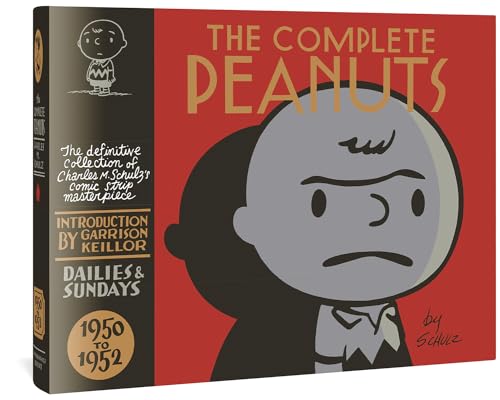
Synopsis
The first volume in the bestselling archival series collecting the most beloved comic strip ever. Many of these formative strips have never been collected or reprinted anywhere else. Introduction by Garrison Keillor.
This first volume, covering the first two and a quarter years of the strip, will be of particular fascination to Peanuts aficionados worldwide: Although there have been literally hundreds of Peanuts books published, many of the strips from the series' first two or three years have never been collected before―in large part because they showed a young Schulz working out the kinks in his new strip and include some characterizations and designs that are quite different from the cast we're all familiar with. (Among other things, three major cast members―Schroeder, Lucy, and Linus―initially show up as infants and only "grow" into their final "mature" selves as the months go by. Even Snoopy debuts as a puppy!) Thus The Complete Peanuts offers a unique chance to see a master of the art form refine his skills and solidify his universe, day by day, week by week, month by month.This volume is rounded out with Garrison Keillor's introduction, a biographical essay by David Michaelis (Schulz and Peanuts) and an in-depth interview with Schulz conducted in 1987 by Gary Groth and Rick Marschall, all wrapped in a gorgeous design by award-winning cartoonist Seth. Black-and-white comic strips throughout
"synopsis" may belong to another edition of this title.
About the Authors
Charles M. Schulz was born November 25, 1922, in Minneapolis. His destiny was foreshadowed when an uncle gave him, at the age of two days, the nickname Sparky (after the racehorse Spark Plug in the newspaper strip Barney Google). His ambition from a young age was to be a cartoonist and his first success was selling 17 cartoons to the Saturday Evening Post between 1948 and 1950. He also sold a weekly comic feature called Li'l Folks to the local St. Paul Pioneer Press. After writing and drawing the feature for two years, Schulz asked for a better location in the paper or for daily exposure, as well as a raise. When he was turned down on all three counts, he quit.
He started submitting strips to the newspaper syndicates and in the spring of 1950, United Feature Syndicate expressed interest in Li'l Folks. They bought the strip, renaming it Peanuts, a title Schulz always loathed. The first Peanuts daily appeared October 2, 1950; the first Sunday, January 6, 1952. Diagnosed with cancer, Schulz retired from Peanuts at the end of 1999. He died on February 13, 2000, the day before Valentine's Day-and the day before his last strip was published, having completed 17,897 daily and Sunday strips, each and every one fully written, drawn, and lettered entirely by his own hand ― an unmatched achievement in comics.
Garrison Keillor has hosted the comedy/variety radio show A Prairie Home Companion since 1974. His many books include Lake Wobegon Days, Leaving Home, Happy to Be Here, The Book of Guys, Homegrown Democrat, Lake Wobegon Summer 1956, Love Me, Wobegon Boy, Pontoon, Liberty, and Pilgrims. Audio CDs and cassettes of compilations of A Prairie Home Companion and Keillor's readings of his books have sold in the millions. He wrote the script for and starred in the 2006 motion picture A Prairie Home Companion, the final film directed by Robert Altman.
Reviews
With its ambitious plan to reprint all of "Peanuts" in chronological order over the next 12 years, Fantagraphics is making this comics masterpiece available for everyone. The real surprise of this first volume is watching the beloved comic strip develop from its embryonic stage. From the start, Schulz had some of the ground rules in place: the ensemble cast whose faces appeared only in profile or three-quarter views, the sophisticated language from the mouths of babes and the absence of visible adults from their world. But, although "good ol' Charlie Brown" appears in the very first strip, the early protagonist is the rather colorless Shermy. Lucy is a googly-eyed baby in a playpen; Linus and Schroeder are pre-verbal infants; and Snoopy is just a small, affectionate dog without a fantasy life. Even more odd, the strip's unique hilarity hasn't quite developed yet; most of the humor here is very mild and generally stems from the characters being little kids playing with each other and fooling around with grown-up roles. They're archetypes of children, not yet archetypes of humanity. Still, flashes of Schulz's later greatness are evident. All the characters show hints of the personalities they'll grow into, and Schulz's clean, magisterially expressive line falls into position by the end of the strip's second year. Regardless, the chance to see the early "Peanuts"—much of it never before reprinted—is a treat.
Copyright © Reed Business Information, a division of Reed Elsevier Inc. All rights reserved.
Peanuts fans who wanted larger doses of the beloved comic strip than their daily newspaper fix afforded have hitherto had to make do with haphazard paperback collections. Now, however, Peanuts' entire 50-year run is to be reprinted in chronology in uniform hardcover volumes, with two years' worth of daily and Sunday episodes in black-and-white per book. As the inaugural strips in this volume show, Schulz plied his successful formula of having children convey adult thoughts and emotions from the beginning, and the underlying melancholy that set Peanuts apart on the comics page was there from the outset. Still, though Charlie Brown was immediately the everyman heart of the strip, other aspects weren't fully developed; for instance, Schroeder and Linus were at first infants. Of special interest to librarians is the volume's index, featuring such entries as "baseball," "Beethoven," and "blockhead, first use of"; perhaps this is a first in a comic-strip collection. Now that Schulz's classic is finally getting its bibliographic just deserts, consider replacing those tattered old Peanuts paperbacks with this definitive series. Gordon Flagg
Copyright © American Library Association. All rights reserved
"About this title" may belong to another edition of this title.
Other Popular Editions of the Same Title

Search results for The Complete Peanuts 1950-1952: Vol. 1 Hardcover Edition

Stock Image
The Complete Peanuts 1950-1952
Seller: Bookmans, Tucson, AZ, U.S.A.
Seller rating 5 out of 5 stars

Hardcover. Condition: Good. . Satisfaction 100% guaranteed. Seller Inventory # mon0002762637
Seller Image
The Complete Peanuts 1950-1952: Vol. 1 Hardcover Edition
Seller: Goodwill Books, Hillsboro, OR, U.S.A.
Seller rating 5 out of 5 stars
Condition: good. Signs of wear and consistent use. Seller Inventory # GICWV.156097589X.G
Stock Image
The Complete Peanuts 1950-1952 (Vol. 1) (The Complete Peanuts)
Seller: HPB-Diamond, Dallas, TX, U.S.A.
Seller rating 5 out of 5 stars
Hardcover. Condition: Very Good. Connecting readers with great books since 1972! Used books may not include companion materials, and may have some shelf wear or limited writing. We ship orders daily and Customer Service is our top priority! Seller Inventory # S_479894877
Seller Image
The Complete Peanuts 1950-1952: Vol. 1 Hardcover Edition
Seller: -OnTimeBooks-, Phoenix, AZ, U.S.A.
Seller rating 5 out of 5 stars
Condition: good. A copy that has been read, remains in good condition. All pages are intact, and the cover is intact. The spine and cover show signs of wear. Pages can include notes and highlighting and show signs of wear, and the copy can include "From the library of" labels or previous owner inscriptions. 100% GUARANTEE! Shipped with delivery confirmation, if you're not satisfied with purchase please return item! Ships via media mail. Seller Inventory # OTV.156097589X.G
Stock Image
The Complete Peanuts 1950-1952: Vol. 1 Hardcover Edition
Published by
Fantagraphics (edition First Edition), 2004
ISBN 10: 156097589X
ISBN 13: 9781560975892
Used
Hardcover
First Edition
Seller: BooksRun, Philadelphia, PA, U.S.A.
Seller rating 5 out of 5 stars
Hardcover. Condition: Fair. First Edition. With dust jacket. The item might be beaten up but readable. May contain markings or highlighting, as well as stains, bent corners, or any other major defect, but the text is not obscured in any way. Seller Inventory # 156097589X-7-1-29
Stock Image
The Complete Peanuts 1950-1952 (Vol. 1) (The Complete Peanuts)
Seller: Half Price Books Inc., Dallas, TX, U.S.A.
Seller rating 5 out of 5 stars
Hardcover. Condition: Very Good. Connecting readers with great books since 1972! Used books may not include companion materials, and may have some shelf wear or limited writing. We ship orders daily and Customer Service is our top priority! Seller Inventory # S_477735942
Stock Image
COMP PEANUTS V1:1950-52 CL
Seller: INDOO, Avenel, NJ, U.S.A.
Seller rating 5 out of 5 stars
Condition: New. Brand New. Seller Inventory # 9781560975892
Stock Image
The Complete Peanuts: 1950-1952
Seller: Manchester By The Book, Manchester-By-the-Sea, MA, U.S.A.
Seller rating 5 out of 5 stars
Hardcover. Condition: Very Good. Dust Jacket Condition: Very Good. No markings. Seller Inventory # 531027
Seller Image
THE COMPLETE PEANUTS 1950-1952 vol 1
Seller: Happy Heroes, Monroe, NJ, U.S.A.
Seller rating 4 out of 5 stars

Hardcover. Condition: Near Fine. Dust Jacket Condition: vg. Seller Inventory # 12309
Stock Image
The Complete Peanuts 1950-1952: Vol. 1
Published by
Fantagraphics, Seattle, WA, 2004
ISBN 10: 156097589X
ISBN 13: 9781560975892
Used
Hardcover
First Edition
Seller: Blue Skye Books, Novato, CA, U.S.A.
Seller rating 5 out of 5 stars
Hardcover. Condition: Fine. Dust Jacket Condition: Very Good+. 1st Edition. Seattle, WA: Fantagraphics, 2004. 1st edition, F/VG+. Book has very little wear. DJ has wear & tiny tears to upper spine, lighter wear to lower spine & corners, closed tear on upper front panel, scattered edge wear. Intro by Garrison Keillor. Comprises all the daily and Sunday strips. Includes essay ("The life and times of Charles Schulz) by David Michaelis, an interview with Schulz by Rick Marschall and Groth and index. The early Peanuts characters were drawn quite immaturely and they are quite different from the later years. Nice copy, great gift. 343 pp. BP. Seller Inventory # 008607