
Mini-Lathe Tools and Projects for Home Machinists (Fox Chapel Publishing) Simple, Practical Designs & Modifications to Extend & Improve the Versatility of Your Small Metal Lathe; Over 200 Photos - Softcover
Book 11 of 26: Home Machinists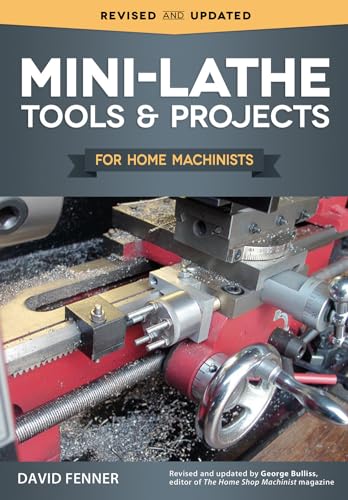
Synopsis
If you own a mini-lathe, this is your must-have resource!
- Extend and improve the versatility of small metal lathes with a series of projects
- Learn tricks and techniques that every mini-lathe operator needs to master
- Well-illustrated with clear diagrams and crisp color photos
- Companion book is a follow-up to the author's beginner-friendly introductory manual, Mini-Lathe for Home Machinists
The ubiquitous mini-lathe has provided an entry into the model engineering hobby for thousands. Available in a wide variety of styles and colors, from an equally varied assortment of vendors, the many models share the basic mini-lathe foundation, and readers will find David Fenner's projects and discussion helpful regardless of their lathe's provenance.
The simple and practical tools and modifications featured in this book will help the hobbyist get the most from this versatile little machine. The straightforward, easy-to-construct designs provide a great deal of flexibility: Modifying to better suit your shop's needs or scaling to fit a different machine are easily accomplished.
With detailed explanations, full-color photography, and insightful diagrams and illustrations, author David Fenner provides practical projects and useful tools and modifications to help you get the most from your mini-lathe. From improving radius turning attachments and strategies for saddle adjustments to techniques for taper turning and knurling, the projects and concepts described in this book can also be applied to various small model engineering lathes, as well as scaled to suit other equipment.
Owners of mini-lathes and other similarly-sized machines will find Mini-Lathe Tools and Projects for Home Machinists to be a valuable resource for the workshop, so you can fully understand everything this little machine can do!
"synopsis" may belong to another edition of this title.
About the Author
After a career of more than forty years spent mainly in manufacturing engineering, David Fenner occupied the editorial chair at Model Engineer's Workshop magazine for five years, relinquishing the role to devote more time to hobby activities and to write about home workshop topics. He lives in Perth, Scotland.
From the Back Cover
"Like the Atlas lathes of a generation ago, the ubiquitous mini-lathe has provided an entry into the model engineering hobby for thousands. Available in a wide variety of styles and colors, from an equally varied assortment of vendors, the various models share the basic mini-lathe foundation, and readers will find David Fenner's projects and discussion helpful regardless of their lathe's provenance. The simple and practical tools and modifications the author features will help the hobbyist get the most from this versatile little machine. The straightforward, easy-to-construct designs provide a great deal of flexibility; modifying to better suit your shop's needs or scaling to fit a different machine are easily accomplished. Owners of mini-lathes and other similarly-sized machines will find Mini-Lathe Tools & Projects for Home Machinists to be a valuable resource for the workshop."
—George Bulliss,
The Home Shop Machinist magazine
This book follows on from the author's introduction to the mini-lathe (Mini-Lathe for Home Machinists, also available from Fox Chapel Publishing) and presents a series of projects that will help to extend the versatility of small metal lathes. Mini-Lathe Tools & Projects for Home Machinists covers the Mark 2 Mini-Lathe, and specific tools such as the radius turning attachment, the tailstock and the dividing head, and includes techniques such as taper turning and knurling. While specifically written for the mini-lathe, the projects in this book can equally be applied to other small model engineering lathes and the concepts can be scaled to suit other equipment.
"About this title" may belong to another edition of this title.
Search results for Mini-Lathe Tools and Projects for Home Machinists (Fox...

Stock Image
Mini-Lathe Tools and Projects for Home Machinists (Fox Chapel Publishing) Simple, Practical Designs & Modifications to Extend & Improve the Versatility of Your Small Metal Lathe; Over 200 Photos
Published by
Fox Chapel Publishing (edition First Edition), 2018
ISBN 10: 1565239164
ISBN 13: 9781565239166
Used
Paperback
First Edition
Seller: BooksRun, Philadelphia, PA, U.S.A.
Seller rating 5 out of 5 stars

Paperback. Condition: Very Good. First Edition. It's a well-cared-for item that has seen limited use. The item may show minor signs of wear. All the text is legible, with all pages included. It may have slight markings and/or highlighting. Seller Inventory # 1565239164-8-1
Seller Image
Mini-Lathe Tools & Projects for Home Machinists
Seller: GreatBookPrices, Columbia, MD, U.S.A.
Seller rating 5 out of 5 stars
Condition: As New. Unread book in perfect condition. Seller Inventory # 30629262
Seller Image
Mini-Lathe Tools & Projects for Home Machinists
Seller: GreatBookPrices, Columbia, MD, U.S.A.
Seller rating 5 out of 5 stars
Condition: New. Seller Inventory # 30629262-n
Seller Image
Mini-Lathe Tools and Projects for Home Machinists
Published by
Fox Chapel Publishing, US, 2018
ISBN 10: 1565239164
ISBN 13: 9781565239166
New
Paperback
Seller: Rarewaves USA, OSWEGO, IL, U.S.A.
Seller rating 5 out of 5 stars
Paperback. Condition: New. Seller Inventory # LU-9781565239166
Seller Image
Mini-Lathe Tools & Projects for Home Machinists (Paperback)
Seller: Grand Eagle Retail, Bensenville, IL, U.S.A.
Seller rating 5 out of 5 stars
Paperback. Condition: new. Paperback. If you own a mini-lathe, this book is a must-have resource to fully understand everything this little machine can do! In continuation with its introductory manual, Mini-Lathe for Home Machinists, this book presents a series of projects to extend the versatility of small metal lathes. With detailed explanations, full-color photography, and insightful diagrams and illustrations, author David Fenner provides practical tools and modifications to help you get the most from your mini-lathe. From improving radius turning attachments and strategies for saddle adjustments to techniques for taper turning and knurling, the projects and concepts described in this book can also be applied to various small model engineering lathes and scaled to suit other equipment. Shipping may be from multiple locations in the US or from the UK, depending on stock availability. Seller Inventory # 9781565239166
Seller Image
Mini-Lathe Tools and Projects for Home Machinists
Published by
Fox Chapel Publishing, US, 2018
ISBN 10: 1565239164
ISBN 13: 9781565239166
New
Paperback
Seller: Rarewaves.com USA, London, LONDO, United Kingdom
Seller rating 5 out of 5 stars
Paperback. Condition: New. Seller Inventory # LU-9781565239166
Buy New
US$ 16.19
Free Shipping
Ships from United Kingdom to U.S.A.
Ships from United Kingdom to U.S.A.
Quantity: Over 20 available
Stock Image
Mini-lathe Tools & Projects for Home Machinists
Seller: Revaluation Books, Exeter, United Kingdom
Seller rating 5 out of 5 stars
Paperback. Condition: Brand New. revised updated edition. 119 pages. 8.25x5.75x0.50 inches. In Stock. Seller Inventory # 1565239164
Buy New
US$ 29.97
US$ 13.31 shipping
Ships from United Kingdom to U.S.A.
Ships from United Kingdom to U.S.A.
Quantity: 1 available
Seller Image
Mini-Lathe Tools & Projects for Home Machinists (Paperback)
Seller: AussieBookSeller, Truganina, VIC, Australia
Seller rating 5 out of 5 stars
Paperback. Condition: new. Paperback. If you own a mini-lathe, this book is a must-have resource to fully understand everything this little machine can do! In continuation with its introductory manual, Mini-Lathe for Home Machinists, this book presents a series of projects to extend the versatility of small metal lathes. With detailed explanations, full-color photography, and insightful diagrams and illustrations, author David Fenner provides practical tools and modifications to help you get the most from your mini-lathe. From improving radius turning attachments and strategies for saddle adjustments to techniques for taper turning and knurling, the projects and concepts described in this book can also be applied to various small model engineering lathes and scaled to suit other equipment. Shipping may be from our Sydney, NSW warehouse or from our UK or US warehouse, depending on stock availability. Seller Inventory # 9781565239166
Buy New
US$ 31.54
US$ 37.00 shipping
Ships from Australia to U.S.A.
Ships from Australia to U.S.A.
Quantity: 1 available
Seller Image
Mini-Lathe Tools & Projects for Home Machinists (Paperback)
Seller: CitiRetail, Stevenage, United Kingdom
Seller rating 5 out of 5 stars
Paperback. Condition: new. Paperback. If you own a mini-lathe, this book is a must-have resource to fully understand everything this little machine can do! In continuation with its introductory manual, Mini-Lathe for Home Machinists, this book presents a series of projects to extend the versatility of small metal lathes. With detailed explanations, full-color photography, and insightful diagrams and illustrations, author David Fenner provides practical tools and modifications to help you get the most from your mini-lathe. From improving radius turning attachments and strategies for saddle adjustments to techniques for taper turning and knurling, the projects and concepts described in this book can also be applied to various small model engineering lathes and scaled to suit other equipment. Shipping may be from our UK warehouse or from our Australian or US warehouses, depending on stock availability. Seller Inventory # 9781565239166
Buy New
US$ 22.96
US$ 49.24 shipping
Ships from United Kingdom to U.S.A.
Ships from United Kingdom to U.S.A.
Quantity: 1 available
Seller Image
Mini-Lathe Tools and Projects for Home Machinists
Published by
Fox Chapel Publishing, US, 2018
ISBN 10: 1565239164
ISBN 13: 9781565239166
New
Paperback
Seller: Rarewaves USA United, OSWEGO, IL, U.S.A.
Seller rating 5 out of 5 stars
Paperback. Condition: New. Seller Inventory # LU-9781565239166