
Synopsis
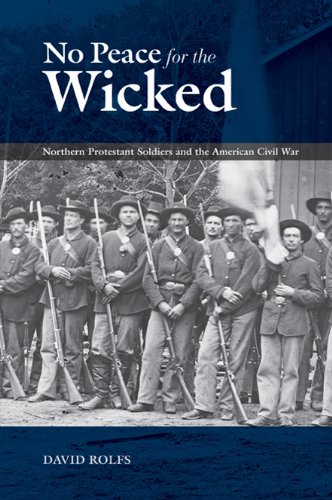
The first comprehensive work of its kind, David Rolfs' No Peace for the Wicked sheds new light on the Northern Protestant soldiers' religious worldview and the various ways they used it to justify and interpret their wartime experiences. Drawing extensively from the letters, diaries and published collections of hundreds of religious soldiers, Rolfs effectively resurrects both these soldiers' religious ideals and their most profound spiritual doubts and conflicts. No Peace for the Wicked also explores the importance of "just war" theory in the formulation of Union military strategy and tactics, and examines why the most religious generation in U.S. history fought America's bloodiest war.
"synopsis" may belong to another edition of this title.
About the Author
Born in Chicago, David Rolfs grew up in southeastern Wisconsin, where he attended the University of Wisconsin at Madison and Whitewater. He earned his Ph.D. in nineteenth-century American history at Florida State University, where he also minored in the history of the Middle East. David's research interests include early American history, the American Civil War, World War II, Holocaust studies, Middle East civilization, and the theme of conspiracy in American history. He has authored articles on just warfare, the Holocaust, and the religious history of the American Civil War. When he is not teaching or writing, he enjoys spending time outdoors with his wife and five-year old twins.
From the Back Cover
"Civil War armies were probably the most religious in American history. Products of the Second Great Awakening in American Protestantism, many Northern soldiers believed they were fighting for God as well as country. Their faith helped them confront danger and possible death. In this fine study, David Rolfs shows how this war over secular issues was nevertheless infused with Christian rhetoric and convictions." --- James M. McPherson
"This book makes an outstanding contribution to our understanding of the Civil War in general and to the place of religion in Northern common soldiers in particular . . . In its use of primary materials (supplemented by printed letters), the book's scholarly content rises to the level of the very best `people's histories' of the Civil War." --- Mark Noll
"No Peace for the Wicked is a deeply thought provoking book that reveals an often overlooked aspect of Northern soldiers' motivations and inner struggles. Those wishing to understand the Civil War soldiers--or the cultural landscape of nineteenth-century America--will not want to miss this book." --- Steven E. Woodworth
From the Inside Flap
In the spring of 1861, young men from all over the Northern states flocked to join the Union arm, eager to crush the newly fomented Southern rebellion. Many were driven by their Protestant religious beliefs, convinced they were joining a holy cause to save the Union from the "wicked" Confederacy. Those religious ideals were quickly put to the test by the vicious nature of the Civil War. Some soldiers rationalized their violent actions, telling themselves that they were engaged in a noble conflict to preserve the ideals of the Union, while others were huanted by the horrors of war and eventually lost their faith altogether. The motives, dilemmas and justifications of these men are now brilliantly captured in David Rolf's "No Peace for the Wicked."
The first comprehensive work of its kind, this book takes the reader into the minds of these often-conflicted soldiers. Drawing from a rich trove of letters, diaries, and published collections, Rolfs offers a penetrating examinination of the religious motives of these Christian warriors, who represented a variety of denominations and social backgrounds. Many of their innermost thoughts--both their ideals and their torments--are shared in the pages of this book. "No Peace for the Wicked" also explores the importance of "just war" theory in the formulation of Union military strategy and tactics.
"About this title" may belong to another edition of this title.
Search results for No Peace for the Wicked: Northern Protestant Soldiers...

Stock Image
No Peace for the Wicked: Northern Protestant Soldiers and the American Civil War
Published by
University of Tennessee Press, 2009
ISBN 10: 1572336625
ISBN 13: 9781572336629
Used
Hardcover
Seller: ThriftBooks-Dallas, Dallas, TX, U.S.A.
Seller rating 5 out of 5 stars

Hardcover. Condition: Fair. No Jacket. Readable copy. Pages may have considerable notes/highlighting. ~ ThriftBooks: Read More, Spend Less. Seller Inventory # G1572336625I5N00
Stock Image
No Peace for the Wicked: Northern Protestant Soldiers and the American Civil War
Published by
University of Tennessee Press, 2009
ISBN 10: 1572336625
ISBN 13: 9781572336629
Used
Hardcover
Seller: ThriftBooks-Atlanta, AUSTELL, GA, U.S.A.
Seller rating 5 out of 5 stars
Hardcover. Condition: Very Good. No Jacket. May have limited writing in cover pages. Pages are unmarked. ~ ThriftBooks: Read More, Spend Less. Seller Inventory # G1572336625I4N00
Stock Image
No Peace for the Wicked: Northern Protestant Soldiers and the American Civil War
Published by
University of Tennessee Press, Knoxville, TN, 2009
ISBN 10: 1572336625
ISBN 13: 9781572336629
New
Hardcover
First Edition
Seller: NWJbooks, Lancaster, PA, U.S.A.
Seller rating 4 out of 5 stars

Hardcover. Condition: New. Dust Jacket Condition: New. 1st Edition. Gilt lettering on blue covers in a blue & pictorial dust jacket. 8vo, 288pp. Seller Inventory # 012409