
Items related to The Resurrectionist: The Lost Work of Dr. Spencer Black
Synopsis
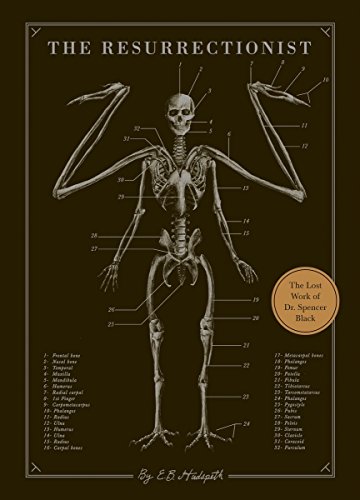
A haunting blend of gothic fiction, Victorian medical history, and breathtaking anatomical illustration, The Resurrectionist imagines a lost scientific archive proving that mythical creatures once walked beside humanity.
“Disturbingly lovely . . . a cabinet of curiosities, stitching history and mythology and sideshow into an altogether different creature.”—Erin Morgenstern, author of The Night Circus
Presented as the recovered life story and scientific work of the infamous Dr. Black, The Resurrectionist offers two extraordinary experiences in one volume. The first part is a chilling fictional biography of Dr. Spencer Black, from his childhood spent exhuming corpses through his medical training, his travels with carnivals, his cruel and crazed experiments, and, finally, his mysterious disappearance. The second part is Black’s magnum opus: The Codex Extinct Animalia, a Gray’s Anatomy for mythological beasts, all rendered in meticulously detailed anatomical illustrations that resemble pages from a Victorian medical textbook.
- A unique blend of mythology, horror, fantasy, and speculative history
- Collectible oversized format perfect for display and gifting
- Ideal for fans of museum curiosities, anatomy art, and illustrated fantasy
Open the lost notebooks of Dr. Spencer Black and decide for yourself whether myth is stranger—or closer to truth—than history ever imagined.
"synopsis" may belong to another edition of this title.
About the Author
E. B. Hudspeth is an artist and author living in New Jersey. This is his first book.
Excerpt. © Reprinted by permission. All rights reserved.
1878
The Fawn-Child
Alphonse is growing so wonderfully, like a plant in the spring. What a miracle, what a machine; I am increasingly grateful for his healthy deliverance into the world. —Dr. Spencer Black
Dr. Spencer Black’s career and aspirations changed after he paid a visit to a local carnival (the exact name of which remains unknown). Featured among the giants, acrobats, and other “marvels of nature” roaming the sideshows was an anatomy museum—an exhibit of strange medical artifacts and bizarre biological specimens.
The anatomy museums, along with cabinets of curiosities, had been popular scientific novelty collections for hundreds of years; many of these grand accumulations are still available for public view. It was this show that eclipsed Black’s previous work and inspired him to study what would become one of the most bizarre and unique pursuits of any scientist, least of all one with his talents.
These sideshows, of which I have seen many, are typically decrepit affairs leaving one with a great thirst for civility, men, and manners. The performers are often subjects of ridicule and humiliation, and they usually become patients of mine in the Ward—seeking a better life or, at the least, humanity.
The show was primarily a showcase of well-known abnormalities with a few less common defects of the human form. The collection included a skeleton of conjoined twins, fused at the skull; the monster-baby (a pig fetus in a jar); and the south pacific mermaid (a monkey and trout sewn together). all the displays were easily identified by anyone familiar with science and medicine. The exception was the fawn-child, a deceased young boy displaying an orthopedic condition that had caused his knees to bend the wrong way. The bones were misshapen, and excessive hair was present over the entire surface of the skin; there were bone or calcium growths at the top of his skull, which gave the appearance of juvenile horns. The dead child was preserved in a large alcohol-filled glass jar.
Black was convinced that the specimen held a secret to his research. He believed that the mutations were manifestations of the ancient past he had written about—evidence of a genetic code that was not completely eradicated. Some have argued that Black found answers in places where there was no need for questions. Whatever the case, the encounter with the fawn-child fueled his obsession for finding a cure for the deformation that was paramount in his work. He would never again practice conventional medicine.
"About this title" may belong to another edition of this title.
Search results for The Resurrectionist: The Lost Work of Dr. Spencer Black

Stock Image
The Resurrectionist: The Lost Work of Dr. Spencer Black
Seller: HPB-Emerald, Dallas, TX, U.S.A.
Seller rating 5 out of 5 stars

Hardcover. Condition: Very Good. Connecting readers with great books since 1972! Used books may not include companion materials, and may have some shelf wear or limited writing. We ship orders daily and Customer Service is our top priority! Seller Inventory # S_478181898
Seller Image
The Resurrectionist: The Lost Work of Dr. Spencer Black
Seller: Goodwill Books, Hillsboro, OR, U.S.A.
Seller rating 5 out of 5 stars
Condition: acceptable. Fairly worn, but readable and intact. If applicable: Dust jacket, disc or access code may not be included. Seller Inventory # 3IICZD000OMI_ns
Seller Image
The Resurrectionist: The Lost Work of Dr. Spencer Black
Seller: Goodwill Books, Hillsboro, OR, U.S.A.
Seller rating 5 out of 5 stars
Condition: good. Signs of wear and consistent use. Seller Inventory # 3IIK100060DE_ns
Seller Image
The Resurrectionist: The Lost Work of Dr. Spencer Black
Seller: clickgoodwillbooks, Indianapolis, IN, U.S.A.
Seller rating 4 out of 5 stars

Condition: acceptable. Used - Acceptable: All pages and the cover are intact, but shrink wrap, dust covers, or boxed set case may be missing. Pages may include limited notes, highlighting, or minor water damage but the text is readable. Item may be missing bundled media. Seller Inventory # CSIV.1594746168.A
Stock Image
The Resurrectionist: The Lost Work of Dr. Spencer Black
Seller: HPB Inc., Dallas, TX, U.S.A.
Seller rating 5 out of 5 stars
Hardcover. Condition: Very Good. Connecting readers with great books since 1972! Used books may not include companion materials, and may have some shelf wear or limited writing. We ship orders daily and Customer Service is our top priority! Seller Inventory # S_478718914
Stock Image
The Resurrectionist: The Lost Work of Dr. Spencer Black
Seller: Half Price Books Inc., Dallas, TX, U.S.A.
Seller rating 5 out of 5 stars
Hardcover. Condition: Very Good. Connecting readers with great books since 1972! Used books may not include companion materials, and may have some shelf wear or limited writing. We ship orders daily and Customer Service is our top priority! Seller Inventory # S_476308259
Stock Image
The Resurrectionist: The Lost Work of Dr. Spencer Black
Seller: HPB-Diamond, Dallas, TX, U.S.A.
Seller rating 5 out of 5 stars
Hardcover. Condition: Very Good. Connecting readers with great books since 1972! Used books may not include companion materials, and may have some shelf wear or limited writing. We ship orders daily and Customer Service is our top priority! Seller Inventory # S_464663955
Stock Image
The Resurrectionist: The Lost Work of Dr. Spencer Black
Published by
Andrews McMeel Publishing, 2013
ISBN 10: 1594746168
ISBN 13: 9781594746161
Used
Hardcover
Seller: World of Books (was SecondSale), Montgomery, IL, U.S.A.
Seller rating 5 out of 5 stars
Hardback. Condition: Good. Philadelphia. The late 1870s. Home to the famous anatomist and surgeon Dr Spencer Black. The son of a "resurrectionist", Dr Black develops an unconventional hypothesis. What if the world's most celebrated mythological beasts - mermaids, minotaurs, and satyrs - were in fact the evolutionary ancestors of humankind? This book tells his story. Seller Inventory # 00109229467
Stock Image
The Resurrectionist: The Lost Work of Dr. Spencer Black
Seller: HPB-Ruby, Dallas, TX, U.S.A.
Seller rating 5 out of 5 stars
Hardcover. Condition: Very Good. Connecting readers with great books since 1972! Used books may not include companion materials, and may have some shelf wear or limited writing. We ship orders daily and Customer Service is our top priority! Seller Inventory # S_483754048
Stock Image
The Resurrectionist: The Lost Work of Dr. Spencer Black
Published by
Andrews McMeel Publishing, 2013
ISBN 10: 1594746168
ISBN 13: 9781594746161
Used
Hardcover
Seller: World of Books Inc, Montgomery, IL, U.S.A.
Seller rating 4 out of 5 stars
Hardback. Condition: Good. Philadelphia. The late 1870s. Home to the famous anatomist and surgeon Dr Spencer Black. The son of a "resurrectionist", Dr Black develops an unconventional hypothesis. What if the world's most celebrated mythological beasts - mermaids, minotaurs, and satyrs - were in fact the evolutionary ancestors of humankind? This book tells his story. Seller Inventory # CIN1594746168G