
Items related to We Are the Ones We Have Been Waiting For: Light in...
Synopsis
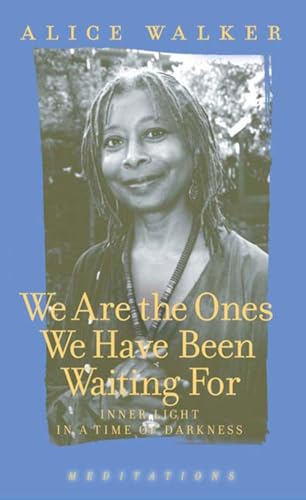
A beautifully packaged book of spiritual ruminations with a progressive political edge, from the incomparable Pulitzer Prize-winner—a woman who has devoted her life to befriending the earth.
From the Introduction: "In fact, the happiness that imbues this kind of (impersonal) friendship, whether for an individual or a country, or an act, is like an inner light, a compass we might steer by as we set out across the lengthening darkness. It comes from the simple belief that what one is feeling and doing is right. That it is right to protect rather than terrorize others; right to feed people rather than withhold food (and medicine); right to want the freedom and joyful existence of all human kind. Right to want this freedom and joy for all creatures that exist already, or that might come into existence. Existence, we are now learning, is not finished! It is a happiness that comes from honoring the peace or the possibility of peace that lives within one's own heart. A deep knowing that we are the earth—our separation from Earth perhaps our greatest illusion—and that we stand, with gratitude and love, by our planetary Self.
Author of the perennially bestselling novel The Color Purple, Alice Walker has long been a force for sanity in a chaotic world. In We Are the Ones We Have Been Waiting For she draws on her deep spiritual grounding, her political conviction and experience, and her literary gifts to offer a series of meditations filled with wisdom, hope, encouragement, and, at times, serenity to a world in need of all these things. The perfect gift for Alice Walker fans and anyone who longs for peace, on earth and within, this lovely volume will be embraced for its wise insights and mature compassion.
"synopsis" may belong to another edition of this title.
About the Author
Alice Walker is one of the most prolific and important writers of our times, known for her literary fiction, including the Pulitzer Prize-winning The Color Purple (now a major Broadway play), her many volumes of poetry, and her powerful nonfiction collections. Her other bestselling books include In Search of Our Mothers' Gardens, The Temple of My Familiar, Possessing the Secret of Joy, By the Light of My Father's Smile, and The Way Forward Is with a Broken Heart. Her advocacy on behalf of the dispossessed has spanned the globe.
Reviews
Often rambling and occasionally pedantic, the essays in Walker's latest collection can also be stunningly insightful. Mixing prose with poetry, she discusses Martin Luther King, feminism and meditation, among other subjects, always circling back to themes of integrity and activism. The most substantial entries are based on live lectures. In a speech to the graduating class of the California Institute of Integral Studies, Walker urges that we not fear the pause that "wisdom requires" when "something major is accomplished," despite our eagerness to rush into "The Future." She manages to show how this "moment of reflection" is natural and necessary, whether the defining event is college graduation, menopause or the buildup to a military invasion. Her 2002 lecture, "I Call That Man Religious," argues that Fidel Castro is a "truly religious man" because he "speaks out for the rights of the poor," in contrast to the Catholic Church, which hid its priests' abuse of children for so long. More contradictory is "Crimes Against Dog," in which she describes a visit to buy a labrador retriever and her discomfort at the similarity between dog breeders and slaveholders, but doesn't consider getting a mutt. Despite the annoying inclusion of homework-like assignments at the end of most essays, this book will inspire hope. (Dec.)
Copyright © Reed Business Information, a division of Reed Elsevier Inc. All rights reserved.
Walker, best known as a novelist, offers a collection of her essays and talks in a variety of venues and efforts to express and encourage spirituality and progressive political ideas. Talking to midwives, black yoga instructors, college students, Buddhists, and other admirers of her work, Walker offers commentary on the ways that modern society is destroying itself and the earth, and yet stands on the threshold of promising development. Walker urges resistance to war, lower birth rates, simpler living, and simple kindness as ways to improve life for us all. In a commencement address, she urges her listeners to value "the pause," the time between accomplishments when we wonder what is next and are afraid of the temporary emptiness. Taking her title from words by the poet June Jordan, Walker encourages the reader to recognize the potential that each of us has to make positive changes in the world and our lives. This is a thoughtful and reflective look at life and the search for meaning. Vanessa Bush
Copyright © American Library Association. All rights reserved
Excerpt. © Reprinted by permission. All rights reserved.
We Are the Ones We Have Been Waiting For
Inner Light in a Time of Darkness
By Alice WalkerThe New Press
Copyright © 2006 Alice Walker
All rights reserved.
ISBN: 978-1-59558-137-2All rights reserved.
Contents
Acknowledgments,
Introduction,
1. Three Fates,
2. Childhood,
3. When Life Descends into the Pit,
4. All Praises to the Pause,
5. Crimes Against Dog,
6. This Was Not an Area of Large Plantations,
7. I Call That Man Religious,
8. Now That You Are with Me Like My People and the Dignity of the World,
9. Metta to Muriel and Other Marvels,
10. How It Feels to Know Someone Died for You,
11. The Glimpse of Life Beyond the Words,
12. Sent by Earth: A Message From the Grandmother Spirit,
13. Orchids,
14. To Be Led by Happiness,
Permissions,
CHAPTER 1
Three Fates
Graduation Address Agnes Scott College 2000
Some years ago, on December 17, 1996, at 7:16 in the morning, I witnessed my first birth. To see a baby being born was something I had wanted since I was a child and heard the mysterious information that babies came out of women's bodies. Who could believe this?
I had been invited to this birth by the midwife, a friend of mine, and by the mother and grandmother of the baby involved.
I arrived at the birth mother's home in the early dawn — the exact time, it seems to me, that one should be summoned. Four o'clock in the morning, if I recall correctly. As I mounted the steps leading to the mother's door, I heard her cries.
This seemed as it should be. I felt — the world being as populated with humans as it is — that I should have been hearing these cries before. It is astonishing that at every moment a new person, many new persons, are being born. And that we do not hear this, so well hidden has the act of birth become.
The living room I entered, after removing my shoes, seemed ancient, even cavelike, as friends of the young mother sat about in clusters, quietly talking, or making tea and coffee for those just entering.
I was asked by my midwife friend to hold the light, and, as labor progressed, I was privileged to see each of its stages. The young mother was oblivious to all but her pain; those of us helping her were so attuned to her feelings that, during contractions, we instinctively panted and breathed with her. Until the last moment I could not believe that a baby would be the result of what I was seeing.
Four hours after my arrival, the baby dropped out of his mother into the soft palms of my midwife friend; in one fluid motion she laid him on his mother's breast. It was a beautiful birth. The mother, only sixteen years old, had demonstrated an authority and courage that were pure warriorship.
As the birth of the baby was announced outside the bedroom in which it occurred, the men of the tribe — the baby was born into an extended Native American family — quietly began to make breakfast, which they served to the women who had participated in the birthing, and later to the clan of people who gathered to celebrate the birth throughout the day. I left this experience feeling blessed, inspired, somehow purified.
The next baby I encountered was in central Mexico, where I have a home and where I sometimes go to write. As a near, quickly reached, Third World country, Mexico is ideal for me because it offers a constant reminder of all that is transpiring in over two-thirds of the so-called developing world. This little girl was six months old when we met. I fell for her instantly. Perhaps it was the elegant baldness of her head. Her direct, curious gaze. Her scent of happiness. Not since my own daughter was born many years before had I felt such joy as I beheld a new addition to our world.
Her parents are quite well-off, and so she has a nurse and a nursery, her own pristine wing, located in her parents' spectacular sea-cliff house. She has excellent food, beautiful, tiny dresses and piles of toys. She will be raised to be upper-class. This of course worries me.
It worries me partly because of the third baby I encountered during this same period. This was the six-week-old daughter of the woman who occasionally keeps house for me; a struggling middle-aged mother of three who'd recently married a man who convinced her to try to give him a son. On my way to visit her and to bring gifts for baby and mother, I pondered the baby's future. The house into which she was born was as different from the previous house as could be imagined: essentially one room, with what appeared to be a dirt floor, in part of a crumbling building that rises very close to a dusty and noisy road.
The furniture in the house consisted of one bed, a table and a couple of chairs, all old and much used. When the mother went to get the baby for me to see, it was as though she rummaged among a pile of rags on the bed before lifting her up, which she did with pride. After talking with her for a while it became clear that her marriage was troubled and that her body was not healing properly from the birth. I urged her to return to the hospital, noting not only her lack of energy, but that the child seemed languid and weak as well.
The first child's mother is too young and unskilled to take on the task of raising a child. Fortunately, the child's grandmother is present, as is the native community into which he was born. This child will have many challenges, as a Native American, in a world in which much of what might have gone into strengthening him has deliberately been destroyed by the dominant culture. His primary obstacle in life might well be despair. On the other hand, he enters a community that is becoming ever more conscious of what it is, what its struggle to survive is, and also what its commitment to its own values must be. It is also a community that, in its essence, venerates beauty, justice and love.
The second baby's parents, it seemed to me — with their baby's spotless white nursery in a very casual and colorful Mexico — are attempting to seal her off from the raw poverty that exists ten minutes away. I dread the day when she awakens to her overwhelming privilege in a country whose children, materially speaking, often have little. I dread even more, however, the possibility that by the time she is an adult, the material disparity between herself and others will have no meaning for her. That she will walk over and around and through her nurse, the servants, and the population of poor Mexicans — as many rich Mexicans do — without seeing their condition of poverty, or even really seeing them. This would be a disaster in one born so beautiful and so inspiring of love.
If I were writing a fairy tale, I would say that the little girl born across the way, on the bed that resembled a pile of rags, might grow up to be the servant of the rich little girl in the sea-cliff castle who is nonetheless at this stage very sweet. The little rich girl, let us call her Hope, would resist becoming the spoiled snob I fear she might become, and instead she and the poor girl, let us call her Joy, would become friends so loyal to each other that Hope's parents would not know what to make of it. Hope would quietly teach Joy everything there is to know about place settings and table manners; horseback riding and society dances. Joy would teach Hope all there is to know about card-playing, algebra, swimming in the river, and how to shop in the pueblo without encountering one word of disrespect. They would be mutually disgusted that Joy's parents were so poor and Hope's parents so outlandishly rich. They would plot, from an early age, to discover a way to equalize things.
Along would come, perhaps, the third child, now a fully grown Native American man, a warrior like his mother. He would join the two women. Together they would open a school to teach the children of the very poor, many of them indigenous. They would agitate for economic democracy in Mexico. They would be vilified in the press as Communists and chased out of town. They would take to the mountains. From there, they, along with the thousands coming to join them, would begin the second Mexican revolution. Perhaps they would model their rebellion on the Zapatista movement, ongoing, presently, in the Mexican state of Chiapas.
What will in fact be the lives of these children? This is the cry that must wake us from sleep.
Since you invited me to Agnes Scott College on this special day — the day in which you launch yourselves into new and ever more challenging studies of and endeavors in the world — I will feel free in giving you the advantage of my own harsh opinion about having children just now. I believe there should be a moratorium on the birth of children. That not one more child should be born on this planet until certain conditions are met. Perhaps the most important of these is that the several missing pounds of plutonium — the most deadly substance ever concocted by man; the inhalation of a single particle causes cancer — must be found. I believe it was the valiant Dr. Helen Caldicott who alerted us to the fact that it is missing, just as she has worked for over a decade to warn us of the lethal effects of nuclear power and nuclear waste. Where is this awful substance? Who has stolen it? For what purpose will they use it? And what about the information we now have about the use of plutonium in fueling rockets, which, as we know, sometimes self-destruct, scattering their fuel and the bodies of the crew over the face of Mother Earth?
In fact, in a recent article it was announced that NASA will launch something called the Cassini probe. It will carry 72.3 pounds of plutonium-238. Enough to disable and kill millions of people on earth, if anything goes wrong. Apparently the scientists at NASA wish to visit Saturn. Do you? A visit that could cost us our lives. A visit Saturn itself has not initiated. The colonizing mind invites itself wherever it wishes to intrude; it is a worthwhile practice for the coming millennium to train ourselves away from such a mind.
Begin, then, with tracking the use and whereabouts of the missing and badly misused plutonium. If we do not find the plutonium that is missing and contain that which is being misused, there is not much hope that any of our children will live free from pain into a healthy old age. Millions of them will not live at all.
From there, work to make the routine drinking of bottled water a distant nightmare. Water was not meant to be polluted, any more than human blood, which is mostly water, is meant to be contaminated. How dare we bring anyone into the world who must, anywhere on earth, run from rain? Native people have always maintained that water — like trees, rocks, and the earth itself — has emotions. Think how it must feel. We must learn respect for water and teach this respect to the billions of humans already here.
And then, there are the lives of the other animals — humans being only one animal, and a minority — to consider. These must be honored, freed from their cages, their lands returned to them, with our deepest apologies and most heartfelt reparations. I recently read about an experiment in which chimpanzees were taught enough sign language to speak with humans. One of the things they divulged was that they liked a movie called Field of Dreams. I have not seen this movie: what moved me was their enjoyment and understanding of it. I want children who are already born to understand that there is much to distrust about the zoo.
There is much work to be done, sister and brother Earthlings. But we have, if we work earnestly enough, all of eternity to do it. I personally take comfort in this thought. In fact, it is by working on these issues that an eternity might be ours. And I leave it to you to consider this, for a time in your life when you will sit on a green hill somewhere and consciously dream up a future for your very own child.
You will have children, the majority of you. Some of you may already have them. You will not listen to me at all. I myself do not listen to me. And this makes me laugh. It is such a classic predicament of human nature. Even as I enumerate the perils we face as a planet, the instability of every single system, the irresponsibility of an obsolete "leadership," the lethal nature of "progress," I find myself longing — hence my recent fixation on babies — to be a grandmother.
I say to my daughter more frequently than she appreciates: Where is my grandchild?
I am not wrong in this. I know how wonderful babies are. How much learning and growth and humor they bring. Babies come empty-handed, but bringing so many gifts! That is why so many of us want them. My own baby's birth was a miracle from which I shall never recover. The way she felt and smelled — where in fact do babies come from? — will be forever a part of why I adore life. Life is audacious.
What then does such a mixed message mean?
It means consciousness about all that is happening around you, that endangers Life. The One Big Life all of us share. Essentially it means hard work. Our Earth home will be insecure and uncertain for many millennia. Despite our anxieties, we will have to learn to find comfort and solace here. Not by cordoning ourselves off from others, not by killing others or stealing their resources, but by learning to sit in council with them as we discuss what has become our common destiny on a planet nearly wrecked by the behavior of human beings. In this regard, it is helpful to witness the growing formation of councils the world over: of women, of elders, of grandmothers, of wise people who love the earth and look forward with apprehension and caring to the coming generations.
So, young women of Agnes Scott College, I salute your great accomplishment, that you have studied long hours in preparation for your graduation day. That you love the world so much you have taken the time and made the effort to prepare yourselves to serve it. Have your work in the world, and have your children. Only one, please, out of respect for the weight we are to our Mother. But be aware that the other children of the world are your responsibility as well. You must learn to see them, to feel them, as yours. Until you do, there is no way you can make your own child feel safe. And because when you do, you will join the rest of the world in cleaning up the rivers, clearing the air, saving the trees, and finding and containing every ounce of the missing and misappropriated plutonium.
What happens to the three children in my non–fairy tale will be largely up to adults of the world, people like you.
I have named the rich little girl Hope. The poor little girl Joy. I will now name the Native American little boy (who became my godchild) Song. Here is a poem for them:
The Day You Are Born
On the day that you are born
Beautiful beings
Those who love you
Tremble
We tremble because
We are afraid
You are so mysterious
Beautiful beings
And we do not know
Who sent you
Nor do we know
Where you are from
Imagine how perplexed
You make us
As your bald (or hairy) head
Slides gradually
Into view
Between your mother's
Thighs
And we hold our breaths
As, after so much pain to her, you casually
Drop.
What struggles you have already
Endured
Just
To get here!
How could we not
Welcome you
In awe?
Watching you emerge
Into the light
We wonder if what we see
Is even possible.
If we were religious
In the way inherited from our parents
We would cross
Ourselves.
And remembering that the cross
Symbolizes that place
Where spirit and matter
Meet
We might cross ourselves
Anyway
Out of respect
For the crossroad
Your birth
Presents
For your mother
And you.
Oh, little ones
Who will one day
Be
So much taller than us
Let us pledge
On your sweet heads
To make a better show
Of things
Than we have done.
Let us promise
To take courage
From the mysterious
Nature of your
Journey.
Let us acknowledge
In all humility
That regardless of
Your status in life
It is we
Who are blessed.
We do not know the beginning
Or the end
We only see the middle of things
Which is our own life.
Perhaps you are a part of
The force
That is coming to help
Us
Rearrange our world
To make it better
We pray that this is
So.
That you have come back
To help heal the confusion
You left behind
So many lifetimes
Ago.
And that you come
Bringing all
We need
To get the job
Done:
Joy, Hope, Song.
* * *
We must abandon the notion that we become grandparents only when our own children give birth. In the same way that all adults are ultimately responsible for all of earth's children, grandparents come into being when we realize we are responsible for all the grandchildren on the earth. This does not mean we can single-handedly feed, house and clothe the eleven or so million orphans in Africa, for instance, whose parents have died of AIDS, but it does mean we find ways to connect and relate to as many endangered children on the globe as possible. There are many organizations already formed to make this connection possible. I am particularly drawn to those that teach self-reliance and sustainability. One of my favorites is Heifer International. Each year, through this organization, I am able to send cows, sheep, water buffalo, chickens, pigs, ducks and rabbits to families with children around the globe. As someone who grew up on a farm I know exactly what I'm sending.
What I would like this and other organizations to consider is the institution, at the many orphanages in Africa and around the world, of small farms stocked with animals for the children to own and care for. Nothing will ever replace their parents, but having animals to tend will ameliorate the loneliness.
I am also an honorary co-founder of Women for Women International, which supports women and their children who have been victims of war. If you are past fifty, take some time to contemplate becoming a grandparent. To what children in what part of the world are you particularly drawn? How are these children faring? What would you do to help them if you lived nearby? Can you find a way to do at least some of that from far away?
(Continues...)
Excerpted from We Are the Ones We Have Been Waiting For by Alice Walker. Copyright © 2006 Alice Walker. Excerpted by permission of The New Press.
All rights reserved. No part of this excerpt may be reproduced or reprinted without permission in writing from the publisher.
Excerpts are provided by Dial-A-Book Inc. solely for the personal use of visitors to this web site.
"About this title" may belong to another edition of this title.
Search results for We Are the Ones We Have Been Waiting For: Light in...

Stock Image
We Are the Ones We Have Been Waiting for: Inner Light in a Time of Darkness
Seller: World of Books (was SecondSale), Montgomery, IL, U.S.A.
Seller rating 5 out of 5 stars

Hardback. Condition: Good. Talks about literature/political science. Seller Inventory # CIN1595581375G
Stock Image
We Are the Ones We Have Been Waiting for: Inner Light in a Time of Darkness
Seller: World of Books (was SecondSale), Montgomery, IL, U.S.A.
Seller rating 5 out of 5 stars
Hardback. Condition: Very Good. Talks about literature/political science. Seller Inventory # CIN1595581375VG
Seller Image
We Are the Ones We Have Been Waiting For: Light in a Time of Darkness
Seller: Bay State Book Company, North Smithfield, RI, U.S.A.
Seller rating 5 out of 5 stars
Condition: good. The book is in good condition with all pages and cover intact, including the dust jacket if originally issued. The spine may show light wear. Pages may contain some notes or highlighting, and there might be a "From the library of" label. Boxed set packaging, shrink wrap, or included media like CDs may be missing. Seller Inventory # BSM.1EEOF
Stock Image
We Are the Ones We Have Been Waiting for: Inner Light in a Time of Darkness
Seller: World of Books Inc, Montgomery, IL, U.S.A.
Seller rating 4 out of 5 stars

Hardback. Condition: Good. Talks about literature/political science. Seller Inventory # CIN1595581375G
Stock Image
We Are the Ones We Have Been Waiting for: Inner Light in a Time of Darkness
Seller: World of Books Inc, Montgomery, IL, U.S.A.
Seller rating 4 out of 5 stars
Hardback. Condition: Very Good. Talks about literature/political science. Seller Inventory # CIN1595581375VG
Seller Image
We Are the Ones We Have Been Waiting For: Light in a Time of Darkness
Seller: Greenworld Books, Arlington, TX, U.S.A.
Seller rating 5 out of 5 stars
Condition: very_good. Fast Free Shipping â" Very Good condition book with a firm cover and clean pages. Shows normal use and some light wear or limited notes markings. A solid, nice copy to enjoy. Seller Inventory # GWV.1595581375.VG
Seller Image
We Are the Ones We Have Been Waiting For: Light in a Time of Darkness
Seller: Goodwill, Brooklyn Park, MN, U.S.A.
Seller rating 4 out of 5 stars
Condition: good. All pages and cover are intact including the dust cover, if applicable . Spine may show signs of wear. Pages may include limited notes and highlighting. May include "From the library of" labels. Shrink wrap, dust covers, or boxed set case may be missing. Item may be missing bundled media. Seller Inventory # MINV.1595581375.G
Stock Image
We Are the Ones We Have Been Waiting for: Inner Light in a Time of Darkness
Seller: ThriftBooks-Atlanta, AUSTELL, GA, U.S.A.
Seller rating 5 out of 5 stars
Hardcover. Condition: Very Good. No Jacket. Missing dust jacket; May have limited writing in cover pages. Pages are unmarked. ~ ThriftBooks: Read More, Spend Less. Seller Inventory # G1595581375I4N01
Stock Image
We Are the Ones We Have Been Waiting for: Inner Light in a Time of Darkness
Seller: ThriftBooks-Dallas, Dallas, TX, U.S.A.
Seller rating 5 out of 5 stars
Hardcover. Condition: Good. No Jacket. Pages can have notes/highlighting. Spine may show signs of wear. ~ ThriftBooks: Read More, Spend Less. Seller Inventory # G1595581375I3N00
Stock Image
We Are the Ones We Have Been Waiting for: Inner Light in a Time of Darkness
Seller: ThriftBooks-Dallas, Dallas, TX, U.S.A.
Seller rating 5 out of 5 stars
Hardcover. Condition: Fair. No Jacket. Former library book; Readable copy. Pages may have considerable notes/highlighting. ~ ThriftBooks: Read More, Spend Less. Seller Inventory # G1595581375I5N10