
Items related to Meditations (Deluxe Hardbound Edition)
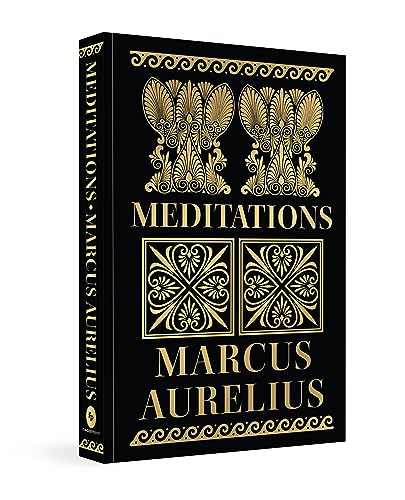
Synopsis
A classic of wisdom. A compass for the soul.
Step into the mind of a Roman emperor and Stoic sage. Meditations is more than just a philosophical text; it's a powerful guide to living with purpose, courage, and grace. Penned as private reflections, Marcus Aurelius’s words continue to echo across centuries, offering timeless insights into the human condition.
Whether you're facing everyday struggles or seeking deeper meaning, this enduring masterpiece speaks directly to the heart and mind, guiding you toward inner strength, clarity, and peace.
Why You’ll Love This Book- Timeless Wisdom, Everyday Relevance: Discover ancient Stoic principles that still resonate in today’s fast-paced world.
- Resilience and Inner Peace: Learn how to stay grounded amidst chaos and cultivate calm through self-discipline and perspective.
- Mindfulness and Self-Reflection: Explore the art of introspection and conscious living to create a life of balance and meaning.
- A Lifelong Companion: Each passage offers fresh insights with every read, making it a trusted guide through life’s many seasons.
- Ideal for Seekers and Thinkers: A must-read for anyone on the path of self-discovery, personal growth, or spiritual exploration.
"synopsis" may belong to another edition of this title.
About the Author
Marcus Aurelius was born Marcus Annius Verus in Rome on 26 April 121. He was taught at home by some of the best tutors. In 161, after the death of Antoninus, Marcus became the ruler of the Roman Empire. He made Lucius Verus his co-emperor, and for the first time in history, Rome was being ruled by two emperors.During his campaigns against the Sarmatians and Germans, Marcus penned down this emotions, thoughts, and reflections in a series of twelve books called Meditations. Originally written in Greek, Meditations records the various stages of his life and gives an insight into his inner life, Stoic ideas, and philosophy. The first English translation appeared in 1634. It was published by Meric Casaubon. With themes, ideas, and beliefs which have continued to inspire the readers across the centuries, Meditations is one of the greatest works of Greek and philosophical literature. Marcus breathed his last on 17 March 180. He was succeeded by his son, Commodus.
From the Inside Flap
Book Summary of Meditations by Marcus Aurelius | ASIN: 9388118782
Meditations by Marcus Aurelius is not a formal treatise on philosophy but a collection of personal, intimate reflections and notes to himself written during his campaigns as Roman Emperor in the latter half of the second century A.D. These writings, never intended for public consumption, serve as the emperor's guide to self-improvement and Stoic practice, providing a profound insight into the mind of a man trying to live a good life while holding immense power. The core of the book is an attempt to master the self and live in accordance with Nature, both the nature of the universe and the specific nature of humanity, which Aurelius defines by reason and social duty.
Aurelius constantly reminds himself of the ephemeral nature of existence. He reflects on the countless individuals who have lived, achieved fame, and then been swept away into the river of time, along with their deeds and monuments. This recurring contemplation of mortality—of how short life is and how quickly one is forgotten—is not meant to induce despair, but to serve as a spur to moral action in the present moment. He urges himself to focus solely on the task at hand, performing it justly and with dignity, viewing every action as if it were the last. The past is gone, the future is uncertain, and only the present moment truly belongs to us. He frequently observes that the universe is in a state of perpetual change, a continuous flux where one thing is dissolving into another, and he must accept this process without complaint or fear.
The bedrock of Aurelius's philosophy is Stoicism, which centers on the distinction between what is within his control and what is not. He repeatedly asserts that the only thing truly under his power is his own judgment and inner will (or prohairesis). External things like health, reputation, wealth, the actions of others, and even death are indifferent; they cannot touch the soul or harm the person's true self. Harm comes only from one's own vice and mistaken judgment. This realization is a source of immense strength and tranquility: by reserving all fear and worry for the state of his own character, the emperor can meet any external event—praise, criticism, pain, or danger—with equanimity and freedom. The appropriate response to adversity is simply acceptance and adaptation, using the event as an opportunity to practice virtue.
Furthermore, Aurelius emphasizes the duty of social action and our interconnectedness with humanity. He sees all men as citizens of a single cosmic state, and argues that since humans are naturally rational and social beings, our highest purpose is to serve the common good. He reminds himself that everything he does must be directed toward making the community better, using the analogy of a limb belonging to a larger body: a detached limb ceases to be useful. When dealing with difficult or vicious people, he instructs himself to remember their kinship and the fact that they, too, are acting based on what they mistakenly believe is good. His anger and judgment should be withheld, and instead, he should practice tolerance, forgiveness, and rational correction, recognizing that their faults are involuntary.
Ultimately, Meditations is a manual for self-governance and moral perfection. It encourages the continuous practice of the four cardinal Stoic virtues: Wisdom (right judgment), Justice (right action toward others), Temperance (self-control), and Courage (facing adversity). Aurelius seeks to cultivate a divine inner principle, a rational self that remains tranquil and unperturbed amidst the chaos of imperial life and the anxieties of the world. The constant repetition of these themes—mortality, the power of judgment, duty to the whole, and living in accordance with Nature—was his method for spiritual training, guiding him toward a life of virtue, acceptance, and inner peace, regardless of the turbulent outer realities of his reign.
"About this title" may belong to another edition of this title.
Search results for Meditations (Deluxe Hardbound Edition)

Seller Image
Meditations (Deluxe Hardbound Edition)
Seller: Goodwill of Colorado, COLORADO SPRINGS, CO, U.S.A.
Seller rating 5 out of 5 stars

Condition: good. All pages and cover are intact. Dust jacket included if applicable, though it may be missing on hardcover editions. Spine and cover may show minor signs of wear including scuff marks, curls or bends to corners as well as cosmetic blemishes including stickers. Pages may contain limited notes or highlighting. "From the library of" labels may be present. Shrink wrap, dust covers, or boxed set packaging may be missing. Bundled media e.g., CDs, DVDs, access codes may not be included. Seller Inventory # COLV.9354407269.G
Seller Image
Meditations (Deluxe Hardbound Edition)
Seller: Austin Goodwill 1101, Austin, TX, U.S.A.
Seller rating 5 out of 5 stars
Condition: good. Book shows general signs of use and handling. May have light wear on the cover or edges and minimal writing or highlighting. Binding remains tight, and pages are clean and readable. Seller Inventory # CTXV.9354407269.G
Seller Image
Meditations (Deluxe Hardbound Edition)
Seller: Goodwill, Brooklyn Park, MN, U.S.A.
Seller rating 4 out of 5 stars

Condition: good. All pages and cover are intact including the dust cover, if applicable . Spine may show signs of wear. Pages may include limited notes and highlighting. May include "From the library of" labels. Shrink wrap, dust covers, or boxed set case may be missing. Item may be missing bundled media. Seller Inventory # 2Y6JCV000Z6P_ns
Seller Image
Meditations (Deluxe Hardbound Edition)
Seller: Goodwill_NE_Indiana, Fort Wayne, IN, U.S.A.
Seller rating 5 out of 5 stars
Condition: good. A book that has been read but is in overall good condition. Very minimal wear damage to the cover including scuff marks, but no major holes or tears. The dust jacket if applicable may not be included. Binding may have minimal wear. The majority of pages are undamaged with minimal creasing or tearing. May have minimal pencil underlining and or highlighting of text and possible small amounts of writing. No missing pages. May have some light marks on the page edges or a remainder mark. May have pale yellow yellowed pages. Fast Shipping, safe and secure mailers. Stock photo used. Seller Inventory # FWV.9354407269.G
Stock Image
Meditations (Hardcover)
Published by
Prakash Books India Private Limited, 2023
ISBN 10: 9354407269
ISBN 13: 9789354407260
New
Hardcover
Seller: Grand Eagle Retail, Bensenville, IL, U.S.A.
Seller rating 5 out of 5 stars
Hardcover. Condition: new. Hardcover. A timeless guide to Stoic philosophy, Meditations by Marcus Aurelius offers invaluable insights into life, virtue, and resilience. This influential work offers a window into the mind of a Stoic philosopher-king as he reflects on the nature of the universe, the meaning of life, and the virtues that lead to a fulfilling existence. This inspirational read is a must-have for anyone seeking personal growth and enlightenment.Ancient wisdom for modern life!Offers practical advice on navigating life's challenges and embracing the present moment.Serves as a source of inspiration for those seeking a more purposeful and meaningful existence.Includes teachings that encourage self-reflection and the art of mindfulness for a more balanced and fulfilling life. Provides practical insights on resilience, self-discipline, and finding inner peace.A must-read for those on a journey of self-discovery. Shipping may be from multiple locations in the US or from the UK, depending on stock availability. Seller Inventory # 9789354407260
Seller Image
Meditations
Published by
Prakash Books India Private Limited, IN, 2023
ISBN 10: 9354407269
ISBN 13: 9789354407260
New
Hardcover
Seller: Rarewaves USA, HEBRON, KY, U.S.A.
Seller rating 5 out of 5 stars
Hardback. Condition: New. Seller Inventory # LU-9789354407260
Seller Image
Meditations (Deluxe Hardbound Edition)
Published by
Fingerprint! Publishing, 2023
ISBN 10: 9354407269
ISBN 13: 9789354407260
Used
Hardcover
Seller: WeBuyBooks, Rossendale, LANCS, United Kingdom
Seller rating 5 out of 5 stars
hardcover. Condition: Good. Most items will be dispatched the same or the next working day. A copy that has been read but remains in clean condition. All of the pages are intact and the cover is intact and the spine may show signs of wear. The book may have minor markings which are not specifically mentioned. Seller Inventory # rev3873602711
Buy Used
US$ 9.79
US$ 8.08 shipping
Ships from United Kingdom to U.S.A.
Ships from United Kingdom to U.S.A.
Quantity: 1 available
Stock Image
Meditations (Deluxe Hardbound Edition)
Seller: Sequitur Books, Boonsboro, MD, U.S.A.
Seller rating 5 out of 5 stars
hardcover. Condition: New. New. Clean, unmarked pages. Fine binding and cover. Hardcover. Seller Inventory # 2610200023
Stock Image
Meditations (Deluxe Hardbound Edition)
Seller: Books in my Basket, New Delhi, India
Seller rating 5 out of 5 stars
Hardcover. Condition: New. ISBN:9789354407260 N.A. Seller Inventory # 2559132
Seller Image
Meditations
Seller: Agapea Libros, Malaga, MA, Spain
Seller rating 5 out of 5 stars
Condition: New. Idioma/Language: Inglés. A timeless guide to Stoic philosophy, Meditations by Marcus Aurelius offers invaluable insights into life, virtue, and resilience. This influential work offers a window into the mind of a Stoic philosopher-king as he reflects on the nature of the universe, the meaning of life, and the virtues that lead to a fulfilling existence. This inspirational read is a must-have for anyone seeking personal growth and enlightenment. Offers practical advice on navigating life's challenges and embracing the present moment. Serves as a source of inspiration for those seeking a more purposeful and meaningful existence. Includes teachings that encourage self-reflection and the art of mindfulness for a more balanced and fulfilling life. Provides practical insights on resilience, self-discipline, and finding inner peace. A must-read for those on a journey of self-discovery. *** Nota: Los envíos a España peninsular, Baleares y Canarias se realizan a través de mensajería urgente. No aceptamos pedidos con destino a Ceuta y Melilla. Seller Inventory # 24213600