Synopsis
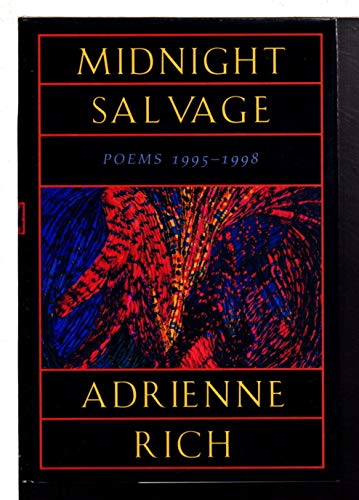
The critically acclaimed, award-winning poet offers a new collection of poems that challenge many aspects of society while presenting her views on the world as it nears the end of the millennium.
Reviews
Her incarnations as activist and maker of new language continue to propel, describe, provoke the poet's words.
Ever since her first volume of poetry in 1951, A Change of World, was selected by Auden for the Yale Younger Poets, Rich has enjoyed a wide and mostly laudatory readership, though it has changed over the years, from admirers of her modest, formal pleasures to believers in her often strident, anti-male rhetoric. Age seems to find her more mellow in these poems from the last three years, though her sociopolitical concerns remain the same, as they have for many of her 19 or so books: a committed radical, Rich engages her readers directly, anticipating objections to her sense of art as intervention and witness. A Long Conversation is just that: a lengthy dialogue, performed for her public, with no lesser figures than Marx, Wittgenstein, Enzensberger, and Gueveraall duly and dully quoted in service of Richs self-aggrandizing bits of comradely memory. Having long abandoned the jaded views of Auden for the democratic vistas of Whitman, Rich the prophet struggles with Rich the proselytizer: she strolls an urban dreamscape in The Night Has a Thousand Eyes, and summons the ghosts of Hart Crane, Muriel Rukeyser, and Paul Goodman, among others. Other poems celebratedespite her admitted tendency to iconizeactivists and artists, Rene Char and Tina Modotti. Everywhere Rich bleeds history, whether imagining those hiding from Nazis, or sorting out her own dead mothers personal effects. Best when plaintive and sensitive to the modest pleasures of her sounds, Richs Iless lines, with their pretentious denial of ego, sound more like the breathless phrases of George Bush. -- Copyright ©1999, Kirkus Associates, LP. All rights reserved.
Rich's poems have always been as complex, polished, and subtly kinetic as a pebble beach, singing with the force of waves and wind, and her newest book is even more potent and startlingly beautiful than what has gone before, as though Rich has descended into the molten core of the planet and the center of our tormented soul. She sees the earth as inlaid with bones, saturated with the salty fluids of the flesh and the heart, and haloed with the prayers of memory. Her language is incandescent, and her musings encompass all time and all people, infinite suffering and blessed liberation. She ponders the tension between our devotion to beauty and intimacy with brutality, writing of people who dwelled both in the magic of art and in the harsh arena of war, including the revolutionary photographer Tina Modotti and the poet and Resistance fighter ReneChar. And in every poem, Rich holds us to the flame of her compassion and to the glint of her sharp vision of the terrible glory that is life. Donna Seaman
Rich's latest collection cuts another notch in the tree of 20th-century history and marks its place on the path toward a poetics of social responsibility. A montage of wordplay and direct historical reference (with endnotes) conveys the necessity for patienceA"horrible patience which is part of the work...which waits for language, for meaning" and freedom of expression. The book amplifies the message we have seen in Rich's work for nearly 50 years. She masterfully presents "all kinds of language" in tone and in content, incorporating the ideas of Blake, Mandelstam, Marx, and Nixon (among others) into a medley setting forth the imperative that historical events be synthesized and expressed in poetry. What she describes as "a theater of voices rather than the restrictive I" is a movement of perspective within the poems and throughout the book. The result is a musical text that is liberating in content and in form.AAnn K. van Buren, New York University
Copyright 1999 Reed Business Information, Inc.
"About this title" may belong to another edition of this title.