Synopsis
A collection of eight short stories that offer a liberationist view of life in the South features "Ironman," "Solace," "Hot," "Graceland," "After Memphis," "Believe Me, Mr. Phoebe," "Licensed for Private Exhibition Only," and "Powwow."
Reviews
Lear's lyrical first book, a collection of eight stories, transports readers to languorous Southern towns where families find air-conditioned comfort at the local Dairy Queen and the mail's daily arrival is viewed as an event. The descriptions here are remarkably synesthetic: we seem surrounded by the thick air of a motel room, where a vacationing group bickers and eats greasy fried chicken; we are immersed in summer sun on a lawn where a man and his pack of hyperactive dogs congregate; we feel the humid air and the coolness of ice cream while sluggishly lounging in a living room. Throughout, there is a sense of time relentlessly oozing by, of kids growing up and of individuals adjusting to adversity. Healthy people frequently witness or experience the fragility of the infirm; for instance, in "Ironman," an athletic woman sustains an injury that tempts her to relinquish goals and surrender to a drab life with her estranged husband, while in "Graceland" a dissatisfied city dweller fearfully suspects her own life might not improve with either time or experience after visiting a terminally ill, elderly friend. Mortality, boredom and change are explored in a collection whose leisurely pace contrasts with its characters' desperation.
Copyright 1992 Reed Business Information, Inc.
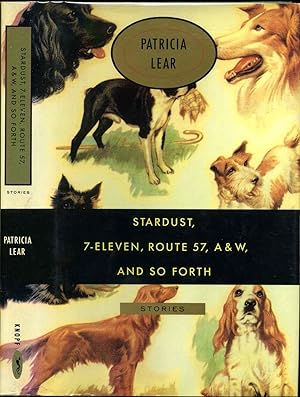
Eight short stories that strain after the colloquial in familiar ways: occasional sparkle and one gem in a mostly uninspired debut. Lear has it down pat: the neo-literary non-literary voice with its awkward syntax, likes, you knows, the sudden unmoored entry into stories, and narrators who tell their lives flat out (``How it usually goes in the mornings is...'') with cute assessments (``The way we are is a couple....''; ``Boredom is what I tell myself I feel''). In the novella-length ``Solace'' (which provides the collection's title: Stardust, 7-Eleven, etc., being the names of the protagonist's dogs), musician C.W. tries to live out a beer- commercial-inspired vision, taking his aspiring trumpeter son and two sexy divorc‚es on a weekend gig; the son--resentful of losing practice time--turns hostile while the women--left in front of the hotel TV with nothing to do--soon, like the reader, grow bored. Characters, dropped into situations touching on life and earth, remain essentially unchanged. In ``After Memphis,'' the lively responses of southern children moving to Yankeeland and a plot involving snakes get lost as the story goes on too long. Only ``Angels''--about the funny, tender but ephemeral relationship between a woman who's recently had a mastectomy and the actor working briefly as her handyman--manages to be contemporary, quirky, and moving. Lear subordinates depth and plot to style, which might work if the style were not by now so familiar. -- Copyright ©1992, Kirkus Associates, LP. All rights reserved.
"About this title" may belong to another edition of this title.