Synopsis
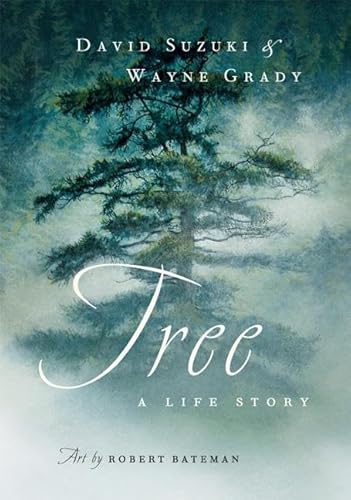
A story that spans a millennium and includes a cast of millions. The story of a single tree.
In this clear, concise, and captivating book, renowned scientist and environmentalist David Suzuki and award-winning writer Wayne Grady tell the life story of a tree, beginning when heat from a devastating forest fire opens thousands of pine cones and sends millions of seeds into the air. Most of these seeds perish, but one falls into the soil and develops into the tree that is the subject of this book.
Suzuki and Grady describe how the tree grows and receives nourishment and what role the tree plays in the forest throughout its life. It acts as a home to succession of creatures and plays a crucial role in the water cycle, in breaking rock down into soil, and in removing carbon dioxide and producing oxygen. Even after the tree dies, it provides a home for moss, ferns, and other plants, which use the tree as a nurse log, and it provides nutrients for insects and fungi. Tree also looks at the community of organisms that share the tree’s ecosystem and at the events going on in the larger world during the tree’s lifetime.
Reviews
Visitors to the Pacific Northwest often find themselves awed by the size of the trees, especially the grand and ubiquitous "Douglas-fir." In this slight, lovely book, environmentalist Suzuki (The Sacred Balance) and Grady (The Bone Museum) tell the tale of one Douglas-fir tree that lived for more than five centuries ("Around the time its seed was soaking in the sunshine... the Aztec Empire was building its capital city"). Woven into the narrative is a history of botany, the study of which developed during the tree’s life (a digression about the Big Bang and the formation of organic molecules feels unnecessary, though). Facts about the species awe: old Douglas-firs can have 12-inch thick fireproof bark, and it can take 36 hours for water to get from the roots to the canopy. "If left alone," write the authors, "our tree would grow forever." Bateman’s misty drawings offer portraits of the tree’s companions—woodpeckers, eagles, mice, ferns—whose lives are more fleeting. Suzuki and Grady lament the loss of old-growth forests and their biodiversity, showing how each tree is part of a massive, interconnected web of organisms including fungi, birds and insects. This book is both a touching look at a single tree and an articulate testimony to nature’s cyclic power. 13 b&w illus.
Copyright © Reed Business Information, a division of Reed Elsevier Inc. All rights reserved.
Trees are among the oldest living organisms on the planet; the oldest tree in North America, a bristlecone pine, may be 4,600 years old. Suzuki and Grady's engaging "biography" covers 700 years in the life of a Pacific Northwest Douglas fir. Each stage in the tree's life is placed not only within the context of history but also an ecological context. When the tree is 15 years old at the end of the Middle Ages, for example, the authors discuss Gutenberg and his printing press, as well as the Douglas fir's primitive form of pollination, by wind, which evolved before there were flying insects. The tree coexists with the pileated woodpecker, the painted suillus mushroom, the lungless salamander, and the bald eagle. After its seven centuries of life, the tree falls to the forest floor to serve as a "nurse log" to young hemlock trees. This happy melding of history, natural history, and biography is further enhanced by Robert Bateman's fine illustrations to create an instructive and graceful look at the interconnectedness of life. Rebecca Maksel
Copyright © American Library Association. All rights reserved
"About this title" may belong to another edition of this title.