Synopsis
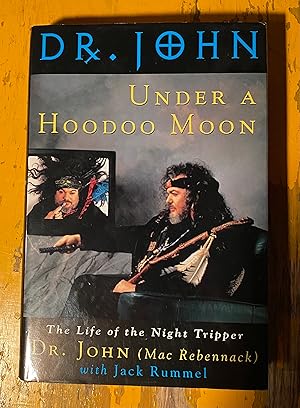
In these pages, Dr. John, the alchemist of New Orleans psychedelic funk, tells his story, and what a story it is: of four decades on the road, on the charts, in and out of trouble, but always steeped in the piano-based soulful grind of New Orleans rhythm and blues of which he is the acknowledged high guru.
He grew up in the 1950s New Orleans, grooving to Little Richard and Fats Domino. At sixteen he was a journeyman rocker, a record producer, a junkie. From recording studio to back alley to whore house to juke joint, he saw every corner of the wide-open city, living one step ahead of the law - until the law caught up with him, and he landed in the penitentiary, with no time to play and hard time to pay. Years later, he mixed all his New Orleans memories into a salty musical gumbo, added a little voodoo spice, and crowned himself Dr. John the Night Tripper - a psychedelic Pied Piper whose crackling voice and eye-opening lyrics made him one of rock's eccentric visionaries. Through the 1970s, his records - Gris-Gris, Gumbo, "Right Place, Wrong Time" - sold millions. And in the 1980s, after kicking the addiction affliction, he became (in the words of the New York Times) "traditions's elegant suitor," his jazzy r&b albums In a Sentimental Mood and Goin' Back to New Orleans winning back-to-back Grammys.
Reviews
As much a tribute to Rebennack's native New Orleans and its vibrant music scene as it is an autobiography, this candid book provides an inside look at the drug-using, hell-raising lifestyle adopted by many rock musicians. Writing in a loose, slangy style with freelancer Rummel, Rebennack, whose albums as Dr. John ( Gris Gris ; Gumbo ) helped popularize the distinctively Cajun-influenced music that is now a hallmark of the New Orleans sound, presents a compelling picture of his hometown as a place of enormous musical energy and excitement. We read of all-night jam sessions, quirky local characters and Voodoo rituals (the sobriquet Dr. John is borrowed from an early Voodoo master). Influenced by such New Orleans greats as James Booker and Professor Longhair, Rebennack hit the road with his first band when he was 16 and, because of narcotics, soon found himself in trouble with the law. He is oddly blase about drugs and tries so hard to maintain his cool-cat rock 'n' roll persona that he comes across more as a caricature than as a real person. The portrait of Crescent City's music scene, by contrast, has depth. Photos not seen by PW. Author tour.
Copyright 1994 Reed Business Information, Inc.
This unflinching autobiography by Mac Rebennack, aka Dr. John, with Rummel (Malcolm X, 1989) gives a firsthand account of New Orleans street life and musical history in the last few decades. Rebennack began frequenting New Orleans music clubs at an early age. In the '50s he dropped out of high school and devoted himself to playing the piano and guitar. While developing his music he also developed a taste for heroin and other drugs. Musicians in the New Orleans scene provided entertainment for ``turistas'' and, in the early morning hours, for pimps, prostitutes and thieves. To supplement their income, musicians also engaged in some of these vocations. Rebennack admits to participating in many shady dealings: He disposed of fetuses for an abortionist, held stick- ups, and conspired to, but evidently did not, murder. After a stint in prison on narcotics charges, he cast himself as Dr. John, based on the 19th-century conjurer by that name, and played distinctly New Orleans music in a wild stage show that featured snake handling and black magic. Dr. John's music became popular with the '60s counterculture. Rebennack also played as a sideman throughout his career with a catalog of music greats--some obscure and some well- known, such as Little Richard and Professor Longhair; considering the ``narcotic haze'' in which he often found himself, he remembers many details from sessions. Rebennack, however, has no respect for fame without musical skill--he refers to the group Iron Butterfly as ``Iron Butterfingers.'' Taken advantage of by unscrupulous music business executives and strung out on heroin for 34 years, he tells a tough tale. A life this varied and chaotic is hard to translate into a linear story. Though Rebennack's prose sometimes rambles, he gives the reader a perspective that most tourists to Bourbon street never see. -- Copyright ©1994, Kirkus Associates, LP. All rights reserved.
Rebennack, a.k.a. Dr. John the Night Tripper, was born in New Orleans in 1940. In his early teens he played hooky from Catholic school in order to pitch songs to Little Richard and Art Neville. By the age of 16, he had recorded an album of original songs and developed a heroin habit. Over the next six years, he honed his craft playing for strippers, pimps, junkies, and even a pickpocketing monkey. When the infamous Jim Garrison cleaned up the city in 1962, Mac took a two-year sabbatical at a federal prison in Fort Worth. Upon his release, he headed for California, where his prodigious session work led to his solo career as Dr. John, one of the Sixties' most outrageous and creative performers. Today, four Grammy Awards later and his drug problems behind him, he's still rocking. This no-holds-barred autobiography by the hippest, "fonkiest" cat to come down the musical turnpike is essential for music libraries.
- Dan Bogey, Clearfield Cty. P.L. Federation, Curwensville, Pa.
Copyright 1994 Reed Business Information, Inc.
Musician Mac Rebennack, aka Dr. John, is the embodiment of New Orleans culture, and his colorful autobiography serves as a virtual history of the city's music from the 1950s on. As a teenager, Rebennack had already launched a successful career as a guitarist when his finger was nearly shot off, forcing him to switch to piano. Eventually, he landed in L.A., where he survived on session work until in 1967 his career as a headliner took off when he created the stage persona Dr. John the Night Tripper, a sort of psychedelic voodoo king. This book ends with Rebennack's return to New Orleans to record his most recent album, a tribute to the city's musical history. Some of its most engaging passages are recollections of musicians Rebennack learned from and played with; most notable among them is the affectionate tribute to his musical godfather, Professor Longhair. Like many such memoirs, the story loses a bit of its drive once its subject begins to achieve commercial success, but Rebennack's distinctive "N'Owleans" patois, which he and Rummel capture to perfection, helps sustain interest throughout. Gordon Flagg
"About this title" may belong to another edition of this title.