Synopsis
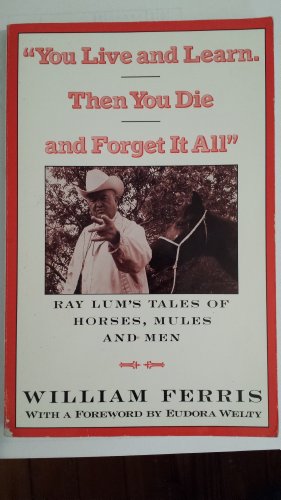
A livestock trader and auctioneer offers his intuitive insight into human nature, chronicling a life of travel in which he encountered depression, dirt farmers, blacks and whites, wealthy ranchers, outlaws, conmen, politicians, and more. Original. 250,000 first printing.
Reviews
Born in 1891 in rural Mississippi, Ray Lum traveled the South for 60 years as a respected livestock trader and auctioneer, collecting rich experiences he retold--even at universities and folk festivals--in a colloquial, humorous and generous voice. Ferris, coeditor of the Encyclopedia of Southern Culture , interviewed Lum (who died in 1977), and notes that his life "bridged the disparate worlds of black and white, of old and new, of South and West." Lum's tales, organized into six chapters of narrative, might better be chopped into episodes, but they remain valuable for those interested in such folklore. His language is vivid (a cemetery is a "marble orchard") and his voice wise (when he loses money on an early deal, the lesson is, "You don't absolutely have to have, you can do without"). Among many adventures, Lum bested cheating gypsies who offered a pretty but vicious horse, ate barbecued rattlesnake, made a deal for wild Texas horses and barely avoided the outlaws Bonnie and Clyde. "I'm fine," said Lum in his old age. "I just need to have my speedometer set back." This book lets him live on. Photos not seen by PW.
Copyright 1992 Reed Business Information, Inc.
Unique stories of travels about the rural South, livestock trading, and persons famous and obscure. Ferris (Anthropology/Univ. of Mississippi; Blues From the Delta, 1977) was a child when he met Lum at the Vicksburg, Mississippi, livestock auctions where Lum, while trading mules, spun out his countless stories. In 1970, Ferris began recording Lum, then 79, and the text here is almost entirely in Lum's voice. Lum's childhood was full of animals, such as his family's razorback hogs that were left to forage among neighborhood trash cans. Dogs chased these fleet pigs in vain: ``When they get to running they go so fast they just float.'' Starting in 1922, Lum traded livestock throughout Texas and met many famous people of the day. Al Smith, running for President, was popular among Texans with his saying, ``I'm for more whiskey and bigger bottles.'' In Dallas, Lum met the outlaw Frank James, brother of the slain Jesse. Frank had been acquitted at trial and was now offering himself on exhibit in a shoe store. In Lum's travels, persons rarely seen in the American literary landscape emerge: stout German farmers in Texas with mules they kept ``fat as town dogs''; solitary and silent West Texas ranchers that Lum considered shrewd judges of character; Lum's own black traveling companion, Squire Harris--an expert rider who displayed Lum's stock, making rough horses ``turn on a dime and then have a nickel to spend.'' Lum reveals some of Harris's secrets: How do you tell if a horse is blind? ``Clap your hands and if he throws up one ear he's blind on that side. If he's blind in one eye, he'll try to see out of that ear.'' A singular voice, detailing rare and fascinating views of the early 20th-century South. -- Copyright ©1992, Kirkus Associates, LP. All rights reserved.
Ferris serves a slice of Southern life in this presentation of the wit and wisdom of Ray Lum, livestock trader and auctioneer. Born in 1891 in rural Mississippi, Lum bartered horses and mules throughout the South and Southwest. He recalls his travels and life experiences with the passion and color characteristic of a consummate storyteller. These personal reflections are a tribute to a way of life gone by and a preservation of its memory. The volume opens with a foreword by Eudora Welty and concludes with an extensive bibliographic essay and endnotes. Full of humor and the drama of life, this book will delight a wide range of readers.
- Eloise R. Hitchcock, Tennessee Technological Univ. Lib., Cookeville
Copyright 1992 Reed Business Information, Inc.
"About this title" may belong to another edition of this title.