About this Item
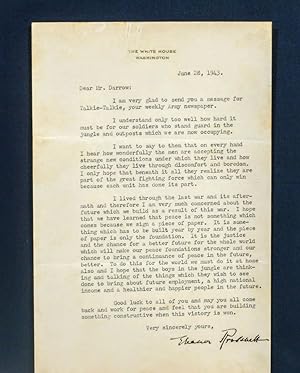
MAGNIFICENT WARTIME LETTER BY ELEANOR ROOSEVELT ON ACHIEVING LONG-LASTING PEACE. This letter, signed and typed by world-renowned social reformer Eleanor Roosevelt on White House letterhead and dated June 28, 1943 (World War II), is addressed to Mr. Jerome Darrow, soldier and army newspaper editor, and reads in full: The White House Washington June 28, 1943. Dear Mr. Darrow: I am very glad to send you a message for Talkie-Talkie, your weekly Army newspaper. I understand only too well how hard it must be for our soldiers who stand guard in the jungle and outposts which we are now occupying. I want to say to them that on every hand I hear how wonderfully the men are accepting the strange new conditions under which they live and how cheerfully they live through discomfort and boredom. I only hope that beneath it all they realize they are part of the great fighting force which can only win because each unit has done its part. I lived through the last war and its aftermath and therefore I am very much concerned about the future which we build as a result of this war. I hope that we have learned that peace is not something which comes because we sign a piece of paper. It is something which has to be built year by year and the piece of paper is only the foundation. It is the justice and the change for a better future for the whole world which will make our peace foundation stronger and our change to bring a continuance of peace in the future, better. To do this for the world we must do it at home also and I hope that the boys in the jungle are thinking and talking of the things they wish to see done to bring about future employment, a high national income and a healthier and happier people in the future. Good luck to all of you and may you all come back and work for peace and feel that you are building something constructive when this victory is won. Very sincerely yours, [signed] Eleanor Roosevelt The date is June 28, 1943. Finally, the tide of the war was starting to turn, and Americans could see an end to this very bloody, and very prolonged conflict. "The Battle of Midway, (June 3-6, 1942), [which was] fought almost entirely with aircraft, was a World War II naval battle, in which the United States destroyed Japan's first-line carrier strength and most of its best trained naval pilots. Together with the Battle of Guadalcanal, [August 1942-November 1943] the Battle of Midway ended the threat of further Japanese invasion in the Pacific" (Encylopedia Britannica) . Yet, as so meaningfully articulated by Eleanor Roosevelt in this letter, the work--to better the post-war lives of Americans and to achieve a long-lasting and effective peace--would continue long after the fighting was over. On boosting soldier's morale and the return to normalcy "I only hope that beneath it all they realize they are part of the great fighting force which can only win because each unit has done its part [.] I hope that the boys in the jungle are thinking and talking of the things they wish to see done to bring about future employment, a high national income and a healthier and happier people in the future." Perhaps one of Roosevelt's most enduring legacies of her wartime work was her commitment to improving the lives of soldiers both during and after World War II. General Halsey, a high-ranking officer at Guadalcanal, was awed by Roosevelt's character and compassion upon her visit to his base and hospitals: "When I say that she inspected those hospitals, I don't mean that she shook hands with the chief medical officer, glanced into a sun room and left. I mean that she went into every ward, stopped at every bed, and spoke to every patient: What was his name? How did he feel? Was there anything he needed? Could she take a message home for him? I marveled at her hardihood, both physical and mental, she walked for miles, and she saw patients who were grievously and gruesomely wounded. But I marveled most at their expressions as she leaned over them. It was a si.
Seller Inventory # 1964
Contact seller
Report this item