Synopsis
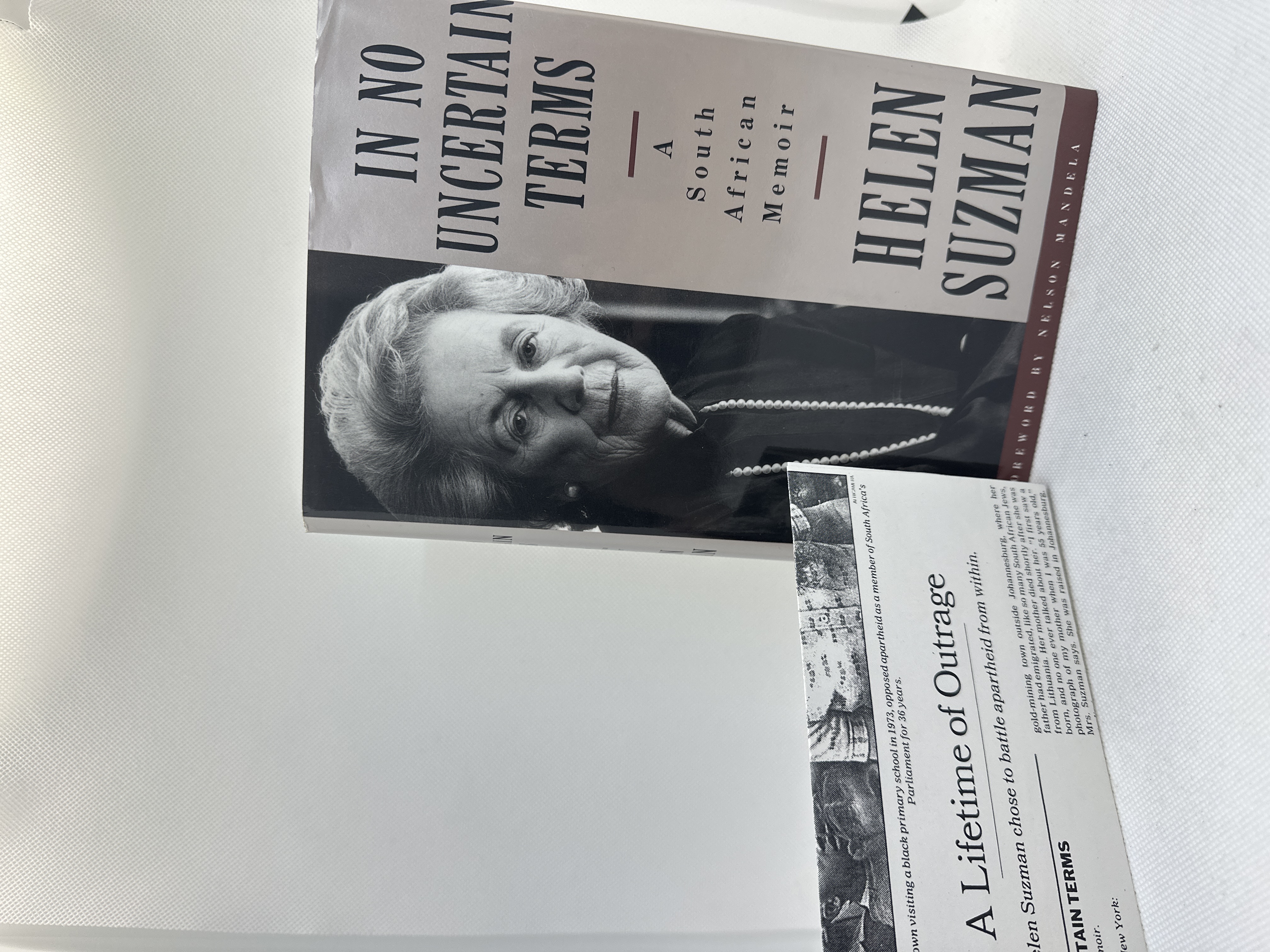
A former member of the South African Parliament describes her friendship with Nelson Mandela, and how she withstood the badgering of racist ruling Nationalists to challenge apartheid
Reviews
A brave, one-woman clarion for liberal values during many of her 36 years in South Africa's parliament, Suzman recalls her life in a forthright, energetic voice. The author, whose father went to South Africa at the turn of the century in order to avoid pogroms in Lithuania, was born in 1917. She first became truly aware of the plight of black South Africans when she taught economic history at Wits University in Johannesburg during the '40s. An admitted "late starter in the field of race relations," Suzman won her first parliamentary election in 1953. Despite anti-Semitic baiting from apartheid supporters, she used her position to expose miseries like detention and the forcible removal of people from their land. Though occasionally overemphasizing insider politics, Suzman incisively portrays such important individuals as former Prime Minister P. W. Botha and the then-imprisoned Nelson Mandela. Defending her anti-sanctions stance, unpopular with the anti-apartheid movement, she emphasizes the importance of economic growth to combat unemployment and housing shortages. Her assessment of the current situation is sketchy but she remains optimistic that rich resources and "innovative citizens" will ultimately allow South Africa to prosper. Photos not seen by PW .
Copyright 1993 Reed Business Information, Inc.
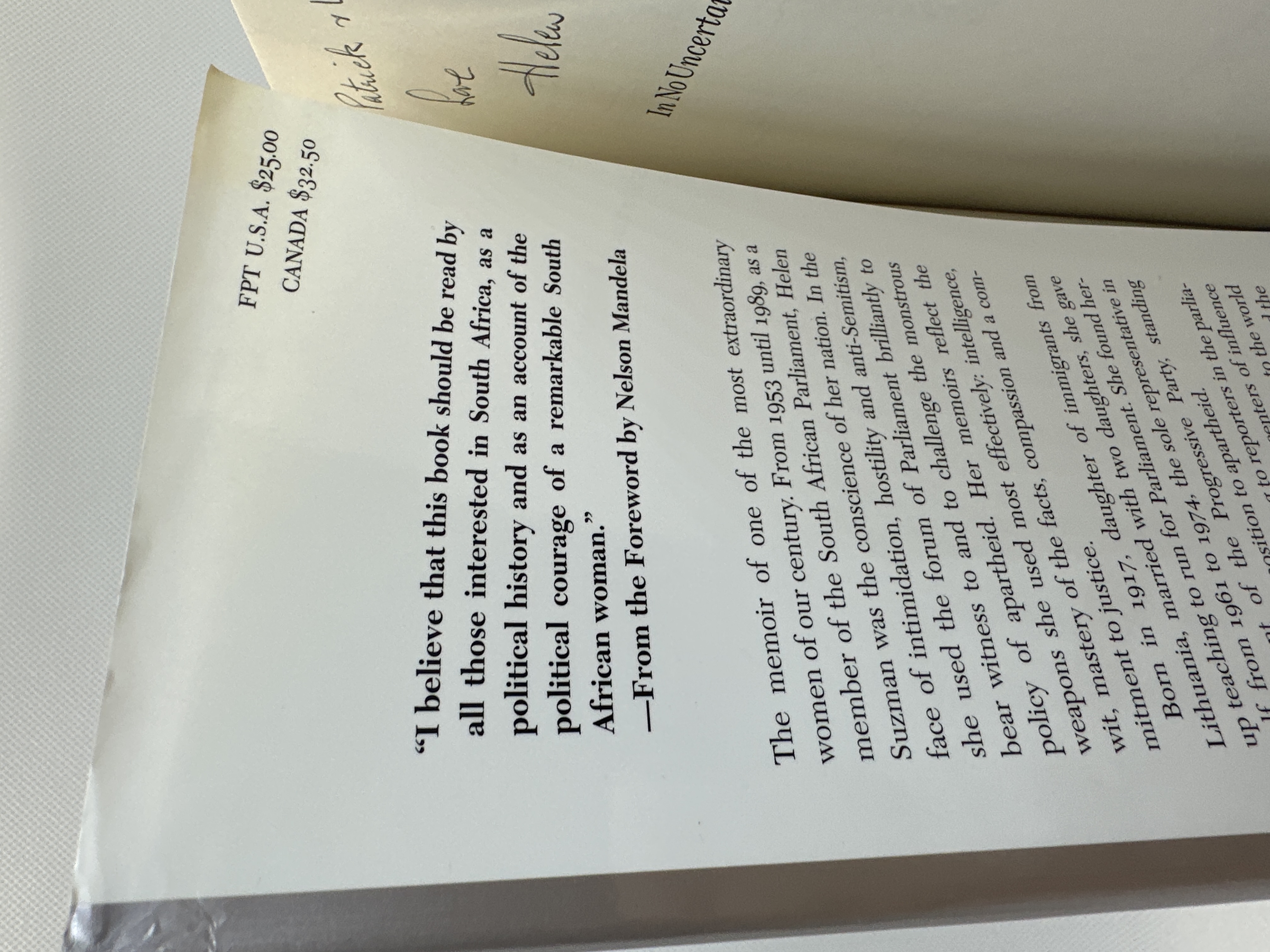
The autobiography of renowned anti-apartheid politician Suzman--who kept the faith and fought the good fight in South Africa's long dark night of shame--that not only ``relives a magnificent battle against apartheid'' but reminds us how daunting that fight was. Following a foreword by Nelson Mandela that acknowledges her ``forthrightness and political astuteness,'' Suzman details just how those qualities shaped her long years in South African politics as a fierce opponent of the Nationalist government and as an equally fierce supporter of justice. In a memoir that's more political than personal, she describes only briefly her childhood as the younger daughter of Jewish immigrants from Eastern Europe; her marriage to a local physician; and her return to college after the birth of her two daughters, where she lectured in economics until her work in local politics led her in 1953 to become a member of Parliament--a position she held until 1989, when she retired. It was from the beginning an uphill fight, as the Nationalists moved to entrench apartheid, the then-opposition party split, and, in 1961, Suzman became the sole representative of the Progressive Party in Parliament--which she remained until 1974. The author had to fight not only male chauvinism and anti-Semitism but also a relentless legislative assault on justice and human rights--an assault that she valiantly opposed through legislation, speeches, and a tireless commitment to helping those most affected by it. Suzman visited prisons, including the notorious Robben Island; intervened personally wherever she could--though disliking her politics, many Nationalists admired her spunk--and was a crucial player in all the great political issues of those years. Today, she's not as optimistic as she used to be about the future, ``but we have to try democracy to show that it will work.'' An inspiring record of courage and principle modestly recalled--and a distinguished contribution to the history of both apartheid and women in politics. -- Copyright ©1993, Kirkus Associates, LP. All rights reserved.
In 1989 Suzman resigned from the South African parliament after serving for 36 years as a member of the opposition; she now heads the South African Institute of Race Relations. This memoir describes the period from 1948, when the National Party came to power, until the present. Meticulous and readable details outline the ruthless and racist path of the Nationalist government. The preface by Nelson Mandela shows the respect many people have for Suzman even while differing with her over the appropriateness of working within the undemocratic government. Suzman's strength and integrity emerge in lengthy quotations from her remarks in parliament. Her ability to retain hope in the future is surprising and inspiring. Those with little background in the history of apartheid can gain here an understanding of its development and complexity within the society of South Africa. Recommended for general readers as well as scholars.
- Maidel Cason, Univ. of Delaware Lib. , Newark
Copyright 1993 Reed Business Information, Inc.
In her 36 years as a liberal South African member of Parliament, Helen Suzman was a lonely voice for the millions who had no vote. Her political biography is both her personal story and a history of white politics under apartheid since the 1950s. While her opponents attacked her as a woman, a Jew, a "sickly humanist," and a "neo-Communist," she forced into the open issues of civil rights and demanded facts about detentions, bannings, whippings, police brutality, and executions. Her book bears witness, as she did in Parliament, to the way the drastic laws affected black housing, education, mass removals, and the breakup of family life. She puts on record how she used her authority to try to get conditions improved in prisons and how she visited Robben Island, where Nelson Mandela and other political prisoners were held, and the barren rural dump where Winnie Mandela was banished. Though she disagrees with the ANC on such issues as sanctions, Nelson Mandela's foreword pays tribute to her sustained opposition to the undemocratic regime. Her story is also about the joy of the fight. When a minister accused her of asking questions just to embarrass the government abroad, she replied with her usual dry wit: "It is not my questions that embarrass South Africa--it is your answers." Hazel Rochman
"About this title" may belong to another edition of this title.