
Items related to Outsmarting IQ: The Emerging Science of Learnable Intelligen...
Synopsis
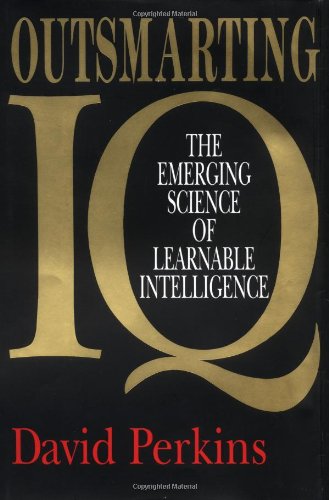
Revealing how earlier discoveries about IQ and recent research indicate that intelligence is not genetically fixed and can be taught, an education researcher identifies three kinds of intelligence, documents dramatic increases in intelligence, and outlines specific strategies for improvement.
"synopsis" may belong to another edition of this title.
About the Author
David N. Perkins is a senior research associate at the Harvard Graduate School of Education, co-director of Project Zero, and the author of several books, including Smart Schools: Better Thinking and Learning for Every Child (Free Press, 1992).
Excerpt. © Reprinted by permission. All rights reserved.
Chapter 1
Telescopes and Intelligence
When I was a child, my family lived in a large sprawling house in a small town in Maine, a former schoolhouse in fact, with a couple of the blackboards still in place. There was a flat roof over part of the house, where my mother hung the laundry to billow and dry on clear days. But the flat roof meant more to me during clear nights. I would sometimes go out with a pillow to rest my head, lie on the roof, and stargaze for an hour or so.
Later, I bought a cheap reflecting telescope. I picked out craters on the Moon, scrutinized the red sphere of Mars, located Saturn, marveling at the tiny image of the planet with its delicate rings. I was caught up by the magnitude of creation and our diminutive place in it, an experience innumerable human beings have had, albeit far fewer human beings than there are stars of which to stand in awe.
Although I was not very educated when I went stargazing on the laundry roof, I had the benefit of some knowledge. I knew that the earth circled around the sun, the moon around the earth. I knew that the other planets circled around the sun. I knew that the stars were way out there, our sun but one of countless hydrogen sparks wending their firefly ways through a vastness without compass. My father told me about such things, and I had read about some of them in books.
So, between 10 and 11 PM up there on the laundry roof, that's how the universe looked to me. Scanning the sweep of the Milky Way, our own galaxy, I often felt I was no more than a speck of rust on the fragile spokes of gravity that made that awesome wheel go round.
I was harvesting the heritage of human intelligence. For thousands of years, priests and scientists, magicians and navigators, astrologers and philosophers had been looking at the sky and wondering, making up stories, proposing theories, building conceptions -- a motley team of human intelligences at work, stirred by every concern from the most cosmic to the most pragmatic.
We think of the telescope as our instrument of inquiry for the heavens. Even more fundamental is the instrument behind the instrument, the resource of human intelligence. Every one of those stargazers drew upon it to make sense of what they were seeing.
An Apple Cart Waiting to Be Upset
Whatever I knew about astronomy at the time, there was another matter of which I knew nothing: how hard-won was that look of infinite reach in the sky, what a work of intelligence it was, what a revolution it took -- a conceptual revolution that changed the universe, by changing what people took the universe to be.
Children, grandfathers, and everyone in between have been looking up at the stars for a long time -- something like 2 million years, if one counts as human the tool-using hominids who once lived and hunted in the environs of the Olduvai Gorge of the Serengeti. It would be easy to assume that what we see today is not much different today than it has been for millennia.
Easy to assume, but quite false. While the physical pattern of the stars has not changed much, what we see has. The look of the stars depends not only on the light that tickles our retinas but on our conceptions, on what we think things out there are really like. Five centuries before, a young ancestor of mine somewhere in the British Isles might have spent that same hour between 10 and 11 lying in a field to watch the heavenly pageant march around the earth. He would not have felt like a mote in an infinite universe. Believing something very different, he would see something quite different, the stars parading for his benefit.
The neat cosmology of Aristotle and the Catholic church had put the universe into a satisfying order and served it up in a form pleasing to most everyone concerned. The earth lay at the center of the universe. Around the earth circled the sun, the moon, the fixed stars, and the planets, all ordered on crystalline spheres at various distances from our planet.
Make no mistake: This was magnificently intelligent in its time. It solved the problems of its day. It certainly made my ancestor happy. He could be proud of his position on the reviewing stand, enjoying the parade of stars, because in the dogma of his day it was all there for him and his fellow human beings, lords of creation every one. But reviewing stand it actually was not. More of an apple cart, just waiting to be upset.
No one then knew that the planets were whole worlds in themselves, like the earth. They were just more lights in the sky like the stars, but with a difference. A half-dozen aberrant points of light wandered around against the background of the innumerable "fixed" stars over periods of months and years. They came to be called planets -- wanderers -- from the Greek verb planasthai, to wander.
The planets became a problem for an idealized earth-centered picture of the universe. As far back as the time of Christ, those who studied the stars had looked upward with better and better instrumentation. They saw the planets, night after night and season after season, tracing their paths against the backdrop of the fixed stars. They measured those paths with some precision. They tried to fit what they found to the theory that the planets were making circles around the earth, but the paths did not quite match. The circles did not quite work.
What to do? When a theory has a leak, patch it! The great patchmaker was the Egyptian astronomer Ptolemy, who lived from about 100 to 170 A.D. Ptolemy made his observations in Alexandria, Egypt, during the period 127-151 A.D. He wanted to preserve the notion that heavenly objects moved in circles, an idea precious to the philosophy of the times. So Ptolemy proposed that each planet not only made a great circle around the earth but also continuously made little circles within that big circle -- epicycles, they were called. These epicycles accounted for the mismatch between a circle-around-the-earth theory and the data on the positions of the planets in the sky. And best of all, they kept the planets moving around the earth and things moving in circles generally.
Ptolemy rescued the whole notion of an earth-centered universe with his epicycles, a brilliant albeit mistaken act of intelligence. Aristotle before him was no fool either, nor the others of those times who looked at, pondered, and wrote about the sky. Intelligence does not make you right, but it helps you find patterns, right or not. It's striking that we understand the optics of telescopes so much better than the true instrument of all inquiry, human intelligence.
Reconstructing the Universe
Ptolemy's patch was clever, but sooner or later the flaws were bound to show up. Copernicus, a Polish astronomer in the years 1473-1543, devoted his life to the meticulous gathering of data about the motions of the stars and planets. He pored over his measurements, compared them with the epicycles theory, and could not make epicycles work, at least not in any reasonably straightforward version. Hoping to get rid of these errors, he reviewed the older literature of the subject and found that a minority opinion had been long neglected, the heliocentric concept that placed the sun at the center of the universe.
So Copernicus bit the cosmic bullet. He mustered his intelligence and his evidence. We had it all wrong, he argued. The planets do not circle around the earth. They make circles around the sun -- and so does the earth. This was his proposal in his great work, On the Revolutions of the Celestial Spheres, not published until well after his death around 1543.
With Copernicus's proposal began modern astronomy and cosmology, sciences that have grown tremendously over the five centuries since, sciences that, every step of the way, have expanded our conception of the scope and complexity of the universe. These same s
"About this title" may belong to another edition of this title.
Search results for Outsmarting IQ: The Emerging Science of Learnable Intelligen...

Stock Image
Outsmarting IQ: The Emerging Science of Learnable Intelligence
Seller: World of Books (was SecondSale), Montgomery, IL, U.S.A.
Seller rating 5 out of 5 stars

Hardback. Condition: Fair. Arguing that intelligence is learnable and not genetically fixed, the author identifies the three distinct types of intelligence and describes how intellectual skills can be developed. Seller Inventory # CIN0029252121A
Stock Image
Outsmarting IQ: The Emerging Science of Learnable Intelligence
Seller: World of Books (was SecondSale), Montgomery, IL, U.S.A.
Seller rating 5 out of 5 stars
Hardback. Condition: Good. Arguing that intelligence is learnable and not genetically fixed, the author identifies the three distinct types of intelligence and describes how intellectual skills can be developed. Seller Inventory # 00105934772
Stock Image
Outsmarting IQ: The Emerging Science of Learnable Intelligence
Seller: BooksRun, Philadelphia, PA, U.S.A.
Seller rating 5 out of 5 stars
Hardcover. Condition: Very Good. With dust jacket. It's a well-cared-for item that has seen limited use. The item may show minor signs of wear. All the text is legible, with all pages included. It may have slight markings and/or highlighting. Seller Inventory # 0029252121-11-18-29
Stock Image
Outsmarting IQ : The Emerging Science of Learnable Intelligence
Seller: Better World Books, Mishawaka, IN, U.S.A.
Seller rating 5 out of 5 stars
Condition: Very Good. Pages intact with possible writing/highlighting. Binding strong with minor wear. Dust jackets/supplements may not be included. Stock photo provided. Product includes identifying sticker. Better World Books: Buy Books. Do Good. Seller Inventory # 4945189-6
Stock Image
Outsmarting IQ : The Emerging Science of Learnable Intelligence
Seller: Better World Books, Mishawaka, IN, U.S.A.
Seller rating 5 out of 5 stars
Condition: Good. Former library copy. Pages intact with minimal writing/highlighting. The binding may be loose and creased. Dust jackets/supplements are not included. Includes library markings. Stock photo provided. Product includes identifying sticker. Better World Books: Buy Books. Do Good. Seller Inventory # GRP9531739
Stock Image
Outsmarting IQ : The Emerging Science of Learnable Intelligence
Seller: Better World Books, Mishawaka, IN, U.S.A.
Seller rating 5 out of 5 stars
Condition: Good. Pages intact with minimal writing/highlighting. The binding may be loose and creased. Dust jackets/supplements are not included. Stock photo provided. Product includes identifying sticker. Better World Books: Buy Books. Do Good. Seller Inventory # 3066477-6
Stock Image
Outsmarting IQ: The Emerging Science of Learnable Intelligence
Seller: Wonder Book, Frederick, MD, U.S.A.
Seller rating 5 out of 5 stars
Condition: Very Good. Very Good condition. Very Good dust jacket. A copy that may have a few cosmetic defects. May also contain light spine creasing or a few markings such as an owner's name, short gifter's inscription or light stamp. Seller Inventory # N22K-01375
Stock Image
Outsmarting IQ: The Emerging Science of Learnable Intelligence
Seller: Wonder Book, Frederick, MD, U.S.A.
Seller rating 5 out of 5 stars
Condition: Good. Good condition. Very Good dust jacket. A copy that has been read but remains intact. May contain markings such as bookplates, stamps, limited notes and highlighting, or a few light stains. Seller Inventory # K06X-00129
Stock Image
Outsmarting IQ: The Emerging Science of Learnable Intelligence
Seller: ThriftBooks-Dallas, Dallas, TX, U.S.A.
Seller rating 5 out of 5 stars
Hardcover. Condition: Very Good. No Jacket. Former library book; May have limited writing in cover pages. Pages are unmarked. ~ ThriftBooks: Read More, Spend Less. Seller Inventory # G0029252121I4N10
Stock Image
Outsmarting IQ: The Emerging Science of Learnable Intelligence
Seller: ThriftBooks-Atlanta, AUSTELL, GA, U.S.A.
Seller rating 5 out of 5 stars
Hardcover. Condition: Very Good. No Jacket. Missing dust jacket; May have limited writing in cover pages. Pages are unmarked. ~ ThriftBooks: Read More, Spend Less. Seller Inventory # G0029252121I4N01