Items related to Misquoting Jesus: The Story Behind Who Changed the...
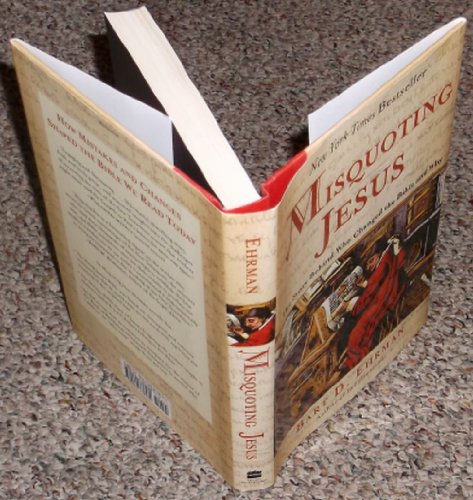

When world-class biblical scholar Bart Ehrman first began to study the texts of the Bible in their original languages he was startled to discover the multitude of mistakes and intentional alterations that had been made by earlier translators. In Misquoting Jesus, Ehrman tells the story behind the mistakes and changes that ancient scribes made to the New Testament and shows the great impact they had upon the Bible we use today. He frames his account with personal reflections on how his study of the Greek manuscripts made him abandon his once ultraconservative views of the Bible.
Since the advent of the printing press and the accurate reproduction of texts, most people have assumed that when they read the New Testament they are reading an exact copy of Jesus's words or Saint Paul's writings. And yet, for almost fifteen hundred years these manuscripts were hand copied by scribes who were deeply influenced by the cultural, theological, and political disputes of their day. Both mistakes and intentional changes abound in the surviving manuscripts, making the original words difficult to reconstruct. For the first time, Ehrman reveals where and why these changes were made and how scholars go about reconstructing the original words of the New Testament as closely as possible.
Ehrman makes the provocative case that many of our cherished biblical stories and widely held beliefs concerning the divinity of Jesus, the Trinity, and the divine origins of the Bible itself stem from both intentional and accidental alterations by scribes -- alterations that dramatically affected all subsequent versions of the Bible.
"synopsis" may belong to another edition of this title.
About the Author:
From Booklist:
Bart D. Ehrman is one of the most renowned and controversial Bible scholars in the world today. He is the James A. Gray Distinguished Professor of Religious Studies at the University of North Carolina, Chapel Hill, and is the author of more than twenty books, including the New York Times bestsellers How Jesus Became God; Misquoting Jesus; God’s Problem; Jesus, Interrupted; and Forged. He has appeared on Dateline NBC, The Daily Show with Jon Stewart, CNN, History, and top NPR programs, as well as been featured in TIME, the New York Times, The Washington Post, The New Yorker, and other publications. He lives in Durham, North Carolina. Visit the author online at www.bartdehrman.com.
The popular perception of the Bible as a divinely perfect book receives scant support from Ehrman, who sees in Holy Writ ample evidence of human fallibility and ecclesiastical politics. Though himself schooled in evangelical literalism, Ehrman has come to regard his earlier faith in the inerrant inspiration of the Bible as misguided, given that the original texts have disappeared and that the extant texts available do not agree with one another. Most of the textual discrepancies, Ehrman acknowledges, matter little, but some do profoundly affect religious doctrine. To assess how ignorant or theologically manipulative scribes may have changed the biblical text, modern scholars have developed procedures for comparing diverging texts. And in language accessible to nonspecialists, Ehrman explains these procedures and their results. He further explains why textual criticism has frequently sparked intense controversy, especially among scripture-alone Protestants. In discounting not only the authenticity of existing manuscripts but also the inspiration of the original writers, Ehrman will deeply divide his readers. Although he addresses a popular audience, he undercuts the very religious attitudes that have made the Bible a popular book. Still, this is a useful overview for biblical history collections. Bryce Christensen
Copyright © American Library Association. All rights reserved
Copyright © American Library Association. All rights reserved
"About this title" may belong to another edition of this title.
- PublisherHarperOne
- Publication date2005
- ISBN 10 0060738170
- ISBN 13 9780060738174
- BindingHardcover
- Edition number1
- Number of pages256
- Rating
Buy New
Learn more about this copy
US$ 11.20
Shipping:
US$ 4.49
Within U.S.A.
Other Popular Editions of the Same Title
Top Search Results from the AbeBooks Marketplace
Stock Image
Misquoting Jesus: The Story Behind Who Changed the Bible and Why
Published by
HarperOne, 2005
ISBN 10: 0060738170
ISBN 13: 9780060738174
New
Hardcover
Quantity: 1 available
Seller: Red's Corner LLC, Tucker, GA, U.S.A.

Condition: New. All orders ship by next business day! This is a new hardcover book. For USED books, we cannot guarantee supplemental materials such as CDs, DVDs, access codes and other materials. We are a small company and very thankful for your business!. Seller Inventory # 4CNOOA001USM
Stock Image
Misquoting Jesus: The Story Behind Who Changed the Bible and Why
Published by
HarperOne, 2005
ISBN 10: 0060738170
ISBN 13: 9780060738174
New
Hardcover
Quantity: 1 available
Seller: Big Bill's Books, Wimberley, TX, U.S.A.
Hardcover. Condition: new. Brand New Copy. Seller Inventory # BBB_new0060738170
Stock Image
Misquoting Jesus: The Story Behind Who Changed the Bible and Why
Published by
HarperOne, 2005
ISBN 10: 0060738170
ISBN 13: 9780060738174
New
Hardcover
Quantity: 1 available
Seller: GoldenDragon, Houston, TX, U.S.A.
Hardcover. Condition: new. Buy for Great customer experience. Seller Inventory # GoldenDragon0060738170
Stock Image
Misquoting Jesus: The Story Behind Who Changed the Bible and Why
Published by
HarperOne, 2005
ISBN 10: 0060738170
ISBN 13: 9780060738174
New
Hardcover
Quantity: 1 available
Seller: Campbell Bookstore, Austin, TX, U.S.A.
Condition: new. Seller Inventory # NewCamp0060738170
Stock Image
Misquoting Jesus: The Story Behind Who Changed the Bible and Why
Published by
HarperOne, 2005
ISBN 10: 0060738170
ISBN 13: 9780060738174
New
Hardcover
Quantity: 1 available
Seller: GoldenWavesOfBooks, Fayetteville, TX, U.S.A.
Hardcover. Condition: new. New. Fast Shipping and good customer service. Seller Inventory # Holz_New_0060738170
Stock Image
Misquoting Jesus: The Story Behind Who Changed the Bible and Why
Published by
HarperOne, 2005
ISBN 10: 0060738170
ISBN 13: 9780060738174
New
Hardcover
Quantity: 1 available
Seller: Front Cover Books, Denver, CO, U.S.A.
Condition: new. Seller Inventory # FrontCover0060738170
Stock Image
Misquoting Jesus: The Story Behind Who Changed the Bible and Why
Published by
HarperOne, 2005
ISBN 10: 0060738170
ISBN 13: 9780060738174
New
Hardcover
Quantity: 1 available
Seller: Wizard Books, Long Beach, CA, U.S.A.
Hardcover. Condition: new. New. Seller Inventory # Wizard0060738170
Stock Image
Misquoting Jesus: The Story Behind Who Changed the Bible and Why
Published by
HarperOne, 2005
ISBN 10: 0060738170
ISBN 13: 9780060738174
New
Hardcover
Quantity: 1 available
Seller: GoldBooks, Denver, CO, U.S.A.
Hardcover. Condition: new. New Copy. Customer Service Guaranteed. Seller Inventory # think0060738170
Seller Image
Misquoting Jesus: The Story Behind Who Changed the Bible and Why
Published by
HarperOne, 2005
ISBN 10: 0060738170
ISBN 13: 9780060738174
New
Hardcover
First Edition
Quantity: 1 available
Seller: Perry Beem, Doylestown, PA, U.S.A.
Hardcover. Condition: New. Dust Jacket Condition: New. 1st Edition. Stated First Edition. New in new dust jacket. Seller Inventory # ABE-1668011738071
Seller Image
Misquoting Jesus: The Story Behind Who Changed the Bible and Why
Published by
HarperOne, 2005
ISBN 10: 0060738170
ISBN 13: 9780060738174
New
Hardcover
First Edition
Quantity: 1 available
Seller: Perry Beem, Doylestown, PA, U.S.A.
Hardcover. Condition: New. Dust Jacket Condition: New. 1st Edition. Stated First Edition. New in new dust jacket. Seller Inventory # ABE-1666992177239