
Items related to Closing Arguments
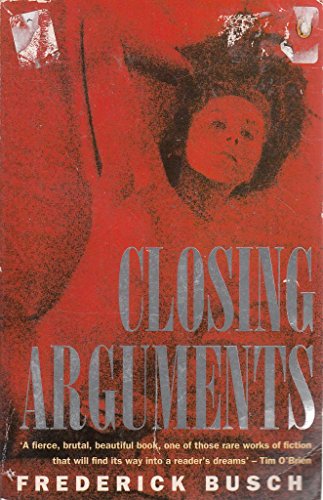
Synopsis
Marcus Brennan is a successful small-town lawyer on the verge of a breakdown. His wife, Schelle, thinks it’s post-traumatic stress disorder from his years as a POW in Vietnam. Planning the dedication of a memorial for Vietnam soldiers, she asks Marcus to say a few words at the ceremony, hoping the experience will help to exorcise his demons. But after agreeing to defend Estella Pritchett, a social worker accused of murdering her lover, Marcus begins a downward spiral into the murky depths of his own past–where sex is violent, where love means betrayal, and where his own memories have the power to destroy him. . . .
"synopsis" may belong to another edition of this title.
About the Author
Frederick Busch, a finalist for the National Book Critics Circle Award and the PEN Faulkner Award, is the recipient of the PEN/Malamud Prize for achievement in the short story. He recently won the Award of Merit Medal from the American Academy of Arts and Letters, given in recognition of a writer’s lifetime achievement. His newest work of fiction is Don’t Tell Anyone. Fairchild Professor of Literature at Colgate University, he lives in upstate New York.
Reviews
``The best defense is a good story,'' Vietnam vet/lawyer hero Mark Brennan obsessively tells himself. The disintegration of Brennan's own ``story'' through his involvement with a sex killing makes a painfully focused one for Busch (Harry and Catherine, 1990, etc.). Brennan's client, tiny Estella Pritchett, is accused of strangling almost-divorced radio-station owner Larry Ziegler during a bout of rough sex. Brennan plans to defend Estella by arguing that Ziegler's abusive behavior caused her to flash back to her abused childhood and strike out to defend herself. But he knows that Estella wasn't really defending herself: she'd already tied Ziegler to the bed at the Stone's Throw Motel--the same bed she's begun to use for her increasingly dangerous liaisons with Brennan. Drawn as he is to Estella, Brennan--already bedeviled by his memories of bombing runs over Vietnam, his capture, interrogation, torture, escape, and return to the US as frontman for the 1968 Democratic convention (he met his wife Rochelle, an antiwar protester, during a Chicago demonstration), and strung out by disturbing revelations about his son and daughter and an unreasoning fear of a visiting journalist who wants to write about a war memorial Rochelle's urged on their upstate New York town- -is ready to crack, and his conduct of Estella's trial becomes his last desperate defense of himself. A constricted tale of self-destructive love that's also one of the most original trial novels in years. -- Copyright ©1991, Kirkus Associates, LP. All rights reserved.
The author of Harry and Catherine and Absent Friends , among other distinguished literary works, Busch has reached a new level of achievement with this taut and gripping novel. Former Marine Phantom pilot Mark Brennan is a small-town attorney in upstate New York. He has a devoted wife who was active as an anti-war demonstrator, a high-school-age son who seems to be on the edge of big trouble, a daughter in New York who may have made a fatal romantic liaison, and his own demons--memories of Vietnam. Code-named Goblin, Brennan was shot down and captured by the Viet Cong. After several soul-crushing months enduring diabolical torture, he managed a bloody escape. Uncomfortable with his local-hero status and his wife's determination to perpetuate it, Brennan has an uneasy and distant relationship with his family; he lives inside his head most of the time, trying to suppress almost hallucinatory flashbacks to his desolate childhood and his later torments as a POW. But when he takes a pro bono murder case, defending a woman accused of killing her lover during rough sex, the past starts to intrude. Layer upon layer of lies and unbearable truths are peeled away as the trial progresses and Brennan succumbs to his own despair. In his disturbing, thrilling, imaginative exploration of some of the darkest sides of human experience, Busch has deftly transmuted rage and anguish into an extraordinary novel, one that packs a visceral wallop.
Copyright 1991 Reed Business Information, Inc.
Mark Brennan was a Marine pilot who became a prisoner of the Vietcong. Now a lawyer in upstate New York, he confronts a failing marriage, a troubled son, and a dangerously seductive client on trial for murdering her lover in a motel bed. Both attorney and client suffer a dark legacy of past violence, and in both cases post-traumatic stress disorder leads to further destruction. As first-person narrator, Brennan observes that "the best defense is a good story," and his carefully wrought closing argument becomes a moving apology for his own life. Although the subplot involving Brennan's daughter (whom we encounter only via long-distance telephone) is not entirely convincing, the central narrative remains powerful. Busch's two previous works are Harry and Catherine (LJ 3/1/90) and Absent Friends (LJ 4/1/89), a collection of short stories.
- Al bert E. Wilhelm, Tennessee Technologi cal Univ., Cookeville
Copyright 1991 Reed Business Information, Inc.
Excerpt. © Reprinted by permission. All rights reserved.
Opening Argument
Let’s say I’m telling you the story of the upstate lawyer, the post-traumatic combat stress, the splendid wife, their solitudes and infidelities, their children, his client with her awkward affinities, the sense of impending recognition by which he is haunted.
You can see me, can’t you? You can see me in my office after hours, after dark, after dawn. The bottle of ink, the sharp-nibbed pen, the pad of yellow sheets with their line after line.
Stand and be recognized a sentry was supposed to call to anyone dragging in after dark. Maybe they’d be on the end of a long-range recon. Maybe they’d be sappers with mines. The perimeter people at Da Nang were Marines, and they were disciplined. They almost always shouted something before they tried to kill you: the best defense is a good story.
Haunted is the word to use, though. His story’s about his wife, Rochelle, her need to publicly acknowledge his war, the recognition he will suffer if she does, and how she’ll suffer worse. The threat to him is real. The deception is real. This is a very cruel story, you know.
If one word is haunted, another is sad. Use it for his wife and kids. And betrayed, because the innocent can never be protected.
And numerous other words that in the course of this testimony you will be asked to consider. Family It was February, very cold, lots of snow. It warmed up during the day and rained, then it froze again: glass on top of slush. I slid my way home, it was ten or eleven, and in the kitchen I found Rochelle sitting over a cup of coffee the way people huddle at a fireplace. Jack was leaning back in his chair, sitting across from her, tilting so far back you knew he had to fall. Those big feet were planted in their unlaced moccasins, his socks were pooled beneath his ankle bones at the tops of the shoes. His face was tight. Tight. Schelle’s was wet with tears. I didn’t need filling in. I knew it. He’d been orbiting further and further. She’d been handling the distance. That’s what we tell each other. Handle it, we say. Which means you don’t take it personally that your kid is insulting you and pushing you and standing in your eyes. Because he needs you taking it personally so he can pop off.
I sat down in my coat. I waited in the silence a little.
“Hello, Dad,” I said. “Have a long day?”
“Yeah, Jack,” I answered myself. “Pretty tough. But I’m glad to see you, kid.”
“Me, too, Dad,” I said.
“Don’t,” she said. “Really. Don’t.”
“Can I do something?”
Schelle said, “Jack? Can you think of anything?”
His large, wet, very dark eyes looked over my shoulder at nothing. I said, “Mom spoke to you, Jack.”
With no expression, he said, “I didn’t hear the question.”
“I think we’re trying to find out why you’re angry. Am I right, Schelle?”
She nodded, reluctantly. I knew how much she wanted me out of this one.
“I can’t remember,” Jack said.
“Is it about something Mom or I did?”
Rochelle said, “We’ve pretty much been through this, Mark.”
“You could answer me,” I said. I was gentle.
“Excuse me?” Jack said.
“Why are you being so evasive, hon?”
“Me?” he said.
“Yes,” I said gently.
“What was the question?”
“Are you on drugs?”
“That’s a new question,” he said.
“Are you?”
Schelle said, “Mark.”
“I don’t think so,” Jack said with exaggerated care.
When he was younger, we’d been through one like this, we were homing on the end of it, and he said something mean, what a parent calls “fresh” before he clips the kid. We were standing up, I remember. Upstairs in the hall, I think. I put a four-finger jab, the hand rigid and fingers locked, directly into his solar plexus. He started to double, and I said, Stand up. I remembered that at the table, trying to get him to talk. Stand up, I remembered saying. I must have said it right. Because he stood. He kept wanting to collapse. His face was very white. His eyes got huge. He wobbled. I told him, The breath’ll come back. You won’t die of it. You’ll get your wind back. You stand and mind your manners, I told him.
I was thinking of that while we sat at the table. My face must have showed it. I must have showed whatever I felt. I thought I regretted what happened. I think my face showed something else. Because Schelle said, “Mark.”
She said it the way I would tell a dog to heel if I had a dog and trained it.
“Mark.”
I said, “Jack.” I sounded gentle. “Jack, it doesn’t feel like we’re functioning here. You know what I mean?”
He looked at me.
“I think you do,” I said. “You’re a troubled boy. You maybe need some help. Mom and I are willing to find it for you.”
“I’m not going to a skull doctor,” he said.
“Psychiatrist. Psychologist. Some kind of professional person who can help you,” Schelle said.
“I’m—listen to me: I am not going.”
Schelle said, “Darling, we don’t think you’re, you know, crazy. It isn’t anything to do with words like that. It’s for help. It’s what you do with a, say an infection. We don’t think you’re crazy.”
“No,” I said. “Good.”
Jack said, “She was talking to me.”
I said, “What?”
Rochelle said, “Are you all right, Mark?”
I said, “What?”
“Yeah,” Jack said. “Oh, yeah.” Problem Solving It feels good. It feels right. My radar intercept officer in back hears me howling when we go in. He calls the numbers off, we let the 500s go, and then we’re supposed to orbit, wait for the wing leader, go home to Da Nang. But I came in hard on my wing leader’s approach. A little close, but still in the classical mode. Maybe I cut it a little steep. I come in, Bird Dog the spotter is asking if I’m hit, my wing man’s heading back up toward 4,000 and he’s asking, Who’s hit?, and I’m howling. Six Phantoms in the squadron had the external pod with the 20 mm gun, they even had ammo that week, and I was in one of them. What I’m saying: it’s 1968, I’m a Marine Phantom pilot, I’m strafing a flak installation and it feels good. Turn the selector, look through the display, punch the tit. The ground jumps up around them, then they jump up. They explode, frankly, and sometimes you get to see. That’s why I was noisy going in and up and out, and everybody’s checking off, checking in, checking up, I level us off at 4,500, stable, and I say, “Goblin on an even keel. Goblin is silky, flight leader.”
“Tuck your ass in here and come home,” Baseball says.
“Roger from Goblin. Tucking in, heading home. Fuel is not an issue. I have you, Baseball. Here I come.”
“Baseball is overjoyed.”
But nobody chewed me. I killed some, and that was the job. We interdicted the Ho Chi Minh Trail. We flew out of Da Nang, and every now and again when we went out to bomb the berry people, we blew some up with cannon shells. Now here’s what I’m saying: you’re up there and I mean homing on them, running right down your own tracers and you’re God, you are winged fucking fury, they explode for you like popcorn.
Of course, I’m a reasonable man now, a sane and reasonable man. I sit at a desk that used to belong to a banker. We bought his whole houseful of antiques when I opened the office in what used to be his very Colonial home. I sit at this desk with a top, it rolls down, all these little drawers and compartments are opened out in front of me. This is organized. I write up my notes on the usual legal pad, black ink, yellow paper, green lines, red-ruled margins.
Bomb runs were good. Shooting off the Sparrows was good—take out a prop job the NVA flew, watch those guys break up. The sky looks yellow and green by the time they’re down, it’s time to go home and debrief, talk the talk. On the way home, the yellow’s out of the sky. It has to do with burning aviation fuel, someone told me. So that was good. The napalm runs were good. We had to mix the stuff ourselves, the first few months we were there. Bad-looking stuff, but it did stick to them. It did fry them. So it was good work, and the main thing is: we got to fly. Am I right? We were flying. There’s the slipstream noise coming off the bomb pylons and the gun pod and the radar sticking out of the McDonnell Douglas F-4 Phantom, and this was before they rigged the slats on the outer wing, so there’s a bit of stick play going on, but nobody’s complaining because in the middle of the roar there is a trimmed aircraft and a very well-adjusted, well-trained airplane pilot, and once in a while I got to ride down howling and make popcorn out of people.
Pop pop pop.
If you have a problem, I’ve always found, you can solve it with a lined yellow legal pad and a good extra-fine point. Draw it up, write it down, lay it out. You work your way in, steady, steady, and you see it. After a while you see it. Tallyho. You say it really low and slow, because you’re a Phantom jock, and yours is bigger than theirs. Goblin has the target. He does. Footwear You want it new and improved? Goblin offers sneakers, for example. But we approach the issue of the foot by way of, well, what you’d get, sometimes: a rat....
"About this title" may belong to another edition of this title.
Search results for Closing Arguments

Stock Image
Closing Arguments
Seller: AwesomeBooks, Wallingford, United Kingdom
Seller rating 5 out of 5 stars

Paperback. Condition: Very Good. Closing Arguments This book is in very good condition and will be shipped within 24 hours of ordering. The cover may have some limited signs of wear but the pages are clean, intact and the spine remains undamaged. This book has clearly been well maintained and looked after thus far. Money back guarantee if you are not satisfied. See all our books here, order more than 1 book and get discounted shipping. . Seller Inventory # 7719-9780140168976
Buy Used
US$ 4.00
US$ 5.45 shipping
Ships from United Kingdom to U.S.A.
Ships from United Kingdom to U.S.A.
Quantity: 2 available
Stock Image
Closing Arguments
Seller: Bahamut Media, Reading, United Kingdom
Seller rating 4 out of 5 stars

Condition: Very Good. Shipped within 24 hours from our UK warehouse. Clean, undamaged book with no damage to pages and minimal wear to the cover. Spine still tight, in very good condition. Remember if you are not happy, you are covered by our 100% money back guarantee. Seller Inventory # 6545-9780140168976
Buy Used
US$ 4.00
US$ 9.24 shipping
Ships from United Kingdom to U.S.A.
Ships from United Kingdom to U.S.A.
Quantity: 2 available
Seller Image
Closing Arguments
Seller: True Oak Books, Highland, NY, U.S.A.
Seller rating 5 out of 5 stars
Paperback. Condition: Good+. Reissue Edition; Second Printing. 288 pages; Paper clip indent on prelims. Light shelf wear on the covers. Light yellowing on pages. Good condition otherwise. No other noteworthy defects. No markings.; - Your satisfaction is our priority. We offer free returns and respond promptly to all inquiries. Your item will be packaged with care and ship on the same or next business day. Buy with confidence. Seller Inventory # HVD-59670-A-0