Items related to Capital: volume 1 (Pelican)
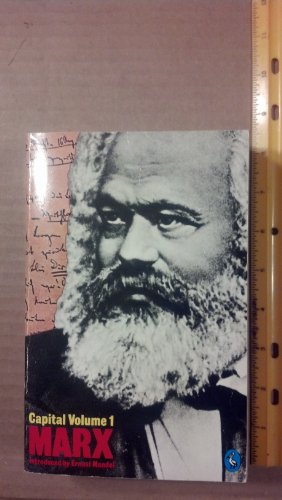

One of the most notorious works of modern times, as well as one of the most influential, "Capital" is an incisive critique of private property and the social relations it generates. Living in exile in England, where this work was largely written, Marx drew on a wide-ranging knowledge of its society to support his analysis and generate fresh insights. Arguing that capitalism would create an ever-increasing division in wealth and welfare, he predicted its abolition and replacement by a system with common ownership of the means of production. "Capital" rapidly acquired readership among the leaders of social democratic parties, particularly in Russia and Germany, and ultimately throughout the world, to become a work described by Marx's friend and collaborator Friedrich Engels as 'the Bible of the Working Class'.
"synopsis" may belong to another edition of this title.
From the Back Cover:
'Capital, ' one of Marx's major and most influential works, was the product of thirty years' close study of the capitalist mode of production in England, the most advanced industrial society of his day. This new translation of Volume One, the only volume to be completed and edited by Marx himself, avoids some of the mistakes that marred earlier versions and seeks to do justice to the literary qualities of the work. The introduction is by Ernest Mandel, author of 'Late Capitalism', one of the only comprehensive attempts to develop the theoretical legacy of 'Capital'.
About the Author:
Karl Marx was born in 1818 in Trier, Germany and studied in Bonn and Berlin. Influenced by Hegel, he later reacted against idealist philosophy and began to develop his own theory of historical materialism. He related the state of society to its economic foundations and mode of production, and recommended armed revolution on the part of the proletariat. Together with Engels, who he met in Paris, he wrote the Manifesto of the Communist Party. He lived in England as a refugee until his death in 1888, after participating in an unsuccessful revolution in Germany. Ernst Mandel was a member of the Belgian TUV from 1954 to 1963 and was chosen for the annual Alfred Marshall Lectures by Cambridge University in 1978. He died in 1995 and the Guardian described him as 'one of the most creative and independent-minded revolutionary Marxist thinkers of the post-war world.'
"About this title" may belong to another edition of this title.
- PublisherPelican/Penguin Books Ltd
- Publication date1976
- ISBN 10 0140219285
- ISBN 13 9780140219289
- BindingPaperback
- Edition number1
- Number of pages1141
- Rating
Top Search Results from the AbeBooks Marketplace

Stock Image
Capital: A Critique of Political Economy, Vol.1
Published by
Pelican/Penguin Books Ltd
(1976)
ISBN 10: 0140219285
ISBN 13: 9780140219289
Used
Paperback
Quantity: 1
Seller:
Rating

Book Description Paperback. Condition: Very Good. The book has been read, but is in excellent condition. Pages are intact and not marred by notes or highlighting. The spine remains undamaged. Seller Inventory # GOR001825919
Buy Used
US$ 4.01
Convert currency
Stock Image
Capital: A Critique of Political Economy, Vol.1
Published by
Pelican/Penguin Books Ltd
(1976)
ISBN 10: 0140219285
ISBN 13: 9780140219289
Used
Paperback
Quantity: 2
Seller:
Rating
Book Description Paperback. Condition: Fair. A readable copy of the book which may include some defects such as highlighting and notes. Cover and pages may be creased and show discolouration. Seller Inventory # GOR001483193
Buy Used
US$ 4.01
Convert currency
Stock Image
Capital: v. 1 (Pelican)
Seller:
Rating
Book Description Paperback. Condition: Very Good. Capital: v. 1 (Pelican) This book is in very good condition and will be shipped within 24 hours of ordering. The cover may have some limited signs of wear but the pages are clean, intact and the spine remains undamaged. This book has clearly been well maintained and looked after thus far. Money back guarantee if you are not satisfied. See all our books here, order more than 1 book and get discounted shipping. Seller Inventory # 7719-9780140219289
Buy Used
US$ 6.36
Convert currency
Stock Image
Capital: v. 1 (Pelican)
Seller:
Rating

Book Description Paperback. Condition: Very Good. This book is in very good condition and will be shipped within 24 hours of ordering. The cover may have some limited signs of wear but the pages are clean, intact and the spine remains undamaged. This book has clearly been well maintained and looked after thus far. Money back guarantee if you are not satisfied. See all our books here, order more than 1 book and get discounted shipping. Seller Inventory # 6545-9780140219289
Buy Used
US$ 6.36
Convert currency
Stock Image
Capital: volume 1 (Pelican)
Published by
Pelican/Penguin Books Ltd
(1976)
ISBN 10: 0140219285
ISBN 13: 9780140219289
Used
paperback
Quantity: 1
Seller:
Rating
Book Description paperback. Condition: Very Good. Connecting readers with great books since 1972! Used books may not include companion materials, and may have some shelf wear or limited writing. We ship orders daily and Customer Service is our top priority!. Seller Inventory # S_401615477
Buy Used
US$ 15.52
Convert currency
Stock Image
Capital: volume 1 (Pelican)
Published by
Pelican/Penguin Books Ltd
(1976)
ISBN 10: 0140219285
ISBN 13: 9780140219289
Used
Softcover
Quantity: 1
Seller:
Rating
Book Description Condition: VeryGood. Volume 1 paperback edition. \r\n\r\nSigns of wear/scuffs/discoloration/tanning/creases on front/back/inside cover, page edges, bind but book is in very good condition. Text is mostly clean readable. Seller Inventory # 5D4000009WW0_ns
Buy Used
US$ 15.52
Convert currency
Stock Image
Capital: A Critique of Political Economy (Volume 1)
Published by
Penguin Books
(1986)
ISBN 10: 0140219285
ISBN 13: 9780140219289
Used
Softcover
Quantity: 1
Seller:
Rating
Book Description Condition: Good. Volume 1. This is an ex-library book and may have the usual library/used-book markings inside.This book has soft covers. Clean from markings. In good all round condition. Please note the Image in this listing is a stock photo and may not match the covers of the actual item,800grams, ISBN:9780140219289. Seller Inventory # 9147123
Buy Used
US$ 23.16
Convert currency
Stock Image
Capital: A Critique of Political Economy, (Volume 1)
Seller:
Rating
Book Description Condition: Good. Volume 1. This is an ex-library book and may have the usual library/used-book markings inside.This book has soft covers. In good all round condition. Please note the Image in this listing is a stock photo and may not match the covers of the actual item,750grams, ISBN:0140219285. Seller Inventory # 9700028
Buy Used
US$ 28.65
Convert currency
Seller Image
Capital: Volume 1
Published by
Penguin Books
(1993)
ISBN 10: 0140219285
ISBN 13: 9780140219289
Used
Paperback
Quantity: 1
Seller:
Rating
Book Description Paperback. Condition: Good. The book is a little bent. The cover has a little wear, with a few small scuffs. The page edges are lightly tanned. 1141 pages. Books listed here are not stored at the shop. Please contact us if you want to pick up a book from Newtown. Seller Inventory # 172518
Buy Used
US$ 20.35
Convert currency
Stock Image
Capital: A Critique Of Political Economy, Volume One/1/I
Published by
Penguin Books In Association With New Left Review, England, Australia, Canada, New Zealand
(1976)
ISBN 10: 0140219285
ISBN 13: 9780140219289
Used
Paperback
First Edition
Quantity: 1
Seller:
Rating
Book Description Paperback. Condition: Good. 1st Edition. (First Edition) Paperback: Good Condition. No Jacket. Pages Tanned But Clean With A Signature By Previous Owner In Front Of Book, Otherwise Unmarked. Binding Tight And Secure. Clean Covers, Lightwear. Photograph Is Added By Selling Site And Not Ours, Therefore May Not Reflect This Edition Or Condition. Please Contact Us For Pictures If Desired. Seller Inventory # 044825
Buy Used
US$ 9.17
Convert currency