
Items related to Climbing Mount Improbable
Synopsis
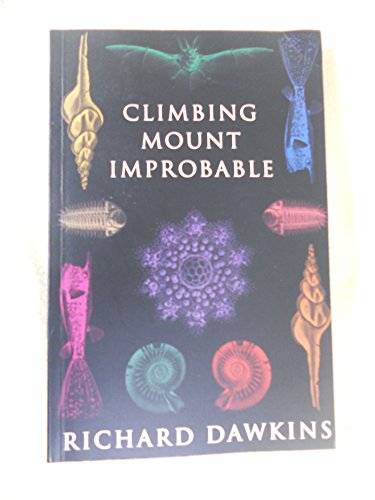
***20th Anniversary Edition - With a New Introduction*** Cover note: Each copy of the anniversary edition of Climbing Mount Improbable features a unique shell. No two covers are exactly alike.How could such an intricate object as the human eye - so complex and so precise - have come about by chance? In this masterful piece of popular science, Richard Dawkins builds a powerful and carefully reasoned argument for evolutionary adaptation as the force behind all life on earth. The metaphor of 'Mount Improbable' represents the combination of perfection and improbability that we find in the seemingly 'designed' complexity of living things. And through it all runs the thread of DNA, the molecule of life, responsible for its own destiny on an unending pilgrimage through time. Evocative illustrations accompany Dawkins' eloquent descriptions of astonishing adaptations in the living world.
"synopsis" may belong to another edition of this title.
About the Author
In 1995 Richard Dawkins became the first holder of the Charles Simonyi Chair of the Public Understanding of Science at Oxford University. He is the bestselling author of THE SELFISH GENE, THE BLIND WATCHMAKER (Penguin, 1988) and UNWEAVING THE RAINBOW (Penguin, 1998).
Reviews
Dawkins (River Out of Eden, 1995, etc.), who now holds a Chair of Public Understanding of Science at Oxford, is at pains in this new work to refute creationists, who have long championed the argument that organs like the human eye could never have arisen ``by chance'' and that therefore a ``Designer'' must be at work. The point made early and oft repeated here is that creationists have got it all wrong: Mutations happen by chance (and are usually bad or at most neutral). But natural selection is not random: If the mutation confers an advantage, its possessor has the potential of leaving more offspring, allowing the mutation to spread. The book's title refers to Dawkins's metaphor for evolution: The process is, he suggests, somewhat like the act of climbing a mountain. One doesn't proceed by launching an immediate assault in a straight line from the base to the peak, but by necessarily working through a series of smaller hills first, attaining the summit gradually, in a seemingly roundabout way. Dawkins uses the evolution of eyes, of spider webs, and of wings, among other features, to press his argument, providing wonderfully rich examples from extinct and contemporary species. There are, however, some assumptions that may be questioned by other equally ardent Darwinists: For example, is evolution necessarily ``good''? Dawkins seems to think so, and, of course, from a selfish point of view it is, since it produced us. But, as Stephen Jay Gould has recently pointed out, the most successful creatures on earth are bacteria and insects, species that have been around for eons and probably will outlast the rest of us complex critters. A second debatable assumption is that evolution necessarily proceeds toward complexity, when much evidence seems to suggest otherwise. Wonderful metaphorical trees examined in minute detail (including a tour de force on actual fig trees and their pollinating wasps), but Dawkins's evolutionary forest may be just a bit overpopulated with complex and improvable species. (16 pages photos, 120 drawings, not seen) (Author tour) -- Copyright ©1996, Kirkus Associates, LP. All rights reserved.
While an enzyme molecule or an eye might seem supremely improbable in their complexity, they are not accidental, nor need we assume that they are the designed handiwork of a Creator, asserts Oxford biologist Dawkins (The Selfish Gene). This foremost neo-Darwinian exponent explains the dazzling array of living things as the result of natural selection?the slow, cumulative, one-step-at-a-time, non-random survival of chance variants. Both a frontal assault on creationism and an enthralling tour of the natural world, this beautifully illustrated study is based on a set of BBC lectures, imparting a tone at once conversational and magisterial. Dawkins explores how ordered complexity arose by discussing spiders' web-building techniques, the gradual evolution of elephant trunks and of wings (birds, he concludes, evolved from two-legged dinosaurs, not from tree gliders) and the symbiotic relationship between the 900 species of figs and their sole genetic companions, the miniature wasps that pollinate specific fig species. Using "computer biomorphs" (simulated creatures "bred" from a common ancestor), Dawkins demonstrates how varieties of the same plant or animal species can vary in shape because of differences in just a few genes. Author tour.
Copyright 1996 Reed Business Information, Inc.
Dawkins (The Blind Watchmaker, LJ 2/1/87 and River Out of Eden, LJ 3/15/95) holds the chair in "Public Understanding of Science" at Oxford University and, if this book is any measure, does so with distinction. This readable, elegantly written, fascinating assessment of why and how living things evolve and how?improbable as it may seem?seemingly random systems abet evolution is the sort of book Stephen Jay Gould would write if he were at Oxford. (Dawkins is Masterpiece Theatre to Gould's National Geographic.) This is not easy science; Dawkins discusses genetics, natural selection, and embryology for hundreds of species spanning millions of years, but he does so in a way that both delights and instructs. This is a book for Gould lovers, certainly, but life scientists of all sorts would appreciate it, as would teachers in the life sciences: it's an invigorating trip through the history of life led by one of Darwin's most articulate disciples.?Mark L. Shelton, Univ. of Massachusetts Medical Ctr., Worcester
Copyright 1996 Reed Business Information, Inc.
"About this title" may belong to another edition of this title.
Search results for Climbing Mount Improbable

Seller Image
Climbing Mount Improbable
Seller: WeBuyBooks, Rossendale, LANCS, United Kingdom
Seller rating 5 out of 5 stars

paperback. Condition: Good. Most items will be dispatched the same or the next working day. A copy that has been read but remains in clean condition. All of the pages are intact and the cover is intact and the spine may show signs of wear. The book may have minor markings which are not specifically mentioned. Seller Inventory # rev7395555442
Buy Used
US$ 9.91
US$ 8.02 shipping
Ships from United Kingdom to U.S.A.
Ships from United Kingdom to U.S.A.
Quantity: 1 available
Seller Image
Climbing Mount Improbable
Seller: Book Grocer, Tullamarine, VIC, Australia
Seller rating 5 out of 5 stars
Paperback. , . NB: This is a secondhand book in very good condition. See our FAQs for more information. Please note that the jacket image is indicative only. A description of our secondhand books is not always available. Please contact us if you have a question about this title. Author: Unknown Format: Paperback Number of Pages: 320 The book titled Climbing Mount Improbable by the author Unknown. This is a secondhand book. Please contact us for more information about this title. Paperback. Seller Inventory # 9780140263022-SECONDHAND
Buy Used
US$ 8.60
US$ 30.00 shipping
Ships from Australia to U.S.A.
Ships from Australia to U.S.A.
Quantity: 1 available
Seller Image
Climbing Mount Improbable
Seller: Chapter Two Books, Ammanford, United Kingdom
Seller rating 5 out of 5 stars
paperback. Condition: Good. Climbing Mount Improbable is Richard Dawkinsâs clear, compelling explanation of how complex life evolves through gradual, step-by-step adaptation rather than sudden leaps. Using vivid metaphors, natural-world case studies and accessible evolutionary logic, he shows how structures such as eyes, wings and spider webs can arise through countless small advantages accumulated over time. The book dismantles common misconceptions about evolution while celebrating the ingenuity of natureâs âdesigns.â A fascinating and highly readable volume for science enthusiasts, Dawkins fans and anyone curious about how complexity emerges in the living world. Seller Inventory # mon0001643497
Buy Used
US$ 13.61
US$ 26.44 shipping
Ships from United Kingdom to U.S.A.
Ships from United Kingdom to U.S.A.
Quantity: 1 available
Stock Image
Climbing Mount Improbable.
Published by
Viking / Penguin Books, London, 1996
ISBN 10: 0140263020
ISBN 13: 9780140263022
Used
Softcover
Seller: BOOKHOME SYDNEY, Annandale Sydney, NSW, Australia
Seller rating 5 out of 5 stars
Paperback large trade, good condition only, figures, black & white photos, spine little faded, edges little foxed, pages lightly toned, minor edgewear, barcode sticker inside front cover. 308 pp. An elegant and riveting series of lectures by Richard Dawkins on the modern improbable face of Darwinism, demonstrating that organisms are merely vehicles for genes. Darwinism explains complex natural natural selection and evolution, for example, ranging from the amazing human brain, the squid's eye and the aeronautical prowess of the albatross. Complex life forms evolve through gradual, step-by-step adaptation rather than sudden leaps. Using vivid metaphors, natural-world case studies and evolutionary logic, he shows how structures such as eyes, wings and spider webs can arise through countless small advantages accumulated over time. Seller Inventory # 20119
Buy Used
US$ 10.75
US$ 43.70 shipping
Ships from Australia to U.S.A.
Ships from Australia to U.S.A.
Quantity: 1 available