
Items related to On Equilibrium
Synopsis
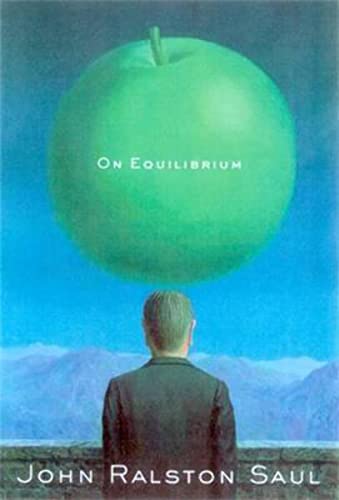
What does John Ralston Saul's influential philosophical trilogy Voltaire's Bastards , The Doubter's Companion and The Unconscious Civilization mean for the real lives of individuals? Is it possible to apply his groundbreaking theories to everyday life?On Equilibrium presents us with a virtual "how to"of the ways that ideas can translate into action. Saul explains how our different qualities give us the intelligence, self-confidence and ability to think and act as responsible individuals.Saul argues that when human qualities are worshipped in isolation they become weaknesses, even forces of destruction or self-destruction. In short, they become ideologies. But as he explores the qualities he has identified as being necessary to integrated human behaviour, he shows us that the key is to use these qualities in combination. How can we use these qualities as positive forces in our own lives and in society? How can we use them to reinforce us as humans?On Equilibrium is an intelligent, persuasive and controversial exploration of the essential qualities of humanity and how to use them to achieve equilibrium for the self and for an ethical society. It is a logical, compelling and humane successor to his bestselling trilogy.
"synopsis" may belong to another edition of this title.
About the Author
John Ralston Saul is Canada’s leading public intellectual. Declared a “prophet” by Time magazine, Saul has received many awards and prizes, including Chile’s Pablo Neruda Medal. He is president of PEN International, an organization dedicated to freedom of expression. He has published fourteen works, which have been translated into twenty-five languages in thirty-six countries, the most recent of which is The Comeback, an examination of the remarkable return to power of Aboriginal people in Canada. Saul lives in Toronto.
From Publishers Weekly
This intriguing but often murky treatise on political philosophy extols balance and moderation in an incongruously vehement tone. Saul, an economist and philosopher and author of Voltaire's Bastards, sees humanism as a "dynamic equilibrium" between the six "qualities" of common sense, ethics, imagination, intuition, memory and reason; trouble starts when balance is disrupted and one quality overshadows the others. In particular, reason-which modernity elevates into a false god, he says-must be tempered by other qualities. Otherwise, we develop a simplistic, "linear" mindset fixated on illusory "certainties," and eventually succumb to "ideology"-especially to the rationalist (but ultimately irrational) orthodoxies of free-market economics and technological determinism. Saul's "six qualities" schema links considerations of individual character to a larger social polemic on the need to subordinate markets and technology to the demands of conscience, tradition and democracy. His ambitious and far-ranging argument is studded with thought-provoking riffs-on the similarities between fascist and modern-day democratic politics, for example, or libertarian conceits about the withering away of the state. But Saul is also prone to psychologizing and his insights can get lost amidst abstract pronouncements ("Ideology, being in the possession of truth, has no need for compassion..."). His ideas are not systematically developed (perhaps because systematic development smacks of rationalist ideology), and the book can feel, at times, like bits of a manifesto for the author's left-liberal views on, say, factory fishing. Saul's is a serious, politicized, if laborious restatement of classic humanist values-broadmindedness, empathy, civic responsibility, distrust of technocracy, attunement to complexity and compromise, opposition to fanatics and absolutists-but it doesn't quite live up to its intellectual pretensions.
Copyright © Reed Business Information, a division of Reed Elsevier Inc. All rights reserved.
"About this title" may belong to another edition of this title.
Search results for On Equilibrium

Stock Image
On Equilibrium
Seller: ThriftBooks-Dallas, Dallas, TX, U.S.A.
Seller rating 5 out of 5 stars

Paperback. Condition: Good. No Jacket. Pages can have notes/highlighting. Spine may show signs of wear. ~ ThriftBooks: Read More, Spend Less. Seller Inventory # G0140293140I3N00
Seller Image
On Equilibrium
Seller: WeBuyBooks, Rossendale, LANCS, United Kingdom
Seller rating 5 out of 5 stars
paperback. Condition: Good. Most items will be dispatched the same or the next working day. A copy that has been read but remains in clean condition. All of the pages are intact and the cover is intact and the spine may show signs of wear. The book may have minor markings which are not specifically mentioned. Seller Inventory # rev7411338359
Buy Used
US$ 6.26
US$ 5.46 shipping
Ships from United Kingdom to U.S.A.
Ships from United Kingdom to U.S.A.
Quantity: 1 available
Stock Image
On Equilibrium
Seller: Vashon Island Books, Vashon, WA, U.S.A.
Seller rating 5 out of 5 stars
Paperback. Condition: Very Good. First Paperback Edition. Size: 8vo - over 7¾" - 9¾". Book. Seller Inventory # 0839115
Stock Image
On Equilibrium
Seller: Housing Works Online Bookstore, New York, NY, U.S.A.
Seller rating 5 out of 5 stars
Paperback. Condition: Very Good. Minimal wear to cover. Pages clean and binding tight. shelf wear. bumped edges. Paperback. What does John Ralston Saul's influential philosophical trilogy Voltaire's Bastards , The Doubter's Companion and The Unconscious Civilization mean for the real lives of individuals? Is it possible to apply his groundbreaking theories to everyday life?On Equilibrium presents us with a virtual "how to"of the ways that ideas can translate into action. Saul explains how our different qualities give us the intelligence, self-confidence and ability to think and act as responsible individuals.Saul argues that when human qualities are worshipped in isolation they become weaknesses, even forces of destruction or self-destruction. In short, they become ideologies. But as he explores the qualities he has identified as being necessary to integrated human behaviour, he shows us that the key is to use these qualities in combination. How can we use these qualities as positive forces in our own lives and in society? How can we use them to reinforce us as humans?On Equilibrium is an intelligent, persuasive and controversial exploration of the essential qualities of humanity and how to use them to achieve equilibrium for the self and for an ethical society. It is a logical, compelling and humane successor to his bestselling trilogy. Seller Inventory # FN3-01254-IN
Stock Image
On Equilibrium
Published by
Penguin Books Australia, 2002
ISBN 10: 0140293140
ISBN 13: 9780140293142
Used
Paperback
Seller: Brit Books, Milton Keynes, United Kingdom
Seller rating 4 out of 5 stars

Paperback. Condition: Used; Very Good. ***Simply Brit*** Welcome to our online used book store, where affordability meets great quality. Dive into a world of captivating reads without breaking the bank. We take pride in offering a wide selection of used books, from classics to hidden gems, ensuring there is something for every literary palate. All orders are shipped within 24 hours and our lightning fast-delivery within 48 hours coupled with our prompt customer service ensures a smooth journey from ordering to delivery. Discover the joy of reading with us, your trusted source for affordable books that do not compromise on quality. Seller Inventory # 3817928
Buy Used
US$ 9.54
US$ 21.31 shipping
Ships from United Kingdom to U.S.A.
Ships from United Kingdom to U.S.A.
Quantity: 1 available
Seller Image
On Equilibrium
Seller: Adelaide Booksellers, Clarence Gardens, SA, Australia
Seller rating 5 out of 5 stars
Softcover. Condition: Very Good. Reprint. Octavo Size [approx 15.5 x 22.8cm]. Very Good condition. 205 pages. .An intelligent, persuasive and controversial exploration of the essential qualities of humanity and how they can be used to achieve equilibrium for the self and to foster an ethical society. Looks at six qualities as common to all people: common sense, ethics, imagination, intuition, memory, and reason. Robust, professional packaging and tracking provided for all parcels. Seller Inventory # 329988
Buy Used
US$ 12.88
US$ 23.50 shipping
Ships from Australia to U.S.A.
Ships from Australia to U.S.A.
Quantity: 1 available
Seller Image
On Equilibrium
Seller: Book Grocer, Tullamarine, VIC, Australia
Seller rating 5 out of 5 stars
Paperback. , . NB: This is a secondhand book in very good condition. See our FAQs for more information. Please note that the jacket image is indicative only. A description of our secondhand books is not always available. Please contact us if you have a question about this title. Author: John Ralston Saul Format: Paperback Number of Pages: 384 John Ralston Saul explains how our different qualities give us the intelligence, self-confidence and practical ability to think and act as responsible individuals. He argues, however, that when certain human qualities are worshipped in isolation they become weaknesses, even forces of destruction or self-destruction. In short, they become ideologies.How can we use our qualities as positive forces in our own lives - and the life of our society? How can we use them so that each builds upon the other to reinforce us as humans?Saul's answer is Balance.On Equilibrium is an intelligent, persuasive and controversial exploration of the essential qualities of humanity and how they can be used to achieve equilibrium for the self and to foster an ethical society. It is at once an attack on our weakness for ideologies and a manual for humanist action. It is the logical, compelling and humane successor to Saul's bestselling trilogy Voltaire's Bastards, The Doubter's Companion and The Unconscious Civilisation. Paperback. Seller Inventory # 9780140293142-SECONDHAND
Buy Used
US$ 7.15
US$ 30.00 shipping
Ships from Australia to U.S.A.
Ships from Australia to U.S.A.
Quantity: 5 available
Seller Image
On Equilibrium
Published by
Penguin Canada, Toronto, 2002
ISBN 10: 0140293140
ISBN 13: 9780140293142
Used
Paperback
Seller: Wombat's Book Nook, Yarraville, VIC, Australia
Seller rating 3 out of 5 stars

Paperback. Condition: Good. Paperback Edition. A thought-provoking work by renowned Canadian philosopher John Ralston Saul, 'On Equilibrium' explores the essential qualities of humanity and their role in fostering an ethical society. Saul argues that while our different human qualities give us the intelligence, self-confidence, and practical ability to think and act as responsible individuals, worshipping certain qualities in isolation can lead to weaknesses, even forces of destruction or self-destruction, effectively turning them into ideologies. He asks how we can use our qualities as positive forces in our own lives and in the life of our society, ensuring they build upon each other to reinforce us as humans. Saul's compelling answer is Balance. 'On Equilibrium' is an intelligent, persuasive, and controversial exploration of these essential human qualities and how they can be used to achieve equilibrium for the self and to foster an ethical society. It is at once an attack on our weakness for ideologies and a manual for humanist action. This book is the logical, compelling, and humane successor to Saul's bestselling trilogy: 'Voltaire's Bastards', 'The Doubter's Companion', and 'The Unconscious Civilisation'. This is a **paperback** edition in **Good** condition. Seller Inventory # SCAN-13-8A36CDF9
Buy Used
US$ 6.80
US$ 36.00 shipping
Ships from Australia to U.S.A.
Ships from Australia to U.S.A.
Quantity: 1 available
Seller Image
On Equilibrium
Seller: Book Express (NZ), Shannon, New Zealand
Seller rating 3 out of 5 stars
Paperback. Condition: Very Good. 370 pages. John Ralston Saul explains how our different qualities give us the intelligen ce, self-confidence and practical ability to think and act as responsible indivi duals. He argues, however, that when certain human qualities are worshipped in i solation they become weaknesses, even forces of destruction or self-destruction. In short, they become ideologies.How can we use our qualities as positive force s in our own lives - and the life of our society? How can we use them so that ea ch builds upon the other to reinforce us as humans?Saul's answer is Balance.On E quilibrium is an intelligent, persuasive and controversial exploration of the es sential qualities of humanity and how they can be used to achieve equilibrium fo r the self and to foster an ethical society. It is at once an attack on our weak ness for ideologies and a manual for humanist action. It is the logical, compell ing and humane successor to Saul's bestselling trilogy Voltaire's Bastards, The Doubter's Companion and The Unconscious Civilisation. Seller Inventory # 2364o
Buy Used
US$ 5.82
US$ 45.00 shipping
Ships from New Zealand to U.S.A.
Ships from New Zealand to U.S.A.
Quantity: 1 available