
Items related to Color Appearance Models
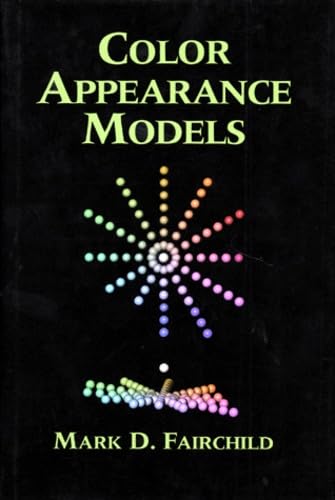
Synopsis
This book is a comprehensive state-of-the-art reference focusing on color appearance models, innovative tools that describe and predict color under a variety of viewing conditions. Written by a leading authority, this book provides any professional or student versed in color science basics with a complete overview of the following five color appearance models: Nayatani et al.; Hunt; RLAB; ATD; and LLAB. For each model, the book examines such aspects as input data, adaptation, opponent-color dimensions, color defining features, predictable phenomena, and the pros and cons of that model. It offers essential background information on human color perception, psychophysics, and the CIE (Commission Internationale de l'Eclairage) system of colorimetry that has formed the foundation for color technology since the 1930s. Also addressed are color appearance terminology, color order systems, color appearance phenomena, and an analysis of viewing conditions. The book discusses chromatic adaptation in depth, one of the most important elements of color appearance. The book also includes an overview of device-independent color imaging, the application that represents the greatest technological push for the development of color appearance models. In all, Color Appearance Models gives you an excellent understanding of the foundation and forefront of color technology, innovative tools now available, and how these recent developments are likely to revolutionize the field. Pages: 400
"synopsis" may belong to another edition of this title.
About the Author
Mark D. Fairchild is Director of the Munsell Color Science Laboratory and an Associate Professor in the Center for Imaging Science at the Rochester Institute of Technology. The Munsell Color Science Laboratory is the preeminent academic laboratory dedicated to research and education in the science of color. At RIT, Dr. Fairchild performs extensive research in the areas of color appearance modeling, gamut mapping, observer variability in color matching, image reproduction, and computer graphics.
0201634643AB04062001
From the Back Cover
"A clear and authoritative review of an important field in color science." --Dr. R.W.G. Hunt
This book is a comprehensive state-of-the-art reference focusing on color appearance models, innovative tools that describe and predict color under a variety of viewing conditions. Written by a leading authority, this book provides any professional or student versed in color science basics with a complete overview of the following color appearance models:
* Nayatani et al.
* Hunt
* RLAB
* ATD
* LLAB
* ZLAB
* CIECAM97s
For each model, the book examines such aspects as input data, adaptation, opponent-color dimensions, color defining features, predictable phenomena, and the pros and cons of that model. It offers essential background information on human color perception, psychophysics, and the Commission Internationale de l'...clairage (CIE) system of colorimetry that has formed the foundation for color technology since the 1930s. Also addressed are color appearance terminology, color order systems, color appearance phenomena, and an analysis of viewing conditions. The book discusses chromatic adaptation in depth, one of the most important elements of color appearance. The book also includes an overview of device-independent color imaging-the application that represents the greatest technological push for the development of color appearance models.
In all, Color Appearance Models gives you an excellent understanding of the foundation and forefront of color technology, innovative tools now available, and how these recent developments are likely to revolutionize the field. 0201634643B04062001
From the Inside Flap
The law of proportion according to which the several colors are formed, even if a man knew, he would be foolish in telling, for he could not give any necessary reason, nor indeed any tolerable or probable explanation of them. -Plato
Despite Plato's warning, this book is about one of the major unresolved issues in the field of color science, the efforts that have been made toward its resolution, and the techniques that can be used to address current technological problems. That issue is the prediction of the color appearance experienced by an observer when viewing stimuli in natural, complex settings. Useful solutions to this problem have impacts in a number of industries, such as lighting, materials, and imaging.
In lighting, color appearance models can be used to predict the color-rendering properties of various light sources, thereby allowing specification of quality rather than just efficiency. In materials fields (coatings, plastics, textiles, and so on), color appearance models can be used to specify tolerances across a wider variety of viewing conditions than is currently possible. The imaging industries have produced the biggest demand for accurate and practical color appearance models. The rapid growth in color-imaging technology, particularly the desktop publishing market, has led to the emergence of color-management systems. It is widely acknowledged that such systems require color appearance models to allow images originating in one medium and viewed in a particular environment to be acceptably reproduced in a second medium and viewed under different conditions.
While the need for color appearance models is recognized, their development has been at the forefront of color science and confined to the discourse of academic journals and conferences. This book brings the fundamental issues and current solutions in the area of color appearance modeling together in a single place for those needing to solve practical problems.
Everyone knows what color is, but the accurate description and specification of colors is quite another story. In 1931, the Commission Internationale de l'...clairage (CIE) recommended a system for color measurement that established the basis for modern colorimetry. That system allowed the specification of color matches through CIE XYZ tristimulus values. However, it was immediately recognized that more advanced techniques were required. The CIE recommended the CIELAB and CIELUV color spaces in 1976 to enable uniform international practice for the measurement of color differences and the establishment of color tolerances.
While the CIE system of colorimetry has been applied successfully for nearly 70 years, it is limited to the comparison of stimuli that are identical in every spatial and temporal respect and viewed under matched viewing conditions. CIE XYZ values describe whether two stimuli match. CIELAB values can be used to describe the perceived differences between stimuli in a single set of viewing conditions. Color appearance models extend the current CIE systems to allow the description of what color stimuli look like under a variety of viewing conditions. The application of such models opens up a world of possibilities for the accurate specification, control, and reproduction of color.
Understanding color-appearance phenomena and developing models to predict them have been the topics of a great deal of research-particularly in the last 10 to 15 years. Color appearance remains a topic of much active research that is often being driven by technological requirements. Despite the fact that the CIE is not yet able to recommend a single color appearance model as the best that is available for all applications, many specialists need to implement some form of a model to solve their research, development, and engineering needs.
One application area is the development of color-management systems based on the ICC profile format that is being developed by the International Color Consortium and incorporated into essentially all modern computer operating systems. However, implementation of color management using ICC profiles requires the application of color appearance models with no specific instructions on how to do so. And unfortunately, the fundamental concepts, phenomena, and models of color appearance are not recorded in a single source. Currently, anyone interested in the field must search out the primary references across a century of scientific journals and conference proceedings. This is due to the large amount of active research in the area.
While searching for and keeping track of primary references is fine for those doing research on color appearance models, it should not be necessary for every scientist, engineer, and software developer interested in the field. So the goal of this book is to provide, in a single source, an overview of color appearance and details of many of the most widely used models. The general approach has been to provide an overview of the fundamentals of color measurement and the phenomena that necessitate the development of color appearance models. This eases the transition into the formulation of the various models and their applications that appear later in the book. This approach has proven quite useful in various university courses, short courses, and seminars in which the full range of material must be presented in a limited time.
Following is a preview of each chapter: Chapters 1 through 3 review the fundamental concepts of human color vision, psychophysics, and the CIE system of colorimetry that are prerequisites to an understanding of the development and implementation of color appearance models. Chapters 4 through 7 present the fundamental definitions, descriptions, and phenomena of color appearance. They review the historical literature that has led to modern research and development of color appearance models. Chapters 8 and 9 concentrate on one of the most important component mechanisms of color appearance: chromatic adaptation. The models of chromatic adaptation described in Chapter 9 are the foundation of the color appearance models described in later chapters. Chapter 10 presents the definition of color appearance models and outlines their construction using the CIELAB color space as an example. Chapters 11 through 13 provide detailed descriptions of the Nayatani et al., Hunt, and RLAB color appearance models, along with the advantages and disadvantages of each. Chapter 14 reviews the ATD and LLAB appearance models that are of increasing interest for some applications. Chapters 15 and 16 describe tests of the various models through a variety of visual experiments and colorimetric applications of the models. Chapter 17 presents an overview of device-independent color imaging, the application that has provided the greatest technological push for the development of color appearance models. Chapter 18 includes thoughts on the future directions for color appearance modeling research and application. The appendix provides a snapshot of the status of the CIE color appearance models being developed for further testing by CIE TC1-34 as this book goes to press.
The field of color appearance modeling is still in its infancy and likely to continue developing in the near future. However, Chapters 1 through 10 of this book provide overviews of fundamental concepts, phenomena, and techniques that will change little, if at all, in the coming years. Thus these chapters should serve as a steady reference. The later chapters describe models, tests, and applications that will be subject to evolutionary changes as research progresses. However, they do provide a useful snapshot of the current state of affairs and provide a basis from which it should be much easier to keep track of future developments.A spreadsheet with example calculations can also be found there. 'Yes,' I answered her last night;
'No,' this morning sir, I say,
Colours seen by candle-light
Will not look the same by day. -Elizabeth Barrett Browning Acknowledgments
A project like this book is never really completed by a single person. I particularly thank my family for the undying support that encouraged its completion. The research and learning that led to it are directly attributable to my students. Much of the research would not have been completed without their tireless work, and I would not have learned about color appearance models were it not for their keen desire to learn more about them from me. I am deeply indebted to all of my students and friends-those who did research with me, those who worked at various times in the Munsell Color Science Laboratory, and those who participated in my university and short courses at all levels. There is no way to list all of them without making an omission, so I will take the easy way out and thank them as a group.
I also am indebted to those who reviewed various chapters while this book was being prepared and who provided useful insights, suggestions, and criticisms. These reviewers include Paula J. Alessi, Edwin Breneman, Ken Davidson, Ron Gentile, Robert W. G. Hunt, Lindsay MacDonald, Mike Pointer, Michael Stokes, Jeffrey Wang, Eric Zeise, and Valerie Zelenty.
Thanks also to all of the industrial and government sponsors of our research and education in the Munsell Color Science Laboratory at R.I.T. In particular, thanks to Thor Olson of Management Graphics for the donation of the Opal image recorder and the loan of the 120-camera back used to output the color images included in this book. Last, but not least, I thank Colleen Desimone for her excellent work as the Munsell Color Science Laboratory secretary, which makes life at the office much easier. M.D.F.
Honeoye Falls, N.Y.
0201634643P04062001
Excerpt. © Reprinted by permission. All rights reserved.
Preface 1
The law of proportion according to which the several colors are formed, even if a man knew he would be foolish in telling, for he could not give any necessary reason, nor indeed any tolerable or probable explanation of them. Plato
Despite Plato's warning, this book is about one of the major unresolved issues in the field of color science, the efforts that have been made toward its resolution, and the techniques that can be used to address current technological problems. The issue is the prediction of the color appearance experienced by an observer when viewing stimuli in natural, complex settings. Useful solutions to this problem have impacts in a number of industries such as lighting, materials, and imaging. In lighting, color appearance models can be used to predict the color rendering properties of various light sources allowing specification of quality rather than just efficiency. In materials fields (coatings, plastics, textiles, etc.), color appearance models can be used to specify tolerances across a wider variety of viewing conditions than is currently possible. The imaging industries have produced the biggest demand for accurate and practical color appearance models. The rapid growth in color imaging technology, particularly the desktop publishing market, has led to the emergence of color management systems. It is widely acknowledged that such systems require color appearance models to allow images originating in one medium and viewed in a particular environment to be acceptably reproduced in a second medium and viewed under different conditions. While the need for color appearance models is recognized, their development has been at the forefront of color science and confined to the discourse of academic journals and conferences. This book brings the fundamental issues and current solutions in the area of color appearance modeling together in a single place for those needing to solve practical problems.
Everyone knows what color is, but the accurate description and specification of colors is quite another story. In 1931, the Commission Internationale de l'clairage (CIE) recommended a system for color measurement establishing the basis for modern colorimetry. That system allows the specification of color matches through CIE XYZ tristimulus values. It was immediately recognized that more advanced techniques were required. The CIE recommended the CIELAB and CIELUV color spaces in 1976 to enable uniform international practice for the measurement of color differences and establishment of color tolerances. While the CIE system of colorimetry has been applied successfully for nearly 70 years, it is limited to the comparison of stimuli that are identical in every spatial and temporal respect and viewed under matched viewing conditions. CIE XYZ values describe whether or not two stimuli match. CIELAB values can be used to describe the perceived differences between stimuli in a single set of viewing conditions. Color appearance models extend the current CIE systems to allow the description of what color stimuli look like under a variety of viewing conditions. The application of such models opens up a world of possibilities for the accurate specification, control, and reproduction of color.
Understanding color-appearance phenomena and developing models to predict them have been the topics of a great deal of research - particularly in the last 10 to 15 years. Color appearance remains a topic of much active research that is often being driven by technological requirements. Despite the fact that the CIE is not yet able to recommend a single color appearance model as the best available for all applications, there are many who need to implement some form of a model to solve their research, development, and engineering needs. One such application is the development of color management systems based on the ICC Profile Format that is being developed by the International Color Consortium and incorporated into essentially all modern computer operating systems. Implementation of color management using ICC profiles requires the application of color appearance models with no specific instructions on how to do so. Unfortunately, the fundamental concepts, phenomena, and models of color appearance are not recorded in a single source. Currently, one interested in the field must search out the primary references across a century of scientific journals and conference proceedings. This is due to the large amount of active research in the area. While searching for and keeping track of primary references is fine for those doing research on color appearance models, it should not be necessary for every scientist, engineer, and software developer interested in the field. The aim of this book is to provide the relevant information for an overview of color appearance and details of many of the most widely used models in a single source. The general approach has been to first provide an overview of the fundamentals of color measurement and the phenomena that necessitate the development of color appearance models. This eases the transition into the formulation of the various models and their applications that appear later in the book. This approach has proven quite useful in various university courses, short courses, and seminars in which the full range of material must be presented in a limited time.
Chapters 1 through 3 provide a review of the fundamental concepts of human color vision, psychophysics, and the CIE system of colorimetry that are prerequisite to understanding the development and implementation of color appearance models. Chapters 4 through 7 present the fundamental definitions, descriptions, and phenomena of color appearance. These chapters provide a review of the historical literature that has led to modern research and development of color appearance models. Chapters 8 and 9 concentrate on one of the most important component mechanisms of color appearance, chromatic adaptation. The models of chromatic adaptation described in chapter 9 are the foundation of the color appearance models described in later chapters. Chapter 10 presents the definition of color appearance models and outlines their construction using the CIELAB color space as an example. Chapters 11 through 13 provide detailed descriptions of the Nayatani et al., Hunt, and RLAB color appearance models along with the advantages and disadvantages of each. Chapter 14 reviews the ATD and LLAB appearance models that are of increasing interest for some applications. Chapters 15 and 16 describe tests of the various models through a variety of visual experiments and colorimetric applications of the models. Chapter 17 presents an overview of device-independent color imaging, the application that has provided the greatest technological push for the development of color appearance models. Appendix A provides a snapshot of the status of the CIE color appearance models being developed for further testing by CIE TC1-34 as this book goes to press.
While the field of color appearance modeling is still in its infancy and likely to continue developing in the near future, this book includes extensive material that will not change. Chapters 1 through 10 provide overviews of fundamental concepts, phenomena, and techniques that will change little, if at all, in the coming years. Thus, these chapters should serve as a steady reference. The models, tests, and applications described in the later chapters will be subject to evolutionary changes as research progresses. However, these chapters do provide a useful snapshot of the current state of affairs and provide a basis from which it should be much easier to keep track of future developments. To assist readers in this task, a world-wide web page has been set up (see http://www.awl.com/cp and/or http://www.cis.rit.edu/people/faculty/fairchild) that lists important developments and publications since the publication of this book. A spreadsheet with example calculations can also be found there.
"About this title" may belong to another edition of this title.
Search results for Color Appearance Models

Seller Image
Color Appearance Models
Seller: Alplaus Books, Alplaus, NY, U.S.A.
Seller rating 5 out of 5 stars

hardcover. Condition: Good. Dust Jacket Condition: Good. Hardbound with dust jacket published by Addison-Wesley, 1998. Name written on page edges and inside front cover; else, no text markings noted. Seller Inventory # 76557a
Stock Image
Color Appearance Models
Seller: Wonder Book, Frederick, MD, U.S.A.
Seller rating 5 out of 5 stars
Condition: Good. Good condition. Very Good dust jacket. A copy that has been read but remains intact. May contain markings such as bookplates, stamps, limited notes and highlighting, or a few light stains. Seller Inventory # Q03Q-00636
Seller Image
Color Appearance Models
Published by
Prentice Hall, 1997
ISBN 10: 0201634643
ISBN 13: 9780201634648
Used
Hardcover
First Edition
Seller: Tubac Book, Tubac, AZ, U.S.A.
Seller rating 5 out of 5 stars
Hardcover. Condition: Near Fine. Dust Jacket Condition: Near Fine. 1st Edition. Great jacket. Interior is free of writing of any sort with a tight binding, Seller Inventory # EGH19
Stock Image
Color Appearance Models
Seller: SatelliteBooks, Burlington, VT, U.S.A.
Seller rating 5 out of 5 stars
Hardcover. Condition: New. Hardcover. New, unused. Free of any markings and no writings inside. For any additional information or pictures, please inquire. Seller Inventory # 210221021
Seller Image
Color Appearance Models
Seller: Cycle Books LA, South el monte, CA, U.S.A.
Seller rating 5 out of 5 stars
Condition: new. Seller Inventory # AMTV.0201634643.N
Stock Image
Color Appearance Models
Seller: Basi6 International, Irving, TX, U.S.A.
Seller rating 5 out of 5 stars
Condition: Brand New. New. US edition. Expediting shipping for all USA and Europe orders excluding PO Box. Excellent Customer Service. Seller Inventory # ABEOCT25-64262
Stock Image
Color Appearance Models
Seller: Romtrade Corp., STERLING HEIGHTS, MI, U.S.A.
Seller rating 5 out of 5 stars
Condition: New. This is a Brand-new US Edition. This Item may be shipped from US or any other country as we have multiple locations worldwide. Seller Inventory # ABBB-97071
Stock Image
Color Apperance Models
Seller: Basi6 International, Irving, TX, U.S.A.
Seller rating 5 out of 5 stars
Condition: Brand New. New. US edition. Expediting shipping for all USA and Europe orders excluding PO Box. Excellent Customer Service. Seller Inventory # ABEOCT25-64263
Seller Image
Color Appearance Models
Published by
Addison Wesley Longman Inc., 1998
ISBN 10: 0201634643
ISBN 13: 9780201634648
Used
Hardcover
Seller: MB Books, Derbyshire, United Kingdom
Seller rating 5 out of 5 stars
Hardcover. Condition: Good. No Jacket. Condition : Good. Ex university library with associated markings. No highlighting or annotations. Hard cover, no jacket. 209pp. Good condition is defined as : structurally sound, text clean, moderate external wear consistent with normal use. Seller Inventory # 945039
Buy Used
US$ 57.35
US$ 29.17 shipping
Ships from United Kingdom to U.S.A.
Ships from United Kingdom to U.S.A.
Quantity: 1 available
Stock Image
Color Appearance Models
Seller: Books Puddle, Woodside, NY, U.S.A.
Seller rating 4 out of 5 stars

Condition: Used. pp. 448. Seller Inventory # 263113267