
Items related to Names for Things
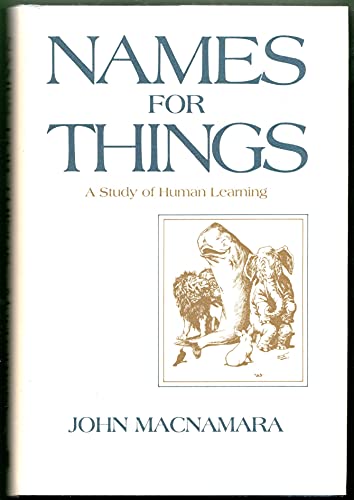
Synopsis
Four chapters in the book's first section, Matters Mainly Psychological, describe empirical observations that explore how a child copes with the fact that many different name-like words can be applied to a single object.
A second major section, Matters Mainly Linguistic, contains chapters on phonology, the learning of grammatical categories, the definite and indefinite articles, and the plural. A third section, Matters Mainly Philosophical, focuses entirely on the complex issues of reference and meaning. A final chapter reflects on the implications of the book for developmental psychology.
John Macnamara is a world-recognized developmental psychologist and Professor of Psychology at McGill University. An MIT Press/Bradford Book.
"synopsis" may belong to another edition of this title.
About the Author
John Macnamara is Professor of Psychology and Director of the Program in the History and Philosophy of Science, McGill University.
Review
"In a fascinating and controversial book, Macnamara explores a complex question—how children learn which words go into which grammatical categories, how they learn to name 'things you could bump into.' The author, a professor of psychology at McGill University, travels through psychological, linguistic, and philosophical domains, weaving empirical research with intelligent speculation. Along the way he criticizes the views of those who, like Piaget and Inhelder, assume that the child's mind is very different from the adult's, and that children cannot form 'true concepts' until at least the age of 7 because they haven't the logical mechanisms required.... Names for Things is a hard but rewarding book."
— Psychology Today
"The strength of the book is its rich mix of many angles and pieces of evidence on these issues, and in its bold claims on how much the child brings cognitively to language acquisition."
— American Scientist
"I know of no other work that so simply spells out all the central issues. The book is concerned with the child's acquisition of names (by which is meant words that refer to objects - including proper names, common nouns in some uses, and pronouns in some uses). Macnamara shows that a theory of acquisition must specify what the child brings to the task, and then how he uses what is innately given. Macnamara then proceeds to lay out the problem in all its complexity, while also carving out chunks of it on which empirical progress can be made. The result is delightful, informative, and precedent-setting."
—Susan Carey, MIT
"Macnamara promises us that a careful treatment of how children learn to use nouns will raise some of the deepest questions to be found in cognitive psychology, linguistics, and philosophy of mind, and will contribute to answers to these questions as well. In his new book, Names for Things, Macnamara keeps that promise."
—Steven Pinker, Stanford University
"About this title" may belong to another edition of this title.
Search results for Names for Things

Stock Image
Names for Things: A Study of Human Learning
Published by
MIT Press, Cambridge, Mass, 1982
ISBN 10: 0262131692
ISBN 13: 9780262131698
Used
Hardcover
Seller: BIBLIOPE by Calvello Books, Oakland, CA, U.S.A.
Seller rating 4 out of 5 stars

Hardcover. Condition: Fine. Octavo in blue cloth boards; xii, 275 p.; 24 cm.; index; bibliography: p. [255]-264. Names -- Psychological aspects. Psycholinguistics. Learning, Psychology of. Onomasiology. Noms -- Aspect psychologique. Psycholinguistique. Apprentissage, Psychologie de l' Onomastique. names; Learning by children. Previous owner bookplate to front paste-down; else Fine with light sunfading to spine. Lacks DJ. Seller Inventory # 7694
Stock Image
Names for Things
Seller: True Oak Books, Highland, NY, U.S.A.
Seller rating 5 out of 5 stars

Hardcover. Condition: Very Good-. Dust Jacket Condition: No Dust Jacket. Scuff to corner of pages. Sun fading present to spine. - Great overall condition. Minor cosmetic wear. No noteworthy blemishes. No writing. ; - We offer free returns for any reason and respond promptly to all inquiries. Your order will be packaged with care and ship on the same or next business day. Buy with confidence. Seller Inventory # HVD-25021-A-0
Stock Image
Names for Things : A Study in Human Learning
Published by
MIT Press, 1982
ISBN 10: 0262131692
ISBN 13: 9780262131698
Used
Hardcover
First Edition
Seller: Better World Books, Mishawaka, IN, U.S.A.
Seller rating 5 out of 5 stars
Condition: Good. First Edition. Former library copy. Pages intact with minimal writing/highlighting. The binding may be loose and creased. Dust jackets/supplements are not included. Includes library markings. Stock photo provided. Product includes identifying sticker. Better World Books: Buy Books. Do Good. Seller Inventory # GRP30277822
Seller Image
Names for Things: A Study in Human Learning (Bradford Books)
Seller: Mom's Resale and Books, River Hills, WI, U.S.A.
Seller rating 5 out of 5 stars
Hardcover. Condition: Very Good. 1982 Hardcover Edition. Light sunning to spine edge. Pages clean & unmarked. Seller Inventory # BB2-9-25-21-06
Seller Image
Names for Things: A Study of Human Learning
Published by
The MIT Press, Cambridge, MA, U.S.A., 1982
ISBN 10: 0262131692
ISBN 13: 9780262131698
Used
Hardcover
Seller: PsychoBabel & Skoob Books, Didcot, United Kingdom
Seller rating 5 out of 5 stars
Hardcover. Condition: Good. Hardcover. Edge-worn, tanned and marked dust jacket. Tape repair on jacket spine head. A few small nicks on jacket spine foot and leading corners. One or two minor scores and bumps on boards. Spine is faded and bumped at ends. 'Ex Libris' stamp and penned details on FEP. Minor sunning on endpapers. Pages are clean. Text is clear. AF. Used. Seller Inventory # 471185
Buy Used
US$ 17.47
US$ 16.54 shipping
Ships from United Kingdom to U.S.A.
Ships from United Kingdom to U.S.A.
Quantity: 1 available
Stock Image
Names For Things: A Study of Human Learning (A Bradford Book)
Seller: Anybook.com, Lincoln, United Kingdom
Seller rating 5 out of 5 stars
Condition: Fair. This is an ex-library book and may have the usual library/used-book markings inside.This book has hardback covers. In fair condition, suitable as a study copy. No dust jacket. Please note the Image in this listing is a stock photo and may not match the covers of the actual item,700grams, ISBN:0262131692. Seller Inventory # 4347963
Buy Used
US$ 17.48
US$ 17.26 shipping
Ships from United Kingdom to U.S.A.
Ships from United Kingdom to U.S.A.
Quantity: 1 available